Congressional Firestorm Erupts Over CISA Security Breach: Contractor Leaks Critical GovCloud Credentials
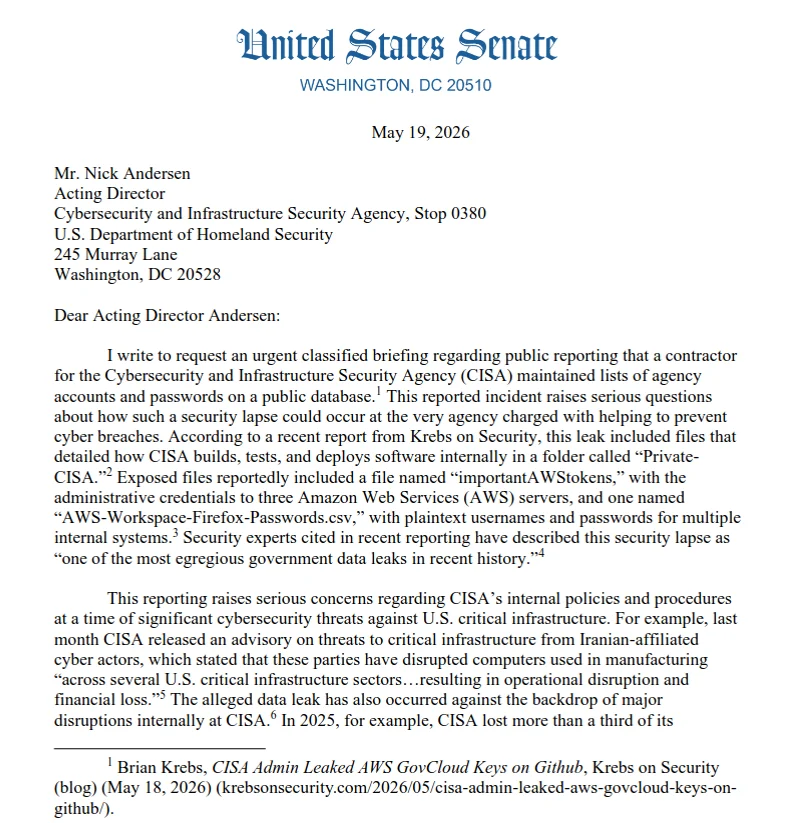
The Cybersecurity and Infrastructure Security Agency (CISA), the federal body tasked with defending the nation’s digital borders, is currently embroiled in a high-stakes security crisis. Lawmakers in both the House and Senate are demanding urgent answers following reports that a contractor intentionally published a repository of highly sensitive credentials, including AWS GovCloud keys and internal system secrets, to a public GitHub profile. The leak, which has sent shockwaves through the federal cybersecurity community, highlights systemic vulnerabilities at the very agency meant to lead the nation’s defense against state-sponsored actors and cybercriminal syndicates.
The Breach: A Public Repository of Secrets
The vulnerability centers on a public GitHub profile discovered by researchers, ominously titled "Private-CISA." This repository served as a digital clearinghouse for agency secrets, containing plaintext credentials to dozens of internal systems. According to forensic analysis of the repository’s commit logs, a CISA contractor with administrative access to the agency’s development platform actively bypassed GitHub’s built-in security features, which are designed to detect and block the publication of sensitive keys.
By intentionally disabling these safeguards, the contractor exposed a trove of data that essentially provided a "roadmap" for adversaries. Among the exposed files were browser bookmarks for AWS workspaces, CSV files containing exported passwords, and critical configuration files such as kube-config.txt. The repository appears to have been used by the operator as a convenient, albeit catastrophically insecure, "scratchpad" to synchronize files between work and personal environments.
Chronology of the Exposure
The timeline of this incident reveals a prolonged window of vulnerability that potentially allowed unauthorized parties to scrape the data:
- November 2025: Initial forensic evidence suggests the "Private-CISA" repository was first established. While it began as a personal workspace, it rapidly became a conduit for sensitive agency data.
- Late April 2026: Researchers believe the repository received its most sensitive uploads during this period, significantly increasing the risk of compromise.
- May 18, 2026: KrebsOnSecurity publicly reports the existence of the repository. By this time, the "firehose" of GitHub’s public event stream had likely broadcast these credentials to anyone monitoring for security keys—including, potentially, foreign intelligence services.
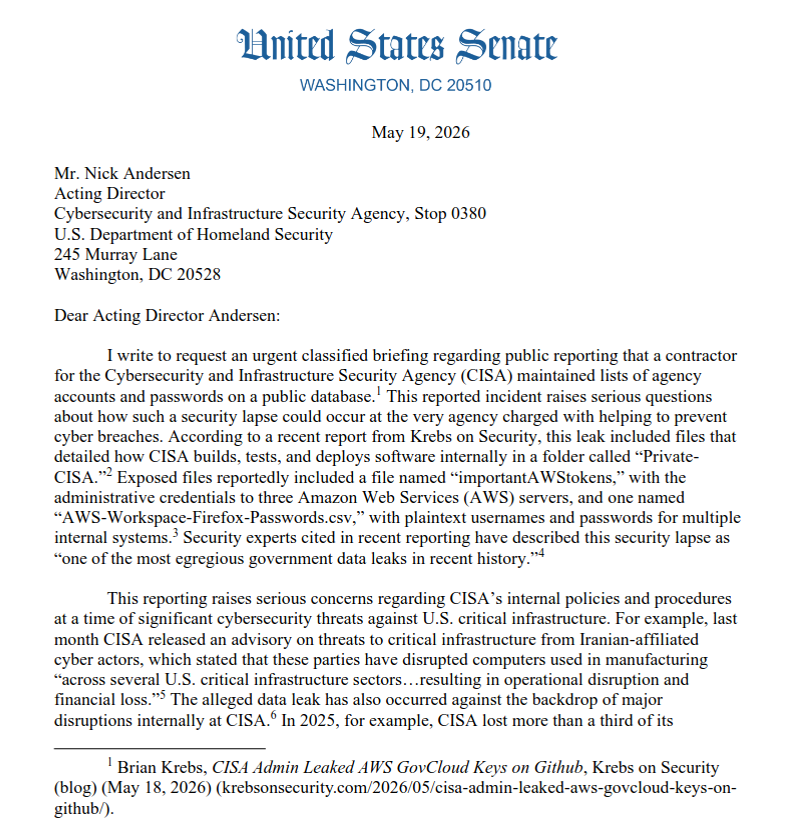
- May 19, 2026: Sen. Maggie Hassan (D-NH) and House Homeland Security Committee leaders formally demand answers from CISA’s acting leadership.
- May 20, 2026: Security researcher Dylan Ayrey, founder of Truffle Security, identifies a critical, unrevoked RSA private key within the repository that granted near-total control over the agency’s GitHub enterprise organization. CISA begins the laborious process of invalidating these keys following notification.
The Scope of the Risk: CI/CD Pipeline Hijacking
The danger posed by the exposed credentials cannot be overstated. Among the items found in the repository was an RSA private key tied to a CISA-owned GitHub app. According to Dylan Ayrey, who specializes in the discovery of exposed secrets via his tool TruffleHog, this specific key was a "master key" of sorts.
"An attacker with this key could read source code from every repository in the CISA-IT organization, including private repositories," Ayrey explained. "They could register rogue self-hosted runners to hijack CI/CD pipelines and access repository secrets, and even modify repository admin settings, including branch protection rules and webhooks."
The mention of CI/CD (Continuous Integration and Continuous Delivery) pipelines is particularly chilling. These pipelines are the automated assembly lines for software; if compromised, an attacker can inject malicious code into software updates that the agency—or its partners—might then unknowingly distribute. This is the hallmark of supply-chain attacks, a vector that has crippled major organizations in the past.

A Diminished Agency: Contextualizing the Failure
Lawmakers have been quick to point out that this incident did not occur in a vacuum. CISA is currently navigating a period of unprecedented institutional instability. Following the transition to the current administration, the agency has seen the departure of more than one-third of its workforce, including a mass exodus of senior leadership through buyouts and forced retirements.
Sen. Maggie Hassan, in her letter to Acting Director Nick Andersen, explicitly linked the security lapse to this "diminished security culture." The concern is that when an agency loses its institutional memory and mid-level oversight, the processes meant to govern contractor behavior—such as enforcing strict data handling policies—begin to crumble.
Rep. Bennie Thompson (D-MS), the ranking member of the House Homeland Security Committee, echoed this sentiment. Along with Rep. Delia Ramirez (D-Ill), Thompson questioned whether CISA possesses the internal maturity to manage its vast network of contractors. "It’s no secret that our adversaries—like China, Russia, and Iran—seek to gain access to and persistence on federal networks," the members wrote. "The files contained in the ‘Private-CISA’ repository provided the information, access, and roadmap to do just that."
Official Responses and Remediation Efforts
CISA’s official stance has been one of controlled mitigation. In a brief statement, the agency asserted that "there is no indication that any sensitive data was compromised as a result of the incident." However, this assertion is being viewed with skepticism by security professionals.
The reality of the "firehose" of data on GitHub is that once a secret is pushed to a public repository, it is indexed by search engines and archived by numerous third-party scrapers almost instantaneously. Whether or not CISA has evidence of a breach does not preclude the possibility that an adversary has already cached the keys.
When pressed on the ongoing exposure of critical technologies, CISA stated: "CISA is actively responding and coordinating with the appropriate parties and vendors to ensure any identified leaked credentials are rotated and rendered invalid and will continue to take appropriate steps to protect the security of our systems."
The slow pace of the cleanup—evidenced by the fact that some critical keys remained live days after the agency was notified—has fueled further scrutiny.
The Human Factor: A Problem Beyond Technology
Industry experts, including James Wilson and Adam Boileau of the Risky Business podcast, have highlighted the uncomfortable truth behind this breach: it is, at its core, a human problem.
While CISA could implement technical controls to restrict access to GitHub from agency-managed devices, the contractor in this case operated outside of these boundaries. By using a personal GitHub account on a personal or improperly segmented device, the individual successfully circumvented corporate policy.
"Ultimately, this is a thing you can’t solve with a technical control," Boileau noted. "This is a human problem where you’ve hired a contractor to do this work and they have decided of their own volition to use GitHub to synchronize content from a work machine to a home machine."
Implications for Federal Cybersecurity
The "Private-CISA" incident serves as a wake-up call for the federal government regarding its reliance on third-party contractors. As federal agencies increasingly outsource technical development, the "attack surface" of the government has expanded to include the personal cloud storage and coding habits of private individuals.
The fallout from this incident is likely to be multifaceted:
- Stricter Contractual Oversight: Expect to see a surge in federal requirements for contractor security, potentially including mandatory hardware-backed keys and strict monitoring of developer environments.
- Congressional Oversight Hearings: The letters from Sen. Hassan and Rep. Thompson are likely precursors to formal hearings, where CISA leadership will be forced to explain the loss of senior staff and the subsequent degradation of internal security audits.
- Cultural Reform: The incident has highlighted the danger of "convenience-first" security. The agency will need to move beyond simple policy documentation and foster a culture where security is prioritized over the ease of code synchronization.
As the investigation continues, the focus will remain on whether any of the leaked credentials were successfully weaponized by foreign intelligence services. For now, CISA remains in damage-control mode, working to close a digital door that was left wide open by one of its own.