Canonical Doubles Down on Memory Safety: The Strategic "Oxidization" of Ubuntu Continues
In a significant move to fortify the foundation of modern Linux infrastructure, Canonical has announced a major expansion of its partnership with the Trifecta Tech Foundation. By becoming a Gold Sponsor, the company behind Ubuntu is committing €40,000 annually to accelerate the development of memory-safe system utilities written in Rust. This financial injection is the latest chapter in a broader, multi-year strategy to systematically "oxidize" the Ubuntu ecosystem, replacing legacy C-based utilities with modern, memory-safe alternatives that are resilient against the most common vulnerabilities plaguing software today.
The Mandate of Memory Safety
The core mission of the Trifecta Tech Foundation is to address the "C language crisis" that has persisted in critical infrastructure for decades. Software written in C and C++ often relies on manual memory management, which—despite the skill of developers—frequently results in buffer overflows, use-after-free errors, and other memory corruption bugs. These vulnerabilities are not merely theoretical; they remain the leading cause of security breaches in system-level software.
By pivoting toward Rust, which enforces memory safety at compile-time, Trifecta aims to eliminate entire classes of security vulnerabilities by design. The foundation concentrates its efforts on three pillars: data compression, time synchronization, and privilege boundaries. Projects like sudo-rs, zlib-rs, and now the centerpiece of their latest collaboration, ntpd-rs, represent a fundamental shift in how the Linux kernel and its user-space utilities interact with the hardware and the network.
A Chronology of Collaboration
Canonical’s commitment to this initiative is not a recent impulse; it is the culmination of a long-term roadmap. The partnership began in 2025, when Canonical first stepped up as a co-sponsor to support the development of sudo-rs. The gamble proved successful, as the Rust-based implementation of the essential sudo command demonstrated both performance stability and enhanced security.
Following rigorous testing, sudo-rs was integrated as the default privilege escalation tool in Ubuntu 25.10. Its success was further cemented when it was carried over into the Ubuntu 26.04 Long-Term Support (LTS) release, marking a turning point in Canonical’s willingness to replace foundational utilities.
This transition is part of an internal philosophy Canonical refers to as "carefully but purposefully oxidising Ubuntu." Having successfully migrated coreutils, findutils, and diffutils to Rust-based alternatives, the engineering teams have identified time synchronization as the next frontier in their quest for a hardened, modern system architecture.
The New Frontier: ntpd-rs
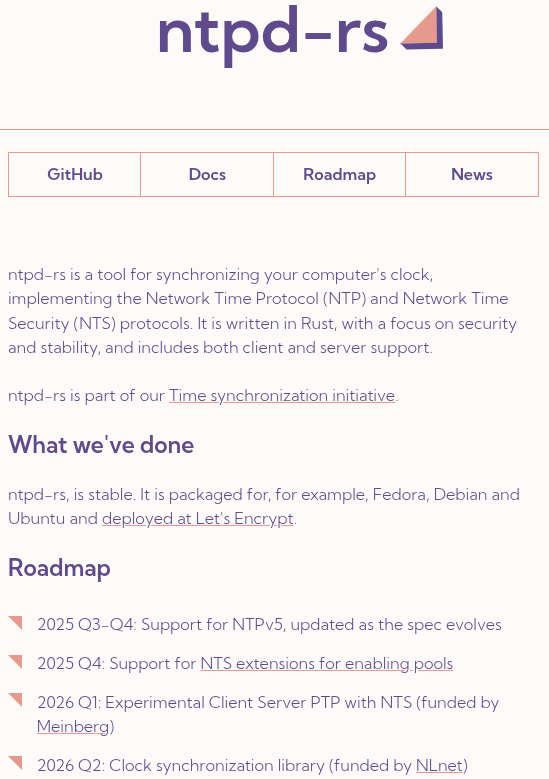
The current phase of the partnership shifts the spotlight to ntpd-rs, a Rust-based rewrite of the Network Time Protocol (NTP) daemon. Time synchronization is a critical piece of infrastructure; it is the heartbeat that ensures TLS certificates, authentication tokens, and system logs remain consistent and verifiable.
ntpd-rs is designed to be a drop-in replacement for traditional NTP clients. However, it is far from an experimental prototype. Jon Seager, the VP of Engineering at Canonical, highlighted that the project has been operating in high-stakes production environments since June 2024, following a successful staging rollout at Let’s Encrypt. This battle-tested pedigree gives Canonical the confidence to push for its adoption as the standard in the Ubuntu ecosystem.

Engineering the Future: Feature Parity and Beyond
One of the primary hurdles in replacing long-standing software like ntpd is the immense complexity built up over years of edge-case support. To make ntpd-rs a viable successor to established tools like chrony, Canonical’s funding is explicitly earmarked for feature-parity development.
Bridging the Gap
The engineering roadmap includes several key enhancements:
- Networking Flexibility: Support for multi-threading and multi-homed server setups, ensuring that the daemon can handle the high-traffic demands of enterprise-grade server environments.
- Specialized Protocols: Integration of GPSd IP socket support and the implementation of Statime—a memory-safe Precision Time Protocol (PTP) stack.
- Niche Use Cases: Support for gPTP (Generalized Precision Time Protocol) is being developed to cater to the automotive and robotics sectors, where microsecond-level synchronization is vital for connected vehicle safety.
- Experimental PTP: The roadmap even includes experimental support for the emerging Client-Server PTP protocol, positioning Ubuntu to be at the forefront of time-sensitive networking (TSN) advancements.
Security Hardening
Beyond mere functionality, the partnership is investing heavily in isolation and compliance. Developers are currently building dedicated AppArmor and seccomp profiles for ntpd-rs to ensure it meets the same, if not stricter, security isolation standards as chrony. Furthermore, for organizations with stringent security policies requiring specific cryptographic standards, the project includes support for rustls, allowing it to fall back on OpenSSL when necessary.
The Implications for Ubuntu Users
For the average desktop user, the transition to ntpd-rs will be largely invisible. The system will continue to keep accurate time, and the user experience will remain unchanged. However, the benefits in terms of "silent security" are profound. By moving to a memory-safe implementation, the attack surface of the entire operating system is reduced. Every line of code written in Rust is one less line where a buffer overflow could potentially allow a malicious actor to escalate privileges or compromise the system.
For system administrators and enterprise users, the change is more significant. It represents a reduction in the "patching tax." When the base utilities of an OS are inherently more secure, the frequency and severity of security advisories are lowered, leading to a more stable and predictable maintenance cycle.
Strategic Roadmap: When to Expect the Transition
Canonical has set a clear trajectory for the integration of ntpd-rs into the Ubuntu distribution:
- Ubuntu 26.10: This release will serve as the first major milestone, introducing
ntpd-rsinto the official archives. This will allow early adopters, sysadmins, and curious developers to begin testing the daemon in various environments. - Ubuntu 27.04: The ultimate goal is to promote
ntpd-rsto the default time synchronization client for all Ubuntu users by the spring of next year.
Official Stance and Industry Impact
Canonical’s decision to fund the Trifecta Tech Foundation is reflective of a larger industry trend where major tech players are moving away from purely consuming open-source projects to actively funding their core development.
"The goal is not just to replace old code with new code," a representative from the project noted during the announcement. "The goal is to provide a blueprint for how we can rebuild the foundational layer of the internet—the infrastructure that keeps our servers, cars, and communication networks secure—using modern safety primitives."

By sponsoring the development of these utilities, Canonical is effectively de-risking its own supply chain. It is a strategic investment that benefits the entire Linux ecosystem, as other distributions are likely to follow suit once ntpd-rs reaches maturity.
Conclusion
The "oxidization" of Ubuntu is more than a technical migration; it is a declaration that the era of memory-unsafe infrastructure is coming to a close. Through the consistent financial support of the Trifecta Tech Foundation, Canonical is ensuring that the tools powering the next generation of computing are as secure as they are performant.
As the industry watches the rollout of ntpd-rs in the coming months, the success of this project will likely determine the pace at which other C-based system tools are retired. For now, the path is clear: Canonical is betting on Rust, and by extension, a safer, more robust future for every Ubuntu user worldwide. Whether for the casual home user or the engineer managing a cluster of thousands of servers, this commitment to "memory-safe by design" is a significant leap forward in the professionalization and security of the Linux desktop and server landscape.