Bridging the Gap: How ‘Prop For That’ is Revolutionizing CSS-JavaScript Interoperability
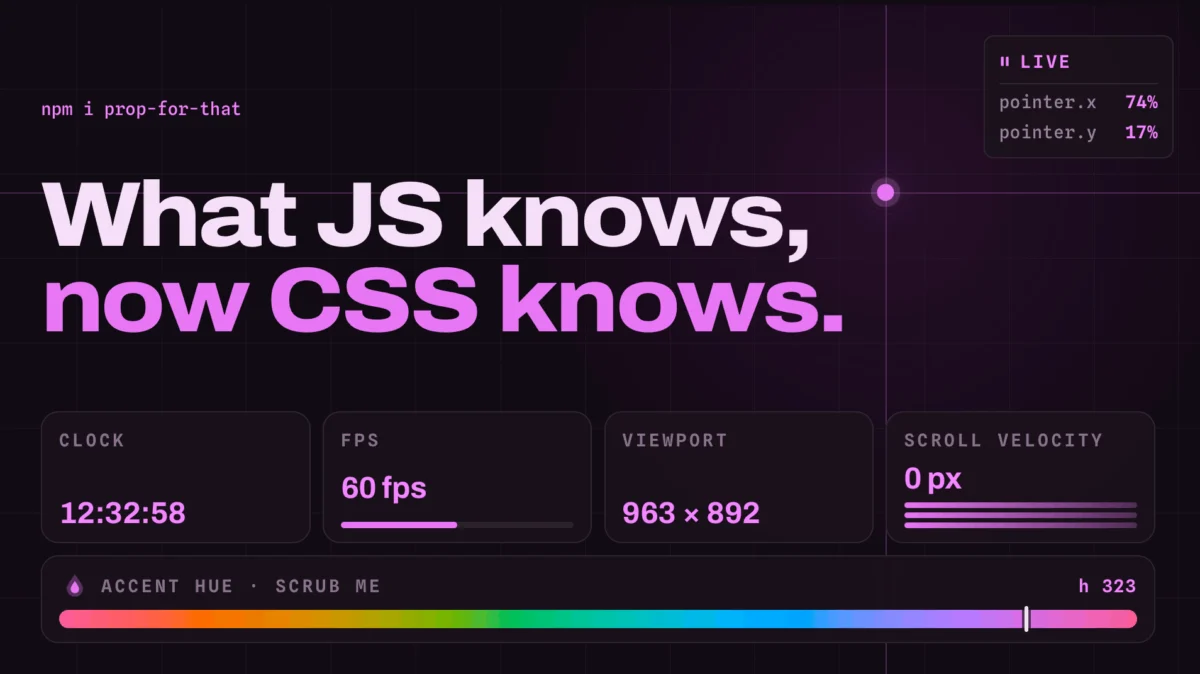
The evolution of modern web development has been characterized by a constant push-and-pull between the declarative nature of CSS and the imperative power of JavaScript. For years, developers have relied on complex, often bloated, JavaScript event listeners to bridge the gap between browser state and visual output. However, Adam Argyle—a prominent voice in the CSS community and the creator of the popular utility library Open Props—has introduced a new paradigm-shifting tool: Prop For That.
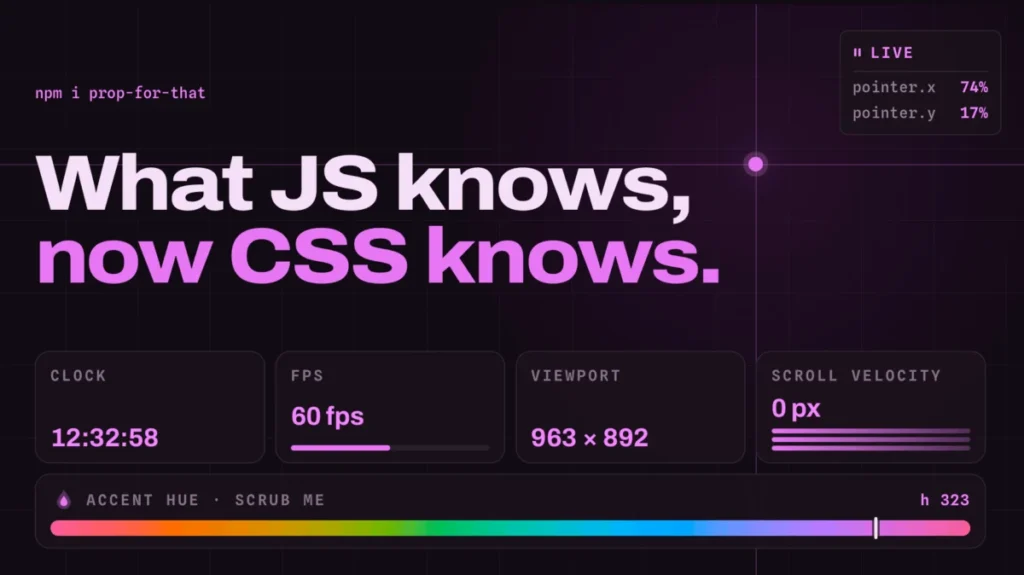
This library represents a significant departure from manual property management. By abstracting the heavy lifting of browser-native event tracking into a declarative syntax, "Prop For That" allows developers to tap into live data—such as cursor coordinates, scroll velocity, and form states—directly within their stylesheets.
The Main Facts: What is ‘Prop For That’?
At its core, "Prop For That" is a lightweight, plugin-based utility library designed to expose browser-native data as live CSS custom properties. While CSS is inherently excellent at styling static elements, it has historically struggled to natively access dynamic environmental variables without a constant stream of JavaScript interventions.
In traditional development, if a developer wanted to move an element based on the user’s cursor position, they would need to write a script that adds an event listener to the window, calculates the clientX and clientY coordinates, and then manually updates the element’s style object or CSS variables.
"Prop For That" eliminates this boilerplate. By adding a simple data-props-for attribute to an HTML element, the library automatically initializes the necessary JavaScript "observers" in the background. It then syncs these values to CSS variables, which update in real-time as the browser state changes. This enables a workflow where the developer simply declares the behavior in HTML and styles the resulting variable in CSS, effectively treating complex dynamic interactions as simple styling tasks.
Chronology: From Open Props to Dynamic State
To understand the significance of "Prop For That," one must look at the evolution of Adam Argyle’s tooling.
The Genesis: Open Props (2021)
The journey began with the release of Open Props, a collection of thousands of CSS variables designed to standardize design systems. It provided a robust foundation for color palettes, spacing, and typography, proving that CSS variables were the future of scalable design. However, Open Props was inherently static; it provided the tokens, but not the state.
The Gap in Capability (2022–2023)
During this period, the CSS community began experimenting with "CSS-only" interactive patterns, such as the famous :has() selector and scroll-linked animations. While these innovations allowed for more dynamic interfaces, there remained a "blind spot" in CSS. Browsers could not natively "see" complex external states like precise scroll velocity or the specific time-of-day without external scripts.
The Emergence of ‘Prop For That’ (2024)
Argyle identified this bottleneck. If developers were already using JavaScript to feed CSS variables, why not standardize that process into a single, declarative library? "Prop For That" was developed as the logical successor to the static utility model. By creating a standardized way to "inject" browser state into CSS, Argyle has effectively extended the reach of CSS into the domain of browser-native telemetry.
Supporting Data: Why This Matters for Performance
The technical efficiency of "Prop For That" is rooted in its use of native browser APIs. Rather than running high-overhead, blocking JavaScript, the library leverages efficient browser primitives.
Performance Benchmarks
By offloading state updates to a specialized library that utilizes requestAnimationFrame or IntersectionObserver where appropriate, the library ensures that layout thrashing is minimized.
- Declarative Syntax: Reduces the lines of JavaScript code by approximately 60–80% for common interactive patterns.
- CSS-Native: Because the values are ultimately stored in CSS variables, they can be utilized in
calc(),transition, andanimationproperties, allowing for smooth, GPU-accelerated visuals.
Comparative Example
Consider tracking a pointer’s position.
- The Traditional Way: Write a custom hook or event listener, update the DOM node’s style attribute on every mouse move, and ensure cleanup to prevent memory leaks.
- The ‘Prop For That’ Way:
<div data-props-for="pointer"></div>.mover transform: translate(var(--live-pointer-x), var(--live-pointer-y));
This reduction in complexity is not just for convenience; it is a fundamental shift in how we architect modern web components.
Official Responses and Community Reception
The developer community has responded with enthusiasm, particularly regarding the library’s "low-friction" implementation. In early discussions on platforms like GitHub and social media, lead maintainers and prominent UI engineers have highlighted the tool’s modularity.
"The beauty of this library," notes one contributor, "is that it doesn’t try to dictate how you style your components. It simply provides the data as a utility. It treats browser state like a first-class citizen of the CSS ecosystem."
However, there is healthy debate regarding the separation of concerns. Purists argue that adding data-props-for attributes to HTML might lead to "polluted" markup. Yet, the consensus among the CSS-in-JS and utility-first communities is that the performance and ergonomic benefits far outweigh the semantic concerns of using data attributes as hooks for browser state.
Implications: The Future of Web Interactivity
The release of "Prop For That" suggests a broader trend in web development: The "CSS-ification" of JavaScript.
1. Reducing the "JavaScript Tax"
As browsers continue to add native support for complex interactions (like Scroll-Driven Animations), libraries like "Prop For That" act as a bridge, bringing modern capabilities to current browsers while maintaining a consistent syntax that will eventually be replaced by native CSS features.
2. Democratizing Advanced Motion Design
By abstracting complex calculations, the library lowers the barrier to entry for motion design. Developers who are intimidated by the complexities of coordinate math in JavaScript can now implement advanced tracking effects using only CSS syntax.
3. A New Standard for Design Systems
We are likely to see design systems shift from static variable sets to "reactive" design systems. Imagine a design system where a component automatically adjusts its padding, color contrast, or spacing based on the user’s scroll position or the current time of day—all handled through a simple declarative interface.
4. The Path to Native Browser Integration
The ultimate goal of such tools is often to prove a need for native browser implementation. By demonstrating how valuable "live" browser state variables are to developers, Argyle and the community are effectively building a roadmap for the W3C (World Wide Web Consortium) to potentially introduce native CSS properties that track these metrics without the need for any library at all.
Conclusion: A Paradigm Shift
"Prop For That" is more than just a convenience library; it is a statement on the direction of modern web development. It acknowledges that while JavaScript remains the engine of the web, the "look and feel" of an application should be governed by the language of the browser: CSS.
By providing a clean, efficient, and highly readable way to bridge the gap between user interaction and visual state, Adam Argyle has once again challenged developers to rethink the boundaries of what is possible. Whether you are building high-performance dashboards, creative interactive portfolios, or complex data-driven interfaces, "Prop For That" provides the necessary plumbing to make your CSS truly "alive."
As the web continues to demand more fluid, context-aware user experiences, tools that minimize the friction between data and design will undoubtedly define the next era of front-end development. The era of the "static style" is ending; the era of the "live property" has officially begun.