Scaling the Frequency Domain: TensorFlow Integrates Native Distributed FFT via DTensor
In the high-stakes world of machine learning, the ability to process massive datasets is the primary differentiator between experimental models and production-grade artificial intelligence. Among the most critical tools in a researcher’s arsenal is the Fast Fourier Transform (FFT), a mathematical algorithm that serves as the backbone for signal processing, feature extraction, and model regularization.
However, as datasets grow to dimensions that exceed the memory capacity of a single GPU or TPU, standard signal processing methods hit a "memory wall." To bridge this gap, Google’s TensorFlow team has announced a significant milestone: the integration of native Distributed Fast Fourier Transform (Distributed FFT) support into TensorFlow v2, powered by the DTensor distribution API. This advancement marks a shift in how developers handle high-dimensional, image-like datasets, moving from cumbersome manual partitioning to seamless, distributed computation.
The Technical Imperative: Why Distributed FFT Matters
The Fast Fourier Transform is a cornerstone of digital signal processing. By decomposing a function into its constituent frequencies, FFT allows developers to perform convolutions more efficiently, isolate signal noise, and apply sophisticated regularization techniques to deep learning models.
For years, the limitation of FFT has been physical hardware memory. In modern machine learning, where input data—such as high-resolution medical imaging, atmospheric climate simulations, or complex wave propagation data—can occupy gigabytes of memory, a single accelerator often lacks the overhead to compute a full transform.
Previously, researchers were forced to use custom, standalone libraries or workarounds to perform large-scale transforms. The implementation of Distributed FFT directly into TensorFlow’s core ecosystem represents a maturation of the framework. By leveraging the DTensor API, Google has enabled a "Single Program, Multiple Data" (SPMD) approach, allowing the framework to automatically handle the sharding of data across multiple devices.

A Chronology of Innovation: From Research Papers to Production
The journey toward native Distributed FFT began with foundational research. In a landmark Google Research paper titled Large-Scale Discrete Fourier Transform on TPUs, author Tianjian Lu explored the mathematical feasibility of executing large-scale transforms across distributed hardware clusters.
- The Research Phase (2021): The initial implementation focused on TensorFlow v1, requiring a specific, standalone library that was often difficult to integrate into modern, high-performance pipelines.
- The DTensor Paradigm Shift (2022-2023): As Google transitioned its focus toward more scalable, user-friendly distribution APIs, the DTensor project emerged. Designed for synchronous distributed computing, DTensor provided a universal framework for data and model parallelism.
- Integration (2024): The current update serves as the culmination of these efforts, moving Distributed FFT from a niche research library into the native TensorFlow v2 API. This ensures that users no longer need to write complex orchestration code to distribute their signal processing workloads; they simply invoke the standard
tf.signal.fft2dcommand, and DTensor handles the heavy lifting behind the scenes.
Supporting Data: The Architecture of Performance
The performance of any distributed system is a delicate balance between computational power and communication overhead. TensorFlow’s implementation of Distributed FFT relies on a "shuffle-and-compute" architecture.
The Trade-off: Communication vs. Memory
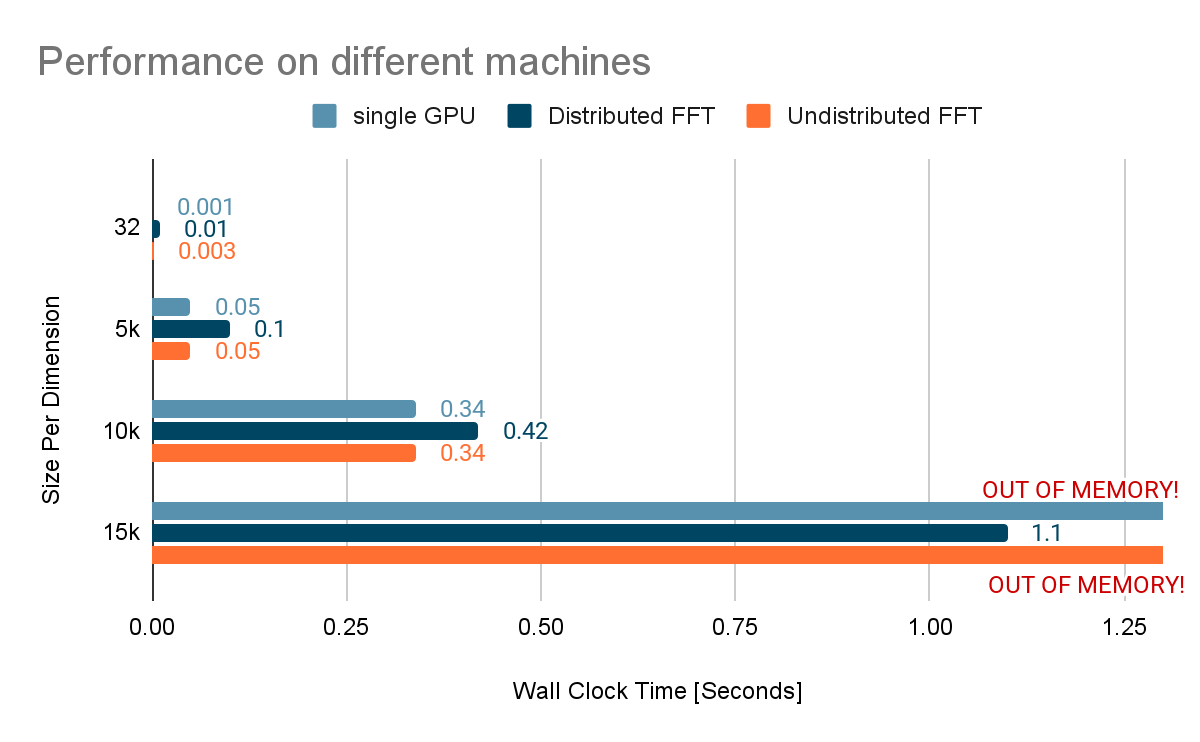
Performance analysis conducted on an 8xV100 GPU cluster reveals a distinct reality: distributed computing is not a panacea for raw speed, but a solution for capacity. By utilizing the memory of eight GPUs, the system can process datasets that would otherwise result in an "Out of Memory" (OOM) error on a single device.
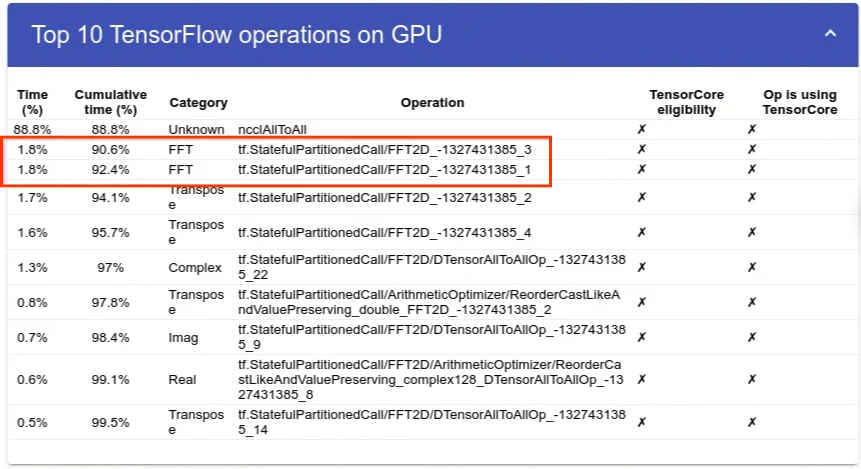
However, the cost of this capacity is "communication tax." Data must be shuffled across the interconnects—the high-speed links between GPUs—to perform the local FFTs. Profiling results indicate that:
- Local FFT Operations: These account for only 3.6% of the total execution time (roughly 15ms).
- Data Shuffling: The vast majority of the latency is incurred during the
ncclAllToAlloperations, where data is redistributed between processors.
Despite this, the ability to solve for a 10K*10K matrix—a size that would be impossible on a single-GPU machine—provides a clear net positive for scientific and enterprise applications. The system successfully mirrors the methodologies of renowned distributed libraries like FFTW and PFFT, but with the added benefit of tight integration into the TensorFlow compute graph.

Official Perspective: The Role of DTensor
The DTensor API acts as the "orchestrator" in this process. By extending the concept of SPMD to TensorFlow, DTensor allows the framework to treat a distributed tensor as if it were a single, contiguous block of memory.
According to Ruijiao Sun, a key developer on the project, the primary design goal was simplicity. "The API interface for distributed FFT is identical to the original FFT in TensorFlow," Sun noted in the technical documentation. "Users just need to pass a sharded tensor as an input. The framework determines the most efficient layout, and the output is returned in a sharded format, ready for the next layer of the neural network."
This abstraction is crucial. By removing the need for developers to manually manage device placement and data sharding, Google is effectively lowering the barrier to entry for large-scale scientific computing.
Implications for the AI and Scientific Community
The integration of Distributed FFT has far-reaching implications across several specialized sectors:
1. High-Resolution Medical Imaging
In fields like MRI or CT scan reconstruction, high-resolution data is standard. Being able to compute Fourier Transforms across a distributed cluster of GPUs means that models can be trained on high-fidelity images without downscaling, potentially leading to more accurate diagnostic AI.
2. Physics-Informed Neural Networks (PINNs)
PINNs often rely on frequency-domain operations to solve partial differential equations (PDEs). These systems often require massive spatial grids that exceed single-device limits. Distributed FFT provides the computational backbone for training these models on complex physical phenomena, such as fluid dynamics or seismic activity analysis.
3. Large-Scale Signal Analysis
For telecommunications and audio engineering, where real-time analysis of wide-band signals is required, this update allows for significantly larger processing windows, enabling the detection of subtle patterns that might be lost in smaller, fragmented data segments.
Future Trajectories: The Path Toward Optimization
While the current implementation is robust, it is merely the first iteration. The Google team has acknowledged that the "simplest algorithm" approach is just the beginning. Future development cycles are expected to focus on:
- Communication Overlap: Implementing techniques to hide the latency of the
AllToAllshuffle by overlapping it with local computation. - Custom Mesh Topologies: Allowing users to define specific communication hierarchies to optimize for different hardware interconnects (e.g., NVLink vs. standard PCIe).
- Precision Tuning: Investigating mixed-precision support to further reduce the memory footprint and increase throughput for specific scientific workloads.
As it stands, the introduction of native Distributed FFT is a significant step forward. It signals a move toward a more modular, scalable TensorFlow ecosystem where the constraints of physical hardware are increasingly abstracted away by intelligent software design.
For researchers and developers, the invitation is open: the feature is currently available in the latest TensorFlow releases. The community is encouraged to test the limits of their data, provide feedback via the TensorFlow Forum, and participate in the ongoing evolution of these distributed tools. As the industry continues to chase larger, more complex models, the ability to handle the "frequency domain" at scale will undoubtedly remain a vital competitive advantage.