Bridging the Prototype-to-Production Gap: How the Open-Source AgentsKit Ecosystem is Reshaping JavaScript AI Engineering
The landscape of artificial intelligence is undergoing a profound paradigm shift. In the initial wave of generative AI adoption, engineering teams focused heavily on "model calls"—the basic act of sending a prompt to a Large Language Model (LLM) and receiving a response. Today, the industry has realized that isolated model calls are insufficient for building autonomous, reliable software. The frontier of AI development has moved to agentic workflows: systems that can plan, use tools, retain memory, self-correct, and interact with external environments.
However, a critical bottleneck has emerged. While building an initial prototype of an AI agent is deceptively simple, transitioning that prototype into a reliable, production-grade enterprise application is remarkably difficult. When a system requires long-term memory, sophisticated tool integration, rigorous evaluation frameworks, responsive user interfaces, and repeatable human-in-the-loop review processes, traditional monolithic software architectures often break down.
To address these challenges, the open-source AgentsKit ecosystem has emerged. Specifically designed for JavaScript and TypeScript environments, AgentsKit departs from the industry’s tendency to build heavy, opinionated, all-in-one frameworks. Instead, it introduces a highly composable suite of independent projects governed by shared contracts, offering a modular alternative for modern web developers.
1. Main Facts: The Architecture of the AgentsKit Ecosystem
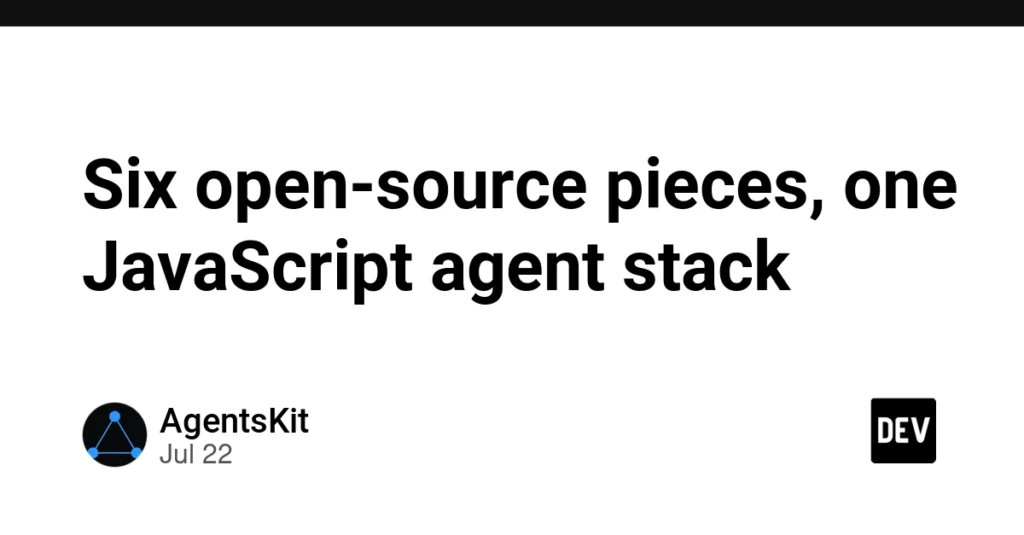
At its core, AgentsKit is designed around a single philosophical principle: interoperability over lock-in. Rather than forcing developers to adopt a monolithic stack that owns the entire runtime, user interface, and database layer, AgentsKit offers six public, decoupled components. Each piece can be utilized independently or composed together to fit into existing enterprise infrastructures.
┌─────────────────────────────────────────────────────────────────────────┐
│                           AGENTSKIT ECOSYSTEM                           │
├─────────────────┬─────────────────┬───────────────────┬─────────────────┤
│  1. Core & SDK  │  2. Chat UI     │  3. Agent Registry│  4. Playbook    │
│  (10KB Runtime) │  (7 Renderers)  │  (shadcn-style)   │  (Eng. Gates)   │
└────────┬────────┴────────┬────────┴─────────┬─────────┴────────┬────────┘
         │                 │                  │                  │
         ▼                 ▼                  ▼                  ▼
┌─────────────────┴─────────────────┐┌──────────────────┴─────────────────┐
│         5. Doc Bridge             ││        6. Code Review CLI          │
│     (Deterministic Handoffs)      ││     (Multi-Lens Verification)      │
└───────────────────────────────────┘└────────────────────────────────────┘
1. AgentsKit: The Composable Foundation
The foundational package, @agentskit/core, provides focused, lightweight JavaScript and TypeScript utilities for managing agent runtimes, adapters, tools, memory, Retrieval-Augmented Generation (RAG), evaluation, observability, sandboxing, and UI bindings.
Crucially, the core engine has zero runtime dependencies and maintains a strict, CI-enforced 10 KB gzipped budget. This makes it exceptionally well-suited for edge computing environments, such as Cloudflare Workers, Vercel Edge Functions, or AWS Lambda, where cold-start times and bundle sizes are critical performance metrics.
To prevent architectural lock-in, AgentsKit enforces six formal, substitutable contracts for its core abstractions:
- Adapters: Connectors for LLM providers.
- Tools: Executable functions agents can invoke.
- Memory: Ephemeral and persistent state management.
- Retrievers: RAG and document search interfaces.
- Skills: High-level behavioral patterns.
- Runtimes: The execution loops coordinating these elements.
Developers can initiate a local agent without an API key using the following bootstrap command:
npm install @agentskit/core @agentskit/runtime tsxOnce installed, developers can seamlessly swap underlying model providers—including OpenAI, Anthropic, Google Gemini, and local models via Ollama—by switching the adapter implementation, without modifying the surrounding runtime orchestration.
2. AgentsKit Chat: One Interaction Model, Seven Renderers
User interface development for AI agents is notoriously repetitive. Developers often find themselves rewriting stream-handling logic, markdown rendering, and tool-call visualization for different frontend frameworks.
agentskit-chat solves this by decoupling the interaction state machine from the UI presentation layer. It defines the interactive agent experience once and offers native renderers for seven major frontend ecosystems: React, React Native, Ink (for CLI applications), Vue, Svelte, Solid, and Angular.
Additionally, the UI layer supports deterministic local answers. For standard documentation or support queries where the exact facts are already known locally, the chat interface can bypass the LLM entirely, reducing latency and inference costs.
To initialize a new chat interface, developers can run:
pnpm dlx @agentskit/[email protected] init my-chat --renderer react --yes3. Registry: Reusable Source, Not Another Dependency
Traditional software distribution relies heavily on compiled npm dependencies. However, in agentic workflows, developers frequently need to customize system prompts, tool schemas, and core agent logic to suit their specific domain. Sealed dependencies make this level of customization nearly impossible.
Taking inspiration from popular UI component libraries like shadcn/ui, the AgentsKit Registry distributes pre-configured agents as raw, reusable source code. Using the CLI, developers copy the agent’s code directly into their repository, giving them full visibility and the freedom to modify the implementation.
npx agentskit add research
npx agentskit add code-review
The public registry currently hosts a catalog of specialized agents, including research assistants, automated code-reviewers, and knowledge-promotion engines, with the ecosystem structured to encourage community-driven contributions.
4. Agents Playbook: Executable Engineering Rules
Vague system prompts like "You are an expert developer; write production-quality code" are notoriously unreliable. They fail to prevent hallucinated imports, architectural violations, or security vulnerabilities.
The Agents Playbook shifts the paradigm from prompt-based wishful thinking to verifiable engineering constraints. It translates abstract development guidelines into concrete, executable checks and zero-dependency validation gates.
The playbook repository currently verifies 87 production patterns, six engineering pillars, six Software Development Life Cycle (SDLC) phases, and 13 gate scripts derived directly from its own source code. This allows teams to enforce strict boundaries around package imports, architectural layouts, and code quality before an agent is permitted to commit changes.
5. Doc Bridge: Deterministic Agent Navigation
One of the most common failure modes for autonomous coding agents is "context drift"—the tendency for an agent to wander aimlessly through a massive codebase, reading irrelevant files and exhausting token limits.
Doc Bridge addresses this by converting repository documentation and system ownership maps into clear, deterministic boundaries. Using a simple JSON configuration, developers can explicitly define where an agent is authorized to work, what checks it must run, and where it should look for guidance:
  "startHere": "docs/for-agents/packages/auth.md",
  "editRoots": ["packages/auth"],
  "checks": ["pnpm --filter @demo/auth test"],
  "humanDoc": "/docs/guides/auth"
This configuration can be consumed via a CLI, the Model Context Protocol (MCP), or CI pipelines. Because the core path is entirely deterministic, it requires no LLM processing or API keys to establish these guardrails. Developers can test this system locally using a bundled demonstration:
npx -y @agentskit/doc-bridge demo --text6. Code Review CLI: Multi-Lens Verification
Deploying coding agents safely requires robust automated review gates. The AgentsKit Code Review CLI functions as an automated code auditor that can be run locally or integrated directly into GitHub Actions. It is designed to work with a wide range of model backends, supporting Codex CLI, Claude CLI, various hosted cloud gateways, and local Ollama deployments.
npx --yes github:AgentsKit-io/code-review-cli --provider codex-cliTo minimize false positives—a common issue with LLM-generated code reviews—the CLI employs a multi-step verification process:
- Seven distinct review lenses independently analyze the code changes, looking for specific issues such as security vulnerabilities, performance bottlenecks, and architectural violations.
- An independent verification voting step evaluates the findings, filtering out weak or hallucinated warnings.
- The final, verified feedback is exported as highly structured markdown, inline GitHub review comments, or standardized Static Analysis Results Interchange Format (SARIF) files.
2. Chronology: The Shift to Modular AI Architectures
To understand the rise of AgentsKit, it is helpful to look at how LLM orchestration frameworks have evolved over the last several years:
  2022-2023: The Monolithic Era
  ┌──────────────────────────────────────────────────────────┐
  │ Heavy, opinionated Python frameworks (LangChain, etc.)    │
  │ High abstraction, rapid prototyping, poor production fit │
  └────────────────────────────┬─────────────────────────────┘
                               │
                               ▼
  2023-2024: The Lightweight SDK Shift
  ┌──────────────────────────────────────────────────────────┐
  │ Rise of TypeScript-first libraries (Vercel AI SDK)       │
  │ Streamlined APIs, but limited native agent guardrails     │
  └────────────────────────────┬─────────────────────────────┘
                               │
                               ▼
  2025: The Composable Ecosystem (AgentsKit)
  ┌──────────────────────────────────────────────────────────┐
  │ Decoupled, zero-dependency cores, shadcn-style registry  │
  │ Deterministic gatekeeping, multi-framework UI rendering  │
└──────────────────────────────────────────────────────────┘- 2022–2023: The Monolithic Era. Early LLM frameworks, primarily written in Python, prioritized rapid prototyping. These libraries wrapped complex behaviors in high-level abstractions, making it easy to build a demo in five lines of code. However, as developers tried to push these systems to production, they ran into significant challenges: bloated dependency trees, rigid runtime loops, and difficult debugging.
- 2023–2024: The Lightweight TypeScript Shift. As web development teams increasingly integrated AI features directly into their applications, TypeScript-first libraries like the Vercel AI SDK gained traction. These libraries focused on clean, lightweight APIs for streaming responses and handling tool calls, but they left developers to build their own custom architectures for complex agent requirements like memory, multi-agent coordination, and validation.
- 2025: The Composable Ecosystem. AgentsKit represents the next step in this evolution. It recognizes that developers do not want a single framework to manage their entire application stack. Instead, they need a collection of highly specialized, independent tools that can be easily integrated into their existing architectures. By decoupling UI rendering, agent logic, and validation rules, AgentsKit provides a production-ready blueprint for modern AI engineering.
3. Supporting Data: Technical Specifications and Performance Metrics
The architectural benefits of the AgentsKit ecosystem are reflected in its technical specifications:
| Technical Metric | Value / Specification | Engineering Benefit |
|---|---|---|
| Core Bundle Size | < 10 KB (Gzipped, CI-enforced) | Fast cold starts in edge environments (Vercel, Cloudflare). |
| Runtime Dependencies | Zero (Core and Playbook) | Minimizes security risks, dependency conflicts, and audit overhead. |
| Framework UI Support | 7 Frameworks (React, React Native, Vue, Svelte, Solid, Angular, Ink) | Write interaction logic once, render on any platform. |
| Pre-Configured Patterns | 87 Executable Production Patterns | Standardizes code generation quality without relying on LLM reasoning. |
| Review Lenses | 7 Independent Lenses | Reduces false positives through multi-step validation voting. |
| Standard Output Formats | Markdown, GitHub Comments, SARIF | Seamless integration with existing CI/CD pipelines and security tools. |
The Cost and Latency of Agentic Workflows
The economic argument for AgentsKit’s deterministic, local-first design is clear. A typical agentic workflow that relies entirely on an LLM to navigate a codebase, decide on tools, and validate its own output can quickly become expensive and slow:
$$textTotal Cost = sum (textPlanning Tokens + textNavigation Tokens + textExecution Tokens + textValidation Tokens)$$
By using deterministic tools like Doc Bridge (which maps codebases without LLM calls) and Agents Playbook (which uses local AST parsing and shell scripts for validation), teams can significantly reduce their overall token consumption.
Monolithic LLM Agent (Relying entirely on LLM reasoning):
[Input Prompt] ──> [LLM Search] ──> [LLM Planning] ──> [LLM Action] ──> [LLM Validation]  (High Token Cost & Latency)

AgentsKit Modular Workflow (Deterministic & Local Guardrails):
[Input Prompt] ──> [Doc Bridge (Local)] ──> [LLM Action] ──> [Playbook Gate (Local)]      (Low Token Cost & Latency)
By offloading pathfinding and code validation to lightweight, local scripts, LLMs can focus purely on code generation, leading to faster execution times and lower operational costs.
4. Community Alignment and Open-Source Governance
The development of AgentsKit is guided by a strong commitment to open-source accessibility. By using permissive licensing and a decoupled architecture, the project avoids the common pitfalls of venture-backed, single-entity open-source software, which often faces pressure to monetize through proprietary cloud platforms or restrictive licensing shifts.
The Value of the Shadcn Distribution Model
The decision to distribute agents via a CLI-driven registry rather than pre-compiled npm packages addresses a long-standing challenge in AI software development. Because AI models are inherently non-deterministic, developers must be able to easily inspect, debug, and modify their agents’ core instructions.
By copying the raw source code directly into the developer’s project, AgentsKit ensures that:
- System prompts can be customized to match a company’s specific brand, tone, or technical guidelines.
- Tool definitions can be modified directly without having to submit upstream pull requests.
- Security audits can easily inspect every line of code executed by the agent, ensuring compliance with strict enterprise data-privacy standards.
Areas for Contribution
As an evolving ecosystem, AgentsKit actively encourages contributions across several key areas:
- Provider Adapters: Adding support for emerging model APIs and local hosting solutions.
- Framework Integration: Expanding UI rendering capabilities and providing comprehensive starter templates.
- Reusable Agents: Contributing specialized agents (e.g., database administrators, automated testing agents) to the public registry.
- Validation Gates: Creating reusable check scripts for the Agents Playbook to verify common security and style guidelines.
5. Implications: The Future of JavaScript in the AI Era
The release of the AgentsKit ecosystem has significant implications for how enterprise software teams approach AI development.
Shifting the Balance of Power from Python to TypeScript
Historically, Python has been the dominant language for machine learning and AI development, largely due to its rich ecosystem of data science libraries like NumPy, PyTorch, and pandas. However, when it comes to building user-facing applications, enterprise integrations, and high-performance web platforms, JavaScript and TypeScript remain the industry standards.
By providing a lightweight, high-performance, and composable agent runtime specifically designed for TypeScript, AgentsKit helps bridge this gap. Web engineering teams no longer need to maintain complex, multi-language stacks (such as a Python backend for agent coordination and a TypeScript frontend for UI rendering). Instead, they can build, test, and deploy end-to-end agentic workflows within a single, unified codebase.
Embracing Software Engineering Best Practices
The transition from experimental AI demos to stable production software requires a return to established software engineering practices. Vague prompting techniques are quickly being replaced by structured validation, deterministic guardrails, and rigorous CI/CD integration.
The AgentsKit ecosystem represents a major step forward in this transition. By treating agents not as mysterious "black boxes," but as highly composable systems governed by strict technical contracts, AgentsKit provides developers with the tools they need to build reliable, scalable, and maintainable AI applications. Whether a team is looking to integrate a simple chat interface or deploy an automated, self-correcting coding agent, AgentsKit offers a flexible, modular foundation designed to grow alongside their production needs.