The Ghost in the Machine: How DIY Enthusiasts Are Resurrecting the Analogue Era
For collectors of vintage cathode ray tube (CRT) televisions, the transition to digital broadcasting hasn’t just been a shift in signal standards—it has been a total blackout. As the world moved toward high-definition digital terrestrial signals, the warmth, the scan lines, and the idiosyncratic "glow" of analogue broadcasts were consigned to the history books. Yet, for those who grew up in the era of rabbit-ear antennas and tuning knobs, the silence of a dead channel is more than a technical inconvenience; it is a loss of a cultural touchstone.
Enter [BorisDigital], a former TV transmitter control room operator from the 1990s, who has decided that the best way to honor the past is to recreate it. By leveraging modern computing power, he has constructed a fully functional, rack-mounted television broadcasting station capable of feeding nostalgic content directly into the aerial inputs of vintage sets. This project represents a fascinating intersection of obsolete hardware and cutting-edge hobbyist electronics, proving that even as standards die, the desire for the analogue experience remains vibrant.
Main Facts: The Anatomy of a Modern Micro-Station
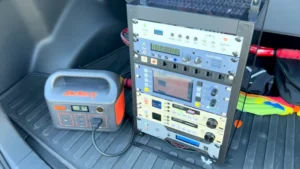
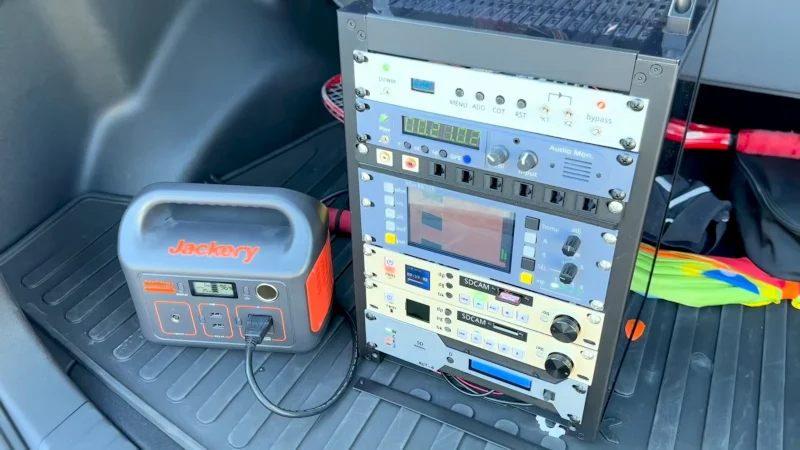
The project, documented extensively by BorisDigital, is housed in a compact 10-inch equipment rack that mirrors the professional broadcast suites of the late 20th century. While an original broadcast setup from the 1990s would have cost tens of thousands of dollars and required a dedicated room for cooling and power, this miniature version fits on a workbench.
At the heart of the system is a low-cost, off-the-shelf transmitter board sourced from China, which modulates the video signal into a frequency compatible with standard analogue television tuners. This is the "final stage" of the broadcast chain. The rest of the rack is a masterclass in modular engineering:
- Broadcast Control: The system utilizes a sophisticated array of Raspberry Pi 5s equipped with USB video digitizers, allowing for the real-time processing and routing of signals.
- Monitoring Suite: The rack features a replica vectorscope and waveform monitor, essential tools for ensuring broadcast-standard signal quality, driven by custom software.
- Automation: A Raspberry Pi Pico manages the audio monitoring and precision timing, while a secondary "fruity board" acts as an automatic scheduler, looping content to mimic the 24/7 nature of a real television station.
- Physical Infrastructure: Perhaps most striking is the 3D-printed rack front paneling. Utilizing multi-filament printing techniques, BorisDigital has created professional-grade labels and bezels that provide the rig with the tactile, robust aesthetic of broadcast-grade equipment.
Chronology: From the Death of Analogue to the DIY Renaissance
The timeline of analogue television is one of rapid technological displacement followed by a slow, sentimental recovery.
The Great Shutdown (2009–2021)
The global "Digital Switchover" began in earnest during the late 2000s. In the United States, the final transition for full-power stations occurred in 2009. However, the slow death of the medium continued for over a decade. By January 2021, the last few analogue television stations in North America officially ceased operations, effectively silencing the airwaves for anyone relying on legacy tuners.
The Collector’s Crisis
Following the 2021 deadline, the vintage TV market saw a bifurcation. While high-end CRTs remained valuable for retro gaming enthusiasts using SCART or component inputs, the average "living room" TV became an oversized paperweight. Collectors were forced to rely on RF modulators—small, often poor-quality devices that converted digital signals to a single, static channel.
The Rise of Micro-Broadcasting (2023–Present)
The current wave of DIY broadcasting, exemplified by BorisDigital, emerged as a solution to the limitations of standard RF modulators. By recreating an entire "station" infrastructure, hobbyists are moving beyond mere signal conversion. They are recreating the experience of television: scheduled programming, commercial breaks, and the aesthetic satisfaction of watching broadcast gear work in real-time.
Supporting Data: Why Analogue Matters
The persistence of analogue television is not merely about nostalgia; it is about the unique way these devices handle data. Analogue signals are continuous waves, not discrete packets of binary code. When a signal is weak, an analogue television displays "snow"—a visual representation of electromagnetic interference. A digital TV, by contrast, simply displays a "No Signal" or "Pixelated" error screen.
| Feature | Analogue TV | Digital TV |
|---|---|---|
| Signal Type | Continuous Wave | Binary Data Packets |
| Failure Mode | Gradual Degradation (Snow) | Sudden Signal Loss (Blackout) |
| Refresh Rate | Interlaced/Variable | Progressive/Fixed |
| Repairability | High (Circuit-level) | Low (Component-swapping) |
The complexity of these systems is significant. BorisDigital’s rig highlights that even a "simple" broadcast requires signal synchronization, audio-video calibration, and precise frequency management—all of which his custom rack handles with the same logic that governed the massive transmitters of the 1990s.
Official Perspectives and Industry Implications
The project has sparked a broader conversation within the engineering community regarding "digital obsolescence." Industry experts have noted that as we move toward an exclusively digital, cloud-based media consumption model, we lose the ability to maintain independent, local control over our media environments.
"There is a beauty in systems that just work," says one broadcast engineer familiar with the project. "Analogue technology was transparent. You could see the signal on a scope; you could adjust the phasing manually. Modern digital broadcasts are ‘black boxes’ where the user has no agency."
The implications of this DIY trend are two-fold:
- Educational Value: These projects are serving as a gateway for younger hobbyists to learn the fundamentals of RF engineering, video signals, and modular system design.
- Cultural Preservation: By maintaining a broadcast infrastructure, collectors are ensuring that the history of television remains a living, breathing entity rather than a static display in a museum.
Implications: The Future of the Living Room
What BorisDigital has built is more than just a converter; it is a piece of art that invites us to rethink our relationship with hardware. In an age where most of our content is streamed from remote servers over which we have no control, the ability to "broadcast" your own content—even if only to a few vintage televisions in your living room—is a powerful act of digital autonomy.
Furthermore, the 3D-printing techniques used for the rack’s exterior signal a shift in how makers approach restoration. No longer limited by what they can find in surplus stores, enthusiasts are now using CAD and additive manufacturing to recreate the visual identity of mid-century industrial design.
Conclusion
As the digital age matures, the divide between "functional" technology and "human" technology will likely widen. The work of BorisDigital stands as a testament to the fact that obsolescence is often a matter of perspective. While the FCC may have turned off the lights on the analogue era, the spark remains for those willing to pick up a soldering iron and a Raspberry Pi.
By building his own miniature transmitter station, BorisDigital hasn’t just solved the problem of a dead screen; he has reclaimed a medium. Whether this leads to a subculture of "pirate" home-broadcasters remains to be seen, but one thing is certain: as long as there is a CRT waiting for a signal, there will be someone standing by to provide it.