The ecosystem of accessories for the ubiquitous Raspberry Pi has long lacked a truly seamless, feature-complete uninterruptible power supply (UPS) tailored specifically for the ultra-compact Raspberry Pi Zero series. While full-sized Pi boards enjoy a wealth of hat and shield options, space constraints on the Pi Zero often force developers to choose between battery backup, real-time clock functionality, GPIO expansion, and protective enclosures.
Enter the Piન-Ener-lite (Pi-Ener-lite), a newly detailed hardware solution engineered by ACE design studio. Designed to eliminate these persistent compromises, the Pi-Ener-lite packs an 18650 lithium-ion battery management architecture, advanced fuel-gaugings, and a dedicated real-time clock (RTC) into a footprint that matches the diminutive dimensions of the Raspberry Pi Zero. Crucially, it achieves this without sacrificing access to the single-board computer’s GPIO header.
Priced around $35 for the total hardware build and featuring an open-source, 3D-printable enclosure, the Pi-Ener-lite addresses critical reliability demands in edge computing, remote environmental sensing, IoT field deployments, and portable instrumentation.
Main Facts: Engineering a Zero-Footprint Power Architecture
At its core, the Pi-Ener-lite is an intelligent power-management system that pairs a standard 18650 cell with precision telemetry integrated circuits, communicating natively over the Raspberry Pi’s I2C bus.
Unlike traditional DIY UPS solutions that rely on bulky wiring harnesses, header-blocking HATs, or unstable micro-USB power pass-throughs, the Pi-Ener-lite utilizes a spring-loaded pogo pin interface. This mechanism handles both continuous power delivery and vital data signaling over a streamlined, solder-free physical bridge that aligns perfectly with the test points or underside pads of the Raspberry Pi Zero.
Key Hardware Specifications:
Host Compatibility: Optimized for Raspberry Pi Zero / Zero W / Zero 2 W (with adaptation potential for larger SBCs).
Primary Energy Storage: Single 18650 lithium-ion battery.
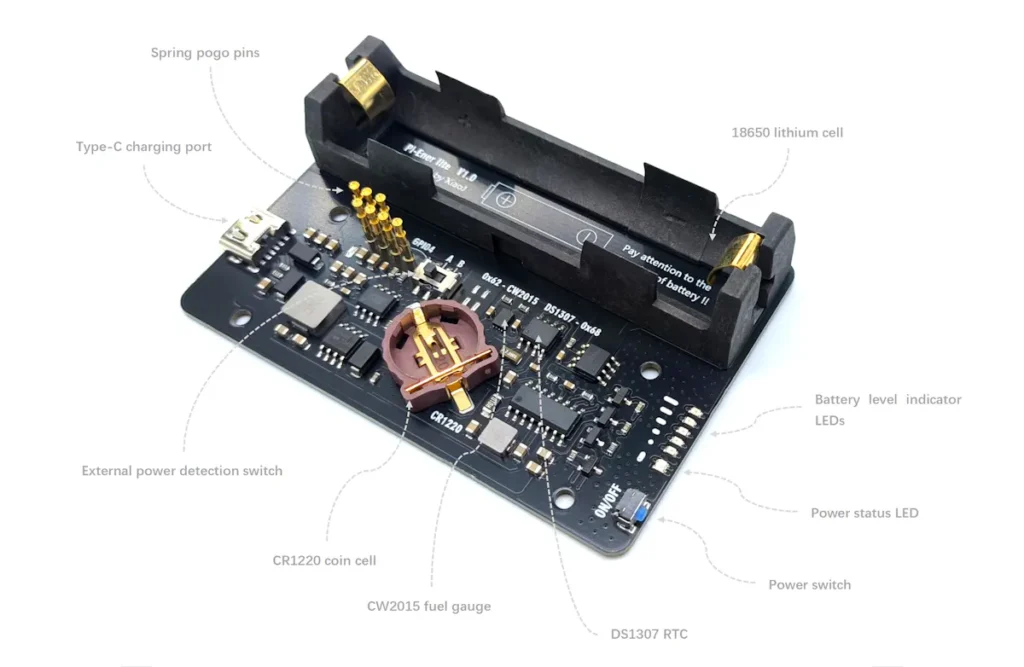
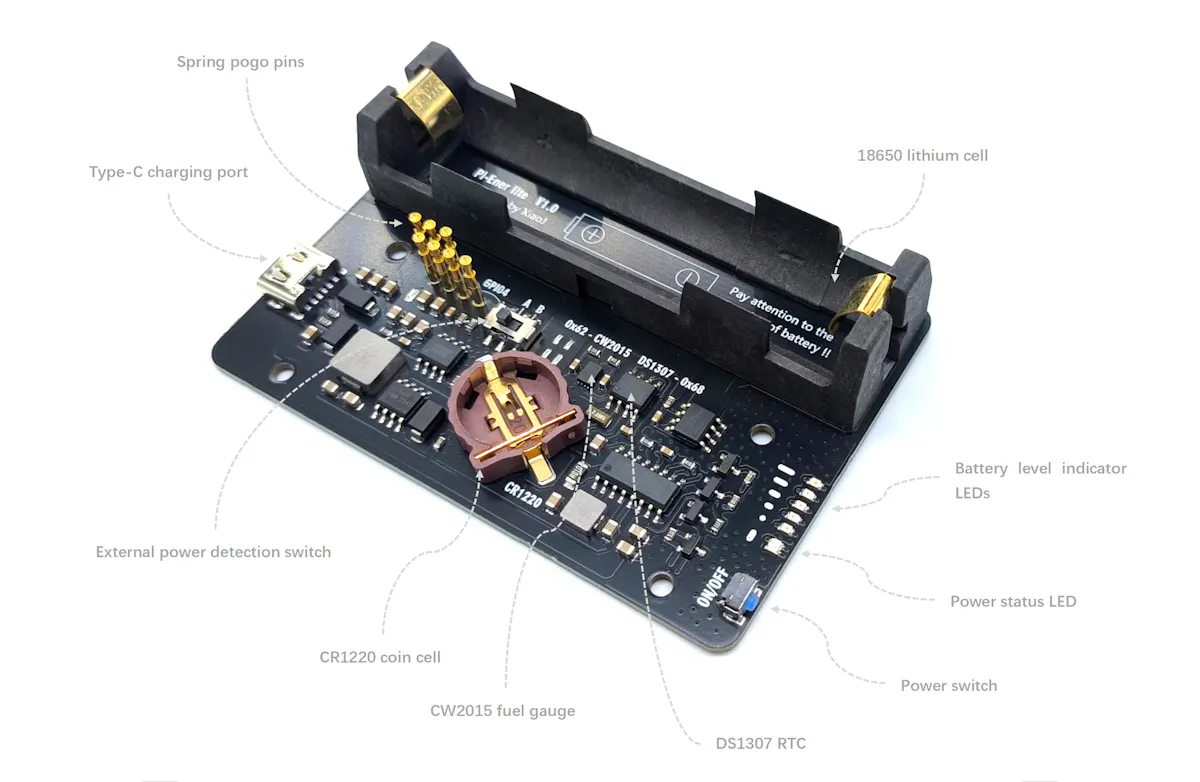
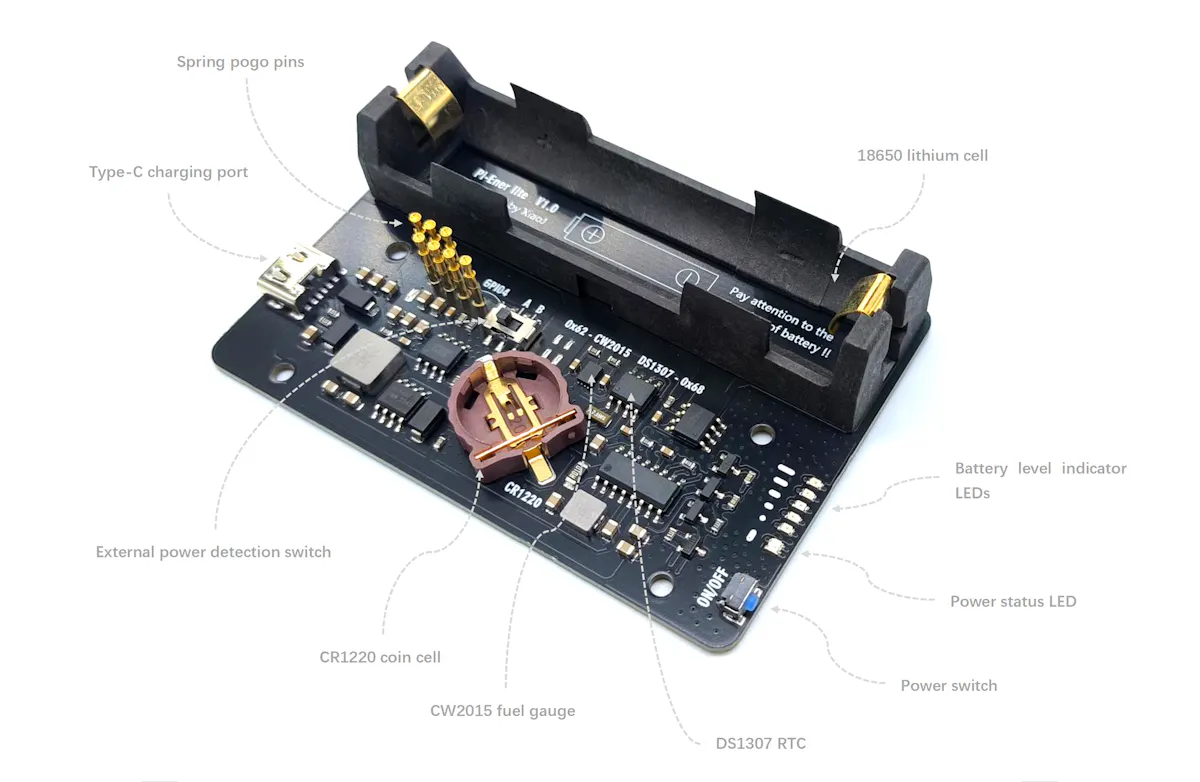
Interface: 7 spring-loaded pogo pins for power delivery and I2C data transfer, leaving the standard 40-pin GPIO header entirely unobstructed.
Fuel Gauge Chip: CW2015 IC providing high-precision state-of-charge (SoC) and voltage monitoring with $pm$2% accuracy.
Real-Time Clock (RTC): DS1307 RTC backed by a CR1220 coin cell battery for continuous timekeeping independent of the main power source.
Power Management Features: Automatic fallback to battery upon mains failure, pass-through simultaneous charging and discharging, and robust onboard safety circuits against overcharge, over-discharge, overcurrent, and short circuits.
Software Support: Ready-to-use Python scripts and open-source documentation for telemetry reading.
Chronology of Development: From Concept to Compact Execution
The journey toward developing the Pi-Ener-lite reflects the evolving demands of modern edge computing, where devices are increasingly expected to operate autonomously in remote or mobile environments where grid power is intermittent or entirely unavailable.
Phase 1: Identifying the Raspberry Pi Zero Power Gap
For years, engineers deploying low-power Linux-based sensors faced a persistent design dilemma. While the Raspberry Pi Zero series offered an unbeatable price-to-performance ratio for low-wattage tasks, keeping it powered reliably in the field required cumbersome external power banks or hazardous DIY lithium-ion wiring jobs. Standard UPS hats for larger Raspberry Pi models were physically incompatible with the Zero’s form factor, and existing Zero-sized battery boards routinely sacrificed the 40-pin GPIO header, preventing the connection of sensor modules, displays, or communications HATs. Furthermore, missing real-time clocks meant that network-isolated units lost track of time during power cycles, corrupting timestamped log files.
Phase 2: Prototyping the Pogo Pin and Telemetry Integration
ACE design studio approached the problem by targeting a zero-obstruction layout. By replacing traditional male/female pin headers with high-reliability spring-loaded pogo pins, the engineering team enabled instantaneous mechanical and electrical coupling.
To solve the perennial issue of unexpected battery-depletion shutdowns—which frequently corrupt SD card filesystems in Linux environments—the team integrated the CW2015 fuel gauge chip. Rather than relying on simple, inaccurate voltage drop curves, the CW2015 tracks algorithmic state-of-charge. Simultaneously, the inclusion of a DS1307 RTC chip, backed by an independent CR1220 coin cell, ensured that system time would be preserved even if the primary 18650 cell was swapped out or completely drained.
Phase 3: Software Ecosystem and Open-Source Enclosures
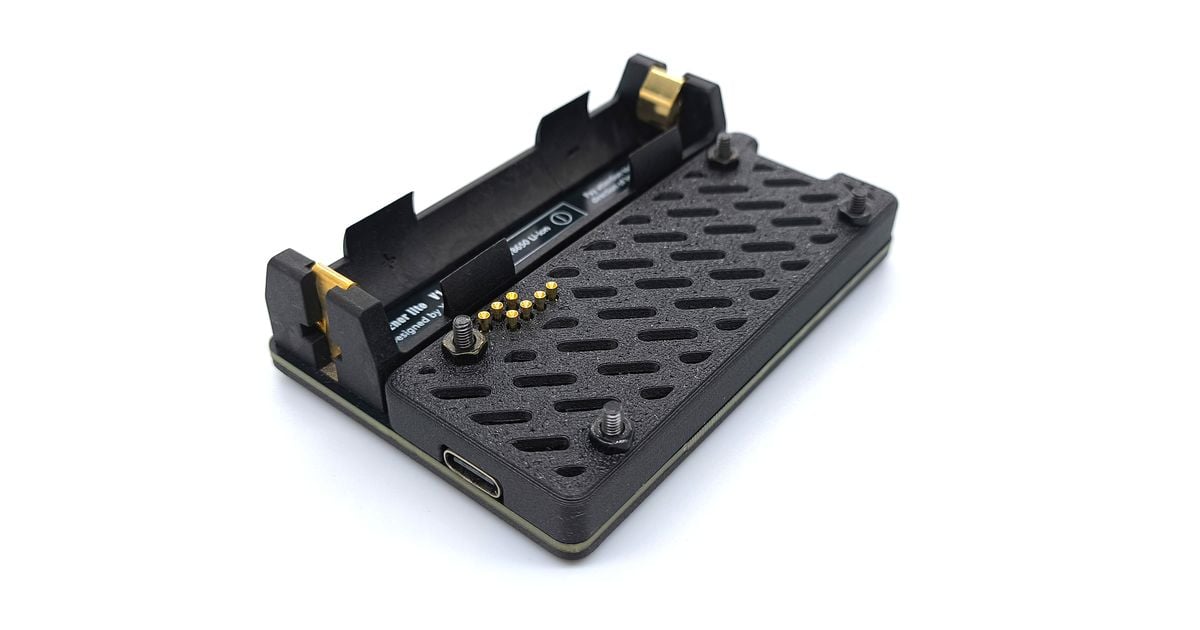
Recognizing that hardware is only as good as its software support, the developers prioritized out-of-the-box accessibility. They authored lightweight Python libraries and documentation enabling developers to pull real-time voltage, capacity percentage, and timestamp data directly over the I2C interface. To complete the hardware cycle, an open-source 3D-printable case design was released, shielding the lithium cell and circuit board within a rugged, portable housing suitable for deployment in the field.
Supporting Data: Telemetry, Safety, and Electrical Performance
Reliability in industrial and remote applications depends heavily on electrical tolerances and data accuracy. The Pi-Ener-lite incorporates industrial-grade safety and monitoring safeguards to ensure long-term stability.
Precision Fuel Gauging with the CW2015
Standard battery monitoring schemes often measure raw voltage, which yields unpredictable results as lithium-ion cells discharge non-linearly under varying loads. The Pi-Ener-lite integrates the CW2015 microchip, which tracks both voltage and cumulative current draw to calculate remaining battery capacity with an impressive $pm$2% margin of error. This accuracy allows automated scripts to trigger graceful shutdowns well before critical voltage thresholds cause kernel panics or filesystem corruption.
Timekeeping Resilience via the DS1307 RTC
Linux single-board computers typically rely on Network Time Protocol (NTP) to synchronize system clocks upon boot. In disconnected or field environments lacking Wi-Fi or cellular connection, this causes timestamps to default to epoch periods. The DS1307 RTC chip, sustained by a long-life CR1220 coin cell, maintains absolute time integrity independently. Even if the primary 18650 cell is removed for maintenance, the system clock remains accurate.
Comprehensive Power Protection and Adaptability
Electrical safety is paramount when working with lithium chemistry. The Pi-Ener-lite’s integrated protection circuitry guards against:
Overcharge Protection: Prevents cell degradation and thermal runaway during charging cycles.
Over-Discharge Cutoff: Stops power drain before cell voltage drops to levels that permanently damage the chemistry.
Overcurrent & Short-Circuit Mitigation: Instantly isolates the load in the event of a downstream fault.
For advanced industrial integrations, the board’s input stage can be adapted. While standard operation relies on conventional 5V micro-USB/USB-C inputs, developers can integrate a 12V DC-DC step-up converter for specialized automotive or remote solar setups, or utilize industrial-grade 36–48V input to 24V output DC-DC converters for heavy-duty deployment scenarios.
Feature / Metric
Pi-Ener-lite Specification
Operational Benefit
Form Factor
Matches Raspberry Pi Zero
Maintains ultra-compact footprint without overhang.
GPIO Access
100% Free / Unobstructed
Allows stacking of sensors, displays, and communication HATs.
Connection Type
7x Spring-loaded Pogo Pins
Tool-free, solderless installation and rapid maintenance.
Battery Chemistry
Single 18650 Li-ion Cell
High energy density, easily swappable, globally available.
State-of-Charge Accuracy
$pm$2% via CW2015 IC
Prevents sudden brownouts and protects SD card data.
Timekeeping
DS1307 RTC + CR1220 Backup
Guarantees accurate logging in offline/remote deployments.
Estimated Build Cost
~$35 USD
Cost-effective professional-grade power resilience.
Official Responses and Developer Perspectives
Makers, embedded systems engineers, and open-source hardware enthusiasts have responded enthusiastically to the launch of the Pi-Ener-lite, highlighting its departure from bulky, compromise-heavy alternatives.
In design notes released alongside the hardware debut, representatives from ACE design studio emphasized the philosophy driving the project:
"We set out to solve the ‘Zero power dilemma.’ Too often, developers building pocket-sized Linux devices are forced to choose between keeping their creation untethered via batteries, keeping accurate time, or maintaining access to their expansion pins. The Pi-Ener-lite was engineered to provide enterprise-grade power monitoring and fail-safes in a package that honors the minimalist ethos of the Raspberry Pi Zero."
Early community testers have similarly praised the pogo pin integration. While traditional HATs require soldering header pins or dealing with fragile jumper wires, the mechanical stability offered by the spring-loaded pogo bridge ensures a robust electrical connection that withstands vibration and transport inside the 3D-printed enclosure.
Implications: Elevating Edge Computing and IoT Reliability
The introduction of the Pi-Ener-lite has notable implications for several sectors relying on low-cost, low-power single-board computing.
1. Robust Remote Environmental Monitoring
Deploying sensor nodes in remote forests, agricultural fields, or rooftop weather stations requires absolute autonomy. Sudden power outages caused by failing solar panels or loose grid connections frequently result in lost data batches and corrupted storage media. With the Pi-Ener-lite’s automatic failover and precise CW2015 telemetry, a Raspberry Pi Zero can detect an incoming power failure, log its status, and execute a safe shutdown protocol, or transition into a low-power sleep mode.
2. Mobile and Wearable Linux Instrumentation
Because the entire assembly—Pi Zero, power board, 18650 battery, and 3D-printed case—remains pocket-sized and lightweight, developers can build portable diagnostic tools, handheld network scanners, or field-data loggers that operate for hours independently of wall power. The preservation of the 40-pin GPIO header ensures that specialized radio modules (such as LoRa, Zigbee, or GPS receivers) can be mounted directly above or alongside the power management system.
3. Scalability to Larger SBCs with Adaptation
While designed primarily for the Pi Zero, the architectural principles of the Pi-Ener-lite point toward broader modular power solutions. Although pairing the board with a power-hungry Raspberry Pi 5 requires step-up current adaptations due to the newer board’s higher power requirements, the project serves as a blueprint for clean, stackable, header-friendly power management across the broader single-board computer landscape.
Conclusion
The Pi-Ener-lite successfully bridges a long-standing gap in the Raspberry Pi Zero accessory market. By ingeniously combining an 18650 battery management system, precision state-of-charge monitoring, a dedicated real-time clock, and a solder-free pogo pin interface—all while leaving the GPIO header completely free—ACE design studio has delivered a professional-grade UPS solution at an accessible price point.
For engineers, hobbyists, and industrial designers seeking to eliminate unexpected shutdowns and timestamp drift in their compact Linux projects, the Pi-Ener-lite stands out as a polished, reliable, and highly versatile addition to the modern maker toolkit.