Engineering the Ultimate Desktop Companion: Inside the Development of "AniMate Waifu"
Introduction and Main Facts
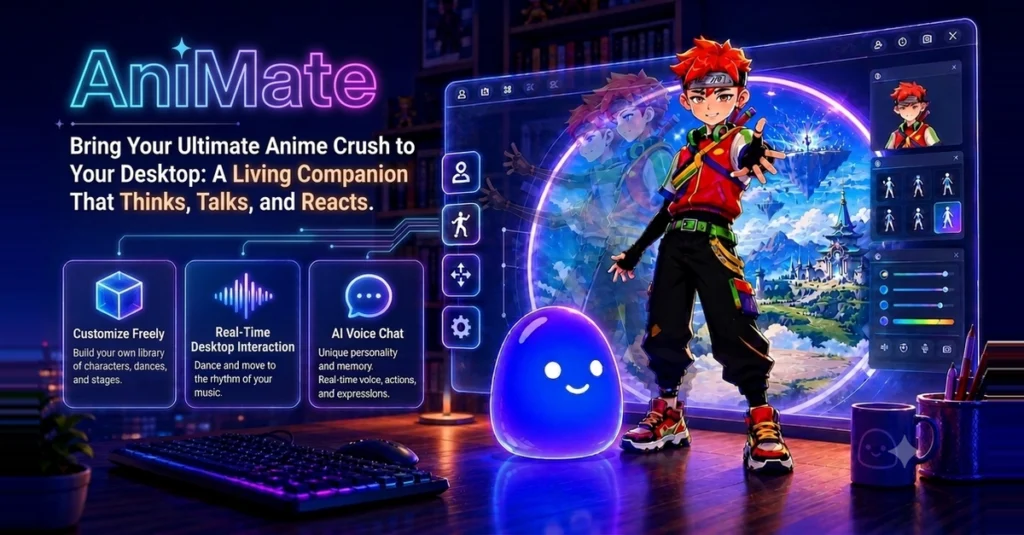
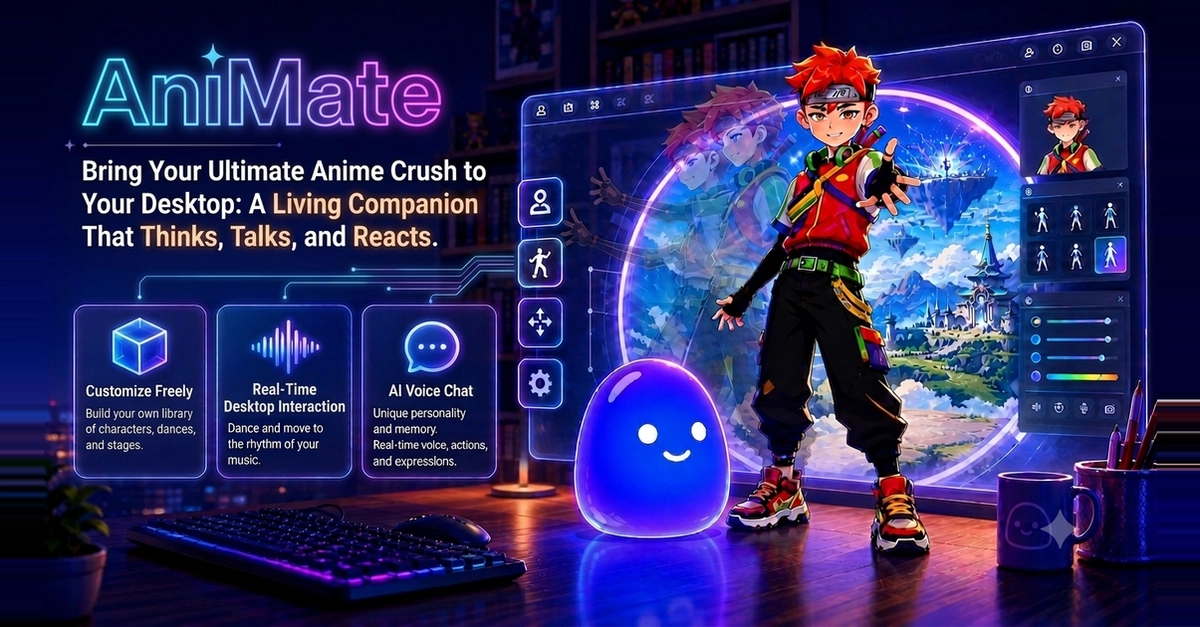
In the evolving landscape of desktop customization and developer tooling, cross-platform utility apps have begun blending aesthetic personalization with advanced rendering technologies. Enter AniMate Waifu, a newly introduced desktop companion application designed to run seamlessly on Windows and macOS. Built by independent developers as an interactive, persistent overlay, the software places fully rigged 3D anime characters directly onto a user’s desktop environment.
Unlike traditional wallpapers or browser extensions, AniMate Waifu acts as a native application that floats in the foreground, interacting with user inputs, tracking cursors, and responding to ambient system activities. At its core, the software leverages a modern, lightweight web and desktop technology stack—combining Tauri, Three.js, and Pixiv’s specialized @pixiv/three-vrm library.
While the application features a freemium model—offering built-in characters for free, with a one-time $9.90 unlock for custom avatars, VRMA dance files, motions, and stages—its underlying engineering journey offers a compelling case study in desktop application architecture. Developing a persistent, non-intrusive 3D desktop overlay requires solving complex problems in platform-specific window management, 3D asset standardization, and aggressive resource optimization.
The Technology Stack: Why Tauri and Three.js?
Building a resource-efficient desktop application requires careful consideration of the underlying runtime. Traditional frameworks like Electron often face criticism for high memory consumption and bloated binary sizes. By opting for Tauri, the developers of AniMate Waifu utilized a framework that pairs a Rust-based backend with the operating system’s native web view for the frontend. This significantly reduces the memory footprint and startup times compared to older web-wrapper paradigms.
For the rendering pipeline, Three.js serves as the backbone, augmented by @pixiv/three-vrm to handle the complex mathematical and structural requirements of Virtual Reality Model (VRM) files. VRM is an open standard file format designed for handling 3D humanoid 3D application avatars, making it the industry standard for creators utilizing software like VRoid Studio.
Chronology of Development: The Three Major Engineering Roadblocks
Every desktop overlay project reaches critical inflection points where standard documentation falls short and low-level operating system architecture pushes back. According to the development team, three distinct challenges defined the early construction phase of AniMate Waifu.
1. The Window Management Trilemma: Transparency, Always-on-Top, and Click-Through
The first major hurdle involved reconciling three core display requirements that fundamentally conflict with one another:

- Keeping the character always on top of other application windows.
- Maintaining a frameless, transparent background without standard OS title bars or borders.
- Ensuring the window remains click-through, allowing user mouse inputs to pass directly through the character to underlying applications (such as a web browser or integrated development environment).
While keeping a window visible and top-most is a relatively trivial configuration in most window managers, making it click-through while it actively renders animations is an entirely different matter. Operating systems view interactive windows as targets for hit-testing. To bypass this without freezing the visual output, the application had to implement platform-specific native hooks. Because hit-testing behavior differs fundamentally between the Windows API (Win32) and macOS Cocoa frameworks, achieving seamless click-through performance required writing custom platform abstractions rather than relying on a generalized configuration flag.
2. The VRM Version Schism: Navigating 0.x vs. 1.0 Standards
As support for diverse user-generated content was integrated into the platform, the development team ran into a major fragmentation issue within the VRM ecosystem: VRM 0.x and VRM 1.0 are not backward-compatible iterations.
- VRM 0.x relies heavily on the legacy MToon shader system and older bone structural definitions.
- VRM 1.0 introduces updated shaders (
MToon10), capsule colliders, granular per-joint SpringBone tuning parameters, and MatCap masking capabilities.
The practical implication for users and developers alike is that simply renaming a file extension or forcing an asset load results in silent failures or broken rendering. Internal data structures, shader parameters, and bone hierarchies differ significantly. To determine file lineage, developers must inspect the raw text of the .vrm file to locate specific structural tags—such as searching for the presence of VRMC_vrm (signifying version 1.0) versus standard VRM headers (signifying version 0.x).
Furthermore, users attempting to import standard 3D asset formats like FBX or PMX cannot use them directly; they must undergo a conversion pipeline to output valid VRM files before AniMate Waifu can parse them.
3. Enforcing Strict Performance Budgets: The "Lightweight" Design Constraint
An application designed to run indefinitely in the background alongside resource-heavy tasks like gaming, video rendering, or software compilation cannot afford to hog CPU and GPU cycles. The developers established early on that "lightweight" could not be a feature patched in later; it had to be a foundational design constraint.
Every component—from per-frame skeletal updates to texture caching and idle motion loops—was scrutinized to ensure that resources remained dormant unless user interaction or state changes triggered them. This architectural philosophy heavily influenced hardware targeting decisions. For instance, the macOS build of AniMate Waifu targets Apple Silicon (M-series processors) exclusively. Attempting to maintain compatibility with aging Intel Macs would have required supporting a secondary, heavier performance profile, increasing maintenance overhead for a rapidly shrinking hardware demographic while compromising the efficiency of the modern build.
Supporting Data & Architectural Overview
To better understand how AniMate Waifu operates within a standard user environment, the following structural breakdown highlights its operational components:

- Core Runtime Engine: Tauri (Rust Backend + Native Webview Frontend)
- Graphics & Animation Library: Three.js with
@pixiv/three-vrmand support for.vrma(VRM Animation) files. - Asset Distribution: Built-in Workshop supporting characters, motions, dances, and customizable 3D stages.
- AI & Persona Integration: Localized chat history storage with cloud-assisted text and voice conversation pipelines mapped to individual character personas and Text-to-Speech (TTS) models.
- Pricing Model: Free tier featuring pre-loaded default characters; $9.90 one-time unlock for custom avatar importation, advanced choreography, and stage management.
Developer Community Responses and Industry Implications
The public introduction of AniMate Waifu on developer-centric forums such as DEV.to has sparked broader discussions regarding the viability of web technologies in native desktop environments. Desktop companions have experienced a resurgence, driven largely by the popularity of virtual streamers (VTubers), productivity gamification trends, and anime subcultures.
Independent developers facing similar challenges have noted that desktop overlays—particularly those combining transparent web views with native graphics APIs—frequently encounter hurdles with operating system security policies, hardware acceleration bugs, and display driver updates. Issues such as transparent windows turning completely black after a GPU driver crash or sudden spikes in idle power consumption remain common pain points across the genre.
By open-sourcing its issue tracker and release pipelines via GitHub while keeping the core application closed-source, the project has established an open feedback loop with its user base to diagnose device-specific rendering anomalies.
Future Outlook and Implications
AniMate Waifu illustrates both the potential and the friction of modern cross-platform desktop development. By marrying the rapid prototyping capabilities of web-based 3D libraries (Three.js) with the systems-level performance of Tauri and Rust, the project demonstrates that resource-efficient, visually rich desktop companions are entirely feasible without resorting to resource-heavy legacy frameworks.
However, the hurdles faced by its creators—ranging from operating system hit-testing discrepancies to the fragmented nature of 3D asset standards like VRM 0.x and 1.0—underscore the complexities inherent in building software that must coexist peacefully with a user’s native operating system. As the development team continues to roll out updates, tackle new edge cases, and expand its Workshop ecosystem, the project serves as a valuable blueprint for engineers building persistent, interactive desktop utilities.