Bridging the Maternal Healthcare Gap: How Google Research Leverages TensorFlow Lite to Bring AI-Powered Ultrasounds to Underserved Communities
By the Health AI Team, Google Research
Enriched and Expanded Report
1. Main Facts
Every year, an estimated 287,000 women lose their lives to complications arising from pregnancy and childbirth, while roughly 2.4 million newborns do not survive their first month of life. These figures, published by the World Health Organization (WHO), represent a profound humanitarian challenge. Even more troubling is the geographic concentration of these tragedies: as many as 95% of these maternal and neonatal deaths occur in low- and middle-income regions or under-resourced settings where access to modern obstetric diagnostics is severely constrained.
A critical component of mitigating these risks involves routine prenatal monitoring—specifically, determining gestational age and identifying fetal malpresentation (such as breech or transverse positions) to plan interventions safely. Traditionally, these assessments rely on ultrasound technology. However, a severe shortage of trained ultrasonography experts in rural and impoverished regions means that up to two-thirds of pregnant individuals never receive an ultrasound screening.

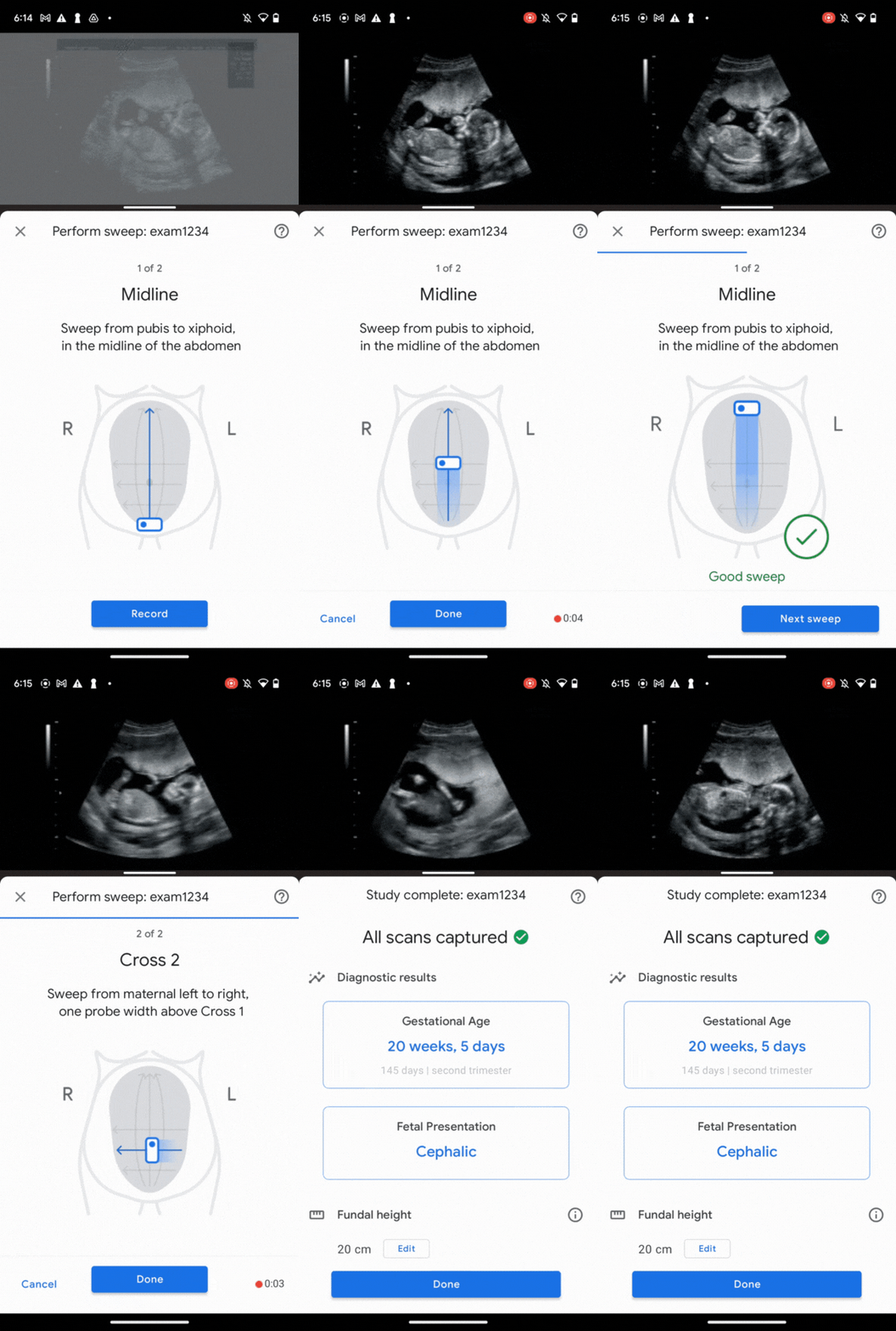
To combat this disparity, Google Research has developed a mobile-optimized artificial intelligence system designed to empower non-experts to capture clinically viable ultrasound data. Utilizing TensorFlow Lite, an open-source framework for running machine learning models on edge and mobile devices, Google’s Health AI team has successfully deployed complex neural networks directly onto smartphones. Paired with an intuitive, easy-to-teach operational method known as the "blind sweep protocol," these on-device models enable frontline healthcare workers with minimal training to achieve diagnostic performance levels comparable to expert sonographers.
2. Chronology of Innovation
The path toward democratizing obstetric ultrasound via mobile AI has evolved through deliberate phases of technological convergence, clinical validation, and edge-computing optimization:
- The Convergence of Portable Hardware (Mid-2010s): Breakthroughs in sensor technology began to drastically reduce the size and cost of ultrasound hardware. Portable transducers capable of plugging directly into smartphones emerged, theoretically lowering the barrier to entry for point-of-care ultrasound (POCUS).
- The Training Bottleneck (Late 2010s): Despite hardware advancements, the clinical bottleneck remained. Operating an ultrasound traditionally requires years of specialized training to correctly position the probe, identify anatomical landmarks, and capture specific biometrics. Rural health clinics continued to lack trained professionals.
- The Shift to Machine Learning and Blind Sweeps (2020–2022): Researchers recognized that shifting the burden of precision from human operators to automated AI could solve the training crisis. By developing algorithms capable of interpreting continuous, unstructured "blind sweeps"—where an operator simply moves the probe across the abdomen without hunting for specific frames in real time—AI made non-expert scanning feasible.
- Publication and Peer Validation (2022): Google Research, in collaboration with academic and clinical partners, published landmark findings in Nature Communications Medicine titled "A mobile-optimized artificial intelligence system for gestational age and fetal malpresentation assessment." This paper validated that non-experts could match standard-of-care performance using AI-guided blind sweeps.
- TensorFlow Lite Integration and Edge Optimization (Present): To ensure these models could function in remote environments lacking reliable electricity or cellular internet, developers turned to TensorFlow Lite. Through post-training quantization and GPU delegation, the team achieved real-time inference speeds exceeding 30 frames per second on standard mobile devices, culminating in field-ready prototype applications.
3. Supporting Data & Technical Architecture
The technical architecture underpinning Google’s mobile ultrasound system is designed to operate within extreme constraints—specifically, low power, zero internet connectivity, and consumer-grade hardware.

Model Architecture: Grouped Convolutional LSTMs
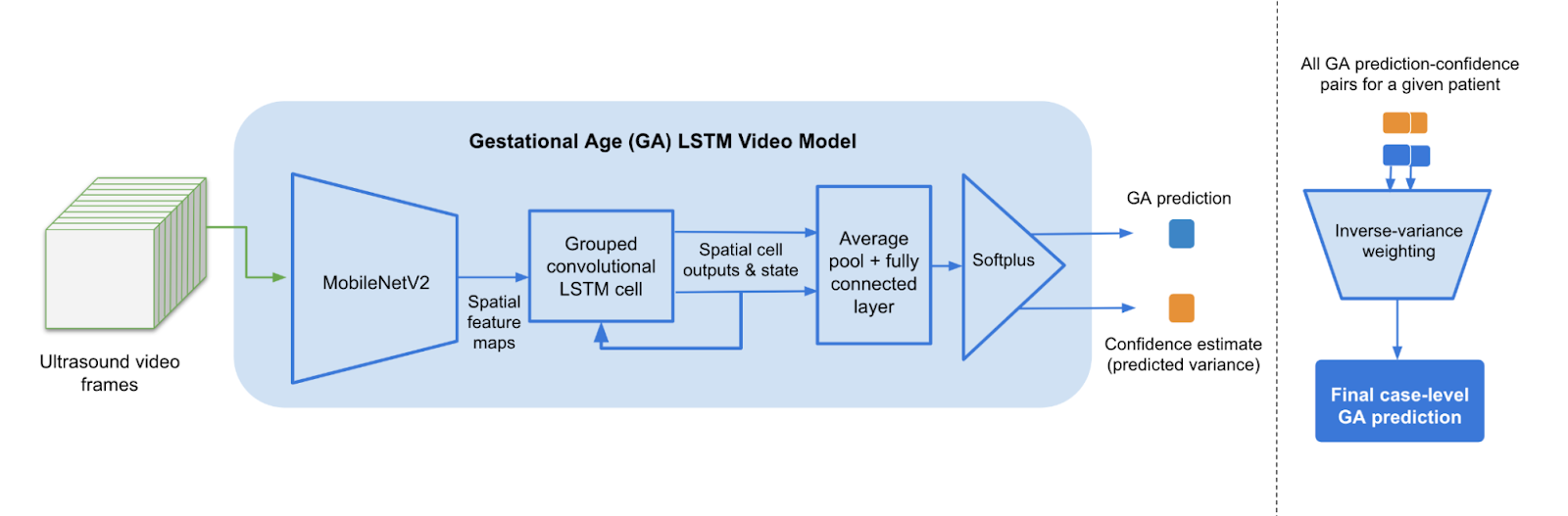
The AI framework relies on a specialized neural network structure that combines MobileNetV2 for spatial feature extraction with Long Short-Term Memory (LSTM) recurrent neural networks to process temporal sequences from ultrasound video clips.
- Feature Extraction: As each video frame streams from the portable ultrasound device, MobileNetV2 extracts image embeddings.
- Sequence Processing: The recurrent LSTM connections operate exclusively on these memory-efficient embeddings rather than raw pixel data. This drastically lowers computational overhead, allowing the model to run smoothly on mobile processors.
- Aggregation and Confidence Estimation: For every subsequence of frames in a sweep, the model generates a clip-level diagnostic. For gestational age, it also computes a confidence estimate represented as predicted variance. Final case-level predictions are generated via inverse-variance weighting across the clips.
Optimization via TensorFlow Lite
Running heavy computer vision models on smartphones historically resulted in high latency and rapid battery drain. By integrating TensorFlow Lite, the research team unlocked significant performance gains without sacrificing diagnostic accuracy:
- Post-Training Quantization: Reducing the precision of the model’s weights minimized its memory footprint, making it suitable for deployment across diverse smartphone manufacturers.
- GPU Acceleration: Implementing a TensorFlow Lite GPU delegate optimized for sustained inference speed yielded a 2x performance boost.
- Real-Time Feedback Loop: Operating at over 30 frames per second on standard Pixel devices allowed the application to analyze sweeps in real time. If the model detects a low-quality sweep—due to insufficient gel or improper pressure—it immediately prompts the user with actionable tips to repeat the process.
Clinical Performance Benchmarks
- Gestational Age: Evaluated across study participants ($n=407$), the blind-sweep regression model demonstrated absolute errors comparable to traditional fetal biometry measurements performed by expert sonographers using standard equipment.
- Fetal Malpresentation: Receiver Operating Characteristic (ROC) curves derived from studies involving $n=623$ participants proved that classification accuracy for identifying abnormal fetal presentations remained exceptionally high, regardless of whether the sweep was captured by a veteran sonographer or a novice operator with only a few hours of training.
4. Official Responses and Collaborative Partnerships
Scaling healthcare innovations globally requires deep institutional alignment. Google Research has structured its deployment strategy around rigorous clinical validation and ethical deployment guidelines rooted in Google’s corporate AI Principles.

Because the system is intended for high-stakes medical environments, leadership emphasizes that technology must be co-developed with local healthcare providers. Dr. Shravya Shetty and other co-authors of the research note that artificial intelligence should serve as an amplifier of human capability, bridging systemic deficits in workforce distribution.
To transition from theoretical research to practical impact, Google has forged key international partnerships:
- Northwestern Medicine (USA): Collaborating on clinical validation, methodological refinement, and institutional oversight.
- Jacaranda Health (Kenya): Working directly within East African maternal care ecosystems to evaluate how mobile-AI tools integrate into existing community health workflows.
- Academic and Clinical Affiliations: The project has benefited immensely from multidisciplinary contributions involving the Department of Obstetrics and Gynaecology at the University of Zambia School of Medicine, the University of North Carolina School of Medicine, and UNC Global Projects—Zambia, ensuring that the technology is culturally and logistically adapted to the regions that need it most.
5. Global Implications and Looking Ahead
The implications of bringing robust, offline-capable diagnostic AI to mobile devices extend far beyond obstetrics. By proving that high-accuracy medical imaging analysis can be decoupled from expensive, stationary machinery and expert operators, this research charts a new course for decentralized medicine.

Overcoming Infrastructure Barriers
In remote areas where clinics may experience rolling blackouts and zero cellular connectivity, the ability of TensorFlow Lite to execute entirely on-device is paramount. Sensitive patient data never leaves the local handset, ensuring robust data privacy and security compliance while eliminating dependency on cloud computing infrastructure.
The Path to Commercial and Clinical Readiness
Despite these promising advances, important caveats remain. As noted by Google Research, TensorFlow Lite has not been certified or validated for clinical, medical, or diagnostic purposes. Developers utilizing the framework bear sole responsibility for their implementations and must independently secure regulatory approvals and validate outputs before clinical deployment.
The current body of work represents foundational research. As Google and its partners continue to refine these algorithms, scale clinical trials, and work alongside regulatory bodies, the horizon of global maternal health grows brighter. By arming community health workers with smartphone-based ultrasound tools guided by on-device intelligence, the global medical community moves one step closer to ensuring that no parent or child loses their life to a preventable, undetected pregnancy complication.
Acknowledgements
This interdisciplinary effort was spearheaded at Google Research by Ryan G. Gomes, Chace Lee, Angelica Willis, Marcin Sieniek, Christina Chen, James A. Taylor, Scott Mayer McKinney, George E. Dahl, Justin Gilmer, Charles Lau, Terry Spitz, T. Saensuksopa, Kris Liu, Tiya Tiyasirichokchai, Jonny Wong, Rory Pilgrim, Akib Uddin, Greg Corrado, Lily Peng, Katherine Chou, Daniel Tse, and Shravya Shetty, in close collaboration with international clinical teams and specialized technical contributors.