Cambium Networks Transforms Network Management with the Launch of cnMaestro™ MarketApps Hub
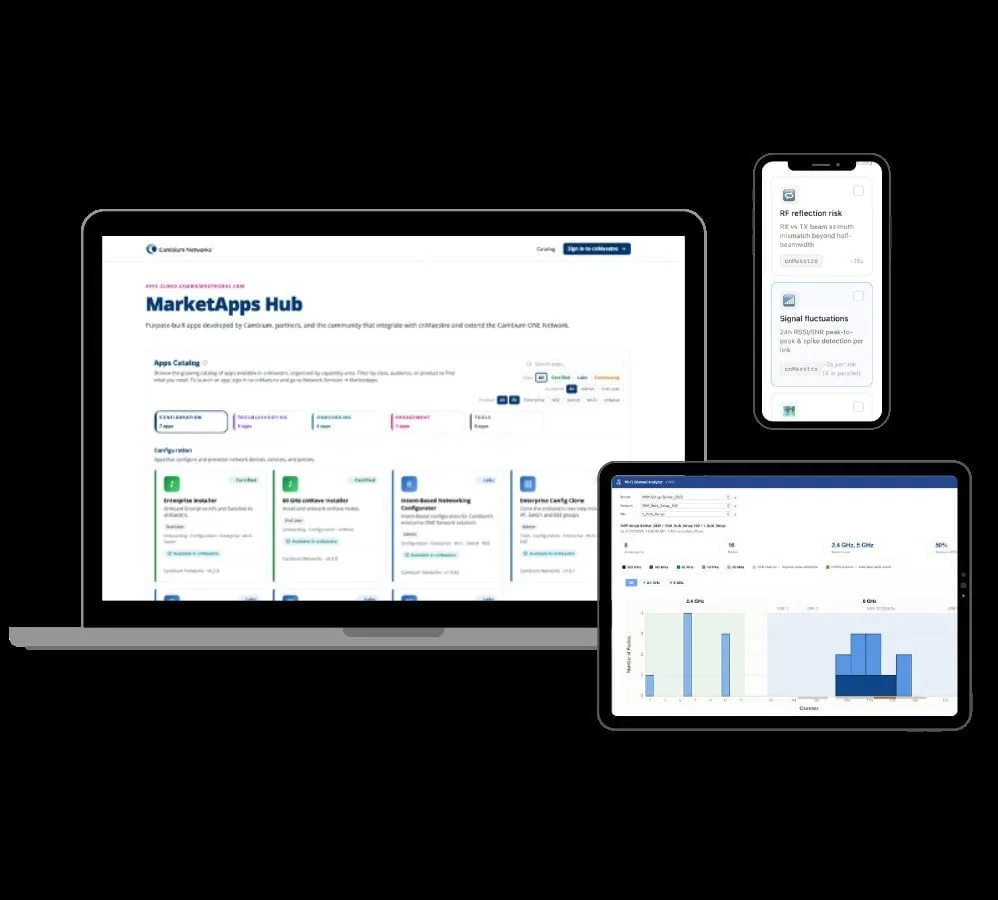
SAN FRANCISCO — In a strategic move blurring the lines between traditional network infrastructure and modern software ecosystems, Cambium Networks has officially unveiled the cnMaestro™ MarketApps Hub. This open marketplace of web applications is designed to radically extend the capabilities of cnMaestro, the company’s flagship centralized network management system.
By pivoting the Cambium ONE network architecture into an extensible application platform, the company is empowering a diverse ecosystem of network operators, Managed Service Providers (MSPs), site managers, and end-users. These stakeholders can now run tailored workflows that were previously impossible within rigid, out-of-the-box management interfaces. Crucially, leveraging public cnMaestro APIs alongside modern AI-ready development frameworks, developers can build, test, and publish custom applications in a fraction of the time traditionally required.
Main Facts: The Anatomy of MarketApps Hub
At its core, the cnMaestro MarketApps Hub transitions Cambium’s existing MarketApps framework into a fully governed, scalable app ecosystem. It supplies a centralized public catalog, a comprehensive developer SDK, single sign-on (SSO) integration, secure app hosting, and robust platform-level security.
Rather than relying solely on internal software roadmaps, Cambium has opened the platform to external ingenuity. Anyone capable of making API calls to cnMaestro can architect and submit applications. These range from Cambium’s own engineers to third-party developers, enterprise IT departments, and the very customers who manage network hardware daily.
Furthermore, the introduction of a structured classification system ensures administrative clarity and user trust. Every application deployed on the MarketApps Hub falls cleanly into one of five distinct app classes, which communicate origin, support levels, and vetting depth:
- Community / Experimental Apps: Built by grassroots developers or users experimenting with novel workflows.
- Validated Apps: Reviewed for basic compatibility and performance standards.
- Certified Apps: Thoroughly tested and endorsed for enterprise-grade deployment.
- Partner Solutions: Developed in collaboration with verified technology alliances and third-party vendors.
- Native cnMaestro Features: Core functionalities seamlessly integrated directly into the foundational platform.
This tiered system creates a natural evolutionary pathway for software. High-performing community concepts that gain widespread traction and prove market demand can seamlessly ascend through the ranks, eventually transforming into Certified apps or even becoming native features within future iterations of cnMaestro.
Chronology: The Evolution Toward an AI-Ready Ecosystem
The rollout of the MarketApps Hub is the culmination of years of deliberate architectural evolution by Cambium Networks.
Phase 1: Centralized Management Foundation
Years prior, Cambium established its architectural baseline with cnMaestro, offering operators a unified pane of glass to provision, monitor, and manage enterprise Wi-Fi, switching, routing, and outdoor wireless infrastructure. While powerful, these platforms traditionally suffered from a common industry bottleneck: feature requests had to wait for vendor-driven software release cycles.
Phase 2: The Emergence of the MarketApps Framework
Recognizing the diverse needs of vertical markets—ranging from hospitality and education to industrial IoT and smart cities—Cambium introduced the preliminary MarketApps framework. This allowed early experimentation with web applications that tied into network telemetry, though distribution and developer onboarding remained constrained.
Phase 3: The AI Development Revolution
The tipping point arrived with the explosive maturation of Large Language Models (LLMs) and AI coding agents. Domain experts—individuals who deeply understand network operations or specific vertical workflows—could suddenly express complex functional requirements in natural language, enabling AI tools to generate functional code rapidly. Cambium identified that while writing software had become democratized, the real friction points shifted to hosting, securing, and distributing those applications to the right audiences.
Phase 4: Launch of MarketApps Hub
With the introduction of the MarketApps Hub, Cambium has closed this loop. By combining a frictionless developer SDK, boilerplate code repositories, live development environments, and instant deployment pipelines, the company has transformed cnMaestro from a passive management tool into an active, programmable application platform.
Supporting Data: Democratizing Development and Accessibility
The most disruptive aspect of the MarketApps Hub lies in its profound compression of software development timelines. According to industry metrics cited by Cambium, complex domain-specific enterprise applications that once demanded dedicated engineering teams working across entire quarterly development cycles can now be conceptualized, coded, and deployed in a matter of hours or days.

The Developer Experience
Cambium has engineered the MarketApps developer platform explicitly with AI coding agents in mind.
- Quick-Start Onboarding: Developers are provided with ready-to-use boilerplate code and a comprehensive SDK.
- Live Environments: A single command spins up a live cnMaestro development sandbox, allowing real-time debugging and testing against mock or live network telemetry.
- Frictionless Publishing: A standard pull request workflow is all that stands between local code and global visibility within the public marketplace.
Extending Beyond the IT Department
Traditionally, network management interfaces are strictly guarded domains meant exclusively for network engineers and IT administrators. MarketApps Hub shatters this paradigm. Because these applications are delivered as standard web apps capable of running seamlessly inside any mobile or desktop browser, they can serve non-technical stakeholders safely and intuitively.
For instance:
- Residents in a Multi-Dwelling Unit (MDU): Can use a custom web app to configure their personal home Wi-Fi SSID and passwords without touching underlying network infrastructure.
- On-Site Facilities Managers: Can monitor local link health or IoT device status at a specific retail branch through a simplified dashboard.
- Field Technicians: Can execute provisioning workflows during hardware installation via a streamlined mobile interface, completely bypassing the need for a high-level cnMaestro administrative account.
Official Responses: Industry Perspective
The leadership at Cambium Networks emphasizes that this launch represents a fundamental shift in how network infrastructure delivers business value.
"Artificial intelligence has fundamentally transformed domain experts into developers," stated Bruce Miller, VP of Enterprise Marketing at Cambium Networks. "A purpose-built application that once took an engineering team a quarter to build can now be created in hours or days. The MarketApps Hub gives these newfound developers a thriving marketplace and gives our customers functions precisely tailored to their unique vertical market and operational workflows."
Industry analysts have echoed these sentiments, noting that hardware differentiation is increasingly commoditized. Modern enterprise customers no longer select vendors based solely on throughput metrics or raw radio performance; instead, they evaluate ecosystems based on how easily networking hardware integrates into broader business operations, software pipelines, and automated workflows. By turning cnMaestro into an open application platform, Cambium is positioning itself at the forefront of this software-defined paradigm.
Implications: What MarketApps Hub Means for the Enterprise
The introduction of the cnMaestro MarketApps Hub carries far-reaching implications for various stakeholders across the telecommunications and enterprise networking landscape:
For Managed Service Providers (MSPs)
MSPs stand to gain a powerful competitive advantage. Rather than waiting for vendor updates to offer specific client-requested dashboards or automated reporting tools, MSPs can now rapidly code proprietary apps or adopt community-vetted solutions. This enables them to offer highly differentiated, white-labeled services tailored to niche industries like healthcare compliance, industrial automation, or hospitality guest management.
For Enterprise IT and Operations
Enterprise IT departments often struggle with "swivel-chair management," jumping between network controllers, security dashboards, and asset management databases. MarketApps Hub allows internal developers to build integration bridges directly inside cnMaestro, pulling data from enterprise resource planning (ERP) systems or custom telemetry tools into a single pane of glass.
For Security and Governance
Opening a platform to external developers invariably raises security concerns. Cambium has proactively addressed this by embedding platform-level security, centralized single sign-on (SSO), and strict governance through the five-tier app classification system. By maintaining control over hosting and distribution, Cambium ensures that rapid innovation does not come at the expense of network integrity or data privacy.
The Future of Network Infrastructure
Ultimately, the MarketApps Hub signals a broader maturation of the networking industry. As AI continues to lower the barriers of software creation, platforms that successfully curate open ecosystems while maintaining enterprise-grade reliability will define the next generation of enterprise connectivity. Cambium Networks has laid down a clear marker, proving that the future of networking lies not just in routing packets, but in empowering the applications that give those packets meaning.