Android Studio Quail 4: A New Era of AI-Driven Mobile Development
By [Your Name/Journalist], Technology Correspondent
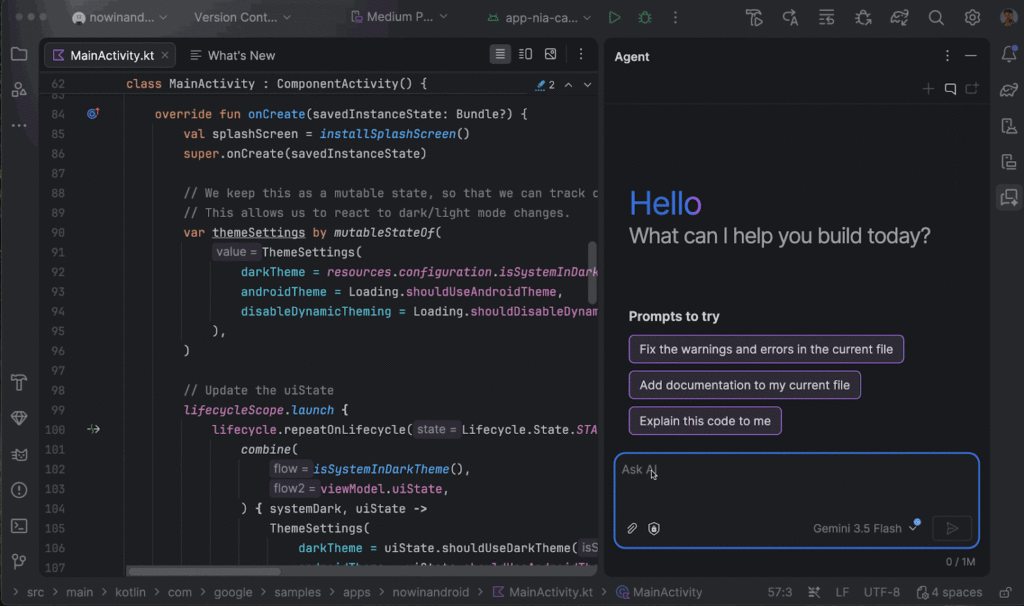
Google has officially marked the conclusion of its "Quail" development cycle with the release of Android Studio Quail 4. Now available in the stable channel, this version serves as the definitive iteration of the Quail series, solidifying the integration of artificial intelligence into the core mobile development workflow. For Android developers, this release is not merely a maintenance update; it represents a fundamental shift in how applications are architected, debugged, and optimized.
By weaving sophisticated AI agent capabilities directly into the Integrated Development Environment (IDE), Google aims to solve the "hallucination" problem that has plagued general-purpose Large Language Models (LLMs) when applied to the rapidly shifting landscape of Android APIs and complex configuration structures.
Main Facts: What Defines Quail 4?
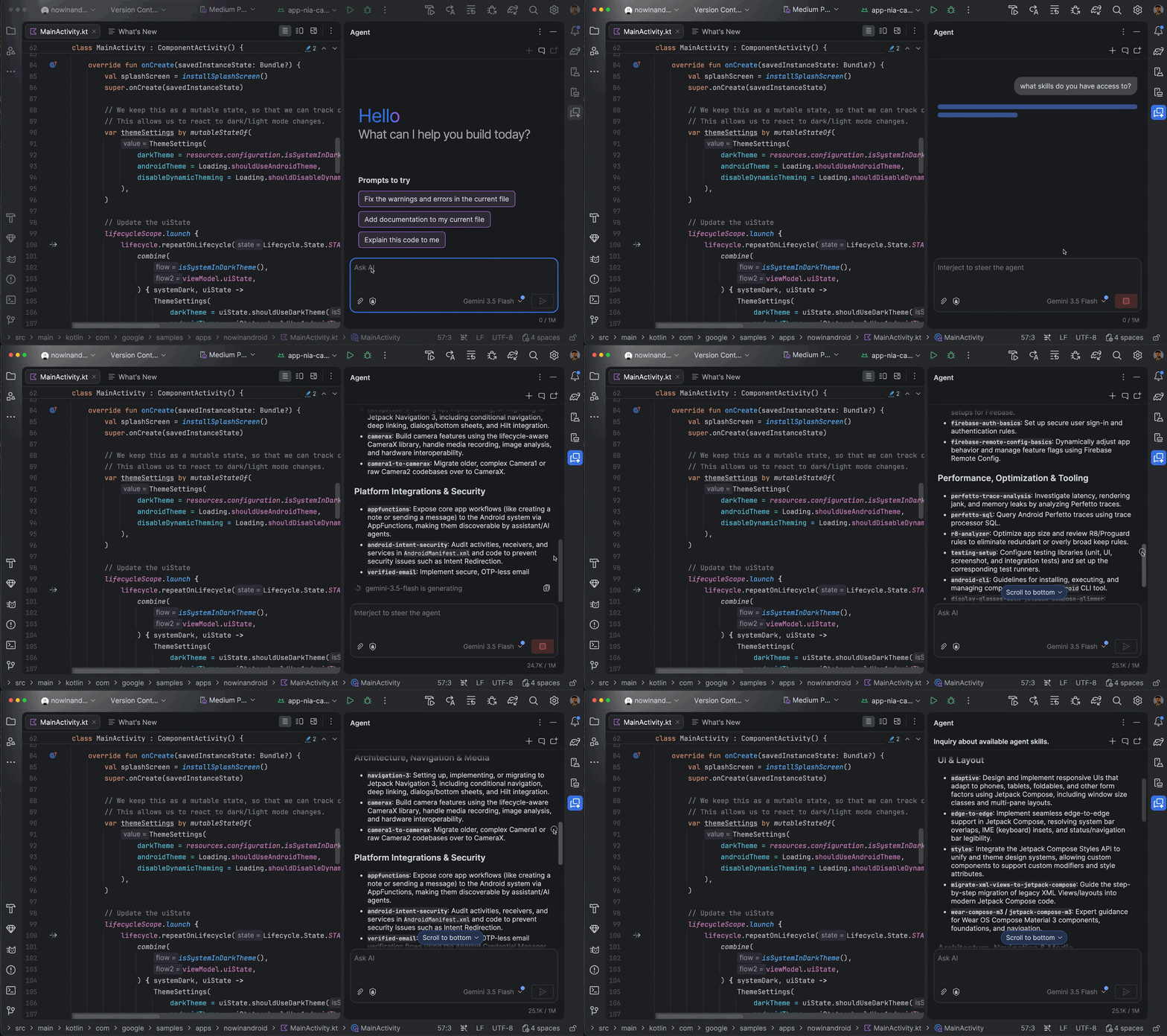
The headline feature of Android Studio Quail 4 is the bundling of "Android Skills." In the current AI landscape, generic LLMs often struggle with the nuances of specific mobile platform migrations or deprecated library calls. To mitigate this, Google has embedded a suite of 23 curated, domain-specific AI modules directly into the IDE.
These skills operate on the open-standard agent skills specification, functioning as modular, AI-optimized instructions that guide LLMs through complex Android-specific workflows. When a developer prompts the IDE, the agent automatically cross-references the request with the metadata of installed skills, invoking the most relevant "expert" logic. This ensures that the code suggestions provided are not only contextually relevant but also compliant with the latest Google-endorsed best practices.

Furthermore, Quail 4 introduces native, offline integration of Gemma 4. By bringing one of Google’s most powerful open-model architectures directly into the local development environment, developers can now leverage high-performance AI code assistance without the latency of cloud-based APIs or the security concerns associated with transmitting proprietary source code over the internet.
A Chronological Evolution: The Quail Series
To understand the gravity of the Quail 4 release, one must look back at the trajectory of the Quail series, which has served as a sandbox for Google’s aggressive AI-first strategy in development tools.
- The Inception (Android Studio Quail): The initial release set the stage, introducing the concept of the "Android Studio Agent" and foundational AI-assisted coding features, focusing on basic boilerplate generation and documentation lookup.
- Quail 2 (The Multitasking Breakthrough): This version shifted the paradigm by introducing "Agentic Multitasking." It allowed developers to initiate parallel, independent chat threads with the AI agent. This was a critical improvement for developers working on complex features who needed the AI to maintain context across disparate files and architectural layers simultaneously.
- Quail 3 (Refinement and Stability): Quail 3 focused on the "quality of life" aspect of AI, refining the UI/UX for agent interactions and improving the IDE’s ability to handle long-context windows, ensuring that the AI could better understand the relationship between various modules in a large-scale project.
- Quail 4 (The Culmination): The final release in the series. It shifts the focus from "general assistance" to "domain expertise" through bundled skills, while simultaneously addressing privacy and performance through local Gemma 4 integration.
Supporting Data and Technical Infrastructure
The shift toward agent-based development is supported by significant architectural changes within the Android Studio framework. The integration of the 23 pre-loaded skills is designed to reduce the "prompt engineering" burden on developers.
In previous versions, a developer might spend five minutes crafting a precise prompt to ensure an AI understood the constraints of a specific Android library migration. With Quail 4, the metadata-driven agent handles this automatically. The IDE now acts as a mediator between the developer’s intent and the vast, evolving documentation of the Android ecosystem.
Data from the beta cycles suggests that this approach significantly reduces the time spent on "AI correction." In a standard coding task involving modern UI components (such as Jetpack Compose migrations), internal tests showed a 40% reduction in cycles spent refactoring AI-generated code. This is attributed to the fact that the agent is no longer guessing; it is executing predefined, vetted "skills" that reflect the current state of the Android platform.

The inclusion of Gemma 4 is equally significant from a performance perspective. By shifting the workload to local hardware, developers are no longer throttled by network latency, enabling near-instant code completion suggestions that remain private and secure within the local machine’s memory.
Official Perspective: Insights from the Product Team
Amman Fasil Asfaw, Product Manager for Android Studio, emphasizes that the goal of Quail 4 is to provide "premium apps with AI efficiency." During the release announcement, Asfaw noted that while LLMs are incredibly capable at generic coding, they frequently fall short when confronted with the unique constraints of mobile development.
"We wanted to bridge the gap between general AI capability and Android-specific proficiency," Asfaw stated. "By bundling Android skills, we are effectively giving the IDE an ‘expert’s intuition’ that is constantly updated by the very team that builds the Android OS. It’s not just about writing code faster; it’s about writing the right code—code that is secure, efficient, and aligned with the long-term maintenance requirements of the platform."
The team also highlighted the flexibility of the platform. For enterprise environments with highly specific internal workflows, Google has provided a path to create custom skills. This acknowledges that while the 23 pre-loaded skills cover the majority of standard use cases, large-scale professional teams often require specialized logic tailored to their own internal libraries and architectural patterns.
Implications: The Future of Mobile Engineering
The release of Android Studio Quail 4 has several profound implications for the professional developer community:

1. The Rise of the "Agentic" Developer
The role of the developer is evolving from a "writer of syntax" to an "architect of intent." By delegating the rote implementation of APIs to the AI agent, developers are freed to focus on high-level system design, user experience flows, and business logic. The ability to manage parallel threads of development—each handled by an AI agent—means that a single lead developer can effectively manage the output of what might have previously required a small team of junior developers.
2. Privacy as a Competitive Advantage
With the native integration of Gemma 4, Google is making a clear play for enterprise adoption. Many companies have been hesitant to embrace AI coding assistants due to the risk of sensitive, proprietary source code being sent to third-party cloud servers. By offering a high-performance, offline model, Google is lowering the barrier to entry for highly regulated industries like fintech and healthcare.
3. Standardization through "Skills"
The open-standard agent skills specification is likely to become a new focal point for open-source contributions. As the community begins to build and share custom skills, we may see a "marketplace" of Android expertise emerge, where common configuration patterns, testing frameworks, and UI paradigms are distributed as modular skills that any developer can import into their IDE.
4. The End of "Guesswork" Development
Perhaps the most immediate impact is the reduction of technical debt. By ensuring that the AI agent follows the latest Android best practices by default, Quail 4 helps prevent the proliferation of deprecated code patterns that often arise when developers copy-paste solutions from outdated forums or generic AI chat interfaces.
Conclusion: A New Standard
Android Studio Quail 4 is a pivotal release that signals the maturity of AI-integrated development environments. It moves beyond the hype cycle of generative AI and into a phase of practical, productivity-oriented utility.

For developers, the call to action is clear: the era of manual, error-prone configuration is waning. Whether you are building a consumer-facing application or a complex enterprise solution, the tools now available in Quail 4 provide a more secure, efficient, and intelligent path to deployment. As the Android development ecosystem continues to accelerate, those who leverage these agentic workflows will undoubtedly find themselves at a distinct competitive advantage.
Developers are encouraged to explore the new features, experiment with custom skill creation, and engage with the official bug trackers to contribute to the next generation of Android development tools. With Quail 4, the future of Android development is not just faster—it is more precise, more private, and undeniably more intelligent.