Beyond "Just Self-Host": Why Enterprise On-Premises Databases Are Failing the Production Test—And How the Paradigm Is Shifting
Main Facts
The modern enterprise database landscape is undergoing a profound structural reckoning. For years, the prevailing wisdom among cloud-native and open-source database vendors when queried about on-premises deployments was disarmingly simple: "We’re open source; you can just self-host it."
While this casual dismissal works fine for a hobbyist, a solo developer, or a small engineering team spinning up a prototype, it rarely survives contact with production environments inside large organizations. Today, enterprises are demanding on-premises deployment models more aggressively than ever before. This resurgence is primarily driven by the explosion of enterprise AI operations (AIops). Running open-source LLMs and embedding models on proprietary hardware is exponentially cheaper than renting token-based inference from third-party cloud providers. Furthermore, in strictly regulated sectors—such as finance, healthcare, and government—retaining absolute control over data residency is not a negotiable preference; it is a legal imperative.
Because AI agents and machine learning pipelines live where the data lives, the database must move back in-house alongside the models. However, companies attempting to repatriate their database infrastructure are discovering a dangerous chasm between three distinct promises: open source, self-hostable, and enterprise-ready. Most vendors successfully deliver only the first, leaving enterprise teams to wrestle with the hidden operational complexities of packaging, securing, and maintaining complex distributed systems.
Chronology and Industry Evolution
The Cloud-Native Era and the "Cloud-in-a-Box" Fallacy
To understand the current friction, one must examine how open-source database business models evolved over the past decade. Cloud-native vendors built sophisticated managed services designed to run seamlessly in hyper-scale public clouds (such as AWS, GCP, or Azure). When market demand shifted toward on-premises infrastructure—spurred by data sovereignty laws and soaring AI inference costs—these vendors repurposed their existing cloud architectures.
Instead of engineering a true, self-contained enterprise product, they packaged their managed cloud services into Docker containers and handed them over to users with instructions to "self-host."
This approach inadvertently dumped a massive wave of undifferentiated heavy lifting onto enterprise engineering teams. Operating these platforms required spinning up fragile multi-container stacks—managing API gateways, authentication services, storage layers, connection poolers, and edge functions—all while wiring in custom security, backups, and high availability (HA).
The Supabase and Xata Case Studies
Recent practical implementations highlight the limitations of this "cloud-in-a-box" model.
- Supabase: Widely praised as an exceptional, fully open-source tool for prototyping, running Supabase in a production self-hosted environment presents severe structural friction. Operating a self-hosted Supabase instance requires juggling roughly a dozen containers. As documented in Supabase’s official self-hosting guides, the self-hosted edition runs as a single isolated project, stripping away multi-organization support, advanced logging metrics, managed backups, point-in-time recovery (PITR), and platform management APIs. Because the codebase is fundamentally tied to the vendor’s cloud service, attempts to run it natively often trigger configuration errors, 404 errors on backup pages, and billing dialogs referencing cloud compute rates for hardware the enterprise already owns. Independent engineering teams that attempted to fork and sanitize the platform reported stripping out hundreds of thousands of lines of cloud-specific code just to achieve operational stability.
- Xata: Taking a different approach, Xata introduced a "Bring Your Own Cloud" (BYOC) model, allowing users to deploy databases within their own cloud accounts rather than a generic data center. While features like built-in anonymization tooling offer distinct advantages for regulated teams, the control plane—the core system responsible for managing organizations, users, regions, and instances—remains anchored in Xata’s AWS account. For security-conscious, air-gapped, or strictly regulated enterprises, allowing an external cloud application to remotely govern internal infrastructure is a non-starter.
Supporting Data and Comparative Analysis
Enterprise self-hosting is fundamentally a software delivery and supply-chain discipline, not merely a GitHub code repository. It demands unglamorous engineering investments: rigorous build-and-validation matrices, cryptographic package signing, automated offline installation workflows, and compliance with federal security standards like FIPS (Federal Information Processing Standards).
To illustrate how alternative platforms measure up against true enterprise requirements, industry analysts and architectural teams have established a rigorous evaluation matrix:
| Enterprise Requirement | Supabase (Self-Hosted OSS) | Xata (BYOC) | pgEdge Enterprise Postgres |
|---|---|---|---|
| Production-Ready Out of the Box | No (Documentation warns against default security) | Yes (Vendor-assisted) | Yes (Fully validated packages) |
| Tested for Specific OS / Architecture | No | Abstracted via Kubernetes | Yes (Thousands of validated builds) |
| Native Packaging | Containers only | Containers only | RPM, DEB, Containers, Helm |
| Deployment Tooling | Docker Compose | Helm / Kubernetes | Ansible, Helm, Control Plane |
| Cryptographic Provenance (Signed Artifacts) | No | Vendor-managed | Signed RPMs, DEBs, and embedded SBOMs |
| FIPS Compliance Mode | No | No | Yes (FIPS and non-FIPS supported) |
| Documented Air-Gapped Install | No | No (Requires cloud control plane tether) | Yes (RPM and DEB local mirroring) |
| Zero Vendor Control Plane "Phone Home" | Yes (User manages all) | No (Tethered to Xata cloud) | Yes (100% autonomous) |
| High Availability Without Kubernetes | No (DIY assembly) | No (Requires 3-node K8s cluster) | Yes (Autonomous Control Plane) |
| Multi-Master Replication Included | No | Branching only | Yes (Spock and Patroni integrations) |
| Self-Hosted AI Toolkit | No | Anonymization only | Yes (MCP, RAG, Vectorizer, Anonymizer) |
| Same-Day Upstream Security Patches | No (Manual rebuild required) | Vendor-scheduled | Yes (Day-of-release matching) |
Official Responses and Strategic Shifts
Recognizing the failure points of traditional open-source handoffs, infrastructure providers are beginning to pivot toward dedicated enterprise solutions that respect operational boundaries.
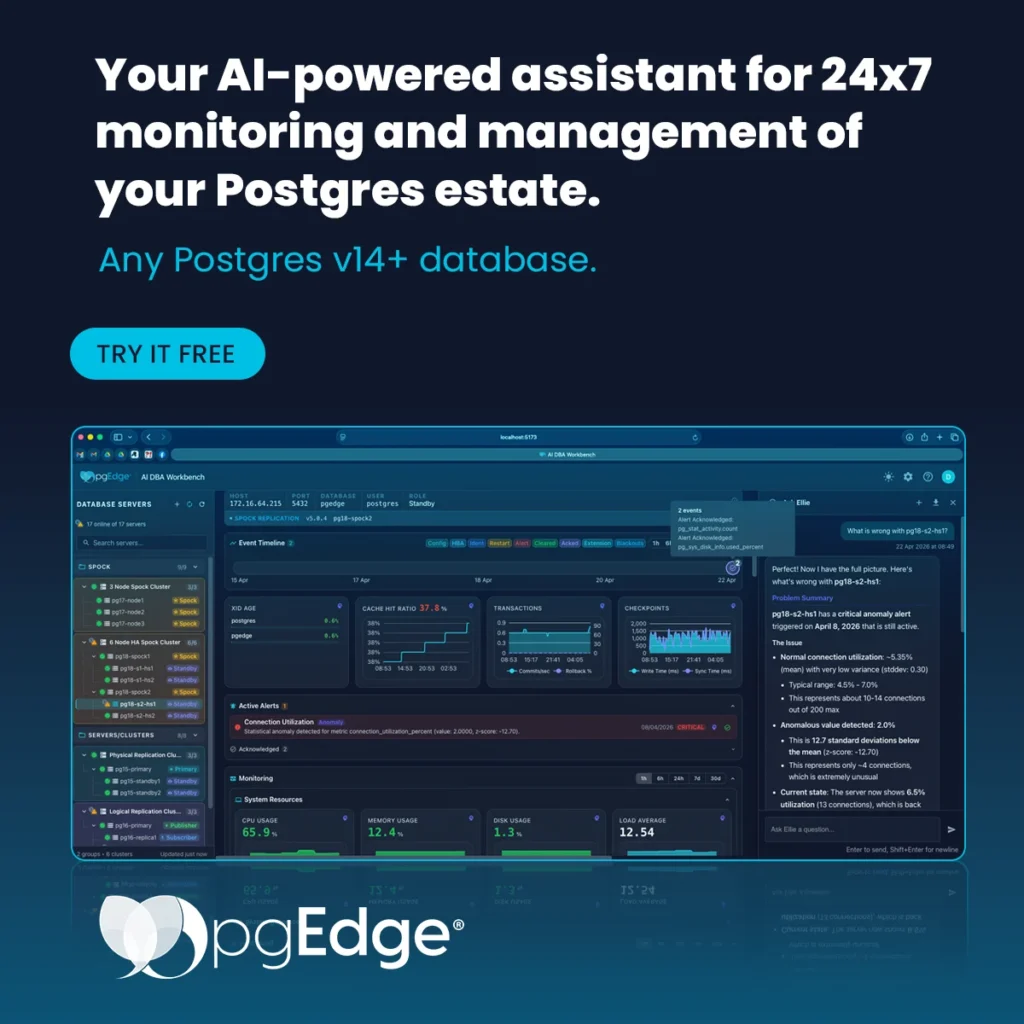
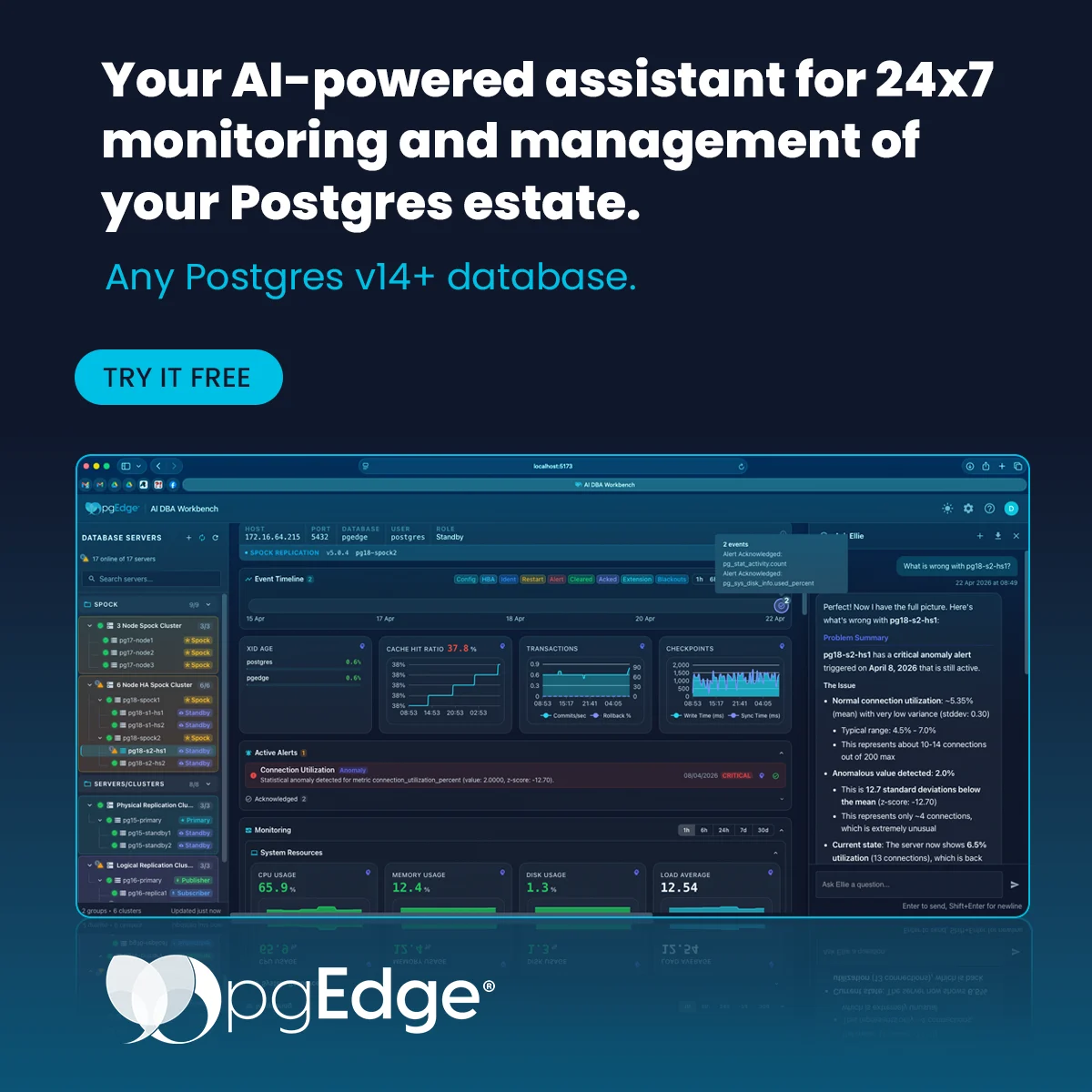
A prominent example of this shift is pgEdge Enterprise Postgres, which approaches on-premises deployment not as an afterthought, but as a core architectural discipline. Rather than forcing teams to adapt a cloud service, pgEdge delivers 100% upstream-compatible PostgreSQL alongside a massive, pre-tested build matrix covering multiple CPU architectures (x86_64 and arm64), enterprise Linux distributions (RHEL, AlmaLinux, Rocky Linux, Oracle Linux), Ubuntu, Debian, and major PostgreSQL versions (16, 17, and 18).
Eliminating the Kubernetes Prerequisite
A major pain point in self-hosting database infrastructure has been the mandatory imposition of Kubernetes. While tools like Xata require complex Kubernetes clusters to function, enterprise teams frequently operate mixed environments consisting of bare metal, virtual machines, and legacy infrastructure.
To solve this, modern control planes—such as the pgEdge Control Plane—utilize declarative, API-driven architectures to automate high-availability fleets across diverse environments without requiring an external cloud connection. Utilizing embedded consistent stores and resumable workflow engines, these systems manage physical replication (via Patroni) and multi-active logical replication (via pgEdge Spock) entirely within local boundaries.
The Rise of Sovereign AI Toolkits and Data Tiering
As organizations integrate artificial intelligence deeper into their workflows, database vendors are expanding their toolsets to accommodate secure, local AI execution. Solutions like the pgEdge Agentic AI Toolkit provide structured, governed database access via Postgres Model Context Protocol (MCP) servers, hybrid vector-and-keyword RAG (Retrieval-Augmented Generation) servers, and built-in anonymization engines.
Furthermore, innovations in data tiering—such as pgEdge ColdFront (currently in beta)—address the massive storage overhead associated with compliance and AI historical logs. By transparently tiering older data to open Apache Iceberg formats on local object storage at a fraction of traditional storage costs, enterprises can maintain compliance and query performance without inflating their primary database footprint.
Implications
The widening chasm between "just self-host" open-source models and true enterprise-grade software carries profound implications for the technology sector:
- The Death of the "Cloud-in-a-Box" Illusion: CTOs and procurement officers are becoming wise to the hidden operational costs of pseudo-open-source software. Projects that require hundreds of hours of custom engineering to secure and patch are increasingly rejected during enterprise architecture reviews.
- Regulatory Compliance as a Product Feature: With tightening global data privacy regulations (such as GDPR, HIPAA, and emerging AI governance frameworks), software that relies on external cloud control planes or unverified container stacks will find itself locked out of government, defense, financial, and healthcare sectors.
- The Normalization of Air-Gapped AI: As corporate paranoia regarding data leaks and intellectual property theft via third-party AI APIs grows, organizations are aggressively moving toward fully air-gapped, sovereign AI stacks. Databases that cannot operate in total isolation—divorced from vendor telemetry and cloud tethers—will struggle to capture the next wave of enterprise AI budgets.
Ultimately, the debate exposes a fundamental philosophical divide in software delivery. There is a vast, unbridgeable gulf between telling an engineering team "you can technically run this code if you rebuild it" and delivering a product engineered from day one so that an enterprise can truly own, secure, and operate it on its own terms.