Impossible Port: The Three-Year Odyssey of Bringing Myst to the Atari 2600
In the annals of computing history, the Atari 2600 stands as a monument to minimalist ingenuity. Released in 1977, the console was a marvel of its time, yet by modern standards, it is a hardware curiosity defined by extreme limitations: a MOS Technology 6507 processor running at a glacial 1.19 MHz and a staggering 128 bytes of RAM. To put that into perspective, a single text character in a modern document occupies more memory than the entire working space available to an Atari programmer in the 1970s.
Despite these constraints, the retro-computing community continues to push the boundaries of what is possible on original silicon. The latest feat in this "demake" culture—the practice of porting complex modern software to primitive hardware—is the successful migration of the 1993 PC classic Myst to the Atari 2600. This project, spearheaded by developer Vince, represents a three-year technical odyssey that bridges two decades of gaming evolution.
The Main Facts: Bridging the Generational Divide
Myst, developed by Cyan and released in 1993, was a landmark title that helped usher in the era of CD-ROM gaming. It featured high-resolution (for the time) pre-rendered graphics, complex logic puzzles, and an immersive, atmospheric soundscape. Porting such a title to the Atari 2600 is, on the surface, a computational impossibility.
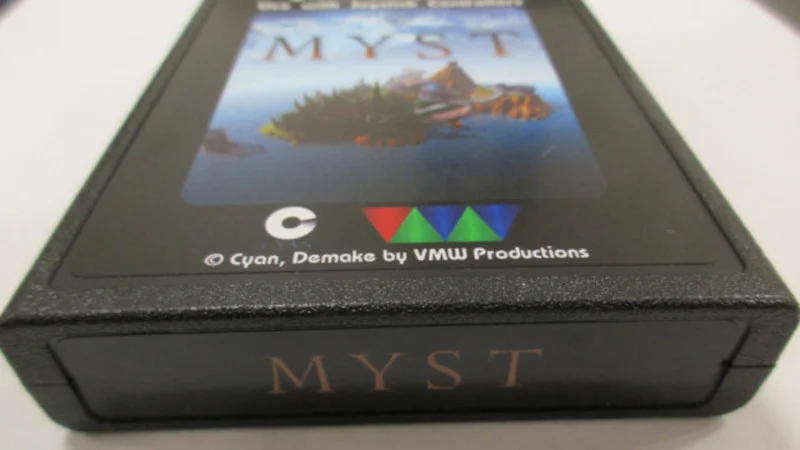
Vince’s project is not a straight port, as that would be physically impossible due to storage and processing constraints. Instead, it is a "demake"—a ground-up recreation designed to capture the spirit and mechanics of the original game while adhering to the harsh reality of 8-bit architecture. The game operates using the E7 bank-switching scheme, a method that allows the Atari to address more ROM than it was originally designed for by swapping memory segments in and out of the CPU’s view.
The project required more than just code; it required custom hardware. Vince utilized the circuit board of an original BurgerTime cartridge—a game that, ironically, contained more onboard memory than the average Atari 2600 title—to house the new software.
Chronology of a Three-Year Development Cycle
The journey of bringing Myst to the Atari 2600 was not a linear path of progress, but rather a series of recursive problem-solving loops.
Phase 1: The Conceptualization (Year One)
The initial year was spent in feasibility studies. Vince had to determine which elements of Myst were essential to the player experience. The core of Myst is its navigation and puzzle-solving. Vince focused on abstracting the game’s first-person exploration into a series of screens that could be rendered within the Atari’s limited graphical capability. During this time, he mapped out the memory management strategy, realizing that the E7 bank-switching scheme was the only viable path to accommodate the game’s assets.
Phase 2: The Hardware Hurdles (Year Two)
The second year was defined by the struggle to make the hardware behave. Simply flashing code onto an EEPROM proved insufficient. Because the Atari 2600 relies on the television’s electron beam to draw the screen in real-time, the CPU must be perfectly synchronized with the display’s scanlines. Any deviation results in "rolling" screens or crashes. Vince encountered significant timing issues that required him to rewrite his kernel repeatedly, ensuring that the bank-switching logic did not interfere with the delicate dance of the video output.
Phase 3: Optimization and Finalization (Year Three)
The final year was a painstaking process of bit-shaving. Every byte of RAM had to be accounted for. Vince optimized the asset compression to ensure the game’s logic could fit into the limited ROM provided by the modified BurgerTime cartridge. This period also involved exhaustive playtesting to ensure that the logic puzzles remained solvable despite the reduced graphical fidelity, culminating in a functional cartridge that could be plugged into an authentic console.
Supporting Data: The Hardware Context
To understand the magnitude of this achievement, one must look at the technical specifications of the hardware involved:
| Feature | Atari 2600 | PC (Minimum for Myst) |
|---|---|---|
| CPU | 1.19 MHz MOS 6507 | 33 MHz 386DX |
| RAM | 128 Bytes | 4 MB |
| Storage | 2KB – 4KB (standard) | 640 MB (CD-ROM) |
| Video | TIA (128 colors, 160×192) | VGA (640×480) |
The Atari 2600 does not have a frame buffer. It has no video memory. It draws the screen on the fly, line by line. To create an environment like Myst, which relies on static backgrounds, the programmer must manipulate the Television Interface Adaptor (TIA) to change colors and shapes as the beam moves across the screen. Achieving this while maintaining the game’s logic requires a level of assembly language mastery that few developers in the modern era possess.
Official Responses and Community Reception
The project has sent ripples through the retro-gaming and "demake" scenes. While Cyan, the original creators of Myst, have not issued a formal statement, the developer community has been effusive in its praise.
"This is the sort of project that redefines the ceiling for original hardware," noted a prominent figure in the Atari Age forum community. "It isn’t just about playing a game; it’s about proving that the limitations of 1977 were not barriers, but rather a different language of creation."
Vince himself has maintained a humble stance, describing the endeavor as a "labor of love" and a "passion project" born from his admiration for the demake scene. He has been careful to share his documentation, hoping that his work on the E7 bank-switching scheme will serve as a resource for future developers looking to push the Atari 2600 beyond its intended limits.
Implications: The Future of Retro-Computing
The successful port of Myst to the Atari 2600 carries several significant implications for the future of digital preservation and hardware hacking.
1. The Longevity of "Dead" Platforms
The project proves that no hardware is truly obsolete as long as there is interest. By demonstrating that complex, narrative-heavy games can be adapted to primitive platforms, Vince has opened the door for others to attempt similar projects. This keeps the history of these consoles active and relevant.
2. The Rise of the "Demake" Economy
Demakes are moving from niche experiments to a recognized art form. Similar to how musicians create acoustic covers of electronic tracks, developers are now "un-producing" games to see how they function at their most fundamental levels. This offers a unique perspective on game design, forcing developers to focus on gameplay mechanics over graphical fidelity.
3. Preservation Through Re-creation
In a world where digital files are subject to "bit rot" and hardware is prone to failure, creating new, functional cartridges for old consoles is a form of preservation. By porting Myst to the Atari, Vince has ensured that the spirit of the game can be experienced on hardware that has outlasted many of the PCs it originally ran on.
4. Hardware Hackery as Education
Finally, projects like this serve as the ultimate educational tool. Understanding how to manage 128 bytes of RAM teaches a level of efficiency that is rarely demanded in modern software engineering. It forces the developer to understand the CPU, the bus, and the display on a molecular level.
As the industry continues to push toward cloud gaming and infinite processing power, the efforts of developers like Vince provide a necessary reminder of the beauty of scarcity. The Myst Atari 2600 port is more than just a game; it is a three-year masterclass in constraints, a tribute to the pioneers of the industry, and a testament to the fact that when it comes to creativity, the only real limit is the imagination of the programmer. Whether played on an original console or a miniaturized handheld, this project ensures that Myst will remain a part of the gaming conversation for decades to come.