Court-Ordered Seizure of Radaris.com Marks a Seismic Shift in the War Against Shadowy Data Brokers

By Investigative Staff
In a landmark legal and technical development reshaping the digital privacy landscape, the high-profile consumer data broker Radaris.com has lost control of its primary web domain. Following a protracted legal battle over non-compliance with state privacy protections, a U.S. court ordered the transfer of radaris.com—alongside more than a dozen sister domains—directly to the plaintiffs.
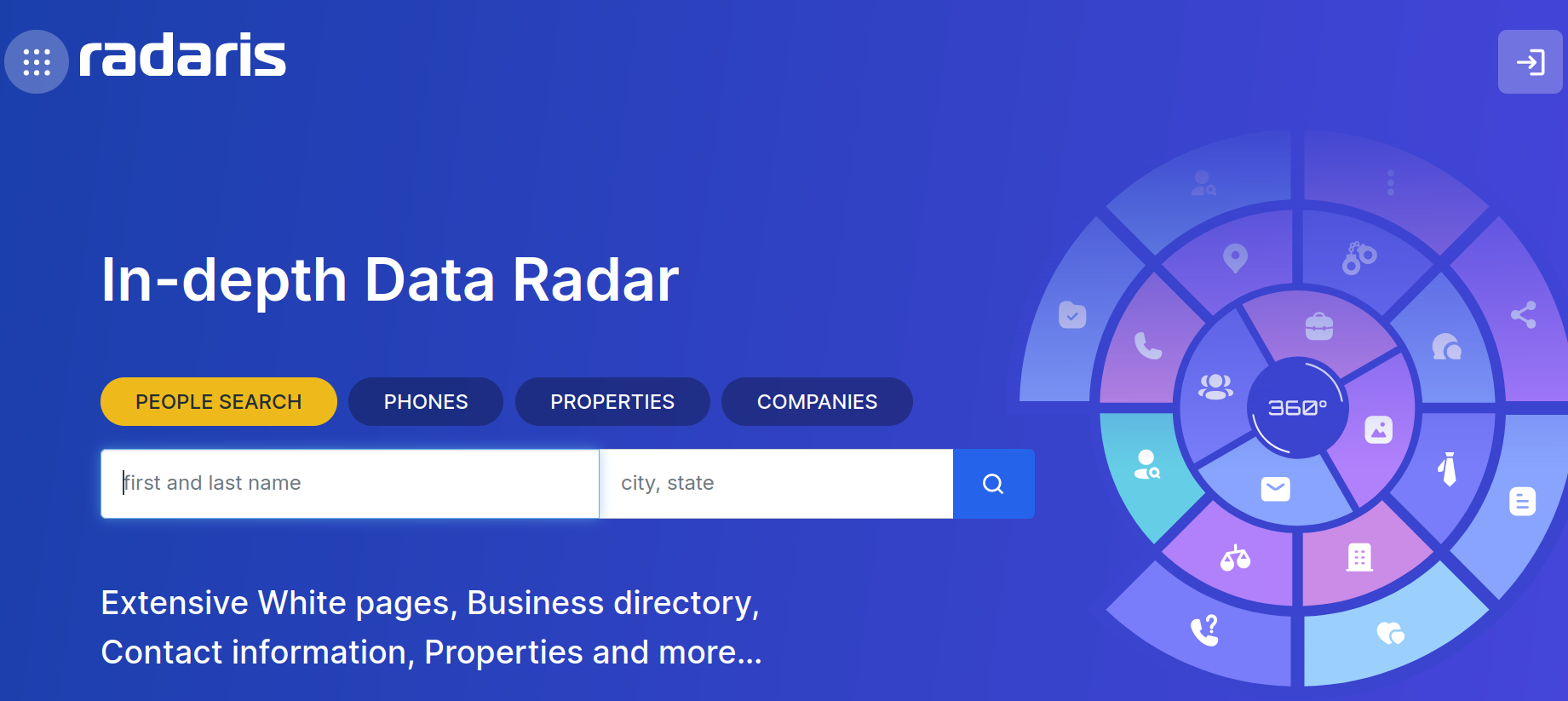
For over a decade, Radaris operated as a titan in the people-search industry, systematically ignoring removal requests, dodging accountability through complex corporate shell games, and utilizing a revolving door of offshore entities. Today, visiting radaris.com no longer yields detailed personal dossiers on millions of Americans. Instead, visitors are greeted by a stark notice detailing the court-mandated domain transfer.
This dramatic takedown highlights the potency of targeted state privacy statutes like New Jersey’s Daniel’s Law, even as the broader data broker industry mounts aggressive constitutional challenges in federal courts.
1. Main Facts: The Fall of a People-Search Empire
The downfall of Radaris centers on its flagrant violations of Daniel’s Law, a New Jersey statute designed to protect public safety. Named after Daniel Anderl—the son of U.S. District Judge Esther Salas, who was tragically murdered at her home in 2020 by an assailant who obtained the family’s home address online—the law gives state law enforcement officials, judicial personnel, and government workers the absolute right to have their personal data scrubbed from commercial databases. It imposes steep financial penalties of $1,000 per violation on companies that ignore removal requests.
When data broker aggregator Atlas Data Privacy Corp targeted Radaris for failing to comply, the company relied on its traditional playbook: stonewalling, legal evasion, and jurisdictional gymnastics. Faced with persistent obstruction and refusal to comply with discovery orders, the presiding judge ordered the forfeiture of radaris.com to the plaintiffs.
Beyond Radaris.com itself, the New Jersey court has transferred a total of 14 domains associated with the enterprise. The seizure effectively short-circuits a machine that generated hundreds of thousands of dollars monthly by indexing and monetizing public records, exposing the fragile infrastructure underlying the multi-billion-dollar people-search industry.
2. Chronology of a Corporate Shell Game
To understand how Radaris operated for so long with impunity, one must trace a decade-long trail of corporate obfuscation, investigative journalism, and legal maneuvering.
- 2017: Radaris defaulted in a class-action lawsuit (
Huebner v. Radaris, LLC), resulting in a $7.5 million default judgment. When plaintiffs attempted to collect, the court ordered the transfer ofradaris.comvia Verisign. Boston Law Group attorney Val Gurvits intervened, successfully appealing the order on due process grounds by arguing that the true owner was a Cyprus-based company called Bitseller Expert Limited. The domain transfer was halted, and plaintiffs did not refile. - October 2020: The operational control of Radaris shifted away from Bitseller to Andtop Company, an entity newly incorporated in the Marshall Islands.
- February 2024: Atlas Data Privacy Corp filed a fresh lawsuit against Radaris under Daniel’s Law.
- March 2024: KrebsOnSecurity published a sweeping investigative deep-dive into the co-founders of Radaris: Igor and Dmitry (Dan) Lubarsky, Russian-born brothers residing in Massachusetts. The brothers operated a vast network of people-search engines alongside Russian-language dating and affiliate platforms.
- Spring 2024: Attorneys for the Lubarsky brothers threatened a defamation lawsuit unless the KrebsOnSecurity exposés were retracted and an apology issued, falsely claiming the true owners were Ukrainians living in Ukraine. KrebsOnSecurity countered by unmasking how the brothers utilized a fictitious CEO named “Gary Norden” to pitch investors and manage operations, a fact later admitted by attorney Val Gurvits.
- June 2025: Atlas re-filed and dramatically expanded its lawsuit, sweeping in dozens of sister entities tied to the Radaris network.
- August 26, 2025: Following repeated failures by the defendants to mount a substantive defense, the New Jersey court ruled in favor of the plaintiffs, triggering the forfeiture and transfer of
radaris.comand its sister properties.
3. Supporting Data: Uncovering the Surveillance Machine
During the litigation, Atlas reportedly obtained more than 10,000 internal emails, financial documents, and operational records. These documents pulled back the curtain on the sprawling corporate web used by the Lubarsky brothers to insulate themselves from liability.
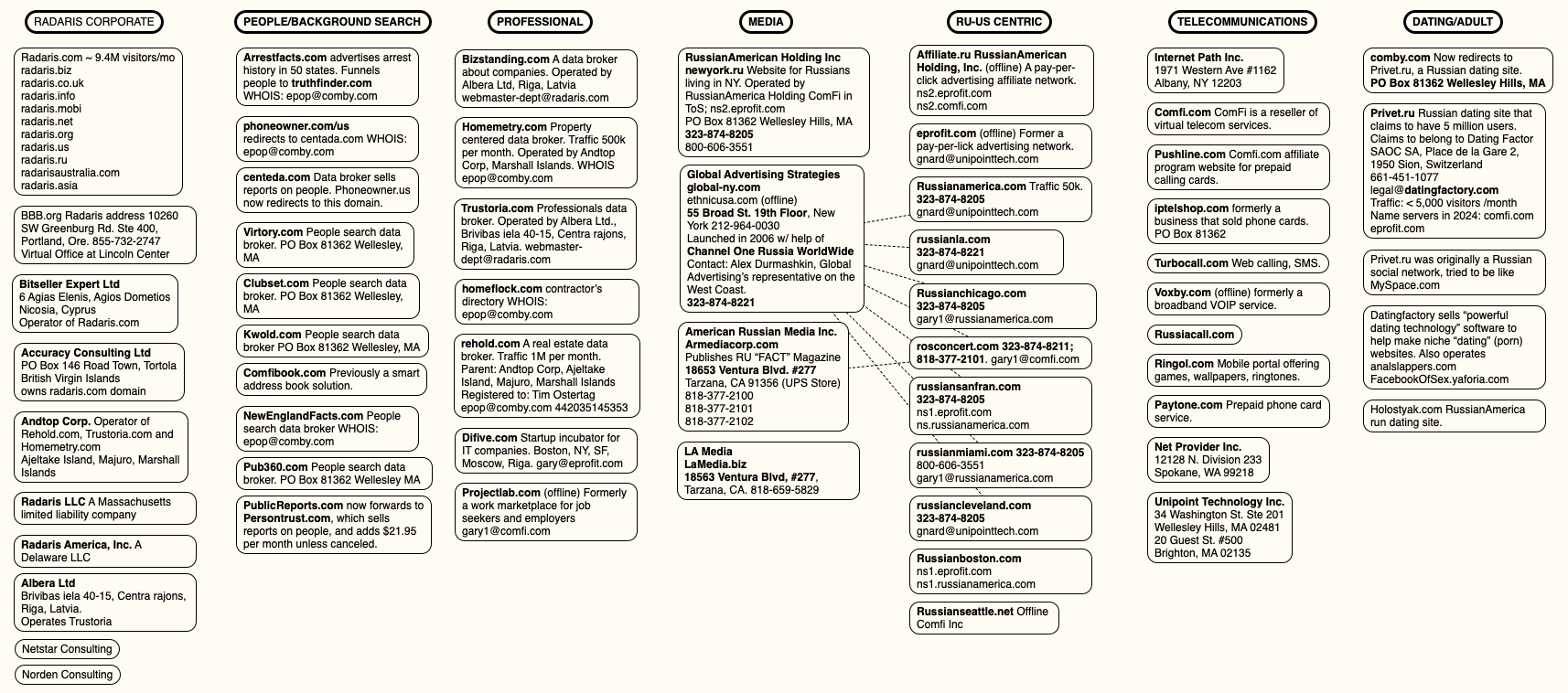
The records established that dozens of seemingly independent corporate fronts—including Radaris America, Inc., Bitseller Expert Limited, Digital Orbit Corp, Core Solutions Group Inc., Lucky Solutions Inc., Virtura Corp, Veripages Inc., Nuform Solutions Inc., Growth Data Advisors Inc., and Property Experts, Inc.—were in reality a single monolithic operation. Administered by a core group of three or four individuals operating out of the Boston area, these entities shared bank accounts, payment processors, virtual office addresses, and technical infrastructure routed through the difive.com mail domain (and its successors like centerex.com, scienteco.com, and pub360.com).
Financial Footprint and Industry Interlocks
Internal communications revealed lucrative revenue streams:
- Radaris.com pulled in roughly $42,000 per month.
- Veripages.com generated approximately $45,000 monthly through partnerships with the Lifetime Value Company (the parent of PeopleLooker, PeopleSmart, NumberGuru, and auto-history tool Bumper).
- The Radaris network raked in an additional $25,000 monthly via partnerships with Onerep, a privacy-washing service whose founder was previously exposed by journalists for concurrently launching competing people-search sites (such as Nuwber).
Matt Adkisson, CEO of Atlas, described the defense strategy as an "island-hopping phase." Whenever legal pressure mounted in one jurisdiction, terms of service were quietly updated to transfer ownership to newly minted shell entities in tax havens like the Marshall Islands, the British Virgin Islands, or the Seychelles—companies that investigators frequently discovered did not legally exist.
4. Official Responses and Legal Defense
As the enforcement actions took effect, legal representation for the Radaris ecosystem shifted. Attorney Val Gurvits stepped back, yielding the file to Victor Worms.
Worms challenged the legitimacy of the proceedings, arguing that the New Jersey court erred by issuing a default judgment against a domain name rather than a recognized legal person.

"We have made a motion to vacate that default judgment on the grounds that it is void since a non-entity has no legal capacity to sue or be sued," Worms stated in correspondence regarding the case. "We also intend to pursue all appropriate appeals because we believe the transfer of Radaris.com amounts to a forfeiture in violation of various constitutional principles."
Conversely, plaintiffs’ counsel expressed satisfaction that persistence had finally overcome a decade of procedural delay tactics. Raj Parikh, a partner at PEM Law in New Jersey representing Atlas, noted that Radaris historically won through sheer attrition.
"Plaintiffs’ attorneys tired of the procedural games and just gave up," Parikh remarked. "That strategy worked for a decade, and it probably would have worked in this case too… But we were acutely aware of the threat this website posed to law enforcement officers and other public officials in New Jersey, and decided early on to commit whatever time and resources were necessary to remove that threat."
5. Broader Implications: Daniel’s Law and the Future of Privacy
While the seizure of Radaris.com is a historic victory for privacy advocates, it occurs against a backdrop of fierce legal uncertainty regarding the constitutionality of Daniel’s Law itself.
Constitutional Challenges and State Statutes
Emboldened by the New Jersey statute, at least 14 other states have introduced or passed similar legislation. However, the data broker industry has pushed back aggressively. Roughly 70 lawsuits filed by Atlas have been moved to federal court, with data brokers arguing that Daniel’s Law infringes upon First Amendment protections by restricting the publication of truthful information derived from public records.
The U.S. Court of Appeals for the Third Circuit is currently weighing these constitutional arguments, with legal scholars anticipating the dispute will ultimately reach the U.S. Supreme Court. Compounding these hurdles, a federal district court ruled West Virginia’s version of Daniel’s Law facially unconstitutional under the First Amendment in August 2025.
The Structural Failure of U.S. Federal Privacy Laws
Privacy expert Justin Sherman, author of the upcoming book The Middlemen, emphasizes that targeted state laws—while impactful—are merely Band-Aids on a gushing wound. According to Sherman, the people-search and data-scraping industries will continue to thrive unless Congress passes comprehensive federal data protection legislation fit for the 21st century.
State-level privacy laws routinely carve out sweeping exemptions for records deemed "public" or "government-held," including:
- Voter registration rolls
- Property deeds and tax filings
- Marriage and divorce certificates
- Motor vehicle and driver’s license databases
- Court dockets, criminal records, and bankruptcy filings
Furthermore, the unchecked appetite for data collection extends far beyond people-search brokers. For example, while 25 states now mandate age-verification checks for online adult content—forcing citizens to upload government-issued IDs—there are no federal guardrails governing how identity-verification firms store, utilize, or monetize that harvested data. A stark reminder of this vulnerability occurred with the massive breach at IDScan.net, which exposed the driver’s licenses of over 153 million Americans on the dark web.
"The average person can look at Daniel’s Law and have a perfectly normal reaction, which is that everyone should be covered, not just police and judges," Sherman noted. "But we don’t need more wake-up calls. We’ve had eight million wake-up calls already on the need for better privacy laws. The lack of comprehensive federal privacy law is not for a lack of knowledge, and anyone claiming otherwise is either not reading the news or kidding themselves."
For now, the silencing of Radaris.com stands as a monumentally disruptive precedent: proof that persistent, well-funded legal action can puncture the offshore shields of the data broker underworld. Yet, until structural federal reform arrives, the vast surveillance economy will continue to adapt, finding new jurisdictions and legal loopholes to monetize the private lives of ordinary citizens.