Mastering Functional Testing: A Comprehensive Guide to Software Quality Assurance, Methodologies, and Automation Strategies
In the fast-paced ecosystem of modern software development, ensuring that applications perform precisely as intended is the baseline requirement for market survival. As digital transformation accelerates across global enterprises, the demand for rigorous, structured quality assurance has never been more pronounced. At the core of this discipline lies functional testing—a foundational black-box testing methodology designed to validate software systems against functional specifications and business requirements.
This comprehensive guide explores the core tenets of functional testing, its diverse methodologies, advanced techniques, and the strategic integration of automation to optimize software delivery pipelines.
Main Facts: Defining Functional Testing in the SDLC
Functional testing is a type of black-box testing—meaning the internal system architecture, code structure, and implementation details are hidden from the tester—focused entirely on verifying that an application’s outputs align with expected inputs and predetermined specifications.
The primary objective is to confirm that the software behaves according to functional requirements, user stories, and business logic. These requirements dictate what an end-user is permitted to do and establish clear benchmarks for acceptable system behavior.

In the broader context of the Software Development Life Cycle (SDLC), functional testing acts as the gatekeeper of core product value. While non-functional testing evaluates how well a system performs (focusing on metrics like speed, scalability, and security), functional testing validates what the system actually does.
Chronology: The Evolution of Testing in Software Development
The integration of testing into software engineering has undergone a profound evolution over the last few decades, shifting from an afterthought at the end of the development cycle to a continuous, integrated practice.
- Early Development Era (Unit & Ad-hoc Testing): Initially, testing was largely informal. Developers wrote basic code units and verified them manually, leading to high rates of defect escape into production environments.
- The Rise of Formalized Quality Assurance: As applications grew in complexity, the need for dedicated QA teams emerged. The waterfall model introduced distinct testing phases occurring only after coding was complete.
- Agile and DevOps Transformation: Modern software engineering demands continuous testing. Functional testing is no longer isolated to the end of a cycle; instead, it is integrated into continuous integration/continuous deployment (CI/CD) pipelines, occurring iteratively across sprints.
- The Automation Revolution: With the advent of complex web and mobile architectures, manual execution alone became insufficient. Organizations increasingly adopted functional test automation frameworks (such as Selenium, UFT, and Ranorex) to handle regression testing and ensure rapid, reliable build deployments.
Supporting Data: Types and Classifications of Functional Testing
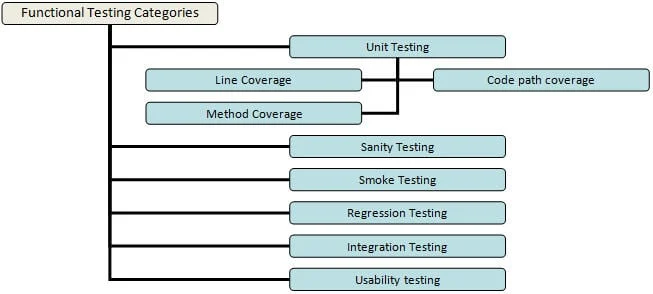
Functional testing is not a monolithic activity; rather, it encompasses a wide spectrum of specialized testing types, each deployed at specific stages of the development lifecycle.
1. Unit Testing
Typically performed by developers, unit testing involves writing isolated code snippets to validate individual methods or functions. Effective unit testing relies heavily on code coverage metrics, specifically:

- Line Coverage: Ensuring every executable line of code has been executed.
- Code Path Coverage: Verifying that all possible decision paths through the code have been tested.
- Method Coverage: Confirming that every defined method has been invoked and tested.
2. Smoke and Sanity Testing
- Smoke Testing (Build Verification): Executed immediately after a new build is released to confirm basic system stability. If the smoke test fails, the build is rejected.
- Sanity Testing: Performed after a minor bug fix or minor update to verify that specific, vital functionalities continue to work properly without unintended side effects.
3. Integration Testing
Modern applications rely on multiple functional modules. While individual modules may operate perfectly in isolation, integration testing ensures they function harmoniously when combined to execute end-to-end user scenarios.
4. Regression Testing
Whenever new code, enhancements, or bug fixes are introduced, regression tests are executed to ensure that existing functionalities remain stable and have not been broken by recent changes. While comprehensive, regression suites are optimized to balance exhaustive coverage with execution speed.
5. System and End-to-End Testing
System testing verifies the complete, integrated software product against all specified requirements. End-to-end testing takes this a step further by simulating real-world user journeys across the entire system, incorporating both functional and non-functional dependencies.
6. Usability and Beta Testing
Exposing the product to actual users in a production-like environment helps evaluate user comfort, intuitiveness, and overall satisfaction, serving as the final qualitative check before widespread deployment.

Official Perspectives: Industry Approaches and Practical Use Cases
To understand how functional testing is applied in practice, consider an enterprise scenario: an online Human Resources Management System (HRMS) portal.
The HRMS Portal Use Case
On the login interface, users interact with two text fields (Username and Password) and two operational buttons (Login and Cancel).
- User ID Specifications: Must be between 6 and 10 characters long, containing alphanumeric characters (0-9, a-z, A-Z) and limited special characters (underscore, period, hyphen). It cannot be left blank and must begin with a letter or a number, not a special character.
- Password Specifications: Must be between 6 and 8 characters long, accepting any standard numbers, letters, and special characters, and cannot be left blank.
Quality Assurance teams divide their approach into two primary paradigms:
- Positive Testing (Happy Path Scenarios): Validates that the system operates correctly under expected, valid inputs (e.g., entering a valid 8-character alphanumeric username and a compliant 7-character password).
- Negative Testing: Ensures the system gracefully handles unexpected, invalid, or malicious data (e.g., entering a username with 5 characters or inserting forbidden special characters at the leading position).
Key Functional Testing Techniques
To optimize coverage without falling into the trap of exhaustive, time-prohibitive testing, QA professionals employ advanced test design techniques:

- Equivalence Partitioning: Segmenting test data into classes where all members are expected to behave similarly. If one condition in a partition passes or fails, the entire class is inferred to do the same.
- Boundary Value Analysis (BVA): Testing limits of application data (e.g., testing inputs at the exact threshold of 5, 6, 10, and 11 characters for the HRMS username field).
- Decision-Based Testing: Mapping system outcomes directly to specific business rules and conditions.
- Alternate Flow Tests: Validating alternative pathways users might take to accomplish tasks outside the primary "happy path."
- Ad-hoc Testing: Unstructured, exploratory testing driven by the tester’s intuition to intentionally break the system and uncover unforeseen anomalies.
Implications: The Role and Limitations of Functional Test Automation
While manual testing provides crucial human intuition, the sheer volume of modern software releases makes automation indispensable. Functional test automation reduces human error, accelerates execution cycles, and prevents bug slippage. However, organizations must approach automation strategically.
Strategic Considerations for Test Automation
- Selecting the Right Tool: The market offers diverse automation tools—ranging from open-source powerhouses like Selenium and Sahi to enterprise solutions like UFT and Ranorex. Selection must be driven by technical requirements, team skill sets, and budget constraints.
- Targeting the Right Test Cases: Not everything should be automated. Tests that require frequent manual configuration or are subject to constant UI layout churn are poor candidates for automation. Stable, repetitive regression tests yield the highest return on investment.
- Dedicated Automation Teams: Imposing automation responsibilities across an entire manual QA team often leads to friction and mixed results. Establishing dedicated automation engineers ensures robust, scalable testing frameworks.
- Data-Driven Frameworks: Automated scripts should decouple test logic from test data, pulling inputs dynamically from external sources such as databases, XML files, or properties files to maximize reusability.
- UI Resiliency: Test scripts must be designed to withstand minor user interface modifications to prevent mass script failures triggered by simple element locator changes.
Limitations of Functional Testing
Despite its critical importance, functional testing has inherent boundaries. By design, it validates what a system does, but it remains blind to how well the system performs under stress. Metrics such as response latency, system throughput, memory utilization, and server scalability fall outside its scope. Consequently, high-quality software releases require a harmonious balance of both functional and non-functional testing methodologies.
Conclusion
Functional testing remains the bedrock of software quality assurance. By rigorously verifying that applications conform to specified business requirements through structured techniques—ranging from equivalence partitioning to boundary value analysis—organizations can significantly mitigate the risk of defect leakage.
When thoughtfully combined with modern test automation frameworks and paired with non-functional evaluations, functional testing empowers engineering teams to deliver robust, reliable, and user-centric software solutions in an increasingly competitive digital landscape.