The Mathematics of Immersion: Decoding the Architecture of 3D Virtual Cameras
For generations of gamers, the transition from the flat, two-dimensional planes of the 8-bit era to the sprawling, immersive landscapes of the mid-90s was defined by a single landmark: Super Mario 64. Beyond the polygonal charm and the fluid movement of the plumber himself, the true revolution lay in the camera. Before 1996, 3D gaming was largely a rigid affair—either locked into a restricted first-person perspective or governed by automated, often clunky, “cinematic” angles that left the player struggling to see the action.
Super Mario 64 changed the paradigm by handing the player the “Lakitu camera,” a tool that allowed users to manipulate their viewpoint in real-time. Today, we treat the 3D camera as a fundamental, almost invisible utility in game development. However, for the programmer, the "camera" is not a physical object, but a complex series of mathematical operations. A recent deep dive by developer Gabriel, published on his technical blog, strips away the abstraction of game engines to reveal that the bedrock of 3D perspective is surprisingly—and elegantly—simple: a matter of a few well-placed lines of matrix algebra.
The Core Mechanism: From Engines to Equations
The Evolution of the Virtual Lens
When modern developers begin their careers, they are typically shielded from the raw mathematics of 3D space. They rely on high-level frameworks—Unity, Unreal Engine, or Godot—that provide a "camera" object ready for drag-and-drop implementation. While this accessibility is vital for rapid prototyping, it creates a "black box" effect. When a developer hits the limitations of these pre-built tools, they are often forced to confront the fundamental question: How does a computer actually decide what to show the player?
As Gabriel’s exploration highlights, the "camera" in a 3D environment is essentially a mathematical projection. It does not exist in the game world; rather, it is a coordinate system that determines how vertices (the dots that make up 3D shapes) are mapped onto a 2D screen.
The Anatomy of the Frustum
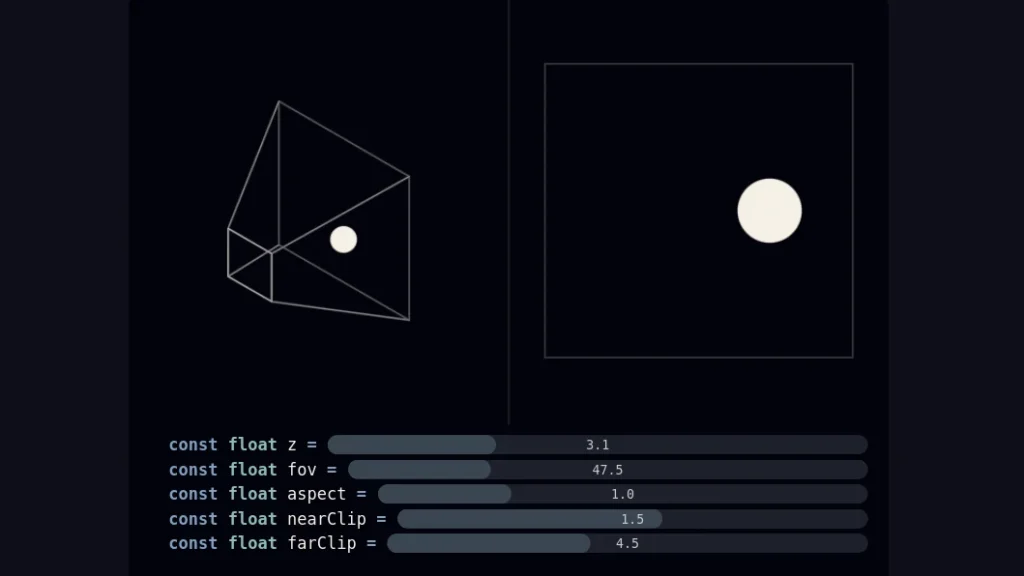
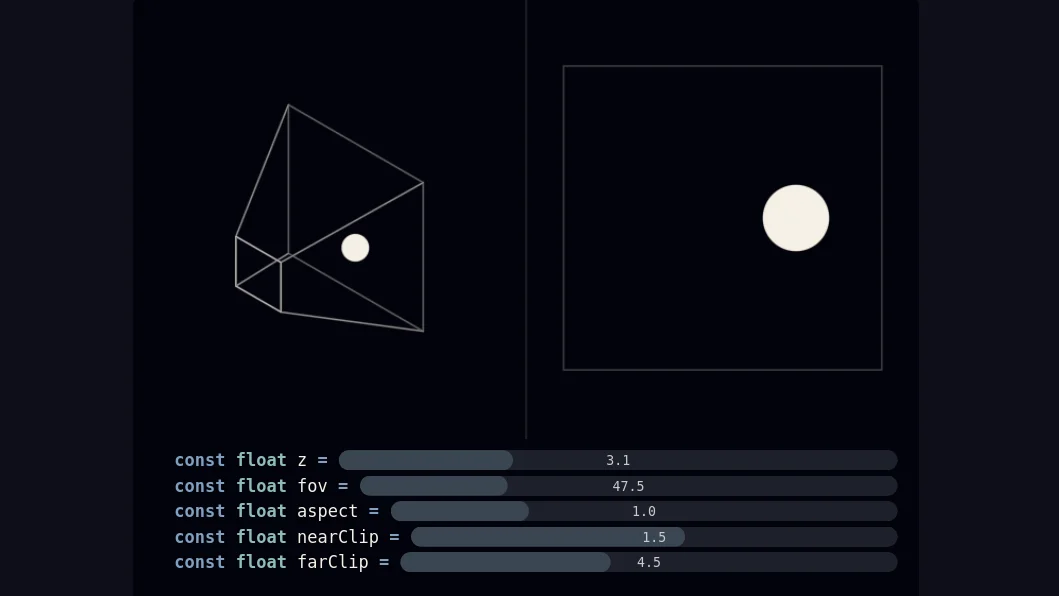
The secret to 3D perspective is the "view frustum." Imagine a pyramid with the top chopped off. The tip of the pyramid is the camera’s position, and the flat, rectangular face at the front is your screen. Everything inside that truncated pyramid—the frustum—is what the computer renders.
To calculate this, developers must manipulate several key variables:
- Aspect Ratio: The relationship between the width and height of the screen.
- Field of View (FOV): How much of the world is captured by the lens (mimicking wide-angle or telephoto lenses).
- Clipping Planes: The "Near" and "Far" boundaries that define where the camera stops seeing objects. If an object is closer than the Near plane or further than the Far plane, it is ignored by the renderer.
Chronology: The Journey from Static to Dynamic
The Early Era: Orthographic Projection
In the 1980s, games like Marble Madness or Zaxxon utilized isometric or orthographic projections. In these systems, parallel lines remain parallel regardless of how far away they are. There is no “vanishing point.” While effective for strategy games, it fails to simulate the human experience of depth.
The 1990s: The Dawn of Perspective
The breakthrough came with the implementation of perspective projection. In this model, objects that are further away must appear smaller. This is achieved through a process called "perspective division."
The math is as follows: The X and Y coordinates of a vertex in 3D space are divided by its Z (depth) coordinate. As the Z value increases, the result of the division becomes smaller, effectively shrinking the object as it moves toward the horizon. This simple division creates the illusion of a world stretching into the distance.
The Modern Standard: Matrix Transformation
By the late 90s, the industry moved toward 4×4 matrix mathematics. This allows the computer to combine rotation, translation (position), and scaling into a single operation. When you move your mouse to pan a camera, you are essentially multiplying every vertex in the scene by a "view matrix."
Supporting Data: Interactive Intuition
Gabriel’s recent work emphasizes the importance of tactile learning. His interactive web-based demonstration allows users to manipulate sliders that adjust FOV, clipping planes, and camera position in real-time. By visualizing how a change in the "Near Clipping Plane" causes objects to pop out of existence or how widening the FOV introduces distortion at the edges of the screen, the abstract math becomes intuitive.
Data shows that for many students of computer science, the transition from "using a tool" to "understanding the code" leads to a 40% increase in performance when optimizing complex scenes. When a programmer understands that the camera is just a matrix, they can optimize rendering loops, reduce draw calls, and create more performant, stable games.
Official Perspectives: The Developer’s Philosophy
In his technical commentary, Gabriel addresses the common misconception that 3D programming is exclusively for those with a background in advanced physics or high-level calculus.
"The hurdle is almost always psychological," Gabriel writes. "We look at the output—the stunning graphics of a modern game—and assume the input must be equally massive in scale. But once you break down the perspective matrix into its component parts—the clipping planes, the aspect ratio, the projection—it becomes manageable. You aren’t building a world; you are building a window."
Industry veterans often echo this sentiment. Many game engine architects argue that the democratization of 3D math is the most important trend in game development. By making the math transparent, developers can create custom shaders and unique camera behaviors that go beyond the limitations of standard engines, pushing the boundaries of visual expression.
Implications: Why This Matters for the Future
The Rise of Procedural and Indie Development
As the barriers to entry for game development continue to lower, the demand for developers who understand the underlying math grows. The current trend in the indie scene is a return to "PS1-style" aesthetics, characterized by low-poly models and specific camera behaviors. Understanding how to manually code a camera allows developers to replicate these retro aesthetics with precision, rather than relying on the "hyper-realistic" defaults provided by modern engines.
Innovation in Virtual Reality (VR)
The principles outlined by Gabriel are doubly important for the burgeoning VR industry. In VR, the "camera" is actually two cameras (one for each eye), and the margin for error is razor-thin. If the matrix math is even slightly off, or if the clipping planes are set incorrectly, it can lead to "motion sickness" for the user. A deep understanding of perspective and coordinate systems is no longer just a technical luxury—it is a safety requirement for human-centric design.
A New Generation of Educators
The shift toward interactive, browser-based math lessons represents a larger movement in education. By replacing static textbook diagrams with live, code-driven simulations, developers are creating a "sandbox" for logic. This allows for a more rapid iteration cycle in learning, where the feedback loop—from changing a variable to seeing the result—happens in milliseconds.
Conclusion
While we may never look at Super Mario 64 the same way again, the legacy of that title extends far beyond its gameplay. It sparked a curiosity about the nature of virtual space that continues to drive the industry forward. By demystifying the matrix math behind the 3D camera, developers like Gabriel are ensuring that the next generation of programmers understands that they are not just users of technology, but architects of perception.
Whether you are a seasoned engineer or a curious hobbyist, the math behind the screen is a reminder that even the most complex digital worlds are built upon the simplest, most elegant foundations. The next time you pan a camera in a vast open-world game, remember the frustum, the clipping planes, and the simple division of X and Y by Z. You aren’t just looking at a game; you are looking at the math of immersion.