
The 21-Gram Horizon: How Maker Science is Democratizing Space Exploration with Open-Source Femtosatellites
By Global Technology & Aerospace Desk
Published: October 2023
Main Facts: The Rise of the Ping-Pong-Ball Satellite
In the rapidly evolving landscape of aerospace engineering, the barrier to entry has traditionally been measured in millions of dollars, specialized clean rooms, and teams of PhD-level physicists. Today, however, that paradigm is shifting dramatically toward the workbench of the garage hobbyist and the university student.
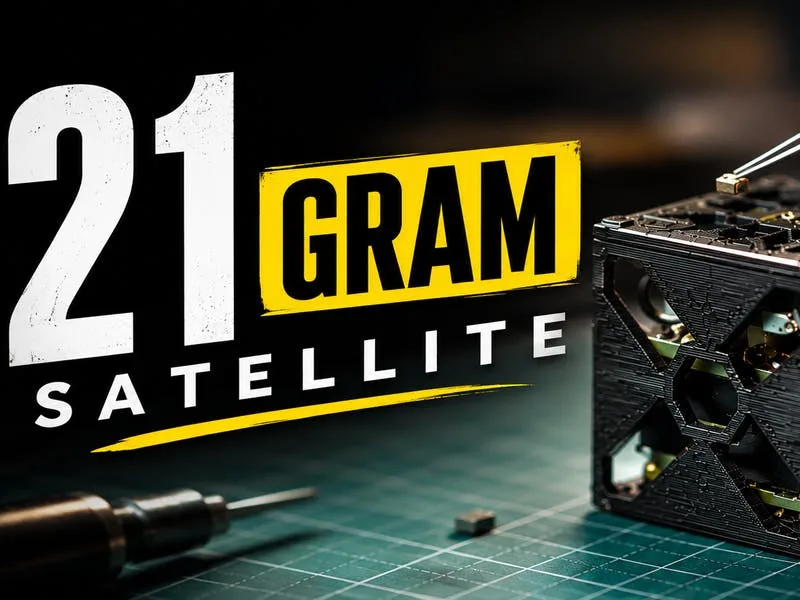
The Maker Science project has recently unveiled a fully functional, recoverable experimental femtosatellite weighing a mere 21 grams—roughly the weight of a standard table tennis ball. Designated as an open-source initiative, this hardware-software hybrid demonstrates that complex atmospheric and inertial data collection during high-altitude or sub-orbital flights can be achieved using off-the-shelf commercial components costing less than a standard restaurant meal.
Categorized strictly within the femtosatellite domain—a classification reserved for spacecraft weighing under 100 grams—this prototype sits comfortably at the lighter end of the scale. It is not designed to achieve orbital velocity or spend years in the harsh vacuum of space. Instead, it is engineered for sub-orbital, high-altitude balloon, drone, or small model rocket deployment. After enduring the stresses of flight, the capsule is physically recovered, and its onboard flash memory is queried to yield a precise dataset detailing atmospheric pressures, humidity, ambient temperatures, and complex multi-axis motion vectors.
At the core of this tiny marvel are three primary off-the-shelf hardware components:
- The ESP32-C3 Super Mini Microcontroller: Acting as the central processing unit and data logger, this compact board balances computing power with ultra-low power consumption.
- The BME680 Environmental Sensor: A high-precision sensor responsible for monitoring temperature, barometric pressure, relative humidity, and indoor air quality parameters.
- The BMI323 Inertial Measurement Unit (IMU): A sophisticated low-power motion tracking sensor that detects acceleration, orientation, and rotational dynamics.
By integrating these components with accessible programming environments like the Arduino IDE, Maker Science has laid out a blueprint that fundamentally alters how enthusiasts, educators, and independent researchers can interact with near-space environments.
Chronology: From Concept to Launchpad
The development of the 21-gram femtosatellite did not happen in a vacuum. It represents the culmination of years of miniaturization trends in consumer electronics, driven largely by the Internet of Things (IoT) revolution and wearable tech sectors.
Phase One: Conceptualization and Component Selection (Early Development)
The project began as an inquiry into how far consumer-grade micro-machined electromechanical systems (MEMS) could be pushed. Traditional sounding rockets and high-altitude weather balloons often require heavy payload housings, expensive telemetry transmitters, and redundant power supplies. Maker Science engineers asked a foundational question: What if the payload was scaled down to the absolute minimum required to record meaningful physical phenomena?
The team selected the ESP32-C3 Super Mini because of its RISC-V architecture, small footprint, and built-in wireless capabilities. For environmental metrics, the BME680 was chosen due to its stellar reputation in weather monitoring and multi-parameter sensing. To capture the violent roll, pitch, and yaw dynamics of a model rocket launch or a drone drop, the BMI323 inertial sensor was integrated for its high sampling rates and low-profile packaging.
Phase Two: Prototyping and Firmware Integration
Once the hardware schema was established, the software architecture was developed using the Arduino IDE, ensuring maximum accessibility for global makers. Writing the firmware required balancing two conflicting priorities: maximizing data collection frequency while minimizing power draw, given the strict limitations of a miniature battery.
The team crafted sketches—the term used for Arduino programs—to poll the BME680 and BMI323 at regular intervals, writing the output directly to the ESP32-C3’s internal non-volatile storage. Rigorous bench-top testing followed, involving thermal chambers and manual movement tests to calibrate the sensors and verify that data corruption would not occur under sudden physical shocks.
Phase Three: Ground Testing and Calibration
Before any physical deployment, the prototype underwent extensive ground-based validation. Engineers subjected the 21-gram assembly to controlled drops, rapid temperature shifts, and vibrational tests simulating rocket engine ignition.
Calibration of the BMI323 was particularly critical. Because the sensor measures acceleration and angular velocity, any offset or baseline drift could skew the trajectory analysis. By running baseline tests with known physical movements, the development team verified that the sensor data mirrored real-world physics with remarkable fidelity.
Phase Four: Public Release and Open-Sourcing
With the prototype fully validated, Maker Science uploaded the entire hardware schematic, parts list, and firmware repository to GitHub (https://github.com/makerscienceofficial/Yeti_SAT1). By making the project completely open-source, the creators shifted from a closed development cycle to a global collaborative framework, inviting independent developers to print, solder, program, and fly their own iterations of the 21-gram satellite.
Supporting Data: Technical Specifications and Limitations
To truly appreciate the engineering constraints of a 21-gram femtosatellite, one must examine the precise metrics, operational envelopes, and physical trade-offs inherent in such a hyper-minimized design.
Hardware Breakdown and Power Dynamics
| Component | Function | Power Consumption (Approx.) | Weight Contribution |
|---|---|---|---|
| ESP32-C3 Super Mini | Processing & Data Storage | ~5mA – 40mA (Active) | ~2g (including PCB) |
| BME680 Sensor | Environmental Metrics | ~3.6µA (at 1Hz) | < 1g |
| BMI323 IMU | Motion & Orientation | ~700µA (Normal Mode) | < 1g |
| Power Supply (LiPo/Coin) | Energy Source | Varies | ~5g – 10g |
| Chassis / Protective Shell | Structural Integrity | 0mA | ~5g – 8g |
| Total Payload | Complete System | Optimized for < 2 Hours | 21 Grams |
The Physics of Micro-Payloads
Operating a spacecraft that weighs roughly the same as a slice of bread introduces unique physical advantages and distinct limitations.
On the positive side, the low mass means kinetic energy upon landing is minimal. Unlike heavier payloads that require complex parachute deployment systems or heat shields to prevent catastrophic impact damage, a 21-gram satellite has a remarkably low terminal velocity. It can safely descend through the atmosphere and land in brush, fields, or even urban environments without posing a danger to persons or property on the ground. Furthermore, launching a 21-gram payload requires very little thrust. Small amateur rocketry clubs or standard commercial drones can easily lift the device to altitudes where meaningful atmospheric data can be gathered.
However, the limitations are equally stark:
- Power Limitations: The physical volume of the satellite precludes the inclusion of large-scale lithium-ion battery banks or expansive solar panels. Missions must be short-duration—typically lasting from a few minutes to a couple of hours.
- Data Transmission vs. Data Logging: Due to weight constraints and power budgets, long-range radio transmitters (such as high-powered VHF/UHF or satellite transceivers) are generally omitted. Instead, the satellite relies on onboard data logging. The data cannot be monitored in real-time during flight; it must be retrieved physically after landing and downloaded via USB or wireless protocols to a ground station dashboard.
- Environmental Exposure: The miniature chassis offers limited physical protection against extreme thermal shocks or moisture ingress unless specifically potted in protective resin, which adds unwanted weight.
Official Responses and Expert Commentary
The release of the Maker Science femtosatellite project has generated considerable discussion within amateur rocketry, educational technology, and aerospace hobbyist communities.
Dr. Elena Vance, an aerospace engineer and academic advisor specializing in micro-satellite architectures, noted the profound educational implications of the project:
"When I started in aerospace, building a satellite meant securing hundreds of thousands of dollars and waiting years for launch manifest slots. Projects like this shift the paradigm from passive learning to active experimentation. Students aren’t just reading about atmospheric pressure profiles; they are soldering the chip that records it, launching it into the sky, and analyzing the raw telemetry themselves."
Meanwhile, Marcus Thorne, a lead contributor to open-source hardware repositories and amateur rocketry enthusiast, emphasized the democratization aspect:
"The genius of the ESP32-C3 Super Mini board in this context is that it bridges the gap between complex embedded systems and accessible tooling. By utilizing the Arduino IDE, Maker Science has ensured that a high school sophomore with basic coding skills can understand, modify, and improve the firmware. You don’t need to learn proprietary, high-cost aerospace operating systems to get into space tech anymore."
Maker Science representatives have also underscored that the project is intended to be a starting point rather than a finished commercial product. In statements accompanying the GitHub release, the development team highlighted that community contributions—ranging from improved power-management algorithms to custom 3D-printed aerodynamic shrouds—will dictate the future evolution of the design.
Implications: The Future of Democratized Space Exploration
The successful demonstration of a 21-gram, fully functional experimental satellite points toward a broader, transformative shift in how humanity approaches near-space research, education, and prototyping.
1. Revolutionizing STEM Education
Traditional aerospace education often suffers from high abstraction levels. Students learn theoretical orbital mechanics, fluid dynamics, and sensor integration through textbooks and computer simulations. The availability of sub-$20 components that can be assembled into a functional flight recorder changes this dynamic entirely. High schools, community colleges, and university physics departments can now incorporate genuine flight-testing modules into their curricula. Students can design an experiment, build the satellite, launch it via weather balloon or model rocket, and analyze the results within a single semester.
2. Rapid Prototyping for Commercial Aerospace
Even for professional aerospace engineers, the iterative design cycle can be slow and expensive. While a 21-gram femtosatellite cannot replicate the radiation environment of a Low Earth Orbit (LEO) satellite, it offers a rapid, low-cost platform for testing sensor accuracy, firmware stability, and power-management routines under real-world physical stress. Before committing thousands of dollars to space-grade components, engineers can test software logic and sensor behaviors in high-altitude drop tests using consumer-grade hardware architectures.
3. Environmental and Atmospheric Monitoring at Scale
Because the cost of entry is so low, researchers envision scenarios where multiple femtosatellites could be deployed simultaneously—such as dropping a cluster of 50 units across a severe weather front via drone or weather balloon. While individual units have limited data storage, a distributed network of low-cost sensors could provide high-resolution, multi-point atmospheric data mapping during phenomena like tornadoes, wildfires, or volcanic ash plumes, where sending expensive equipment is prohibitive.
4. Cultivating a Global Maker Ecosystem
The open-source nature of the Yeti_SAT1 project fosters a collaborative global community. Developers from diverse backgrounds can fork the repository, optimize the code for extreme cold performance, add GPS modules (if weight permits), or design specialized recovery parachutes. This decentralized innovation model mirrors the software industry’s open-source revolution, applying it directly to physical hardware and aerospace exploration.
Conclusion
The Maker Science 21-gram femtosatellite project proves that the final frontier is no longer exclusively the domain of sovereign space agencies and billionaire-backed corporations. By stripping away unnecessary weight, leveraging the incredible processing power and energy efficiency of modern IoT microcontrollers like the ESP32-C3, and relying on precise environmental and motion sensors (BME680 and BMI323), the project establishes a new baseline for amateur space exploration.
As hobbyists, students, and engineers download the code from GitHub, solder their own boards, and send ping-pong-ball-sized satellites into the upper atmosphere, they are doing more than just collecting data. They are rewriting the rules of access to space, proving that with ingenuity, open-source collaboration, and a bit of maker spirit, the sky is truly no longer the limit.








