
YuzukiNeko: The Tiny RISC-V Linux Development Board Bringing Rich Graphics to the Pico Form Factor
In the fast-evolving landscape of microcontrollers and single-board computers, form factor often dictates capability. For years, the ultra-compact, thumb-sized footprint pioneered by boards like the Raspberry Pi Pico has been synonymous with bare-metal microcontrollers—powerful for their size, yet fundamentally limited to running real-time operating systems (RTOS) or simple loops without memory management units (MMUs).
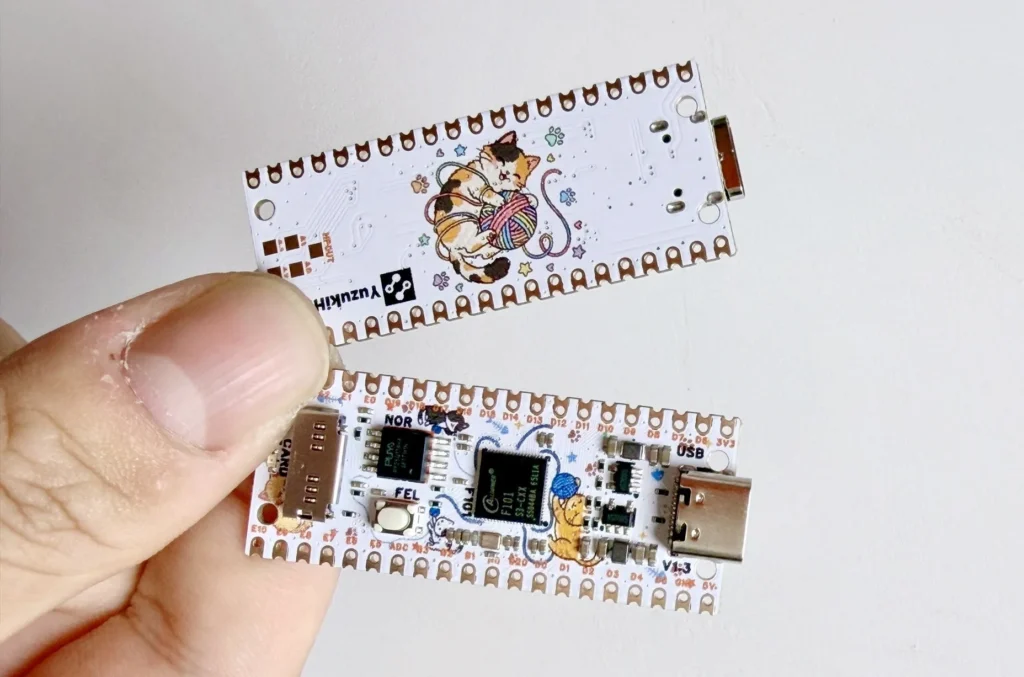
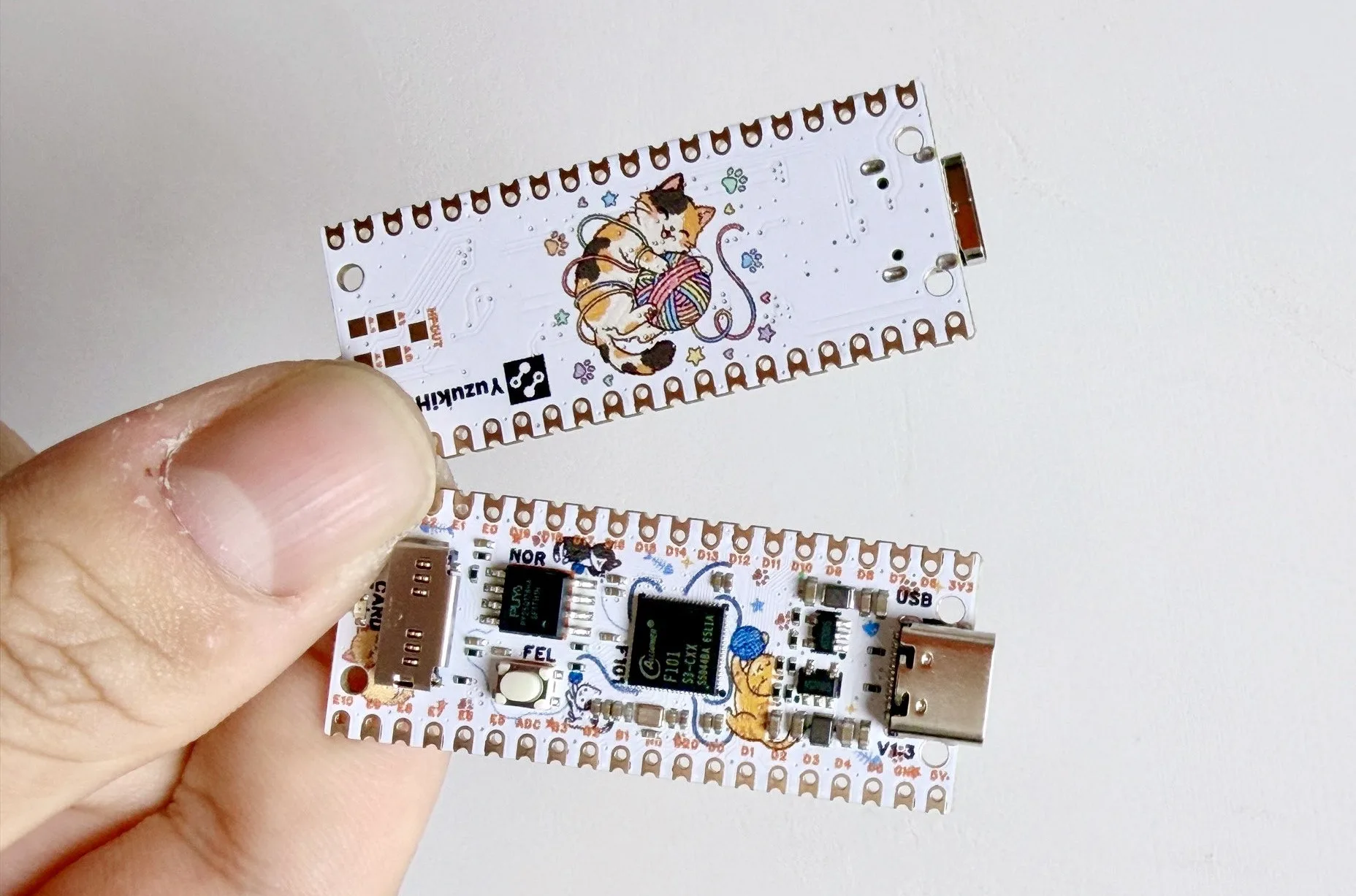
Now, developer community contributor YuzukiHD is challenging those boundaries. Enter the YuzukiNeko, a fully open-source Linux-capable development board built around the Allwinner F101 RISC-V System-on-Chip (SoC). Measuring a mere 51 x 21 mm, the YuzukiNeko packs hardware architecture usually reserved for much larger single-board computers. Featuring a dedicated XuanTie C907 RISC-V processor, onboard PSRAM, Execute-in-Place (XIP) NOR Flash, and robust display capabilities supporting RGB, LVDS, and MIPI DSI interfaces, this miniature marvel is engineered to bridge the gap between microscopic microcontrollers and full-fledged Linux application processors.
Main Facts: What is the YuzukiNeko?
At its core, the YuzukiNeko is a credit-card-fraction, Pico-styled development board designed for embedded Linux applications requiring graphical user interfaces (GUIs), multimedia handling, and flexible general-purpose input/output (GPIO) operations.
Key hardware specifications include:
- Processor: Allwinner F101S3 SoC featuring a T-Head XuanTie C907 RISC-V core clocked at 1.008 GHz.
- Cache: 32 KB L1 instruction cache and 16 KB L1 data cache.
- Memory: 16 MiB of System-in-Package (SiP) PSRAM (running at up to 252 MHz) and 16 MiB (128 Mbit) of external NOR Flash with Execute-in-Place (XIP) capabilities.
- Graphics & Display Engines: Integrated display controller capable of driving RGB888 (up to 1280×720 at 60 fps), single-link LVDS (up to 1366×768 at 60 fps), and 4-lane MIPI DSI (up to 1280×800 at 60 fps) panels.
- Multimedia Hardware Accelerators: JPEG decoding up to an astonishing 16384 x 16384 pixels, PNG decoding up to 2048 x 2048 pixels, JPEG/MJPEG encoding at 720p @ 30 fps (max 8192 x 8192), and a hardware de-interlacer supporting 720p @ 60 fps.
- Physical Dimensions: Approximately 51 x 21 mm, utilizing a compact QFN68 (7 x 7 mm) package layout for the central SoC.
- Connectivity & Expansion: USB Type-C port (handling power, data, and programming), a micro-SD card slot for expanded storage, an onboard FEL button for low-level firmware flashing, and a dual-row 2×20-pin GPIO header.
- Licensing: Fully open-source hardware and software, released under the permissive CC0 license.
Chronology: The Evolution of Open-Source RISC-V Linux Boards
The journey toward micro-sized, Linux-capable RISC-V development boards has been rapid, reflecting broader industry shifts away from proprietary ARM architectures toward open-instruction-set architectures (ISAs).
The Rise of RISC-V in Embedded Systems
For the past decade, the Allwinner ecosystem has dominated low-cost application processors, frequently powering cheap tablets, smart home devices, and hobbyist Linux boards (such as the popular Allwinner V3s or H-series chips). However, these chips typically required bulky packaging and extensive routing.
As the RISC-V ISA gained commercial momentum—championed by architectures like Alibaba’s T-Head XuanTie cores—silicon vendors began integrating these cores into smaller, highly integrated packages. The Allwinner F-series emerged as a viable contender for low-cost multimedia devices, blending low power consumption with surprisingly competent display controllers.
YuzukiHD’s Development and Open-Source Release
The YuzukiNeko project crystallized through the work of hardware designer and developer YuzukiHD, who sought to maximize the utility of the Allwinner F101 SoC within an ultra-compact footprint. Recognizing that community adoption hinges on accessibility, YuzukiHD opted to release the entire hardware and software stack as open source.
By publishing schematics, board layouts, pin configurations, and Buildroot-based Linux toolchains directly to GitHub, the project bypassed the typical closed-ecosystem bottlenecks plaguing commercial silicon launches. Developers worldwide were immediately given the blueprints required to audit, modify, and manufacture their own iterations of the board, cementing YuzukiNeko as a collaborative community venture rather than a strictly commercial product.
Supporting Data: Deep Dive Into Hardware Architecture
To truly understand why the YuzukiNeko represents a technical leap over traditional microcontrollers, one must examine its memory hierarchy, processing core, and peripheral interfacing capabilities.
The XuanTie C907 Core and Memory Subsystem
The heart of the YuzukiNeko is the XuanTie C907, an efficient RISC-V processor core implementing the RV64IMAFDCv vector-extension-capable architecture. Operating at 1.008 GHz, it easily outperforms typical 32-bit ARM Cortex-M microcontrollers found on standard Pico boards, which usually max out around 133 MHz to 250 MHz and lack memory management units capable of running full-fat Linux kernels.
To feed this processor efficiently, the YuzukiNeko integrates two critical memory components:
- SiP PSRAM: Offering 16 MiB of Pseudo-SRAM operating at 252 MHz, providing enough volatile workspace for lightweight Linux distributions, user-space applications, and networking stacks.
- NOR Flash with XIP: The 16 MiB (128 Mbit) external NOR flash supports Execute-in-Place (XIP). This allows the processor to execute code directly from the flash memory chip without needing to copy the entire instruction payload into RAM first, drastically reducing boot latency and optimizing system responsiveness.
Display and Multimedia Processing Power
What sets the YuzukiNeko apart from other low-cost Linux modules (such as the Milk-V Duo or various ESP32-S3 implementations) is its heavy investment in native display and video acceleration hardware.
Standard microcontrollers struggle to push anything beyond small SPI-driven TFT displays (like ST7735 or ILI9341 panels). In contrast, the Allwinner F101S3 SoC on the YuzukiNeko features native routing for:

- RGB888 parallel displays up to 1280 x 720 resolution at 60 frames per second.
- Single-link LVDS panels up to 1366 x 768 at 60 fps, opening the door to repurposed laptop screens and industrial HMI panels.
- 4-lane MIPI DSI interfaces up to 1280 x 800 at 60 fps, making it ideal for modern smartphone-grade LCD modules.
Furthermore, offloading tasks like JPEG and PNG decoding to dedicated hardware blocks ensures that the 1.008 GHz RISC-V core isn’t bogged down by image rendering, leaving maximum processing cycles available for user logic, GUI management, or sensor data processing.
GPIO Flexibility and Pin Multiplexing
Physical prototyping requires accessible I/O. The YuzukiNeko exposes its capabilities via a standard 2×20-pin header layout, making it drop-in compatible with a wide array of existing breakout boards, sensors, and breadboards.
Because the Allwinner SoC packs numerous peripherals into a small package, its pins are heavily multiplexed. Developers manage this complexity using pinctrl software configurations, ensuring that individual pins can be dynamically assigned to specific alternate functions (such as UART, SPI, I2C, PWM, or specialized display lines) during system initialization.
Official Responses and Developer Integration
The reception from the open-source hardware community has been overwhelmingly positive. Speaking through repository updates and developer documentation channels, YuzukiHD emphasized that the project was built to empower hobbyists and professional embedded engineers alike to experiment with low-cost RISC-V Linux silicon.
Software Ecosystem: Buildroot and Linux
Running Linux on a microcontroller-sized board requires a streamlined operating system image. To achieve this, YuzukiHD provides comprehensive support for Buildroot, a simple, efficient, and easy-to-use toolset for generating embedded Linux systems through cross-compilation.
By utilizing Buildroot, developers can construct a custom, minimal Linux kernel and root filesystem tailored precisely to the YuzukiNeko’s hardware constraints. The official GitHub repository (https://github.com/YuzukiHD/YuzukiNeko) hosts the necessary configuration files, device tree blobs (DTBs), and script files required to compile a bootable image from scratch.
Typical developer workflow instructions provided by the project include:
- Cloning the repository and setting up the Buildroot cross-compilation environment.
- Configuring the kernel target for the Allwinner F101 RISC-V architecture.
- Compiling the bootloader, kernel, and root filesystem images.
- Flashing the resulting binaries onto a micro-SD card or transferring them directly via the board’s built-in USB-C FEL download mode.
Implications: Where Does YuzukiNeko Fit in the Market?
The introduction of boards like the YuzukiNeko signals a broader shift in embedded systems design. By packing application-processor capabilities into a microcontroller footprint, it blurs the historical line dividing MCUs from single-board computers.
Comparison to the Raspberry Pi Pico Paradigm
While the Raspberry Pi Pico revolutionized physical computing by offering a dual-core ARM Cortex-M0+ chip for $4, it cannot run Linux natively due to its lack of an MMU and restricted RAM (264 KB). The YuzukiNeko addresses this limitation directly. Though it occupies a virtually identical physical footprint, it behaves like a fully functional Linux computer.
Potential Use Cases
Given its unique blend of size, processing power, and display capabilities, the YuzukiNeko is ideally positioned for several distinct applications:
- Smart Home Information Displays: Driving compact, high-resolution MIPI or LVDS touchscreens to display weather data, home automation dashboards (such as Home Assistant clients), or media playback controls.
- Compact Media Players: Leveraging its hardware JPEG/PNG decoders and audio interfaces to construct lightweight, dedicated audio/visual streaming nodes.
- Industrial HMI (Human-Machine Interface): Integrating into machinery control panels where space is at an absolute premium, yet a graphical Linux interface is required.
- Computer Vision and IoT Edge Nodes: Utilizing the RISC-V core and memory subsystems for localized data logging, simple camera monitoring, and smart sensor management.
The Future of Open-Source RISC-V Hardware
Projects like YuzukiNeko demonstrate the incredible viability of community-driven hardware design. As RISC-V architectures mature and silicon fabrication costs for small-footprint SoCs decrease, developers can increasingly expect powerful, versatile computing tools in packages no larger than a stick of gum.
For engineers, makers, and students looking to dive into RISC-V Linux development without investing in bulky developer kits, the YuzukiNeko offers an accessible, highly capable entry point into the next generation of open-source computing.
To explore the hardware schematics, build instructions, and source code, visit the official YuzukiHD GitHub Repository.








