
The Silent Breakdown: How AI-Generated Translations Are Breaking Mobile Apps—And How Developers Are Fighting Back
SAN FRANCISCO — In the modern era of rapid software deployment, artificial intelligence has become an indispensable silent partner for development teams worldwide. From generating boilerplate code to translating user interfaces into dozens of languages, AI tools like ChatGPT, Claude, and integrated editor coding agents have drastically accelerated the software lifecycle. A developer can now prompt an AI to translate an application’s resource files into Ukrainian, Spanish, or Japanese, run a build script, watch the compiler pass without a single warning, and ship the product to the global market within minutes.
Yet, beneath this veneer of seamless efficiency lies a growing, insidious threat to software quality. AI-driven localization is introducing subtle, structurally devastating bugs that bypass standard compilation checks entirely. Because these errors do not throw syntax exceptions or break builds, they slip past quality assurance pipelines unnoticed, degrading the user experience for non-English speakers before anyone realizes a failure has occurred.
Main Facts: The Hidden Vulnerability in AI Localization
The core issue stems from a fundamental mismatch between how traditional compilers validate code and how localization logic actually functions. When a developer builds an application—such as a cross-platform Flutter app—the compiler checks whether code files are syntactically valid. It ensures that functions receive the correct data types and that brackets are properly closed.
However, localization files (such as Application Resource Bundle .arb files, iOS String Catalogs, Android XML strings, or i18next JSON files) are treated by compilers as mere data assets. If a translation file is syntactically valid JSON or XML, the build process succeeds—regardless of whether the translated text matches the structural integrity of the original source string.
This blind spot creates a dangerous illusion of safety. Two primary structural failures commonly emerge when AI models translate complex user interfaces:
- Placeholder Erasure: Dynamic strings that rely on variables (like
Total: amount) are frequently stripped of their necessary interpolation tags by AI models, resulting in broken sentences rendered to the end user. - Pluralization Rule Mismatch: English relies on a simple binary pluralization structure (one item vs. many items), whereas languages like Ukrainian, Polish, Arabic, and Russian possess intricate grammatical rules involving multiple plural categories. AI models frequently default to translating only the baseline English forms, leaving critical pluralization cases unhandled and causing jarring grammatical errors in production.
Because these errors are purely structural rather than linguistic, developers do not need to speak or read the target language to catch them. They simply need a tool designed to audit localization architecture rather than raw syntax.
Chronology: The Rise of AI-Assisted Localization and Its Discontents
To understand how software engineering reached this juncture, it is necessary to examine the rapid evolution of development workflows over the past several years.
Phase 1: The Manual Era of Localization
Historically, software localization was a deliberate, methodical process. Engineering teams extracted string keys and handed them off to professional localization agencies or bilingual community translators. These translators worked within dedicated Computer-Assisted Translation (CAT) tools that enforced strict validation checks, ensuring that variable placeholders like amount or %s were preserved across every target language. While slow and relatively expensive, this process guaranteed structural integrity.
Phase 2: The Rise of Generative AI in IDEs
As large language models (LLMs) matured, developers quickly realized that coding agents and chat interfaces could instantly generate translations for dozens of locales at a fraction of the time and cost. Instead of waiting weeks for human translators, an engineer could prompt an editor agent to translate an entire en.arb file into Ukrainian or Vietnamese in seconds.
Phase 3: The Silent Failure Epidemic
As AI localization adoption surged throughout 2023 and 2024, customer support tickets began trickling in from international users. Apps were displaying nonsensical checkout totals, malformed notification badges, and broken UI elements. Because these bugs never broke the local build pipelines, engineering teams were left scrambling to diagnose issues reported exclusively by foreign-language user bases—bugs that native English-speaking developers could not easily reproduce or identify by inspecting the codebase.
Supporting Data: Dissecting the Structural Failures
To grasp the technical nature of these localization flaws, consider two concrete examples drawn from recent Flutter application deployments.
Bug 1: The Total With No Number
In the application’s base English localization file, a checkout summary string is defined with a dynamic placeholder for the monetary value:
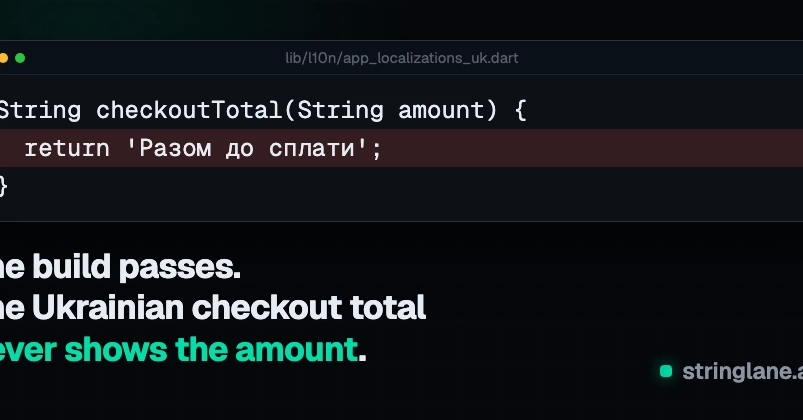
"checkoutTotal": "Total: amount"When an AI agent is tasked with translating this string into Ukrainian, it attempts to convey the meaning ("Total to pay"), but completely drops the amount variable in the process:
"checkoutTotal": "До сплати"When the build script (flutter gen-l10n) executes, it parses the file without complaint, exits with a status code of 0, and generates the corresponding Dart localization methods. The generated method dutifully continues to accept the amount parameter in code, but because the translation string no longer contains the amount placeholder, the value is silently discarded. Ukrainian users are presented with a checkout screen displaying a label that translates to "Total to pay" with zero numerical data attached.
Bug 2: Grammatical Collapse in Plurals
Pluralization represents one of the most complex challenges in software internationalization (i18n). In English, pluralization is relatively straightforward, operating on a binary model: 1 item ("1 item") and anything else ("2 items", "0 items", "5.5 items").
Ukrainian grammar, by contrast, is far more complex, requiring four distinct plural forms depending on the exact numeric value (e.g., numbers ending in 1 take one form; numbers ending in 2, 3, or 4 take a second; numbers from 5 to 20 take a third; and so forth).
When an AI model translates an ICU-syntax plural string from English, it frequently inspects the source structure, identifies the two forms present in English (one and other), and terminates its work:
"itemsInCart": "count, plural, onecount товар othercount товарів"In this generated snippet, the AI has mapped the English other category to the Ukrainian plural form used for numbers 5 through 20. Consequently, when a user adds exactly 2 items to their cart, the application’s pluralization fallback logic looks for a matching rule, fails to find the proper category for the number 2, and defaults to the only other available form—the one intended for numbers 5 through 20.
The resulting badge reads 2 товарів instead of the grammatically correct 2 товари. To a native Ukrainian speaker, this reads with the strange, jarring cadence of saying "2 of items" in English. Yet, once again, the build passes without a whisper of warning.
Official Responses and Industry Perspectives
As these localization blind spots become more widely recognized within the software engineering community, tool creators and open-source developers are stepping forward to offer architectural safeguards.
Industry veterans argue that relying on LLMs to handle raw localization files without programmatic validation is an unsustainable anti-pattern. While tech giants with dedicated internationalization (i18n) engineering departments have built proprietary linting systems, solo developers and small-to-medium-sized product teams have historically lacked access to lightweight, specialized auditing tools.
To bridge this gap, independent developers have begun releasing targeted utilities designed to intercept localization errors before they reach production. Among these is StringLane, a free command-line interface (CLI) tool purpose-built to audit localization files across major frameworks, including Flutter (ARB), iOS (String Catalogs and .strings), Android (XML), and JavaScript/TypeScript environments (i18next JSON).
The Automated Solution
By integrating a validation check directly into continuous integration (CI) pipelines, engineering teams can automatically halt merges when structural discrepancies are detected. Running a simple command in the project directory:
$ npx @stringlane/cli checkScans the repository and outputs a clear diagnostic report:
flutter · arb · single-origin · base en
3 locales · 3 keys · 86% complete

  de      4/4        complete
  en      4/4        complete
  uk      4/6        2 missing

3 errors · 0 warnings · 0 info
  error    placeholder_mismatch  uk/checkoutTotal
  error    missing_key           uk/itemsInCart[few]
  error    missing_key           uk/itemsInCart[many]
By configuring CI/CD workflows to execute this check as a blocking step:
- run: npx @stringlane/cli checkTeams ensure that any pull request containing stripped placeholders or incomplete pluralization rules automatically fails the build, preventing faulty code from merging into main branches. Furthermore, modern implementations support Model Context Protocol (MCP) servers, allowing coding agents to execute translations and self-correct their output before writing files to disk.
Implications: The Future of AI-Driven Software Development
The emergence of silent localization bugs highlights a broader philosophical shift in software engineering: Automation without structural verification is a recipe for silent failure.
As generative AI and autonomous coding agents take on increasingly complex development tasks—ranging from multi-language support to end-to-end feature implementation—human oversight must evolve. Developers can no longer assume that a passing compiler or a successful test suite guarantees a functional user experience across global markets.
Key Takeaways for Engineering Teams:
- Never Trust Raw AI Outputs in Production: While LLMs are exceptional at drafting initial translations, their lack of deterministic rule-checking makes them fundamentally unsuited for direct, unverified writes to localization files.
- Automate Structural Audits: Localization linting must become a standard pillar of CI/CD pipelines, sitting alongside unit tests and static code analysis.
- Understand the Limit of Automation: Tools can successfully verify whether placeholders exist and whether all required pluralization buckets are populated, but they cannot evaluate stylistic nuance or cultural appropriateness. Ensuring that a translation sounds natural to a native speaker still ultimately requires human empathy and expertise.
Ultimately, the goal is not to reject AI assistance in localization, but to cage its shortcomings with robust, automated guardrails. By combining the raw speed of generative AI with strict structural validation, development teams can safely scale their applications to a global audience without sacrificing quality, accuracy, or user trust.







