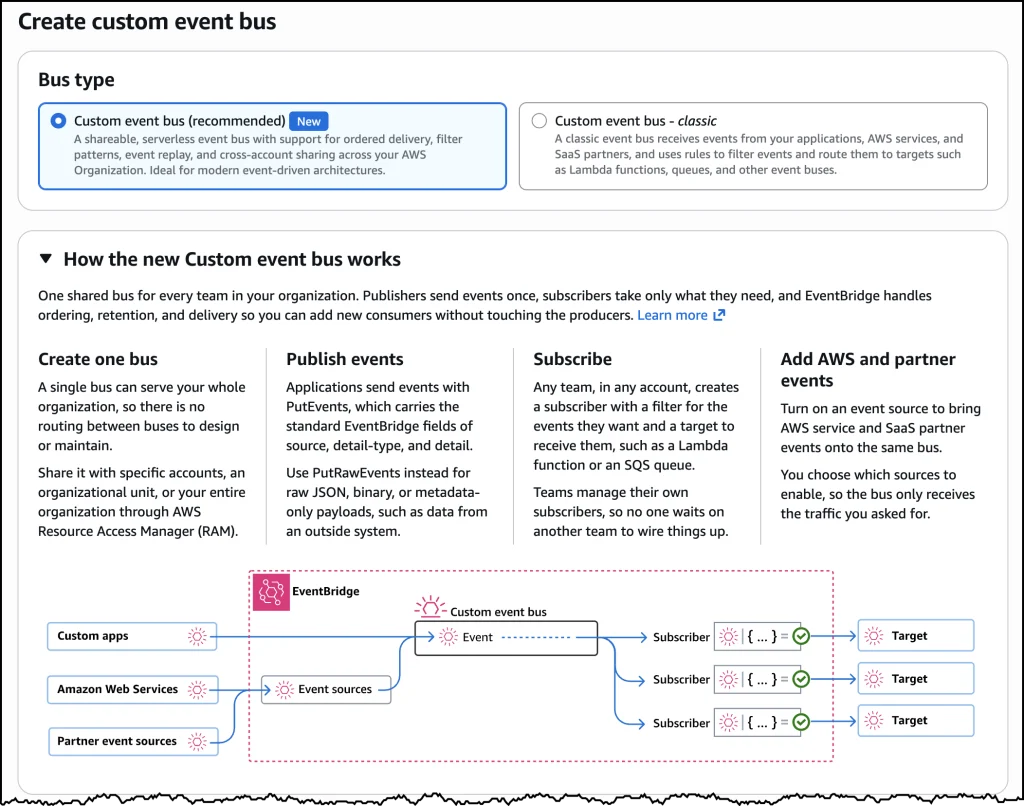
SEATTLE — In a major development for cloud architects and serverless developers, Amazon Web Services (AWS) has announced the official launch of an enhancedcustomevent bus for Amazon EventBridge. Purpose-built to address the operational friction of managing event-driven applications across complex, multi-account enterprise landscapes, the new feature introduces organization-wide resource sharing, native event ordering, simplified subscriber management, and a modernized ingress-egress pricing model.
The launch marks a significant evolutionary step for Amazon EventBridge, shifting the paradigm from fragmented, multi-bus topologies toward a centralized, highly scalable, and frictionless event backbone.
Main Facts: What is the Enhanced Custom Event Bus?
The newly released enhanced custom event bus addresses a foundational friction point in modern cloud architecture: the transition from single-team serverless deployments to enterprise-wide operations.
In traditional enterprise setups, organizations following AWS best practices adopt a multi-account structure where individual teams operate within isolated AWS accounts. While this guarantees security boundaries and resource governance, it traditionally complicates event-driven systems. To route events between disparate accounts, engineering teams have historically relied on a web of cross-account rules, custom resource policies, and complex bus-to-bus configurations.
This workaround architecture reintroduces the very operational overhead that serverless paradigms are designed to eliminate. Platform teams lose centralized visibility over event subscriptions, cross-account data transfer costs compound rapidly, and workloads requiring strict message sequencing are forced to engineer brittle workarounds or pivot to alternative technologies.
The enhanced custom event bus directly solves these bottlenecks. Key components of the new release include:
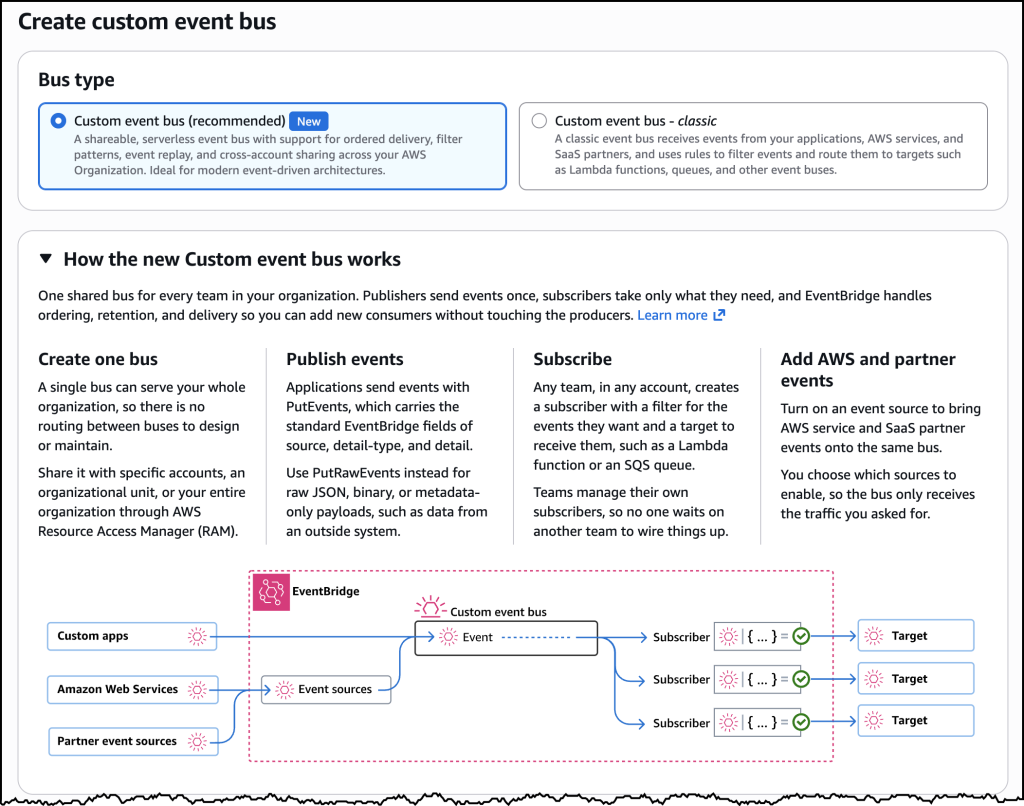
Centralized Organization-Wide Sharing: A single event bus can now be deployed by a platform team and shared natively across all AWS accounts within an enterprise organization using AWS Resource Access Manager (AWS RAM).
Native Event Ordering: Publishers can specify an EventGroupId, allowing EventBridge to deliver sequential events in the correct order to designated subscribers without sacrificing asynchronous performance for other workloads.
Streamlined Subscriber Resource: A new, unified Subscriber resource bundles event filtering, target configuration, custom retry policies, and dead-letter queues (DLQs) into a single manageable entity.
Content-Based Deduplication: Built-in payload hashing automatically detects and drops duplicate retries arriving within a five-minute window, offering exactly-once processing semantics for unreliable sources.
Advanced Payload Transformation: Integrated support for JSONata data transformation and automatic deserialization of Apache Avro or Protocol Buffers formats.
Scalable Ingress-Egress Pricing Model: A decoupled pricing structure where publishers pay for ingestion and subscribers pay for delivery, eliminating compounded cross-account routing fees.
Existing EventBridge implementations remain fully supported and will now be categorized as "Custom event bus – classic," ensuring that legacy workloads continue running without interruption while teams migrate to the enhanced architecture at their own pace.
Chronology: The Evolution of Event-Driven Architectures on AWS
To understand the weight of this announcement, it is necessary to examine how event-driven serverless architectures have matured within the AWS ecosystem.
Phase 1: The Single-Account Paradigm
When Amazon EventBridge (originally launched as Amazon CloudWatch Events) evolved into a fully managed serverless event bus, early adopters typically operated within a single AWS account. A custom event bus served as the central nervous system for localized microservices. Publishers pushed events, rules matched patterns, and targets (such as AWS Lambda functions or Amazon SQS queues) processed payloads. This single-account model thrived on simplicity and loose coupling.
Phase 2: The Multi-Account Explosion
As enterprise adoption accelerated, organizational scale outgrew single-account boundaries. Security guidelines, compliance mandates, and blast-radius minimization drove companies toward multi-account setups via AWS Organizations.
However, EventBridge was initially optimized for single-account boundaries. To bridge the gap, AWS introduced cross-account permissions and target routing. While functional, this forced platform engineering teams to construct intricate webs of resource policies, IAM roles, and multi-hop bus configurations. Operational visibility fragmented, and cost tracking grew opaque.
Phase 3: The Workaround Era
Faced with strict compliance requirements, ordering constraints, and scaling limits—such as legacy subscriber caps—architects turned to defensive engineering. Many inserted intermediate Amazon SQS queues between event buses and AWS Lambda simply to guarantee message ordering or manage retries, inadvertently driving up infrastructure costs and latency.
Phase 4: The Next-Generation Unified Architecture
Today’s release represents the culmination of years of enterprise feedback. By baking native organization-wide sharing, deterministic ordering, and streamlined subscriber management directly into the core service, AWS has effectively bridged the gap between enterprise governance and developer agility.
Supporting Data and Technical Architecture
The structural advantages of the enhanced custom event bus are underscored by key technical specifications and architectural changes designed to handle enterprise workloads at scale.
1. Frictionless Sharing via AWS RAM
Setting up the new bus requires minimal configuration. Platform administrators navigate to the AWS Management Console, select the new custom event bus option, and toggle on event bus sharing. By integrating with AWS Resource Access Manager (AWS RAM), administrators can restrict sharing boundaries specifically to their AWS Organization, organizational units (OUs), specific account IDs, or IAM roles.
This eliminates the need to manually write complex cross-account resource policies or manage individual bus-to-bus target handshakes. Furthermore, the enhanced bus launches with a default quota of 10,000 subscribers per bus, a threshold that can be increased upon request, drastically mitigating the architectural fragmentation previously caused by tight subscriber ceilings.
2. Balancing Asynchronicity and Order
Event-driven systems fundamentally rely on asynchronous, decoupled execution where event ordering is irrelevant. Yet, real-world domains—such as financial transaction processing, IoT device telemetry, and logistics routing—frequently demand strict sequencing. Out-of-sequence location updates, for instance, can cause algorithmic errors based on stale data.
The enhanced custom event bus resolves this tension by allowing mixed patterns on a single bus:
Publishers inject an EventGroupId into the event metadata.
Subscribers requiring strict sequencing opt into ordered delivery. EventBridge guarantees that events sharing the same EventGroupId arrive sequentially.
Concurrently, other subscribers consume the same event stream asynchronously without performance penalties.
To support deterministic sequencing reliably, the enhanced bus features synchronous invocation modes for targets like AWS Lambda. This ensures that downstream functions successfully process and acknowledge an event before the bus advances, removing the necessity of deploying intermediary SQS buffers for sequencing assurance.
3. Advanced Payloads and Smart Deduplication
Data hygiene is a persistent challenge in distributed systems. Network timeouts and partial infrastructure failures often trigger retries, flooding downstream services with duplicate events.
The new bus introduces content-based deduplication, which hashes meaningful sections of the event payload. If identical payloads arrive within a five-minute window, EventBridge automatically suppresses the duplicates, granting "exactly-once" delivery semantics to sources incapable of generating native idempotency tokens.
Additionally, native JSONata integration empowers subscribers to reshape incoming payloads dynamically—extracting, renaming, or computing fields directly within the subscription layer. For organizations leveraging binary serialization formats such as Apache Avro or Protocol Buffers, EventBridge can automatically deserialize payloads into JSON, enabling fine-grained filtering across the entire event payload without requiring custom ingestion parsing microservices.
4. A Modernized Economic Model
Under legacy multi-bus configurations, cross-account and bus-to-bus routing fees compounded rapidly, penalizing organizations for adopting best-practice architectural separation.
The enhanced custom event bus introduces an ingress and egress throughput pricing model:
Publishers pay solely for events successfully ingested into the central bus.
Subscribers pay exclusively for events delivered to their endpoints.
This transparent division simplifies cost allocation across business units, making enterprise-wide event tracking financially predictable.
Official Responses and Industry Perspective
In briefings accompanying the launch, AWS engineering leaders emphasized that the updates were driven directly by the operational realities of modern enterprise customers scaling serverless operations.
"As organizations double down on serverless and event-driven architectures, we saw platform teams spending an inordinate amount of time managing infrastructure plumbing—cross-account policies, routing rules, and queue workarounds—just to keep data flowing between teams," noted an AWS product spokesperson. "With the enhanced custom event bus, we are returning the focus to where it belongs: letting publishers publish, subscribers consume, and the platform handle the heavy lifting securely and economically at scale."
Early enterprise adopters who participated in the preview phases have reported dramatic reductions in architectural complexity. Financial technology firms and logistics enterprises highlighted the elimination of intermediate SQS queues and the newfound ease of managing audit compliance through centralized visibility as major wins for their engineering organizations.
Implications for Cloud Architects and Developers
The release of the enhanced custom event bus has profound implications for how cloud-native engineering teams design, govern, and scale serverless applications.
1. Shift Toward Centralized Platform Governance
In many enterprises, decentralized serverless adoption has led to "wild west" architectures where individual teams spin up fragmented event buses with little to no central oversight. The enhanced bus empowers platform engineering teams to establish a single, auditable, enterprise-wide event backbone. By retaining visibility over all subscribers while granting teams autonomy to create subscriptions independently, organizations achieve an ideal balance of governance and speed.
2. Simplification of Serverless Topologies
The reduction of boilerplate infrastructure is perhaps the most immediate benefit. By folding retry policies, dead-letter routing, payload transformation, and filtering into a single Subscriber resource, AWS has eliminated the need for complex, multi-resource CloudFormation or Terraform templates. Furthermore, bypassing intermediary SQS queues for ordered Lambda processing reduces architectural latency and lowers total cost of ownership.
3. Migration Pathways for Existing Workloads
AWS has ensured business continuity by maintaining full support for legacy workloads under the "Custom event bus – classic" designation. Organizations are under no pressure to execute risky, wholesale migrations. Instead, cloud architects can adopt the enhanced custom event bus iteratively for new greenfield projects or complex multi-account domains, migrating legacy workloads at a sustainable pace.
Availability
The enhanced custom event bus is available immediately across a broad footprint of global AWS Regions, including:
North America: US East (N. Virginia, Ohio), US West (Oregon)
Europe: Europe (Ireland, Frankfurt, Stockholm, Spain)
Asia Pacific: Asia Pacific (Hong Kong, Malaysia, Mumbai, Singapore, Sydney, Thailand, Tokyo)
Developers and platform engineers can provision their first enhanced custom event bus today via the AWS Management Console, the AWS Command Line Interface (AWS CLI), or infrastructure-as-code frameworks through updated EventBridge APIs. Detailed implementation guides and migration documentation are available via the official AWS EventBridge documentation portal.