AWS Expands Amazon EBS Capabilities: Cross-Account Volume Clones Introduce New Era of Secure Data Sharing and DevOps Efficiency
SEATTLE — Amazon Web Services (AWS), a subsidiary of Amazon.com, Inc., has announced a significant evolution in cloud infrastructure management with the introduction of cross-account copy support for Amazon Elastic Block Store (Amazon EBS) Volume Clones. This powerful new capability allows cloud architects, developers, and DevOps engineers to seamlessly create instantaneous, point-in-time copies of EBS volumes across distinct AWS accounts.
By integrating AWS Resource Access Manager (RAM) and AWS Key Management Service (AWS KMS), the feature bridges the gap between collaborative development flexibility and stringent enterprise security. Organizations can now provision staging, testing, and sandbox environments using real-world production data—all while preserving strict isolation barriers between production workloads and secondary environments.
Main Facts: What is Cross-Account Amazon EBS Volume Cloning?
At its core, the new feature extends the utility of Amazon EBS Volume Clones, which AWS originally launched to provide instant, block-level storage copies within the same Availability Zone without requiring full data migrations or degrading storage performance.
With today’s update, the scope of these clones expands globally across AWS accounts. Key operational facts include:
- Cross-Account Interoperability: Volume owners can securely share EBS volume clones with designated target AWS accounts, simplifying multi-account architectures commonly used by modern enterprises.
- Target-Side Re-Encryption: Target accounts can optionally re-encrypt the copied data using their own localized AWS KMS keys, ensuring that organizational boundaries and encryption compliance are strictly maintained.
- RAM Integration: The sharing workflow is managed via AWS Resource Access Manager (RAM), allowing administrators to share volumes individually or as part of broader resource shares within an AWS Organization.
- Programmatic and AI Readiness: The feature supports standard AWS APIs and command-line interfaces (CLIs), and integrates with modern developer toolsets such as the AWS MCP Server and plug-ins for AI coding assistants.
- Regional Availability: The feature is live today in all AWS Regions that currently support Amazon EBS Volume Clones.
Chronology: The Journey to Cross-Account EBS Flexibility
To understand the significance of this release, it is helpful to review the chronological milestones of Amazon EBS data management evolution:
- The Traditional Era (Snapshot Workflows): For years, creating copies of production data across accounts required taking a snapshot of an EBS volume, sharing that snapshot across accounts, and then materializing a new volume from the shared snapshot in the target environment. While reliable, this process introduced time delays and complex snapshot lifecycle management overhead.
- The Introduction of EBS Volume Clones: Last year, AWS revolutionized local storage manipulation by introducing Amazon EBS Volume Clones. This capability allowed users to create instantaneous, independent copies of volumes within the same Availability Zone immediately, bypassing the traditional snapshot conversion bottleneck.
- The Multi-Account Bottleneck: While Volume Clones drastically improved intra-account workflows—such as rapid patching or local debugging—organizations operating multi-account strategies (a best practice under the AWS Well-Architected Framework) still faced friction when trying to move those clones into isolated development or auditing accounts.
- Today’s Release (Cross-Account Volume Clones): AWS removes this architectural hurdle by marrying the speed of EBS Volume Clones with the multi-account governance capabilities of AWS RAM and AWS KMS, creating a streamlined pathway for inter-account data propagation.
Supporting Data and Technical Implementation
In enterprise cloud architecture, operational efficiency must be balanced against precise security controls. The cross-account volume cloning mechanism is architected to satisfy both demands through a clear, step-by-step workflow.

1. Initiating the Share (Source Account)
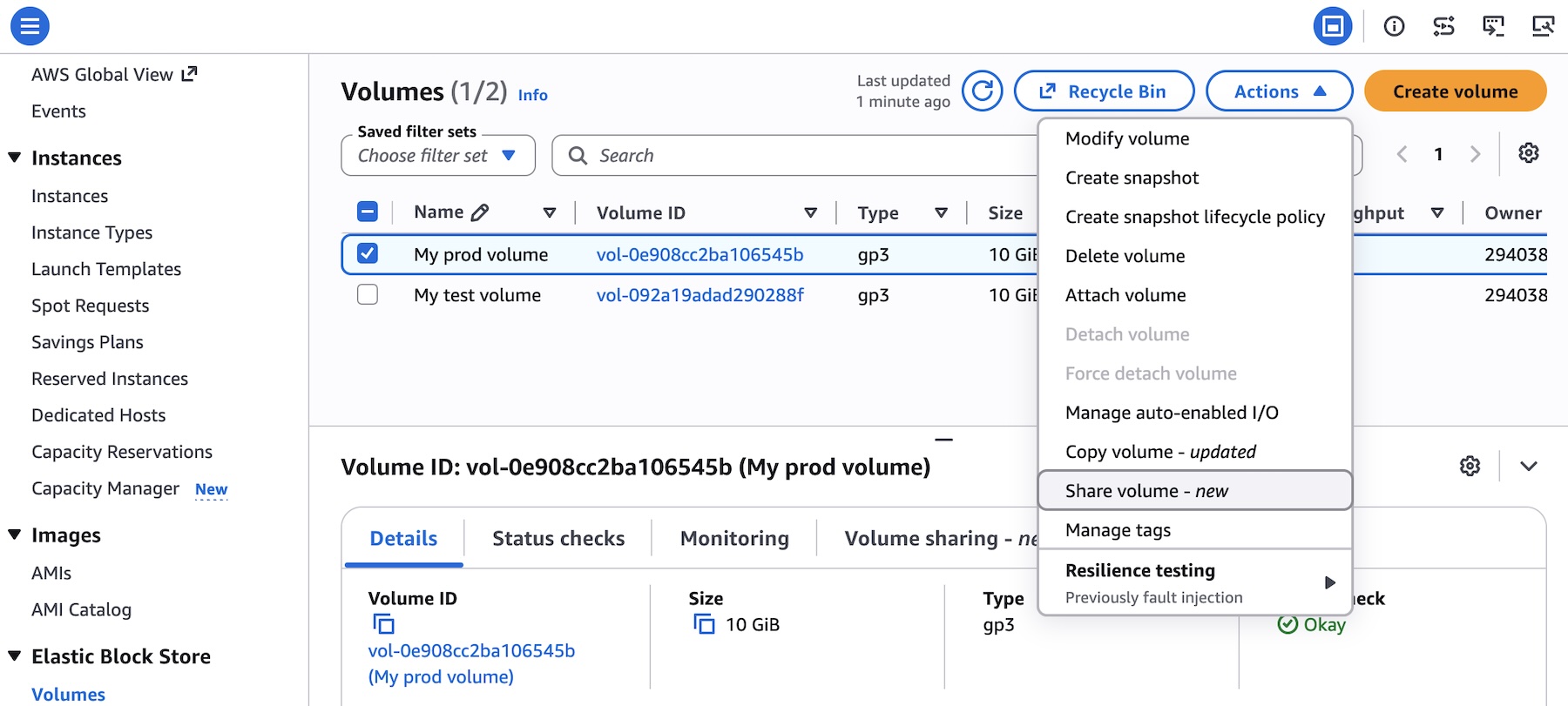
A volume owner navigates to the Amazon EBS console, selects the desired volume, and chooses the Share volume option. Through integration with AWS RAM, administrators can add the volume to existing resource shares or build dedicated shares scoped to specific organizational units or individual accounts.
[Source Account: EBS Volume]
       │
       ▼ (Via AWS RAM)
[Resource Share Created]
       │
       ▼
[Target Account Invoked]
2. Accepting the Share (Target Account)
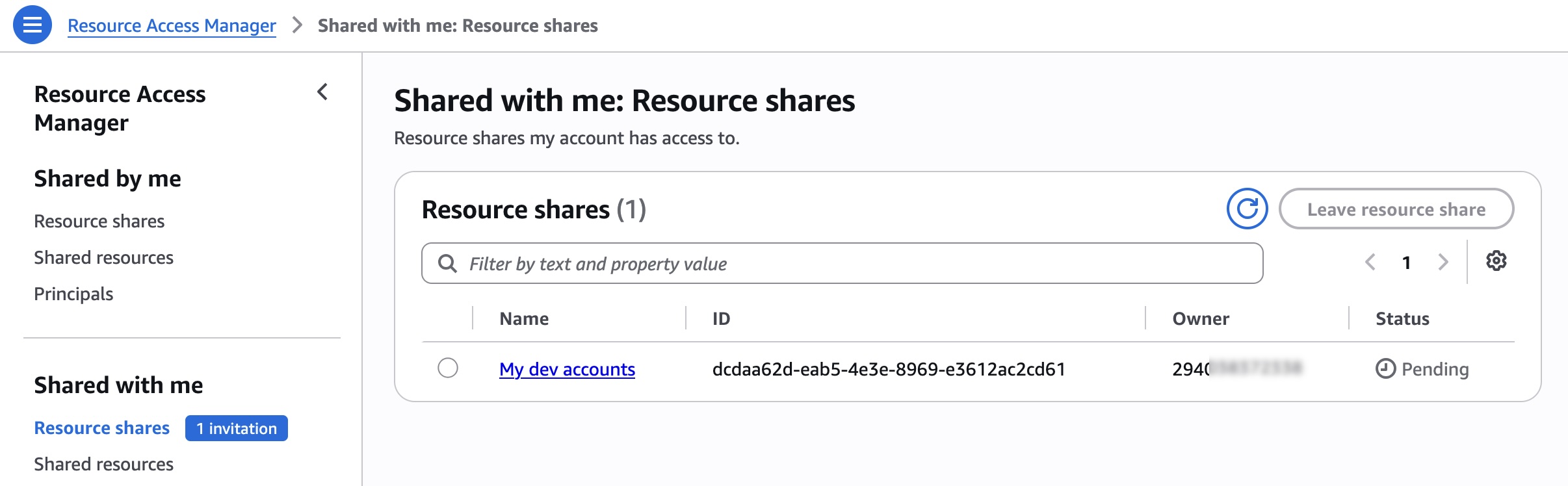
Once shared, the target account administrator must log into the AWS RAM console to formally accept the resource share. Upon acceptance, the shared volume becomes visible within the target account’s Amazon EBS console dashboard, clearly tagged under volume sharing metadata.
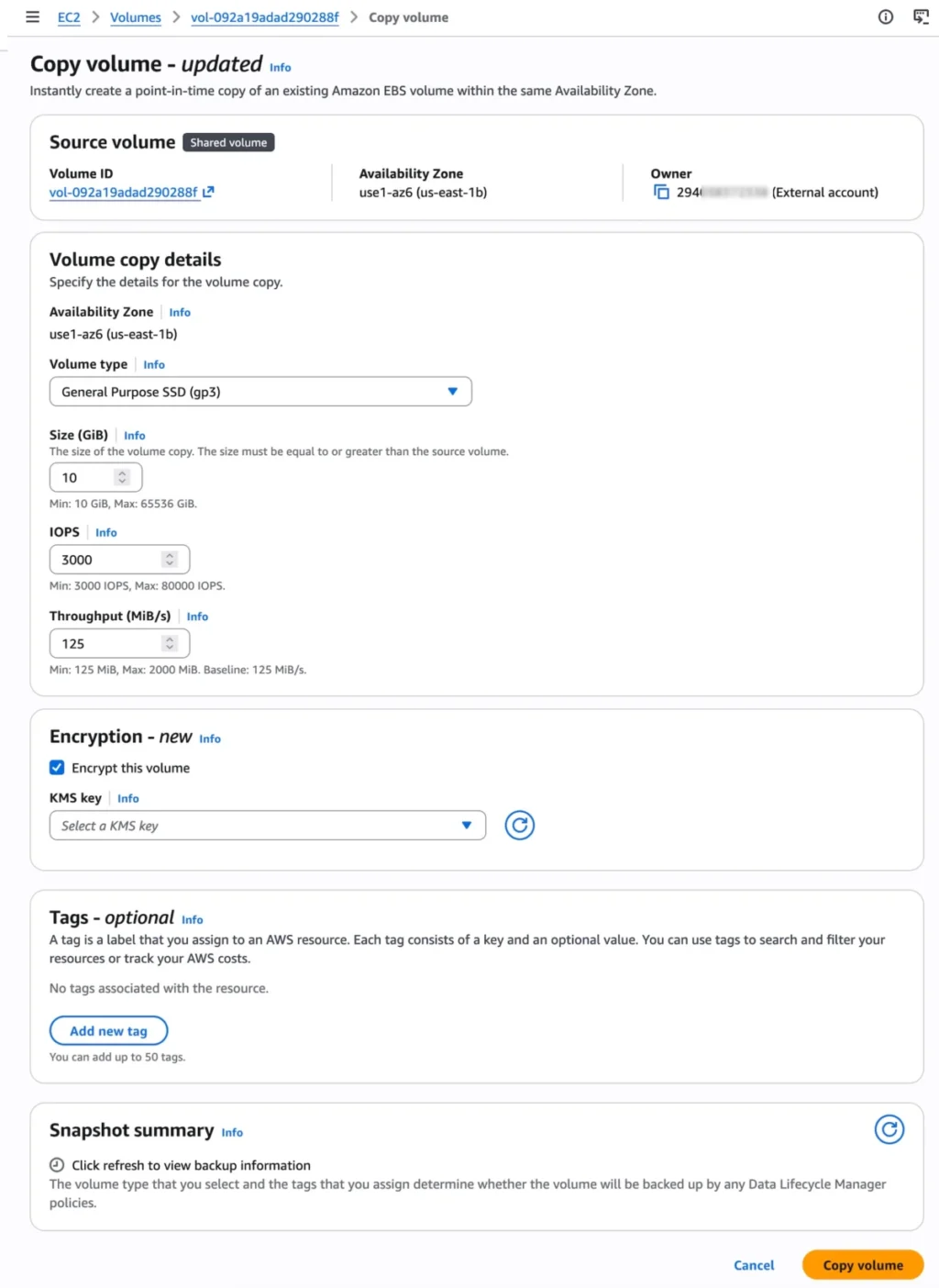
3. Cloning and Re-Encryption (Target Account Execution)
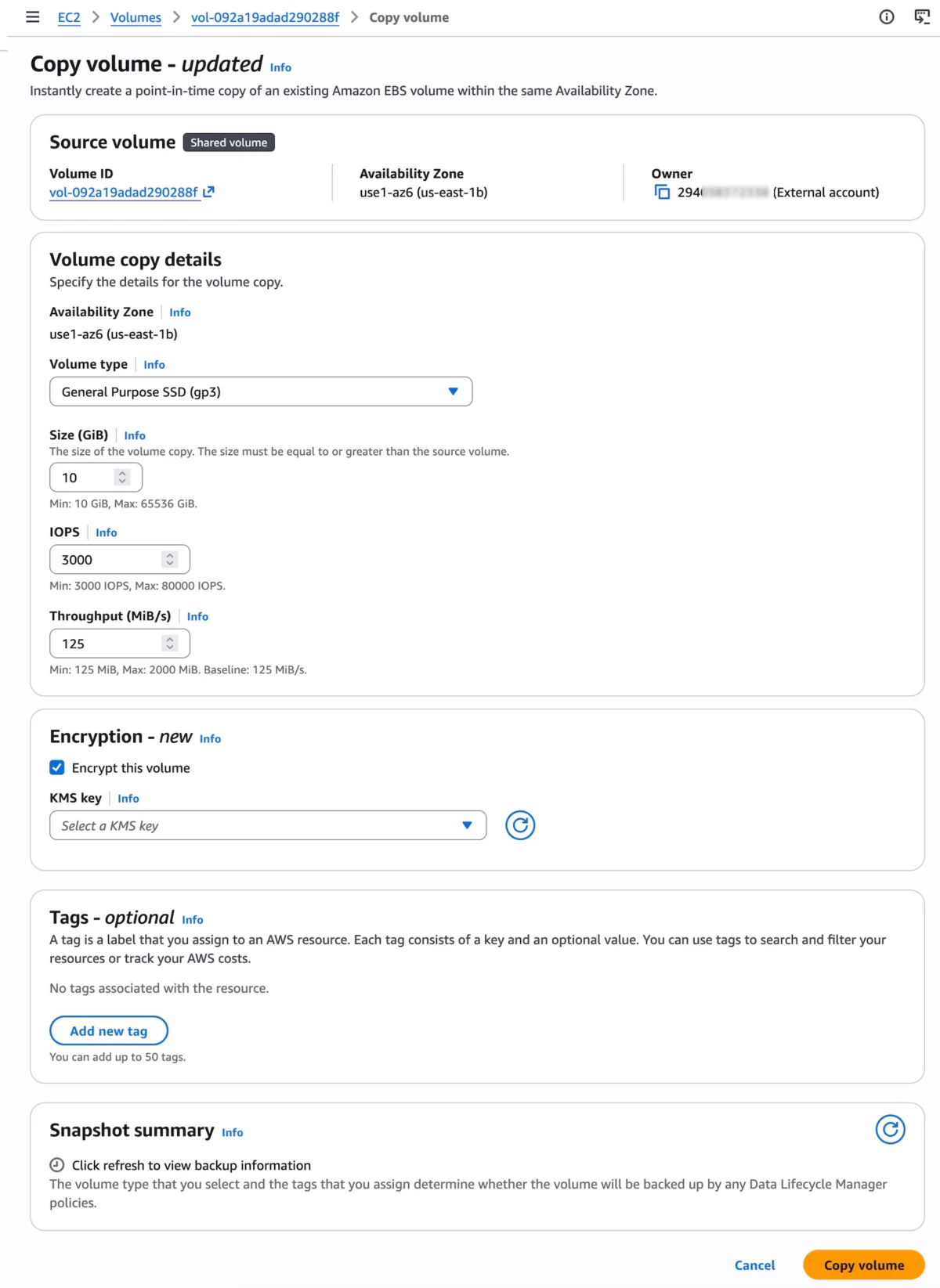
From the target account interface, the engineer selects Copy volume. During this execution phase, the system allows the user to apply a target-specific AWS KMS encryption key. This guarantees that even though the underlying data originated from a production environment, the cryptographic perimeter of the development or staging account remains entirely sovereign.
Programmatic and AI-Driven Operations
AWS has also ensured that automation pipelines are not left behind. Teams utilizing Infrastructure as Code (IaC) or AI-assisted development toolchains can manage these cross-account workflows programmatically. By leveraging the AWS MCP Server and associated agent toolkits, developers can query documentation, invoke APIs, and script cross-account volume replications directly from their preferred integrated development environments (IDEs).
Official Responses and Strategic Perspectives
Industry analysts and AWS product leaders emphasize that this feature directly addresses the operational friction inherent in modern enterprise software delivery pipelines.
In a technical briefing accompanying the launch, AWS engineering leads highlighted the perennial challenge faced by DevOps teams: How to test applications against realistic, up-to-date data sets without exposing sensitive production infrastructure to auxiliary environments.
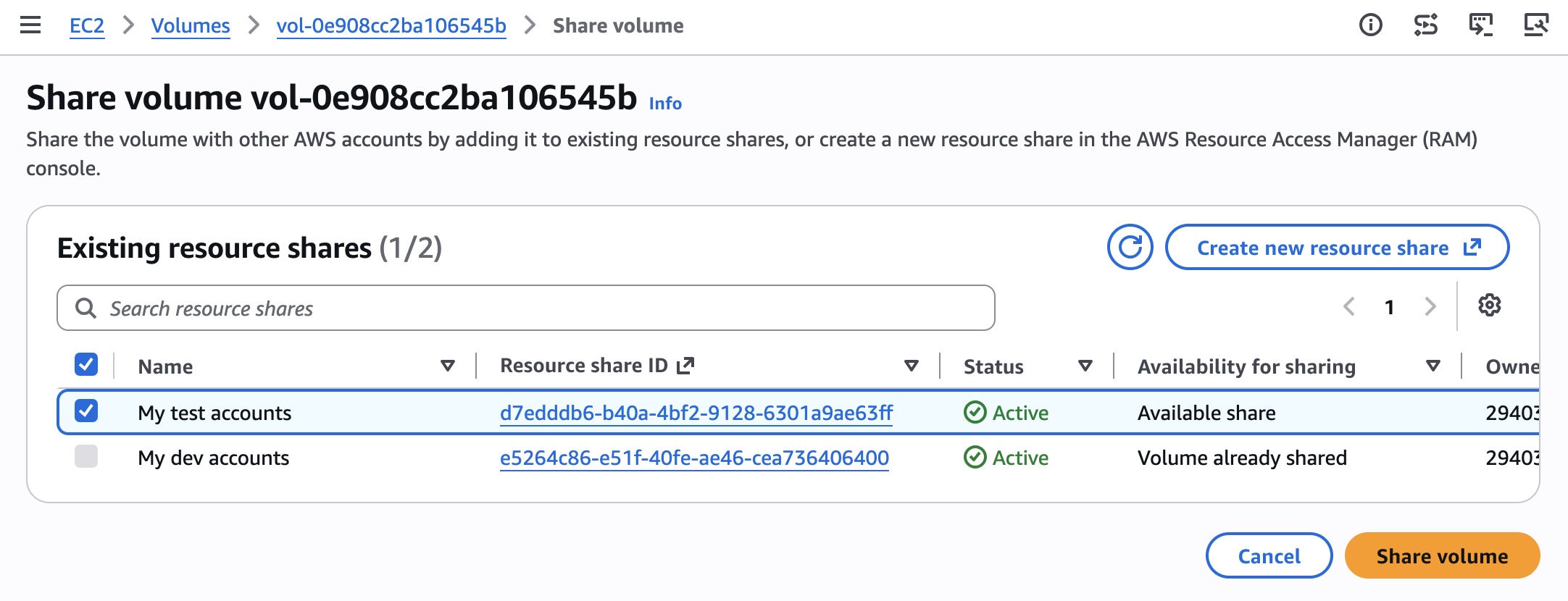
"With this new feature, you can use your latest application data to develop, test, and experiment in a secondary environment, while protecting and isolating the information in the production environment," noted AWS technical communications. "For example, you can create copies of a production environment to refresh test and development environments set up in separate accounts with the desired EBS encryption."
Enterprise security architects have similarly praised the decision to embed AWS KMS re-encryption directly into the copy workflow. By ensuring that data never crosses account boundaries unencrypted—and allowing secondary accounts to maintain absolute control over their decryption keys—AWS has aligned the feature with stringent compliance frameworks such as SOC 2, HIPAA, and PCI-DSS.
Implications for Enterprises and Developers
The introduction of cross-account EBS Volume Clones carries profound implications across multiple technical and organizational dimensions:

1. Accelerated Software Delivery Lifechains (SDLC)
Staging and QA environments often suffer from "data drift"—the divergence between outdated test databases and live production data. By enabling instant, cross-account cloning, QA teams can spin up fresh, production-accurate environments in minutes rather than hours. This directly reduces bug discovery timelines and accelerates time-to-market for new features.
2. Enhanced Security Posture and Least-Privilege Access
In legacy setups, granting developers access to production data often involved risky credential sharing or overly permissive IAM policies. Cross-account cloning enforces the principle of least privilege. Production data is securely exported as an isolated, cryptographically protected clone, ensuring that development errors, misconfigurations, or compromised sandbox credentials cannot impact live production systems.
3. Streamlined Data Governance and Auditing
Because the sharing process relies entirely on AWS RAM and AWS KMS, centralized cloud governance teams maintain complete visibility and auditability over data movement. CloudTrail logs capture every resource share, acceptance, and volume copy event, satisfying internal compliance and external regulatory auditing requirements.
Availability and Next Steps
Cross-account volume clones for Amazon EBS are generally available starting today. The capability is deployed across all AWS Regions that currently support standard Amazon EBS Volume Clones.
Cloud administrators and developers wishing to test the feature can access the functionality immediately through the Amazon EC2 Console. Comprehensive documentation, API references, and step-by-step integration tutorials are available via the Amazon EBS User Guide.
Feedback and feature requests can be submitted directly to the engineering teams through AWS re:Post for Amazon EBS or through standard enterprise AWS Support channels.