Revolutionizing Music Discovery: Inside Spotify’s Reinforcement Learning Breakthrough with TensorFlow and TF-Agents
In the hyper-competitive landscape of digital audio streaming, user retention hinges on personalization. Delivering the right song at the exact psychological moment can turn a casual listener into a lifelong subscriber, while a poorly timed track can trigger an immediate skip and user fatigue. To tackle this complex, ever-evolving challenge, a team of researchers and engineers at Spotify—Surya Kanoria, Joseph Cauteruccio, Federico Tomasi, Kamil Ciosek, Matteo Rinaldi, and Zhenwen Dai—turned to an advanced branch of artificial intelligence: Reinforcement Learning (RL).
In a technical leap detailed at KDD 2023, the Spotify machine learning team unveiled a robust, scalable offline simulation framework built using TensorFlow and TF-Agents. This architecture allows the streaming giant to train and evaluate sophisticated AI agents safely in a virtual environment before deploying them to production, effectively bridging the gap between theoretical machine learning and real-world audio recommendations.
Main Facts: The Intersection of Reinforcement Learning and Music Curation
At its core, music recommendation is not a static classification problem; it is a sequential decision-making process. Every time a user interacts with a playlist—by listening, skipping, liking, or abandoning the session—their intent shifts. Traditional recommendation models often treat these interactions independently, failing to capture the narrative arc of a listening session.

Reinforcement Learning offers a mathematical framework designed explicitly for sequential decision-making. However, applying RL to a platform with hundreds of millions of active users presents a massive operational dilemma: how do you train an AI agent that starts off knowing nothing without subjecting real users to poor listening experiences?
To solve this, Spotify’s engineering team constructed an offline model-based simulator. By utilizing TensorFlow, TFX, TensorFlow Serving, and specifically TF-Agents, the team created a virtual ecosystem populated by simulated users. These digital stand-ins react to machine-generated track selections based on deep learning models trained on historical user behavior. This allows RL agents to trial, fail, learn, and optimize their recommendation strategies millions of times in a controlled, offline setting before ever touching a live production environment.
Chronology: From Concept to Production-Scale Simulation
The journey to building Spotify’s modern RL simulation pipeline required a methodical, multi-phase approach to architecture, prototyping, and validation.

Phase 1: Architectural Alignment with TensorFlow
Spotify’s existing production machine learning stack is deeply rooted in the TensorFlow ecosystem. Knowing that any experimental framework would eventually need to integrate smoothly with production systems, the team made a strategic decision early on to adopt TF-Agents as their primary reinforcement learning library. This choice ensured that experimental models could eventually transition into enterprise-grade deployment pipelines with minimal friction.
Phase 2: Designing the Offline Simulator
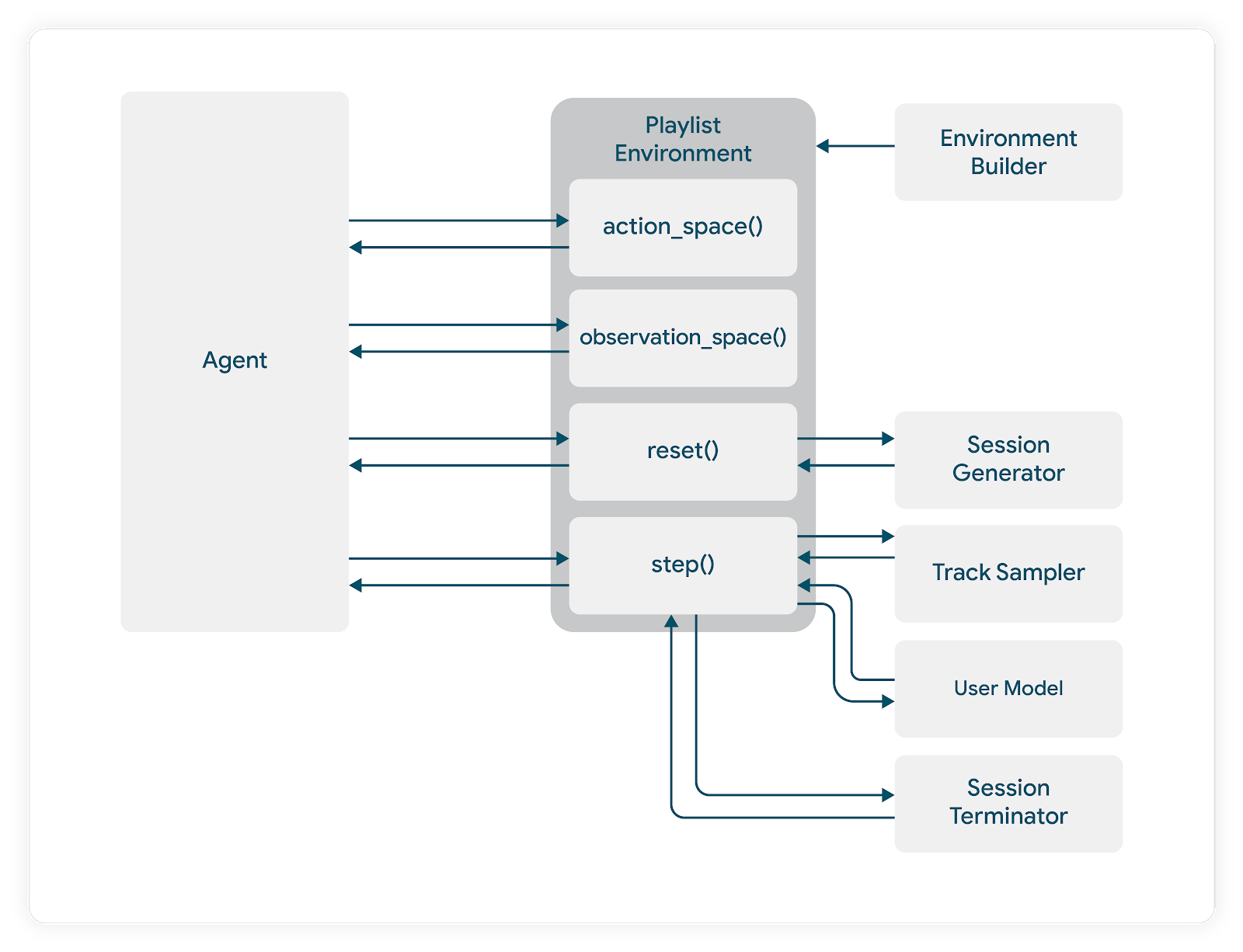
With the library selected, the team faced a missing link: a reliable, offline simulation environment tailored to music listening behavior. Leveraging the environment primitives provided by TF-Agents, the engineers built a custom simulator architecture. This system was designed to ingest user models (built via Keras) and track samplers to simulate end-to-end user listening sessions.
Phase 3: Solving the Action-Space Bottleneck
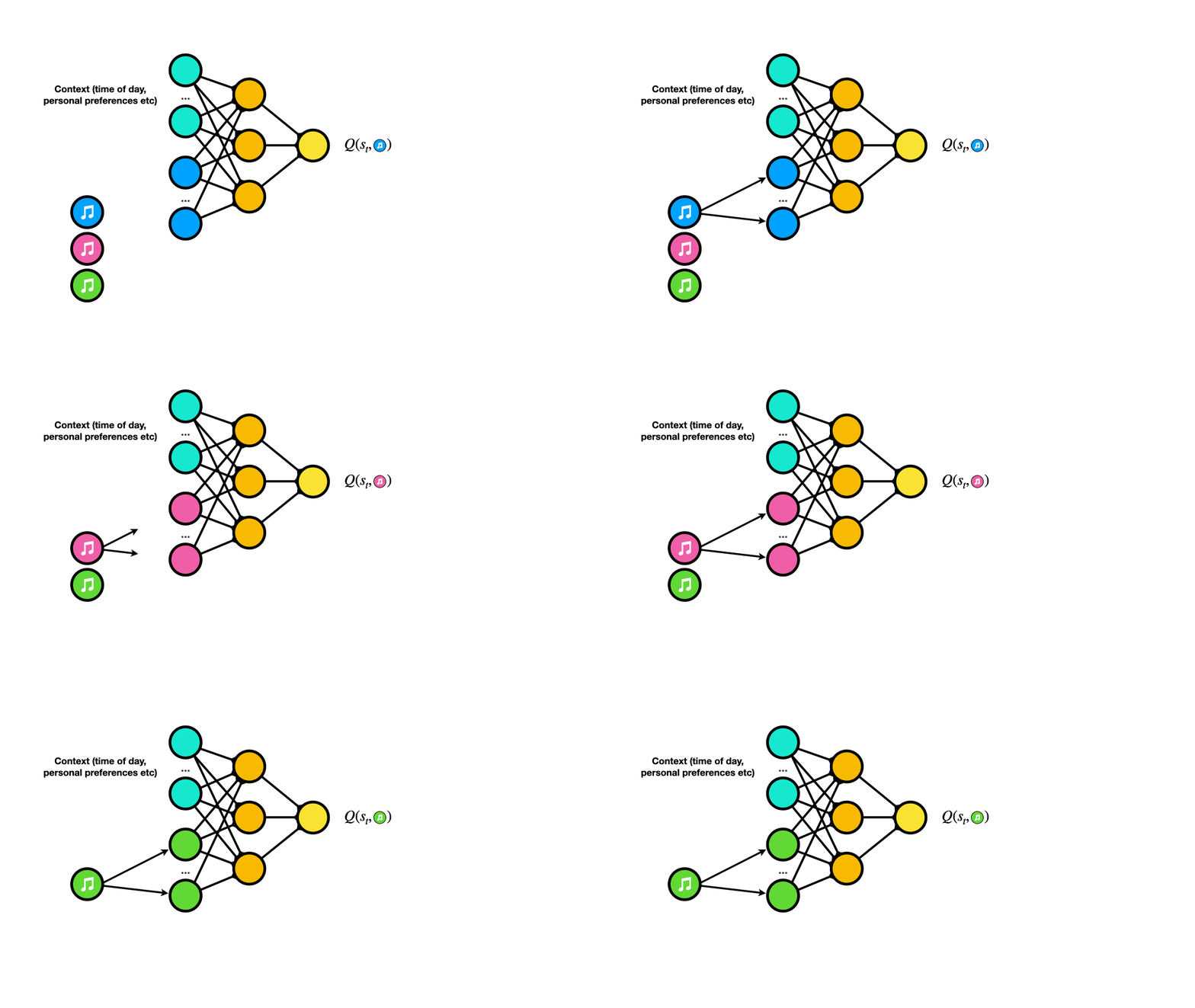
Standard RL environments often deal with discrete, low-dimensional action spaces (e.g., moving left, right, up, or down). Music recommendations, however, require curating ordered lists (slates) of tracks drawn from an astronomical, constantly changing pool of audio assets. To overcome the combinatorial explosion of this large state and action space, Spotify developed a novel deep Q-network (DQN) variant known as the Action-Head DQN (AH-DQN).
Phase 4: Offline-to-Online Validation
Following extensive offline training, the team put their models to the ultimate test: comparing simulated performance against real-world online metrics. By running live experiments, the engineers discovered a strong positive correlation between their offline simulation estimates and actual online user engagement. This breakthrough validated the simulator’s accuracy and paved the way for large-scale RL deployments across the platform.
Supporting Data and Technical Architecture
The technical elegance of Spotify’s simulation environment lies in its modularity. The team structured the simulator to mirror standard TF-Agents environment specifications while injecting domain-specific abstractions for music streaming.
The RL Loop and Simulated Users
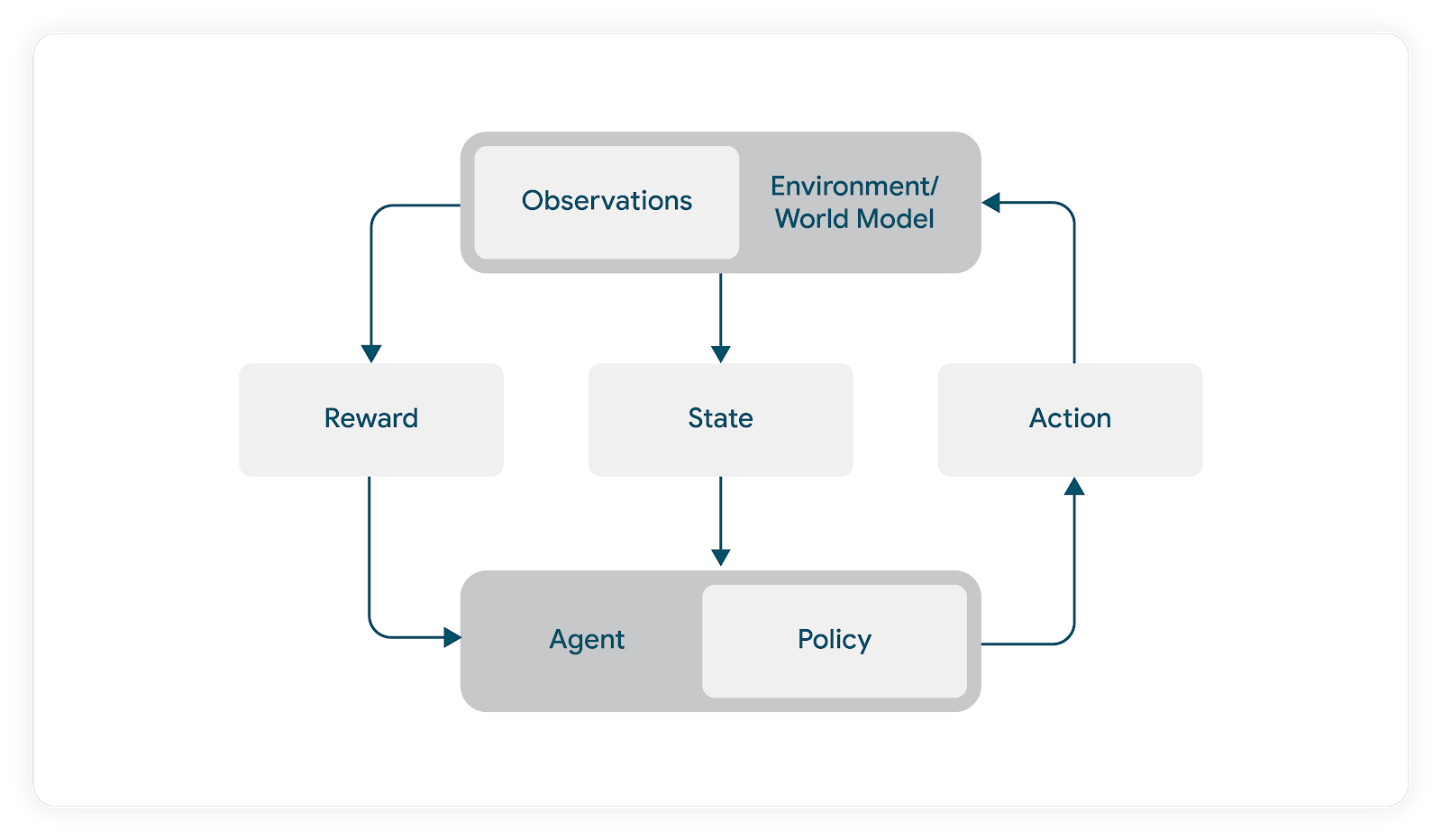
In a classical RL setup, an Agent receives an observation from the environment, executes an action based on its current policy, and receives a reward alongside the next observation. In Spotify’s architecture:

- The Agent: Proposes musical recommendations.
- The Environment: Encapsulates the simulated user session.
- The Reward: Represents the simulated user’s predicted satisfaction or engagement response to the recommended tracks.
To prevent untrained agents from frustrating real users, the environment relies on an AbstractUserModel trained in Keras. This model evaluates the suitability of recommended tracks and outputs a predicted satisfaction metric, eliminating the risks associated with online trial-and-error.
Core Modular Abstractions
The codebase utilizes a strict object-oriented abstraction. Every concrete simulation instance inherits from an AbstractEnvironment class, which mandates the implementation of essential methods such as reset(), step(), observation_space(), and action_space():
class AbstractEnvironment(ABC):
    _user_model: AbstractUserModel = None
    _track_sampler: AbstractTrackSampler = None
    _episode_tracker: EpisodeTracker = None
    _episode_sampler: AbstractEpisodeSampler = None

    @abstractmethod
    def reset(self) -> List[float]:
      pass

    @abstractmethod
    def step(self, action: float) -> (List[float], float, bool):
      pass

    def observation_space(self) -> Dict:
      pass

    @abstractmethod
    def action_space(self) -> Dict:
      pass
Action-Head DQN (AH-DQN): Managing Massive Action Spaces
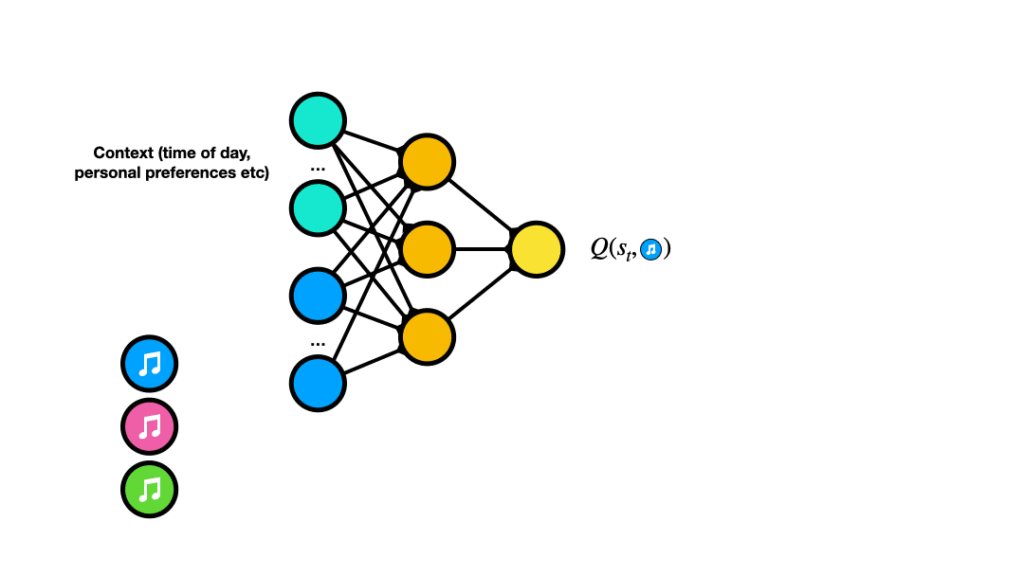
Traditional slate recommendation algorithms struggle when users interact with multiple items in a sequence, or when the underlying catalog shifts continuously. Spotify’s Action-Head DQN addresses this by evaluating individual actions sequentially.

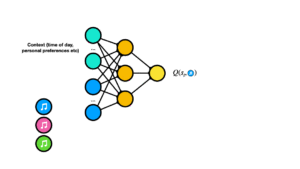
The AH-DQN network ingests the current state and a candidate action to produce a single Q-value. This calculation is iterated across available items in the pool. The item yielding the highest Q-value is appended to the listening queue, and the process repeats until the playlist slate is fully populated. Furthermore, built-in guardrails ensure that duplicate tracks are never recommended within the same session, prompting the system to dynamically select the next best alternative.
Official Responses and Industry Significance
The introduction of simulated Spotify listening experiences represents a paradigm shift in how audio streaming platforms approach automated curation. By successfully leveraging TF-Agents, Spotify has demonstrated that model-based reinforcement learning can be reliably scaled to handle complex consumer behaviors.
The project authors—Federico Tomasi, Joseph Cauteruccio, Surya Kanoria, Kamil Ciosek, Matteo Rinaldi, and Zhenwen Dai—shared their findings at the prestigious KDD 2023 conference, drawing immense interest from both academic researchers and industry practitioners.
In their closing acknowledgements, the authors extended formal gratitude to past and present Spotify colleagues, highlighting early developmental contributions from Mehdi Ben Ayed. They also credited the open-source TensorFlow Agents team for their continuous support, noting that the flexibility of the TF-Agents library was the foundational pillar that made the entire end-to-end architecture possible.
Broader Implications for the Audio Streaming Industry
The success of Spotify’s TensorFlow-powered RL simulator extends far beyond automated playlist generation. It unlocks several strategic capabilities for the future of digital media:
- Risk-Free Experimentation: By proving that offline simulation metrics strongly correlate with live online performance, Spotify has established a blueprint for testing disruptive algorithmic changes without risking user churn or degrading user experience.
- Generalizability Across Audio Formats: While initially applied to music playlists, the core principles of the AH-DQN and simulation framework can theoretically be extended to spoken-word content, podcasts, dynamic ad insertion, and personalized radio stations.
- Efficiency in Machine Learning Operations (MLOps): The seamless integration between Keras, custom PyEnvironment wrappers (
TFAgtPyEnvironment), and the broader TensorFlow ecosystem demonstrates how complex reinforcement learning research can be streamlined into production-ready pipelines.
As machine learning continues to evolve, Spotify’s pioneering work illustrates that the future of personalized audio lies not in static rules or isolated recommendations, but in intelligent, adaptive agents capable of understanding and anticipating the fluid rhythm of human listening habits.