UK Slams Heavy Economic Sanctions on Cryptocurrency Hub Cryptomus in Crackdown on Russian Sanctions Evasion and Global Cybercrime
LONDON — In a major escalation of international financial enforcement, the United Kingdom has officially issued sweeping economic sanctions against Cryptomus, a notoriously fluid cryptocurrency platform. According to leading blockchain intelligence firms and cybersecurity experts, Cryptomus has operated as a critical financial conduit for ransomware syndicates, narcotics networks, darknet marketplaces, high-level fraud, and illicit cybercrime services. Crucially, investigators point out that the platform’s operations have actively helped the Russian government and its allied financial institutions circumvent punishing Western financial restrictions tied to the ongoing war in Ukraine.
The U.K. Foreign, Commonwealth & Development Office formally enacted the restrictions, which freeze any assets held by Cryptomus within British financial institutions and legally bar U.K. companies from engaging in any business dealings with the firm, whether virtual or physical. Alongside Cryptomus, the U.K. government targeted several other interconnected virtual payment platforms, including VexPay, TokenSpot, and the Tsunami Payments service, in a synchronized effort to dismantle the modern digital architecture sustaining illicit cross-border finance.
1. Main Facts: Anatomy of a Shadowy Payment Hub
Cryptomus is not a standard, compliant digital asset exchange. Instead, it functions as a high-volume payment processor catering to shady online merchants, Russian crypto-exchanges, and underground cybercrime forums. Over the years, the platform has repeatedly rebranded to evade law enforcement scrutiny. Previously operating under corporate banners such as Certa Payments and Xeltox Enterprises, the platform most recently morphed into a parallel service known as Heleket following immense regulatory pressure in North America.
The scope of Cryptomus’s illicit operations is staggering. Data compiled by prominent blockchain analytics firm TRM Labs in April 2026 reveals that Cryptomus processed more than $7 billion in transactions since its inception in 2022. This enormous capital flow did not merely consist of low-level financial crime; the platform’s ledgers have been linked directly to vendors distributing child sexual abuse material (CSAM), international terrorist financing networks, and sophisticated human trafficking operations.
Despite its chameleon-like ability to change names and spin up sibling infrastructure, the platform’s underlying utility remains consistent: providing frictionless, "no-KYC" (Know Your Customer) payment rails for criminal enterprises and sanctioned Russian entities seeking to launder digital assets into fiat currency.
2. Chronology of a Global Crackdown: From Canada to the U.K.
The downfall of Cryptomus has been years in the making, marked by a game of regulatory catch-up as the platform continuously alters its corporate nomenclature and digital footprint.
- 2022: Cryptomus emerges onto the digital landscape, quickly establishing itself as a preferred checkout gateway for Russian cybercrime websites and illicit exchanges.
- December 2024: Investigative reporting by Krebs on Security exposes how Cryptomus turns cryptocurrency into cash via Russian banks, highlighting its dubious corporate roots and shared virtual office space in Vancouver, Canada. The investigation uncovers links to a bizarre pseudo-regulatory body in northwest Africa.
- October 2025: Facing mounting pressure, Canada levies a record-shattering CAD $176 million fine against Cryptomus for severe anti-money laundering (AML) violations. Rather than folding, Cryptomus appeals the penalty, institutes cosmetic changes, and launches Heleket as a parallel, no-KYC payment processor to pick up where Cryptomus left off.
- April 2026: TRM Labs releases intelligence detailing that Cryptomus-linked entities have processed over $7 billion since 2022, implicating the network in some of the web’s most egregious harms, including terrorism and CSAM distribution.
- October 8, 2026: The United Kingdom drops economic sanctions against Cryptomus, Heleket, VexPay, TokenSpot, and Tsunami Payments. Simultaneously, automated support bots for Cryptomus and Heleket on Telegram go dark, abruptly informing users that the platforms are suddenly unable to process transactions.
3. Supporting Data: The Scale of Illicit Volume
Blockchain intelligence agencies have provided unprecedented visibility into the inner workings of the Cryptomus ecosystem, underscoring why Western governments were forced to take direct punitive action.

According to a detailed advisory published by Chainalysis on October 8, 2026, Cryptomus and its derivative entity Heleket have effectively integrated themselves into the financial backbone of Russia’s wartime economy. Chainalysis noted that these services received more illicit funds across tracked categories than traditional cryptocurrency mixers—historically the primary tool for laundering cyber-extortion funds. At its peak in late 2025, the number of distinct illicit counterparties interacting with the Cryptomus ecosystem surged to more than 900 in a single month.
Independent blockchain analyst and investigator Richard Sanders, who spent months mapping out Cryptomus’s complex payment infrastructure and transacting with its customer base, emphasized the profound tactical difference between financial fines and economic sanctions.
"A fine doesn’t stop a cryptocurrency payment processor from processing payments," Sanders wrote in a public analysis. "Sanctions kill the operation. The distinction matters."
Sanders noted that while Canada’s historic CAD $176 million fine sent a strong regulatory message, it was ultimately unenforceable and uncollectible against a shell-structured digital enterprise. By contrast, U.K. sanctions criminalize transactions with the entity, effectively cutting it off from institutional banking pipelines and western liquidity.
4. Official Responses and Institutional Impact
The international cyber-defense and intelligence community has lauded the U.K.’s decisive action, noting that it establishes a critical legal precedent for cross-border cooperation.
Security experts have pointed out a unique historical milestone tied to these sanctions: this marks the first known instance of a "Five Eyes" nation (comprising Australia, Canada, New Zealand, the United Kingdom, and the United States) officially sanctioning a cryptocurrency operation whose corporate entities were previously incorporated within another Five Eyes jurisdiction (specifically, Canada).
Following the announcement of the sanctions on October 8, users attempting to interact with the platform encountered immediate operational gridlock. Telegram channels operated by the platforms—including customer support bots for Heleket—began issuing automated notices stating that the systems were suddenly unable to process deposits or withdrawals, signaling that the U.K. treasury’s designations had successfully disrupted their operational liquidity and partner API integrations.

5. Implications: The Phony Regulators of Western Sahara
Perhaps the most bizarre element uncovered during the investigation into Cryptomus is the origin of its operational legitimacy. For years, cybercriminals and unregulated financial start-ups have relied on an elaborate web of shell companies and fabricated regulatory bodies to project an aura of legitimacy to partner banks and payment networks.
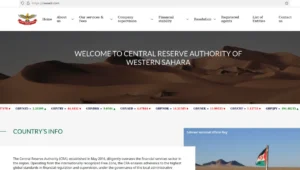
Investigations into the corporate ownership of Certa Payments (the initial parent company of Cryptomus) revealed that its sole shareholder was a 25-year-old Ukrainian woman. Concurrently, she headed several other corporate entities, including the WS Management and Advisory Corporation. This enterprise marketed itself as an exclusive regulatory body responsible for licensing cryptocurrency exchanges, foreign exchange (forex) brokers, and online gaming businesses incorporated within the Western Sahara—a disputed territory in northwest Africa that is not widely recognized as a sovereign nation.
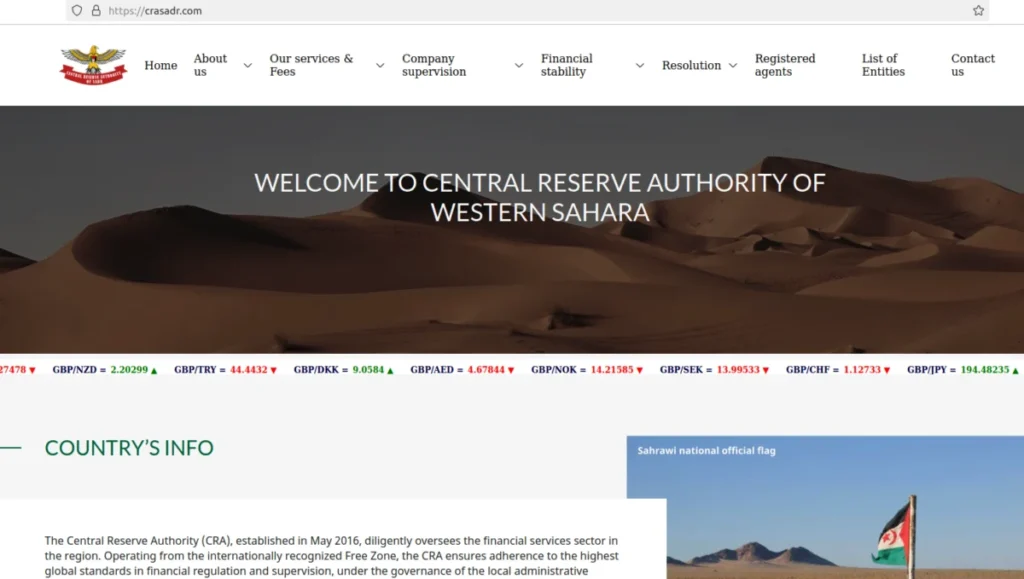
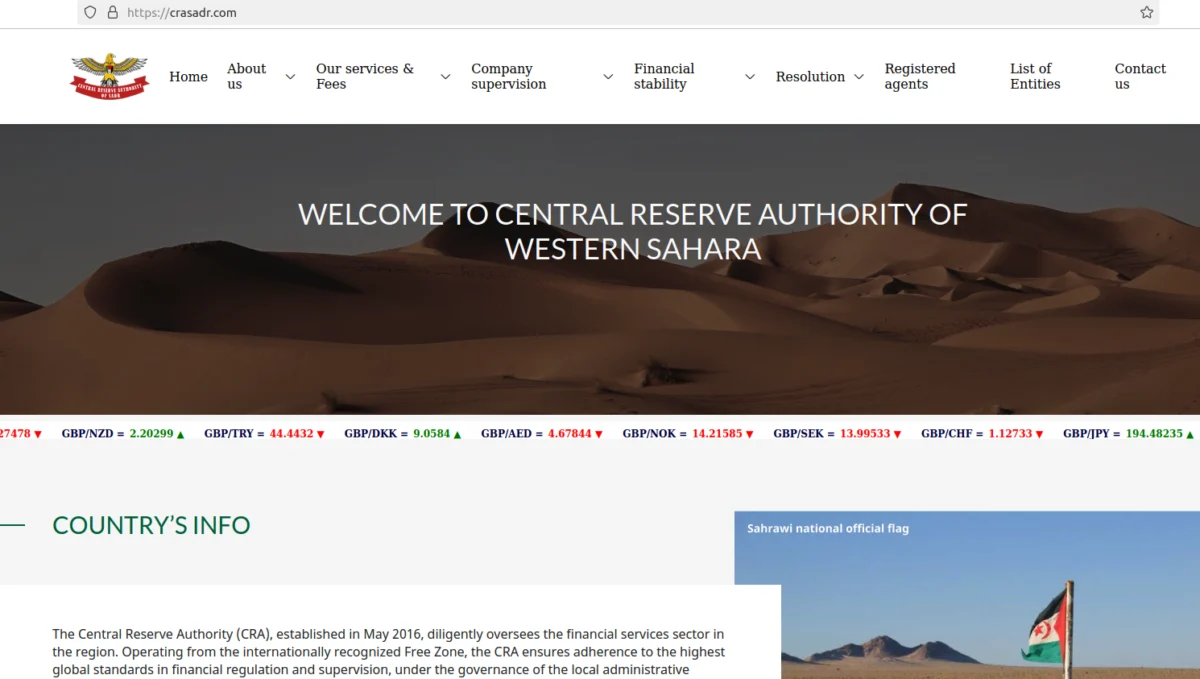
The regulatory body’s official web portal (crasadr.com), operating under the guise of the Central Reserve Authority of the Western Sahara, boldly listed the entities it had supposedly vetted and licensed. Forensic analysis further revealed that Certa Payments’ early infrastructure shared web hosting servers with domains linked directly to this fictional central bank apparatus (rasd-state.ws).
A Turning Point for Crypto Regulation
The U.K.’s targeting of Cryptomus and Heleket signals a definitive shift in how western governments intend to combat cybercrime and sanctions evasion. Regulators are moving past symbolic monetary fines directed at opaque foreign shell corporations, pivoting instead toward total asset freezes and structural blacklisting.
As blockchain analysts continue to untangle the remnants of the Cryptomus, VexPay, and TokenSpot networks, the message to illicit crypto-processors is unambiguous: corporate rebranding, fake regulatory certificates from disputed territories, and shifting domains will no longer provide immunity from the long arm of international law enforcement.