Securing the Modern Web: A Comprehensive Review and Evaluation of Acunetix Web Vulnerability Scanner (WVS)
Introduction: The Escalating Threat Landscape of Web Applications
In the contemporary digital ecosystem, web applications and websites have evolved far beyond digital brochures; they are the core operational components of modern business. From managing global supply chains and housing sensitive customer databases to executing high-volume financial transactions, organizations rely heavily on web-based infrastructure. However, this hyper-connectivity comes with a heavy cost. As the volume of web deployments surges, cybercriminals and malicious hacking collectives are increasingly targeting the application layer—the weakest link in many corporate security postures.

According to recent cybersecurity statistics, a significant percentage of data breaches originate from web application vulnerabilities such as SQL Injection (SQLi), Cross-Site Scripting (XSS), and flaws outlined in the OWASP Top 10. In response to this relentless threat environment, proactive security measures are no longer optional. Website vulnerability scanning must be integrated natively into every phase of the Software Testing Life Cycle (STLC).

Among the myriad tools available to security auditors, penetration testers, and developers, Acunetix Web Vulnerability Scanner (WVS) remains a gold standard for automated security audits. This review explores the architecture, core capabilities, advanced engines, and overall efficacy of Acunetix WVS, examining how it helps organizations safeguard their critical digital assets.

Main Facts: What is Acunetix Web Vulnerability Scanner?
Acunetix WVS is a robust, automated web application security testing tool explicitly designed to combat the exponential rise in web layer attacks. At its core, the software audits a website or web application’s security posture by launching a simulated, controlled series of aggressive attacks against the target. Following the assessment, it generates concise, actionable reports detailing discovered vulnerabilities alongside remediation advice.

Key Capabilities at a Glance:
- Black-Box Testing Engine: Operates without prior knowledge of the target’s underlying architecture, mirroring the behavior of an external attacker.
- Technology Fingerprinting: Intelligently identifies the underlying technology stack (PHP, .NET, Ruby on Rails, Java, and various CMS platforms like WordPress) to optimize scan times and test methodologies.
- DeepScan Engine: Features a fully integrated headless browser to evaluate HTML5, AJAX, and JavaScript-heavy applications, ensuring high-accuracy detection of DOM-based XSS.
- Interactive Application Security Testing (IAST) via AcuSensor: Optional server-side component for PHP and .NET applications that pinpoints exact lines of vulnerable code.
- Out-of-Band Detection via AcuMonitor: Automatically detects elusive "second-order" vulnerabilities, including Blind XSS, SSRF, XXE, and Blind Out-of-Band SQLi.
Chronology: Step-by-Step Execution of an Acunetix Vulnerability Scan
To understand how Acunetix WVS operates in a real-world scenario, we can walk through a hands-on audit of a test environment (such as the PHP test site provided by Acunetix at http://testphp.vulnweb.com).

1. Initiating the Scan Wizard
Starting a new scan is streamlined through the intuitive Scan Wizard, accessible via the main toolbar. Users input the target URL and begin configuring the scan parameters. For users operating behind specialized network configurations, the scanner permits granular control, allowing proxy routing (such as HTTP proxies) and integration with external tools like Burp Suite, Fiddler, or Acunetix’s built-in HTTP Sniffer.

2. Selecting Scanning Profiles
Scanning Profiles allow users to logically group tests based on specific requirements. While the Default profile executes every test in the scanner’s library, auditors can customize scans to focus strictly on high-risk vulnerabilities, thereby optimizing resource allocation and testing duration.

3. Navigating Password-Protected Areas
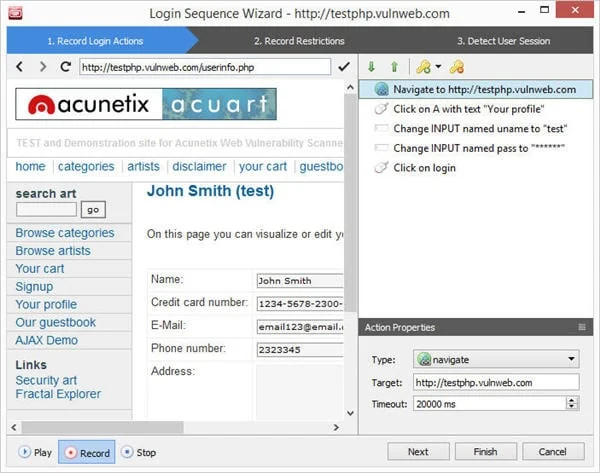
One of the most historically tedious aspects of web vulnerability scanning is authenticating into secure portals. Acunetix WVS simplifies this via the Login Sequence Recorder.

- Recording: Users log into the application normally while the recorder logs actions to replay during the scan.
- Session Management: Users can restrict the scanner from clicking sensitive links—such as a Logout button—using wildcards to handle dynamic tokens (nonces).
- Session Patterns: The recorder automatically detects unique differences between logged-in and logged-out states to ensure the session remains active throughout the scan.
4. Executing the Scan and Reviewing Results
Once crawling and testing conclude, Acunetix WVS presents a prioritized list of high-severity vulnerabilities. Clicking an alert reveals the vulnerable input parameter, specific attack variations, impact analysis, and remediation steps. If the optional AcuSensor is installed, the output even displays the exact file name and line of code requiring modification.

5. The Retest Feature
Rather than running an entire scan from scratch after applying a patch, administrators can utilize the Retest feature. By right-clicking an alert and selecting Retest alert(s), the software re-runs the specific validation check, updating resolved vulnerabilities in a grey, strike-through font.

Supporting Data: Advanced Technical Engines
What elevates Acunetix WVS above basic web crawlers is its suite of specialized, high-performance engines designed to tackle modern web complexities.

The DeepScan Engine for AJAX and JavaScript
Modern web applications rely heavily on client-side rendering frameworks, Single Page Applications (SPAs), and complex JavaScript execution. Traditional scanners often fail to traverse these dynamic interfaces. Acunetix integrates a fully functional headless browser known as the DeepScan Engine. This engine allows the crawler to execute and interact with AJAX-heavy web applications, rendering DOM environments accurately and achieving exceptional detection rates for DOM-based XSS. Furthermore, it provides developers with a clear stack trace mapping how the XSS payload traversed the Document Object Model.

IAST via AcuSensor
Black-box scanners cannot observe backend code execution during runtime, while static code analysis tools often fail to understand how code behaves in production. Acunetix AcuSensor bridges this gap by introducing Interactive Application Security Testing (IAST). Installed on the server-side for PHP and .NET applications, AcuSensor communicates directly with the scanner.

Because the sensor has direct visibility into the backend, it detects vulnerabilities hidden deep within the application logic—such as SQL injections inside complex INSERT statements—that standard black-box scans might miss. Crucially, it achieves this without requiring developers to recompile pre-existing .NET DLLs, as the sensor can be dynamically injected and un-injected.

AcuMonitor for Second-Order Vulnerabilities
Many critical vulnerabilities do not manifest immediate feedback during a scan. These "second-order" vulnerabilities include Blind XSS, Server-Side Request Forgery (SSRF), XML External Entity (XXE) injection, and Out-of-Band Remote Code Execution. Acunetix addresses this via AcuMonitor, a background intermediary service. Working seamlessly alongside the scanner, AcuMonitor captures callbacks from external systems, enabling the automated detection of these elusive, high-risk security flaws without manual intervention.

Official Responses and Reporting Capabilities
Compliance mandates and stakeholder communication are critical pillars of any vulnerability management program. Acunetix WVS features a comprehensive Reporter tool capable of translating technical findings into digestible formats.

Report Categories:
- High-Level Executive Summaries: Tailored for management and non-technical stakeholders, highlighting overall risk postures through affected items and quick reports.
- Compliance Standard Reports: Automatically updated to map vulnerabilities against major regulatory frameworks, including the OWASP Top 10, PCI-DSS, and HIPAA.
- Developer Reports: Highly configurable, granular technical reports that provide engineering teams with the precise data needed to remediate bugs efficiently.
Reports can be compiled and exported into industry-standard formats such as PDF and HTML for effortless distribution across enterprise teams. Additionally, the software features built-in manual penetration testing tools, allowing auditors to verify automated findings without constantly switching software environments.

Implications: The Strategic Value of Automated Web Scanning
The integration of advanced web vulnerability scanners like Acunetix WVS into enterprise workflows carries profound implications for organizational security, software development, and risk management.

- Shift-Left Security: By embedding automated scans and IAST technologies into the STLC, organizations can identify and neutralize vulnerabilities before code reaches production environments. This dramatically reduces the financial and reputational cost of remediation.
- Bridging the Developer-Security Divide: Detailed reporting, precise line-of-code identification via AcuSensor, and clear remediation guidelines empower developers to write more secure code organically, fostering a culture of shared security responsibility.
- Regulatory Compliance Assurance: With automated mapping to regulatory frameworks like PCI-DSS and HIPAA, compliance officers can streamline audit preparations and avoid steep financial penalties associated with data governance failures.
- Resilience Against Advanced Persistent Threats (APTs): By leveraging DeepScan for modern JavaScript frameworks and AcuMonitor for second-order vulnerabilities, organizations close blind spots that sophisticated attackers routinely exploit.
Conclusion
Acunetix Web Vulnerability Scanner represents a mature, highly capable solution for web application security. By combining the speed and ease of black-box scanning with the deep visibility of IAST (AcuSensor) and out-of-band tracking (AcuMonitor), it equips security professionals and software engineers with the precision needed to secure modern web infrastructure. Whether deployed on-premises or accessed via online cloud solutions, Acunetix WVS remains an indispensable asset in the ongoing battle to secure the digital perimeter.