Engineering IdeaPilot: A Masterclass in Modern Full-Stack Architecture for AI-Powered Applications
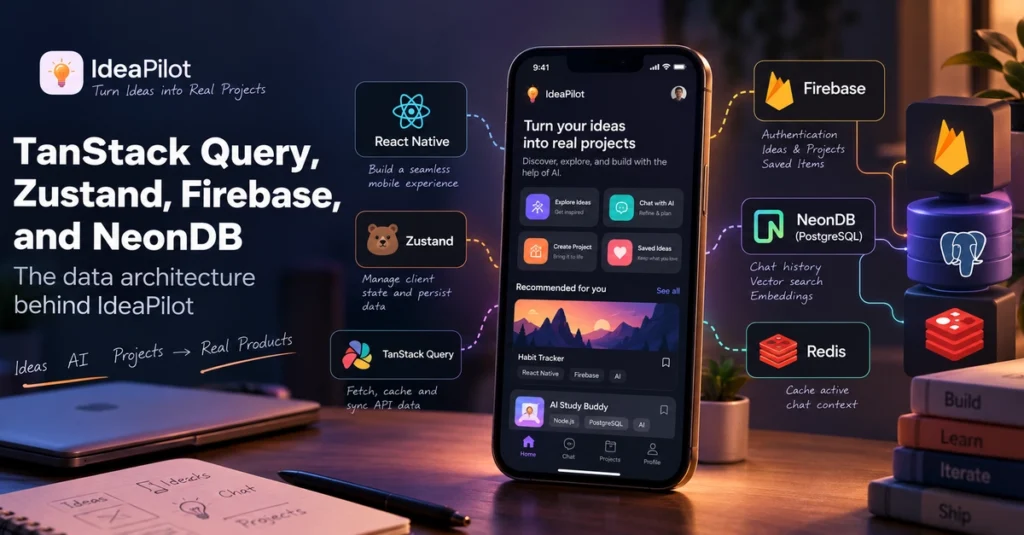
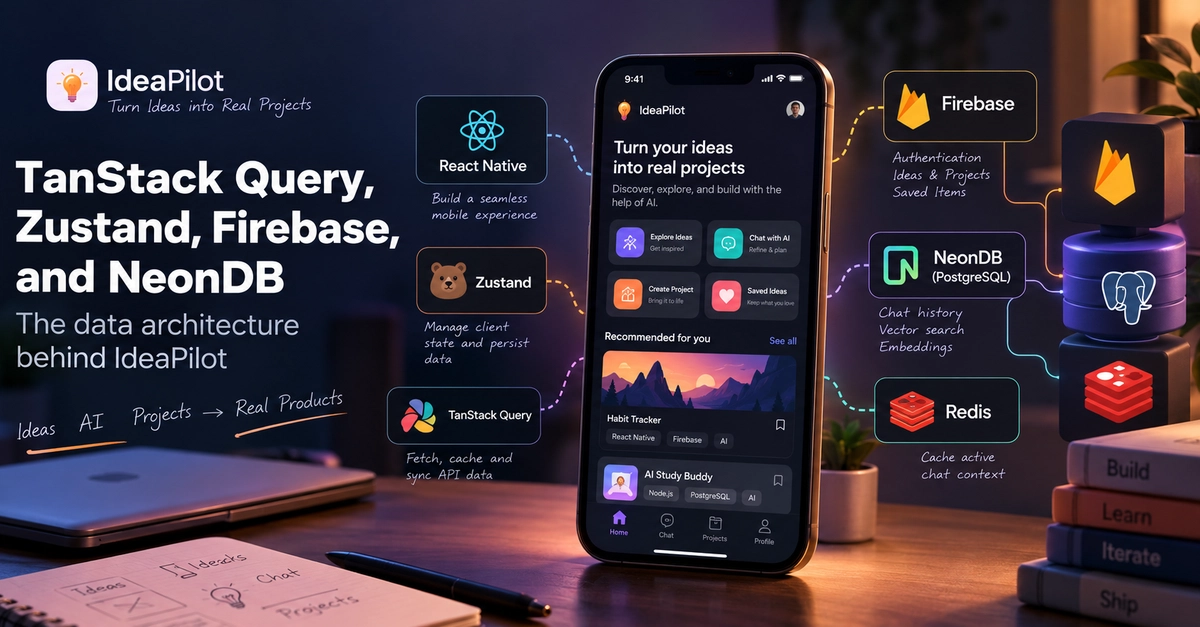
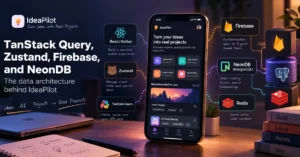
Abstract & Overview: In the rapidly evolving landscape of artificial intelligence-driven software, selecting the right tech stack is only half the battle. The true architectural challenge lies in defining data ownership, mutation lifecycles, and persistence layers. This comprehensive technical report explores the structural blueprint of IdeaPilot, a cutting-edge React Native and Expo application designed for AI-powered project discovery, creation, and contextual chat. By examining its integration of TanStack Query, Zustand, Firebase, NeonDB with pgvector, and Redis, developers can glean invaluable lessons on building resilient, scalable cross-platform AI tools.
1. Main Facts: The Anatomy of a High-Performance AI Ecosystem
Modern mobile applications—particularly those leveraging heavy Large Language Model (LLM) integrations—suffer from distinct performance bottlenecks. They must balance real-time conversational UI updates, asynchronous network requests, offline-first client states, and heavy vector database computations on the server.
IdeaPilot approaches these challenges through a strict separation-of-concerns philosophy. Rather than forcing a single database or state management library to handle every edge case, the application delegates specific responsibilities to tailored technologies:
- Client Framework: React Native powered by Expo, delivering cross-platform native performance with rapid iteration cycles.
- API & Backend Services: Node.js running Express, handling resource orchestration, authentication verification, and proxying requests to AI models.
- Client State Management: A hybrid approach utilizing TanStack Query for remote API lifecycle management and Zustand for global client-owned UI state and form drafts.
- Authentication & Document Storage: Firebase Auth for secure identity provisioning and Cloud Firestore for user-scoped document storage (saved ideas, custom projects).
- Relational & Vector Database: NeonDB (Serverless PostgreSQL) augmented with the
pgvectorextension for durable chat histories and high-performance semantic retrieval. - Caching Layer: Redis, deployed to store ephemeral conversational contexts and drastically reduce database read overhead during active user sessions.
2. Chronology: The Architectural Evolution of IdeaPilot
The construction of IdeaPilot followed an iterative, problem-driven developmental timeline. Understanding this chronology reveals why specific tools were adopted at distinct phases of the product’s maturity.
Phase 1: Client Foundation and Authentication
Initially, the primary objective was establishing a robust client-side shell. The developer integrated React Native with Expo to accelerate mobile deployment. Concurrently, Firebase Auth was implemented to solve the identity management problem. By establishing secure token-based authentication early, every subsequent API request from the client could safely inject a Firebase ID token via an Axios interceptor:
apiClient.interceptors.request.use(async (config) =>
  const token = auth.currentUser
    ? await auth.currentUser.getIdToken()
    : null;

  if (token)
    config.headers.Authorization = `Bearer $token`;

  return config;
);
Phase 2: Solving Remote Data Lifecycles
As soon as the Express backend began serving chat logs and project resources, raw useEffect hooks and local component states proved insufficient. Race conditions, duplicate network requests, and stale UI states plagued early builds.
To resolve this, TanStack Query was introduced. By centralizing API data fetching, caching lifetimes (staleTime and gcTime), and pagination (useInfiniteQuery), the application achieved instantaneous performance gains. Network requests for chat messages were cleanly paginated via cursors, ensuring that users scrolling through extensive history only fetched data on-demand.
Phase 3: Scaling AI Context with Vector Embeddings
Building a conversational interface meant addressing the "context window" problem inherent to LLMs. Simply loading every historical message into memory was financially and computationally unsustainable.
In response, the backend architecture was upgraded to incorporate NeonDB (PostgreSQL) paired with Drizzle ORM and the pgvector extension. This enabled HNSW (Hierarchical Navigable Small World) indexing for vector similarity searches, allowing the system to fetch both recent conversational context and semantically relevant historical snippets in parallel.
3. Supporting Data: Deep Dive into Code and Component Layers
To truly understand how IdeaPilot operates under the hood, we must examine the specific implementation details across its client and server layers.
Managing Remote Data with TanStack Query
TanStack Query acts as the gatekeeper for all server-client synchronization. For instance, managing chat history is handled via a dedicated, highly optimized query hook:
export function useChatHistory(enabled: boolean)
  return useQuery<Chat[]>(
    queryKey: ["chats"],
    queryFn: async () =>
      const  data  = await apiClient.get("/chats");
      return data;
    ,
    staleTime: 1000 * 60 * 5,
    gcTime: 1000 * 60 * 30,
    enabled,
  );
Furthermore, optimistic updates are heavily utilized to ensure the user interface feels instantaneous. When a user renames, pins, or deletes a chat, the application updates the cache immediately while rolling back changes gracefully should the server mutation fail:
onMutate: async ( chatId, title ) =>
  await queryClient.cancelQueries( queryKey: ["chats"] );
  const previousChats = queryClient.getQueryData<Chat[]>(["chats"]);

  queryClient.setQueryData<Chat[]>(["chats"], (old) =>
    old?.map((chat) => (chat.id === chatId ?  ...chat, title  : chat)) ?? []
  );

  return  previousChats ;
,
onError: (_error, _variables, context) =>
  if (context?.previousChats)
    queryClient.setQueryData(["chats"], context.previousChats);

,
onSettled: () =>
  queryClient.invalidateQueries( queryKey: ["chats"] );
,
Client-Owned State via Zustand
While TanStack Query masters server state, client-owned state—such as multi-step form drafts for project creation—requires a different tool. Zustand provides a lightweight, performant store that keeps drafts accessible across screens without polluting component trees:
const useCreateProjectStore = create<CreateProject>((set) => (
  project: INITIAL_PROJECT,
  update: (values) =>
    set((state) => (
      project:  ...state.project, ...values ,
    )),
  reset: () => set( project: INITIAL_PROJECT ),
));
By leveraging Zustand’s persistence middleware coupled with React Native’s AsyncStorage and selective serialization (partialize), user workspaces persist across app reboots without sacrificing memory efficiency.
Semantic Retrieval and Database Engineering
The core differentiator of IdeaPilot is its AI intelligence. When a user submits a prompt, the backend executes a parallel query to NeonDB, fetching the top three semantically similar past messages alongside the four most recent messages:
const [semanticContext, recentMessages] = await Promise.all([
  db.select( content: messages.content )
    .from(messages)
    .where(eq(messages.chatId, chatId))
    .orderBy(cosineDistance(messages.embedding, userEmbedding))
    .limit(3),

  db.select( role: messages.role, content: messages.content )
    .from(messages)
    .where(eq(messages.chatId, chatId))
    .orderBy(desc(messages.id))
    .limit(4),
]);
This hybrid retrieval approach ensures the AI maintains conversational continuity while pulling relevant conceptual insights from much earlier in the project’s lifecycle.
4. Official Responses and Engineering Philosophy
The creator of IdeaPilot emphasizes that the overarching lesson learned during development is that state ownership must strictly follow data responsibility.
In official post-mortem notes regarding the project’s architecture, the engineering rationale highlights:
- Never duplicate remote state: Keeping the same data independently mirrored across multiple state managers without strict synchronization leads to unpredictable bugs and stale UI anomalies.
- Local persistence is not synchronization: Storing data locally via
AsyncStorageor IndexedDB does not guarantee its validity against the server. A robust refresh and invalidation strategy is always required. - Caching vs. Durability: Caching layers like Redis optimize active performance, but they must never be treated as the ultimate source of truth, which remains the domain of durable databases like NeonDB and Firestore.
5. Implications for the Future of React Native and AI App Development
The architectural patterns proven in IdeaPilot carry profound implications for mobile developers building AI-heavy applications. As users increasingly expect real-time, context-aware artificial intelligence embedded natively into mobile workflows, traditional CRUD application designs fall short.
By demonstrating how to cleanly bridge client-side state managers (TanStack Query/Zustand), scalable authentication layers (Firebase), serverless relational/vector databases (NeonDB + pgvector), and ephemeral caching tiers (Redis), IdeaPilot serves as a blueprint for the next generation of intelligent software architecture.
Developers embarking on similar generative AI projects would do well to heed its primary directive: Before writing code, define who owns the data, how it mutates, and where it persists.
Explore the complete source code and contribute to the ecosystem via the official IdeaPilot GitHub Repository.