Accelerating the Dashboard: Google’s Major Overhaul for Android in Cars

By Editorial Staff
The automotive cockpit is undergoing its most significant transformation since the invention of the radio. As the digital and physical worlds converge, Google is doubling down on its commitment to the automotive sector. At this year’s Google I/O, the Android for Cars team—led by Developer Relations Engineers Jan Kleinert and Thomas Weathers, alongside Senior Product Manager Noam Gefen—unveiled a suite of updates designed to bridge the gap between mobile innovation and automotive safety.
For developers, the message is clear: "Build once, reach every screen." With new tools, expanded template capabilities, and the integration of mobile-first design languages, Google is effectively turning the car dashboard into a first-class citizen of the Android ecosystem.
Main Facts: The Evolution of the In-Car Ecosystem
The latest updates to the Android for Cars platform focus on three core pillars: Media Versatility, Video Immersiveness, and UI Consistency.

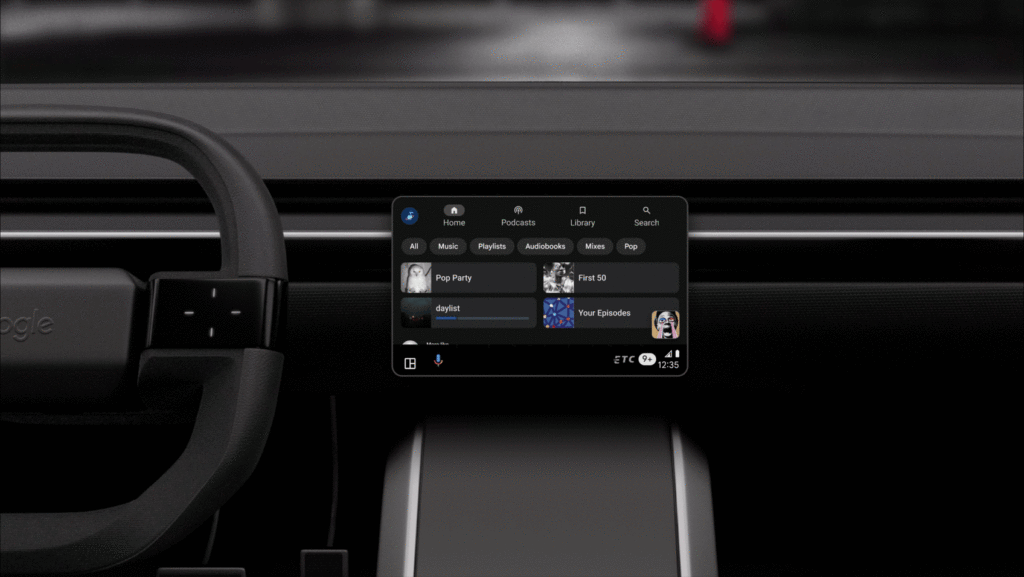
At the heart of these updates is the evolution of the Car App Library. With the release of versions 1.8.0-beta01 and 1.9.0-alpha01, Google is providing developers with a more modular toolkit. These updates allow for more expressive layouts, including spotlight sections, grid variations, and expanded headers.
Perhaps most notably, the "build-once" philosophy is finally extending to Android Automotive OS (AAOS). Developers can now deploy media browsing and playback experiences across both Android Auto (phone-projected) and AAOS (built-in) using a unified templated approach. Furthermore, for the first time, Android Auto will support high-definition video playback while the vehicle is parked, enabling a cinematic experience that mirrors the capabilities currently found in native Google-built-in systems.
Chronology: A Roadmap of Rapid Deployment
The progress of Android in cars has been exponential rather than linear.
- Early 2023: Initial rollout of media templates for Android Auto began setting the standard for distraction-optimized design.
- Late 2023: Google accelerated the adoption of Android Automotive OS, moving away from phone-dependent projection toward full, hardware-integrated software stacks.
- Google I/O 2026 (Present): The launch of Car App Library 1.9.0-alpha01 marks a shift toward "adaptive" design. Developers can now utilize Material 3 Expressive components, allowing mobile widgets to migrate seamlessly into the car’s dashboard.
- The Future (Late 2026 and beyond): The rollout of video-on-demand capabilities for parked Android Auto users and the integration of widget support across all Google-built-in platforms.
Supporting Data: Why This Matters for Developers
The shift toward a unified car app architecture is driven by the sheer scale of the Android ecosystem. Currently, millions of vehicles worldwide rely on Android for their infotainment needs. By reducing the development friction—allowing developers to use the same codebase for both projection and embedded OS—Google is inviting a new wave of third-party innovation.

Key technical enhancements include:
- API Level 35-ext15 Support: Updated system images for the AAOS emulator ensure that developers can stress-test their media templates against the latest software standards before deployment.
- Adaptive Mini-Players: By introducing a persistent mini-player, Google is solving the "browsing vs. listening" dilemma, ensuring that users can explore new content without losing control of their current audio playback.
- 60fps HD Video: This capability represents a significant technical hurdle cleared by the Android team, ensuring that latency is minimized while maintaining high-fidelity visuals, even in the constrained environment of a car’s infotainment system.
Official Perspectives: The Vision from Mountain View
The Android for Cars team emphasizes that these changes are not merely cosmetic; they are structural improvements designed to enhance safety while increasing engagement.
"We’re thrilled to see developers continuing to bring their apps and experiences to Android for Cars," said Jan Kleinert. According to the team, the goal is to make the dashboard feel as intuitive as a smartphone while respecting the unique constraints of the driving environment.
The introduction of the "early-access beta program" for media apps suggests that Google is taking a collaborative approach, working closely with industry giants like Spotify, YouTube Music, and Amazon Music to ensure that the new templates meet the high standards expected by modern drivers. By inviting feedback through programs like the Media Comms EAP, Google is positioning itself as an orchestrator of a broader automotive ecosystem rather than a monolithic gatekeeper.

Implications: The Future of the Digital Cockpit
The implications of these updates are profound, affecting how we interact with our vehicles and how developers monetize their software.
1. The Death of the "Second-Class" Experience
Historically, car apps were stripped-down versions of mobile apps. With the integration of Material 3 Expressive design, the visual language of the phone is finally matching the dashboard. This creates a psychological continuity for the user; moving from the driveway to the highway doesn’t mean leaving your familiar UI behind.
2. The Rise of the "Parked Experience"
For years, the "parked" state of a car was considered dead time. By enabling 60fps video, Google is unlocking the car as a third living space. Whether it is a commuter waiting for a school pickup or a family charging their EV at a station, the ability to watch high-definition content represents a massive expansion of the "in-car" addressable market for media companies.
3. Widgetization of the Dashboard
The introduction of widgets to the car UI is perhaps the most significant functional change. Mobile widgets allow for "glanceable" information. By bringing these to the car, Google is enabling users to see their next calendar appointment, weather updates, or smart home status without navigating through complex menu structures. This reduces driver cognitive load while increasing the utility of the vehicle’s screen.

4. Developer Monetization and Reach
For smaller developers, the ability to "build once" for Android Auto and Android Automotive OS is a game-changer. It lowers the barrier to entry, allowing independent studios to compete with major media corporations on a level playing field. As the "Google built-in" footprint grows, the potential reach for these apps will likely eclipse that of traditional app stores in the coming decade.
Conclusion: The Road Ahead
As the industry moves toward autonomous and semi-autonomous driving, the infotainment screen will become the primary touchpoint for the human-machine interface. Google’s commitment to providing a flexible, robust, and beautiful development platform is the bedrock upon which the next generation of driving experiences will be built.
With the 1.9.0-alpha01 release, developers have more power than ever to create, iterate, and distribute. The "road ahead" is not just about the car moving from point A to point B; it is about the software inside the dashboard keeping the driver connected, informed, and entertained in ways that were once the stuff of science fiction.
For those ready to start building, the tools are available today at goo.gle/cars-whats-new. As the ecosystem expands, we can expect the car to become not just a machine, but a fully integrated mobile environment. The transition has begun, and for the Android developer community, the dashboard is wide open.