Architecting the Intelligent Enterprise: Beyond Memory to Planning, Tool Use, and Reflection
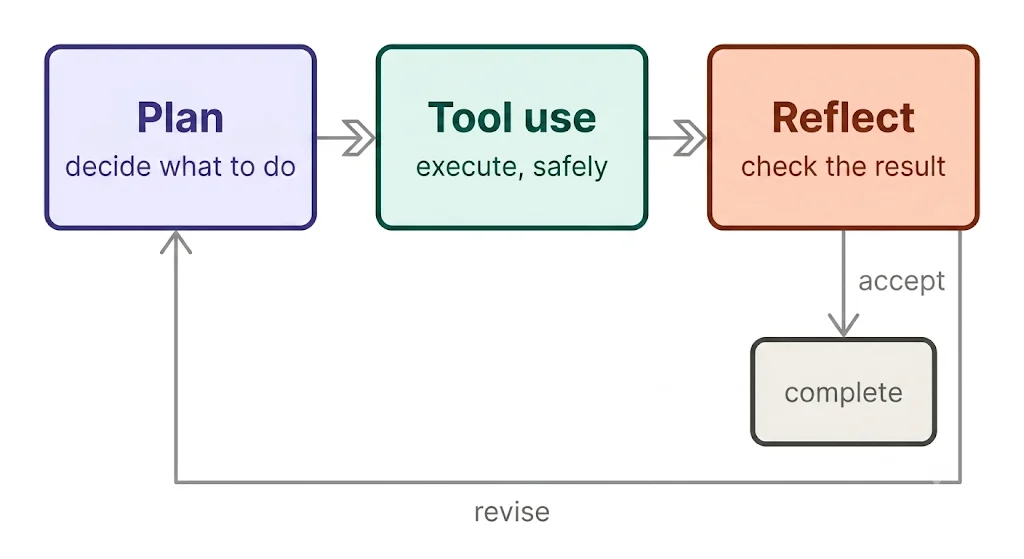
In the rapidly evolving landscape of enterprise artificial intelligence, a fundamental shift is occurring. Organizations are moving away from simple, chat-based LLM interfaces toward robust, autonomous agentic systems. However, as developers have discovered, memory—while necessary for continuity—is insufficient to drive actual business value. An agent that remembers everything but cannot act is merely an expensive search index.
To participate in meaningful business processes, an AI agent must master three critical pillars: planning, tool use, and reflection. These capabilities represent the transition from probabilistic question-answering to deterministic enterprise execution.
Main Facts: The Operational Core of the Agent Layer
At its essence, an enterprise agent is a bridge between the fluid, probabilistic reasoning of Large Language Models (LLMs) and the rigid, deterministic world of enterprise systems—databases, APIs, and workflow engines.
The architecture for such a system must be built on a "Plan-and-Execute" model. Planning involves decomposing an ambiguous business objective into a sequence of executable steps with clear inputs and outputs. Tool use provides the mechanism to interact with operational systems, while reflection acts as the quality control layer, ensuring that the agent’s outputs are trustworthy, safe, and aligned with business logic.
Unlike consumer-grade AI, which can afford the occasional hallucination, an enterprise agent operating on financial or operational data requires auditability. Every action must be logged, every tool call must be validated, and every decision must be traceable back to a specific piece of evidence.
Chronology of Development: From Chatbot to Agent
The progression of AI in the enterprise can be mapped through three distinct phases:
- The Retrieval Phase: Early enterprise AI focused on RAG (Retrieval-Augmented Generation). The goal was to feed context into a model so it could answer questions based on internal documentation. The limitation was that the model remained a passive respondent.
- The Reasoning Phase: The industry moved toward "Chain-of-Thought" prompting, where models were encouraged to show their work. While this improved accuracy, it remained transient and lacked the structure required for long-term, multi-step operations.
- The Agentic Phase (Current): Today, the industry is building durable, agentic workflows. By incorporating external planning, formal tool contracts, and independent evaluation models, engineers are creating systems that can safely interact with production PostgreSQL databases and enterprise APIs to execute tasks ranging from anomaly detection to automated reporting.
Supporting Data: Why "Plan-and-Execute" Outperforms ReAct
For years, the industry leaned heavily on the "ReAct" (Reasoning + Acting) pattern, where an agent decides its next move after every step. While excellent for exploratory tasks or incident response, it is a liability for regulated financial workflows.

| Pattern | Best Fit | Enterprise Risk |
|---|---|---|
| ReAct | Incident response, exploration | High cost, low observability, poor auditability |
| Chain-of-Thought | Complex logic within a single step | Not a durable plan; transient reasoning |
| Tree-of-Thought | Strategic, high-stakes decisions | Overkill for routine tasks |
| Plan-and-Execute | Regulated workflows, production systems | The gold standard for audit and control |
Data suggests that as the complexity of the task increases, the overhead of ReAct’s iterative prompting creates a "cost-inflation" loop. By contrast, a Plan-and-Execute architecture allows the agent to generate a structured, reviewable plan before touching a production system. This enables human-in-the-loop validation, where a supervisor can review the proposed sequence of SQL queries or API calls before the agent executes them.
The Role of Reflection: Building a Rubric, Not a Vibe
"Reflection" is often misunderstood as the model simply "thinking about its output." In a professional environment, reflection must be operationalized as a rigid rubric.
The Mechanism of Evaluation
When an agent generates a report or a SQL query, it should not be the sole judge of its own work. A secondary "Critic" model should be employed to evaluate the output against a pre-defined checklist:
- Completeness: Does the output address every part of the original prompt?
- Safety: Does the query contain unauthorized commands (e.g., DROP, GRANT)?
- Accuracy: Does the evidence provided support the conclusion reached?
By stacking deterministic checks (e.g., parsing SQL against an Abstract Syntax Tree) with model-based semantic evaluation, organizations can create a defense-in-depth security posture. If the agent’s logic fails, the system must trigger one of four terminal states: Approve, Revise, Escalate, or Halt.
Implications: The Shift to Systems Engineering
The transition from "prompt engineering" to "systems engineering" is the most significant implication of this architecture. Developers are realizing that the most important part of an agent is not the prompt—it is the tool contract.
Designing Reliable Tool Contracts
A tool should never be a "black box" that accepts free-form text. It must be a strongly typed API. For example, instead of a tool named run_query(sql), the system should expose get_recurring_revenue(period_id, region_id). This prevents the model from attempting to inject malicious code or querying sensitive tables. By narrowing the contract, we enforce the principle of least privilege at the architectural level.
The PostgreSQL Guardrail
For agents interacting with PostgreSQL, the use of EXPLAIN as a pre-execution guardrail is a non-negotiable best practice. By analyzing the execution plan of a proposed query before it runs, the system can estimate the cost and potential impact. If a query requires a full table scan on a massive production table, the system can automatically reject it, regardless of how "confident" the LLM was in its generation.

Official Perspectives: The Human-in-the-Loop Requirement
There is a misconception that as models improve, the "Human-in-the-Loop" will become obsolete. Industry experts argue the opposite: human oversight is a procedural and legal necessity, not just a technical safeguard.
In high-stakes environments—such as finance, healthcare, or legal—accountability must remain with a human role. The architecture must therefore treat "Human Approval" as a first-class citizen. An agent that prepares a financial adjustment should pause, present the evidence to a controller, and await a cryptographically signed approval before the transaction is committed to the database. This does not hinder speed; it enables the trust required to scale AI adoption across the enterprise.
Conclusion: Toward Multi-Agent Orchestration
We have established that memory, planning, tool use, and reflection are the foundational layers for a single, reliable agent. However, real-world enterprise tasks are rarely confined to a single process. A revenue analysis, for instance, might involve an agent that fetches data, another that runs statistical models, a third that checks compliance, and a final one that drafts the executive summary.
The next frontier—and the focus of Part 3 of this series—is the coordination of these multi-agent systems. When agents interact, they introduce complex problems: state synchronization, idempotency, and dependency management.
Designing for the intelligent enterprise requires us to stop viewing AI as a "chatbot" and start viewing it as a component in a distributed, reliable software system. The goal is not just to build a system that can think, but to build a system that must follow the rules of the enterprise. As we move into multi-agent orchestration, the disciplines of software engineering—explicit contracts, failure isolation, and durable state—will remain the most valuable tools in the developer’s arsenal. Any vendor suggesting that "better models" will solve these systemic challenges is missing the core requirement of enterprise-grade AI: control.