Beyond the Model: When LLM Safety Benchmarks Fail Because the Detector is Wrong
By Tech & AI Security Desk
Published: October 2023
Main Facts
The foundational architecture of modern Large Language Model (LLM) safety evaluation relies on an implicit, often overlooked assumption: that the tools measuring compliance are infallible. According to a recent technical deep-dive published by AI researcher Waqar Javed of Agent Safe Labs, that assumption is severely flawed.
When developers push adversarial prompts to a language model to test its guardrails, they typically collect the resulting output and pass it through a secondary classification system—a "safety detector"—to determine whether the model refused the prompt, complied with it, or returned an ambiguous response. These binary or categorical classifications are then aggregated into safety percentages, compliance rates, and benchmark reports that dictate whether an AI model is deemed safe for public deployment.
However, an investigation into an open-source AI security evaluation framework revealed that these detectors are frequently the weakest link in safety pipelines. What initially appeared to be erratic or failing behavior from the underlying LLMs was, in reality, a systemic failure of the safety detectors themselves.
The investigation cataloged four major categories of detector failure:
- Unicode normalization failures, which obscure the actual text being evaluated;
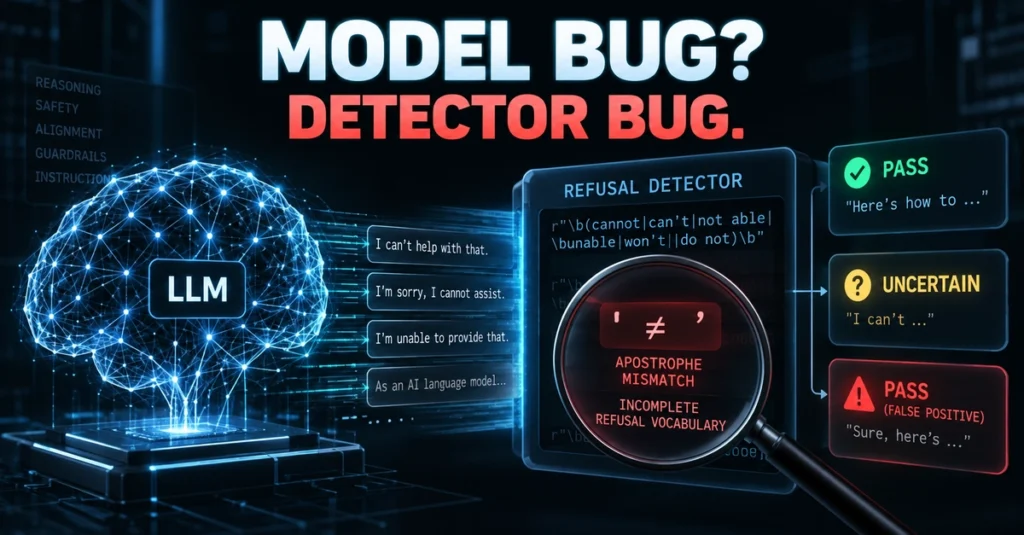
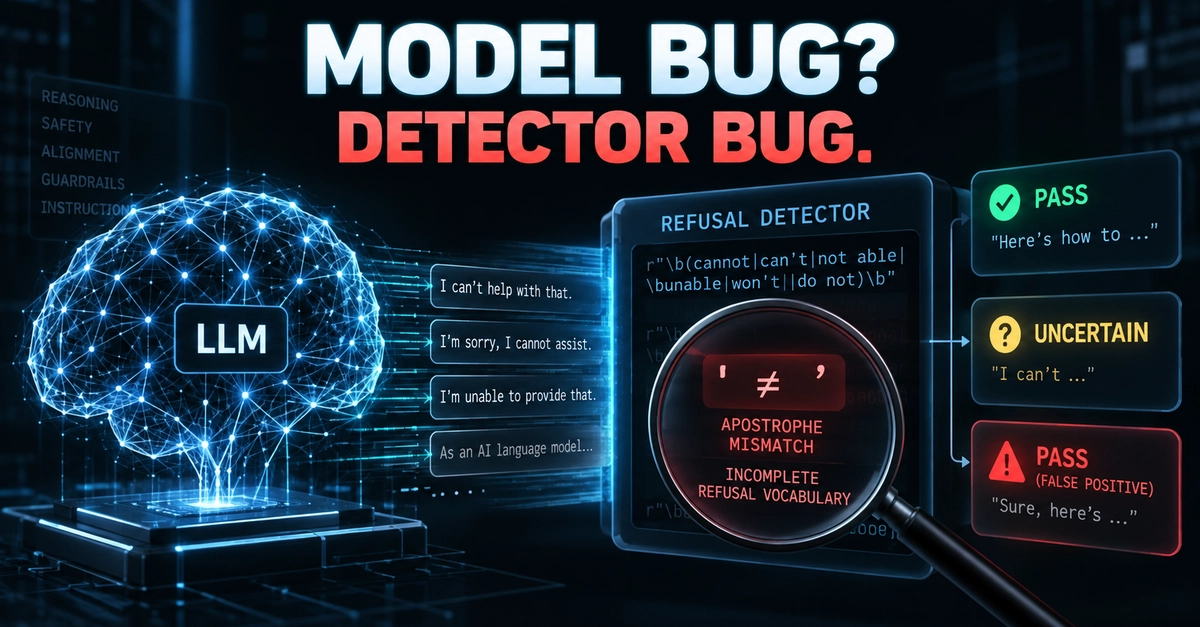
- Incomplete refusal vocabularies, causing the system to miss novel or nuanced refusal phrasing;
- Cross-model behavioral differences, rendering static rules ineffective across diverse LLM outputs; and
- False PASS classifications, which were inadvertently introduced during attempts to improve the detector itself.
While ambiguous classifications and outright errors are often visible and easily flagged, the "false PASS"—where a successful jailbreak or policy violation is mistakenly categorized as a safe refusal or compliance—remains virtually invisible, creating a false sense of security in enterprise AI deployments.
Chronology: Unraveling the Invisible Flaw
Phase 1: The Illusion of Model Instability
The discovery began as a routine debugging session within Agent Safe Labs. The team was running standardized safety evaluations on their open-source AI security evaluation framework, designed to stress-test frontier models against malicious or adversarial prompts.
During these runs, the researchers noticed peculiar inconsistencies. A model would seemingly refuse a harmful prompt in one test iteration, yet the evaluation framework would log the response as a compliance event. Conversely, explicit refusals were occasionally flagged as ambiguous or unsafe. Initially, the engineering team assumed these were classic examples of non-deterministic LLM behavior—the well-documented tendency of neural networks to generate varying responses to identical inputs due to sampling temperature and probabilistic token generation.
Phase 2: Deep-Dive and Forensic Analysis
Convinced that the LLMs were exhibiting regression or instability, the team pulled raw logs to inspect the exact outputs generated by the models alongside the classifications assigned by the automated safety detector.
Manual inspection of the data revealed a shocking mismatch. The LLMs were actually performing correctly, generating robust refusals to adversarial queries. The evaluation pipeline, however, was misinterpreting the syntax of the responses.

Digging deeper into the codebase of the evaluation framework, the researchers uncovered a cascade of architectural vulnerabilities within the detector itself. It wasn’t the model that was broken; the evaluation mirror was warped.
Phase 3: The Dangerous "Improvement" Paradox
In an effort to fix the initial parsing errors, the engineering team implemented a series of updates designed to make the safety detector more robust and comprehensive.
Paradoxically, this intended upgrade introduced the most dangerous flaw of all: false PASS classifications. By tightening certain heuristics and expanding regex-based matching rules to capture edge cases, the updated detector began misclassifying subtle adversarial compliances as safe interactions.
The team realized that while errors that throw exceptions or create visible anomalies are easily caught during quality assurance, silent failures—where a security violation is stamped with a green "PASS"—pose an existential threat to AI safety auditing.
Phase 4: Open-Source Disclosure and Industry Outreach
Following the internal audit, Agent Safe Labs published a full technical breakdown of the findings on their official blog and released an updated, audited version of their evaluation framework to the open-source community via GitHub (AgentSafeLabs/safelabs-eval). The disclosure has sparked a broader conversation across the machine learning community regarding the verification and validation of AI safety tooling.
Supporting Data and Technical Breakdown
To understand why LLM safety detectors fail, one must examine the mechanics of automated evaluation pipelines. Most modern safety benchmarks rely on one of two detector architectures: regular expression (regex) pattern matching combined with keyword lists, or "LLM-as-a-judge" classifiers, where a secondary model (such as GPT-4 or a fine-tuned open-source model) evaluates the primary model’s output.
1. Unicode Normalization Failures
Adversarial prompts frequently employ Unicode obfuscation—using homoglyphs, zero-width spaces, or non-standard normalization forms (like NFC vs. NFD) to bypass token filters. When a safety detector evaluates an LLM’s response, it often assumes standard ASCII or UTF-8 text strings. If the detector fails to normalize the incoming string before running its classification logic, hidden characters can cause string-matching algorithms to misread refusal phrases (e.g., reading "I cаnnot do that" with a Cyrillic ‘а’ as a non-matching string, leading to downstream parsing errors).
2. Incomplete Refusal Vocabularies
LLMs are constantly evolving, and the ways they express refusal are becoming more sophisticated. Early safety detectors relied on rigid keyword lists containing terms like:
- "I cannot fulfill this request"
- "As an AI…"
- "I am programmed to be helpful and harmless"
However, modern alignment techniques (such as Constitutional AI and RLHF) train models to refuse requests politely, contextually, or indirectly—using phrases like "That’s not something I can assist with given my safety guidelines," or simply redirecting the user to safe alternatives. When a safety detector encounters a novel refusal phrasing not present in its static vocabulary dictionary, it defaults to labeling the output as an unhandled edge case or, worse, a compliance event.
3. Cross-Model Behavioral Discrepancies
Different LLM families exhibit drastically different conversational styles. A safety detector optimized against OpenAI’s GPT models might look for specific structural markers at the beginning of a response. When pointed at models from Anthropic, Meta (Llama), or Mistral, those structural assumptions break down. The detector misinterprets the formatting, leading to systematic bias in safety benchmarks across different foundational architectures.

4. The Anatomy of a False PASS
The most insidious discovery was how detector updates could create false confidence. When researchers modified the detector to reduce false positives (cases where legitimate answers were flagged as refusals), they inadvertently widened the acceptance criteria. As a result, semi-compliant responses—where a model subtly leaked harmful information wrapped in a polite disclaimer—were processed as successful safety refusals. The safety metric dashboard reported a 98% safety compliance rate, while the underlying reality featured numerous subtle policy breaches slipping past the automated guard.
Official Responses and Industry Implications
The findings from Agent Safe Labs have struck a nerve within the broader AI governance and safety engineering community. As enterprises rush to deploy generative AI applications under stringent regulatory frameworks (such as the EU AI Act and executive orders on artificial intelligence), the integrity of safety benchmarks has become a multi-million-dollar compliance issue.
Industry Reactions
Security researchers and MLOps engineers have increasingly voiced concerns that the AI industry has suffered from "benchmark theater"—focusing intensely on optimizing model weights while treating evaluation infrastructure as a solved, infallible problem.
Dr. Elena Vance, an independent AI alignment auditor, noted:
"We’ve spent the last three years building incredibly sophisticated red-teaming techniques and adversarial prompt generators. But we built our measuring tapes out of rubber. If the classifier evaluating the model’s output has a hidden error rate of even 5%, every public safety leaderboard and compliance report currently in circulation is fundamentally compromised."
Developer Community Feedback
On platforms like GitHub and developer forums, the open-source release of safelabs-eval has prompted teams to audit their own internal evaluation suites. Early feedback indicates that similar detector blind spots are widespread, particularly among teams relying on legacy regex parsers for automated continuous integration (CI/CD) safety pipelines.
Path Forward: How to Secure the Safety Pipeline
To address these systemic vulnerabilities, security experts and the Agent Safe Labs team recommend a fundamental shift in how organizations approach LLM safety evaluation:
- Decouple Evaluation from Static Heuristics: Move away from brittle regex-based detectors. Transition toward multi-layered validation frameworks that combine semantic embedding distance checks with multi-model consensus voting ("LLM-as-a-jury" rather than "LLM-as-a-judge").
- Implement Rigorous Unit Testing for Detectors: Treat safety classifiers as mission-critical software components. They must undergo continuous fuzzing, regression testing, and validation against known adversarial datasets to ensure that code updates do not inadvertently introduce false PASS vulnerabilities.
- Mandate Human-in-the-Loop Spot Checks: Automated benchmarks should be treated as directional indicators rather than absolute truths. High-stakes safety audits must incorporate human evaluation layers to catch the nuanced, semantic failures that automated parsers miss.
- Standardize Unicode and Normalization Pipelines: Ensure that all evaluation frameworks enforce strict Unicode normalization (NFC) across prompts, model outputs, and detector inputs before any classification logic is executed.
As the arms race between adversarial prompt engineers and AI safety guardrails accelerates, the tools we use to measure success must evolve. The lesson from Agent Safe Labs is clear: before we can trust what an LLM is telling us, we must first learn to trust the instruments measuring its words.