Raising the Bar: Android Bench Evolves with Harbor Framework and New AI Model Additions
In the rapidly accelerating landscape of artificial intelligence, the tools available to mobile developers are shifting from passive assistants to active, agentic collaborators. Since its inception in March, Android Bench has served as the definitive litmus test for Large Language Models (LLMs) tasked with navigating the complexities of the Android ecosystem. Today, Google announced a significant mid-year update to the platform, signaling a shift toward industry-standardized evaluation frameworks and the inclusion of eight high-performance models that are redefining the boundaries of automated coding.
Main Facts: A New Standard for AI Evaluation
The July release of Android Bench marks a transition from bespoke testing methods to the integration of the Harbor framework. This shift is not merely cosmetic; it represents a fundamental change in how the performance of AI models is measured against real-world Android development hurdles, such as Jetpack Compose migrations, wearable device networking, and complex platform API integration.
Key updates in this release include:
- Methodological Overhaul: Adoption of the Harbor framework, ensuring greater transparency, reproducibility, and standardized agent evaluation.
- Expanded Leaderboard: The addition of eight new models, including industry heavyweights like Claude Fable 5, Claude Sonnet 5, and Qwen 3.7 Max.
- Community Integration: A new initiative that invites the Android developer community to contribute their own testing tasks, ensuring the benchmark evolves alongside the actual day-to-day challenges faced by developers globally.
- Performance Recalibration: To maintain data integrity, the entire existing model catalog has been re-run under the new Harbor-based methodology, establishing a more rigorous, standardized baseline for all participants.
Chronology: From Concept to Industry Standard
The journey of Android Bench reflects the broader, breakneck pace of AI development over the last six months.
- March 2024: Google introduced Android Bench to address a clear gap in the market: the lack of specialized benchmarks for mobile development. Most general LLM benchmarks focus on Python or generic coding tasks; Android Bench was built to understand the nuances of the Android SDK.
- Q2 2024: Following the initial launch, the project expanded to include open-weight models and added granular metrics regarding cost and operational efficiency. This was in direct response to developer feedback, which highlighted that raw performance is secondary to usability and cost-effectiveness in a production environment.
- July 2024: The current milestone. By adopting the Harbor framework, the team has moved toward a "standardized agent" approach, moving away from the proprietary mini-swe-agent v1. This transition allows for better cross-industry comparison and makes it easier for third-party developers to run the benchmark on their own local infrastructure.
Supporting Data: Decoding the New Leaderboard
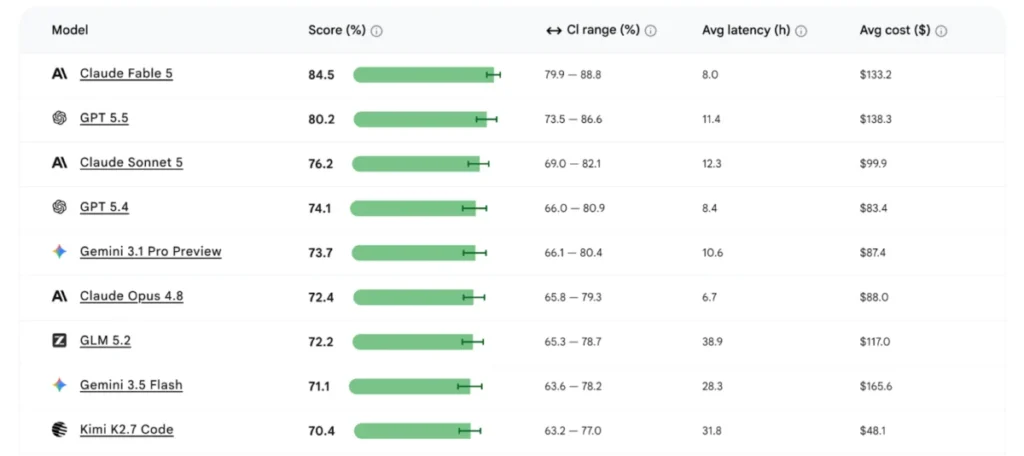
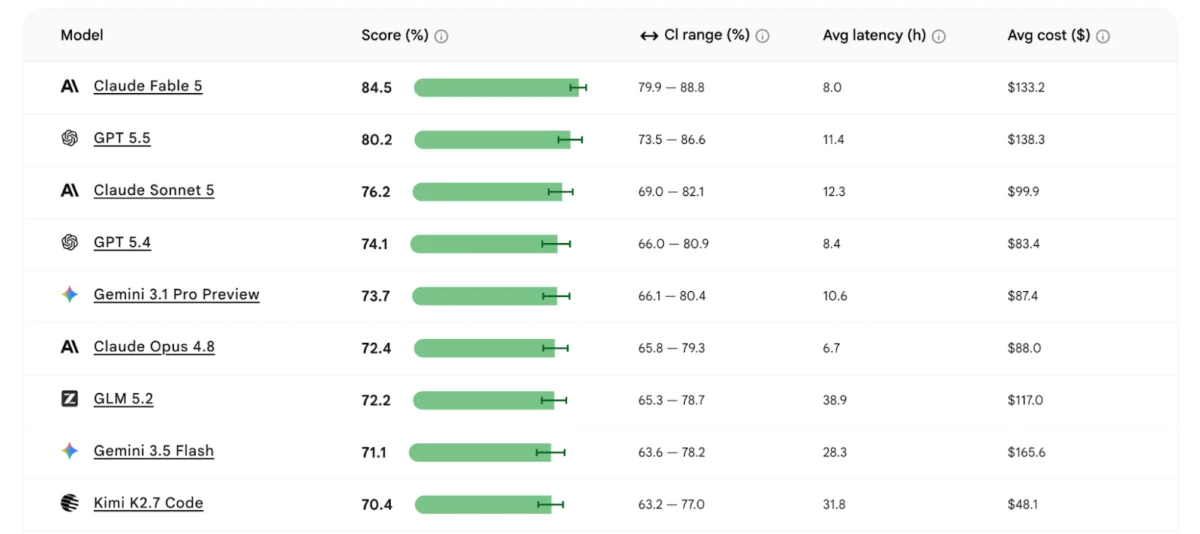
The leaderboard has seen a significant shakeup following the transition to the Harbor framework. The top-tier rankings now reflect a tighter competitive race between proprietary models and the rapidly improving open-weight segment.
The Top Tier
- Claude Fable 5: Leading the pack with an impressive score of 84.5. This model has demonstrated exceptional capability in handling long-context Android tasks.
- GPT 5.5: Following closely with a score of 80.2, maintaining its status as a robust choice for complex architectural tasks.
- Claude Sonnet 5: Holding the third spot with a score of 76.2, proving to be a highly efficient performer in the mid-range model category.
The Open-Weight Landscape
Perhaps most significant is the performance of open-weight models, which are becoming increasingly viable for enterprise use cases where data privacy and cost control are paramount.

- GLM 5.2: Leading the open-weight category with a score of 72.2.
- Kimi K2.7 Code: Following at 70.4.
These scores represent a shift in the "agentic" capabilities of these models. Unlike simple code completion, the Android Bench tasks require the AI to browse files, run tests, diagnose errors, and iteratively refine code—a much higher bar than traditional syntax-prediction benchmarks.
Official Responses and Strategic Vision
The decision to pivot to the Harbor framework was driven by a desire for "open-source alignment," according to the engineering team. By utilizing the Harbor framework, the Android Bench team is effectively democratizing the evaluation process.
"Our goal has always been to provide transparency," a spokesperson noted in the official release documentation. "By integrating with Harbor, we aren’t just creating a scorecard; we are creating a shared language for how we evaluate AI in the mobile domain."
The decision to open the benchmark to community contributions is equally strategic. By allowing developers to submit their own real-world bugs and tasks, the dataset becomes a living repository of the current "pain points" in Android development. Whether it’s a tricky transition from XML to Compose or a persistent issue with modern Gradle build scripts, these community-contributed tasks ensure the AI agents are being trained and tested on the problems that actually matter to the working developer.
Implications for the Android Ecosystem
The implications of this update are profound for both the individual developer and the broader software engineering industry.
1. Transparency as a Product Feature
For years, the "AI Black Box" problem has plagued developers. By providing a transparent, open-source benchmarking method, Google is allowing developers to verify if a model is actually capable of performing the heavy lifting involved in a professional app lifecycle. This reduces the time spent on "AI hallucination" debugging.

2. The Rise of the Agentic Workflow
The inclusion of models like Qwen 3.7 Max and MiniMax M3 highlights a shift toward "agentic" development. These models are not just suggesting lines of code; they are being evaluated on their ability to navigate entire project directories and perform multi-step operations. For the developer, this signals a transition toward an era where the IDE acts as a co-pilot that can manage technical debt, automate dependency updates, and perform integration tests with minimal human intervention.
3. Efficiency and Cost Optimization
The addition of efficiency metrics—which will be expanded upon in the coming months—serves as a vital filter. For a freelance developer or a startup, the most "intelligent" model is not always the best choice if it is prohibitively expensive or slow. Android Bench provides the data necessary to make an informed trade-off between model accuracy and operational cost.
4. A Call to Action for the Community
The move to open the benchmark to community contributions is a call to action for the broader Android ecosystem. Developers are encouraged to visit the GitHub repository to review existing tasks and submit their own. By participating, the community is essentially "teaching" the next generation of AI models how to be better Android developers.
Looking Ahead: The Future of AI-Assisted Development
As we look toward the remainder of 2024, the trajectory is clear: the gap between human-written code and AI-assisted code is closing, but the demand for accuracy is increasing. The standardization of Android Bench is a necessary step in maturing the role of AI in the mobile developer’s toolkit.
The integration of the Harbor framework is not just an update to a website; it is the establishment of a rigorous, academic-grade infrastructure that will dictate how we measure the progress of mobile software development for years to come. Whether you are an individual developer curious about which model to integrate into your workflow, or an enterprise architect looking for the most reliable tool for code migrations, the updated Android Bench serves as the essential compass for navigating the AI-driven future of mobile development.
For those eager to dive into the technical details, the full archival data is available on the official Android Bench website, and the community-driven dataset can be explored via the Harbor Hub. The next frontier is not just building faster, but building smarter, and with these latest updates, the Android community is well-positioned to lead the charge.