Bridging the Comprehension Gap: New Open-Source Tool ‘FluencyLoop’ Forces AI Agents to Teach Developers the Code They Write
Main Facts: The Rise of FluencyLoop and the Struggle for Codebase Ownership
In the rapidly evolving landscape of software engineering, artificial intelligence has transitioned from a simple autocomplete assistant to an autonomous agent capable of writing, refactoring, and deploying complex codebases. However, this unprecedented velocity has introduced a quiet crisis of comprehension among human developers: the phenomenon of the "blind merge." Fearing the loss of codebase familiarity and the long-term maintenance liabilities of AI-generated code, developer and open-source creator BaoKhang (known online as baokhang83) has developed FluencyLoop.
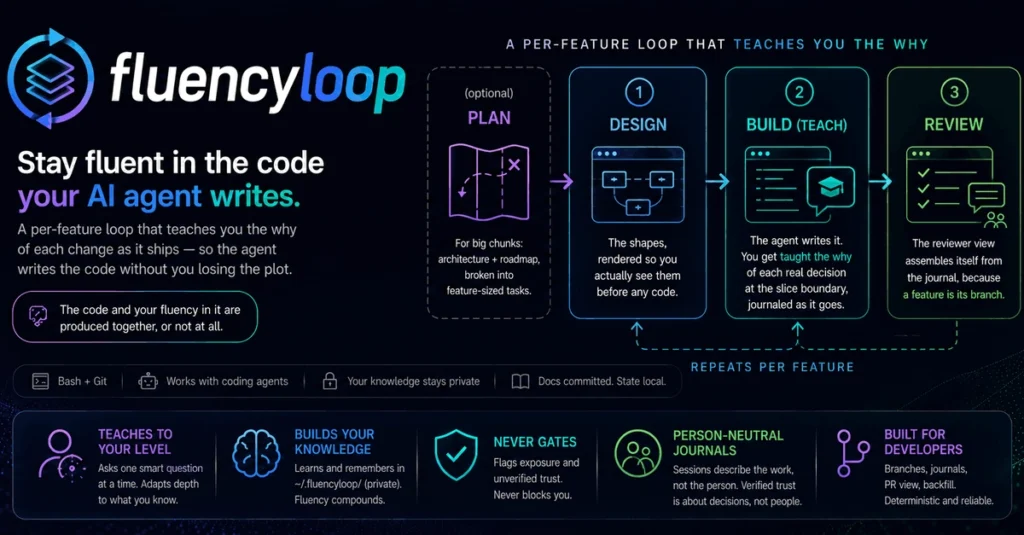
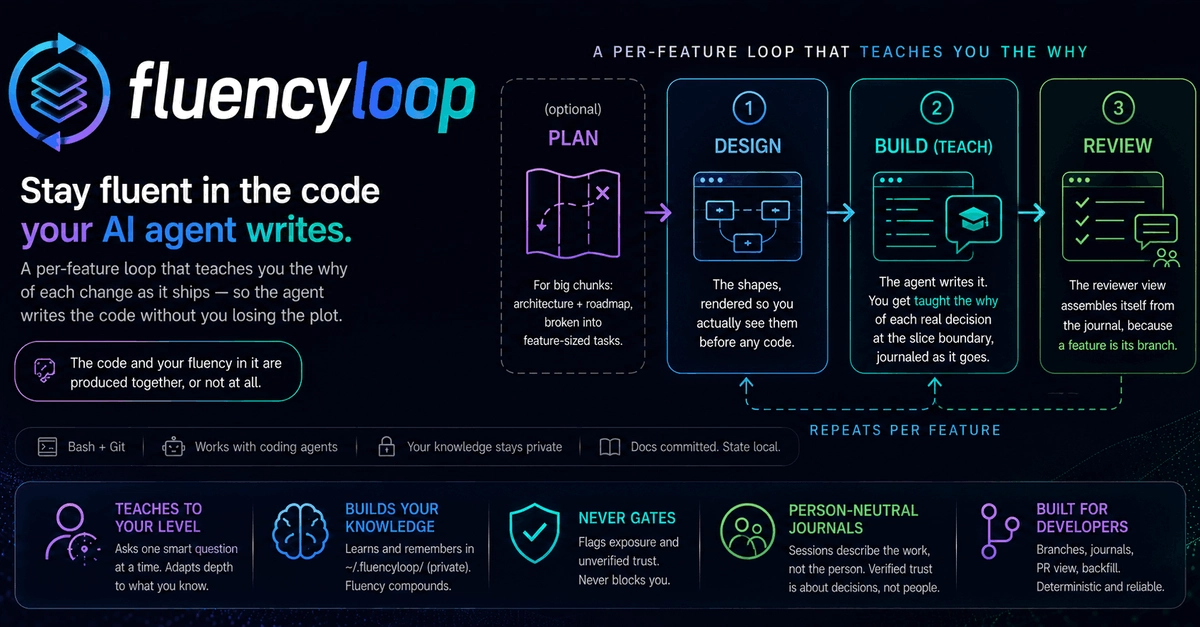
FluencyLoop is an open-source, local-first workflow plugin designed specifically for advanced command-line AI agents, such as Anthropic’s Claude Code and Codex. The tool’s primary objective is to slow down the generation process just enough to ensure that a developer’s understanding of their codebase grows in lockstep with the code itself.
+-----------------------------------------------------------------+
|                          FluencyLoop                            |
|                                                                 |
|  [ AI Agent (Claude Code/Codex) ] ---> [ Local Familiarity Map ] |
|                                                |                |
|                                                v                |
|  [ Explain Architectural Choices ] <--- [ Detects Knowledge ]   |
|  [ Document Rejected Alternatives]      [     Gaps?         ]   |
+-----------------------------------------------------------------+
Instead of allowing an AI agent to autonomously dump massive, complex pull requests into a repository, FluencyLoop actively tracks the developer’s technical familiarity locally. When the agent introduces novel architectural patterns, external libraries, or complex algorithms, FluencyLoop pauses the execution. It then prompts the agent to explain its structural choices, document rejected alternatives, and record key architectural decisions—tailoring these explanations strictly to the topics the developer does not yet understand.
By keeping the developer "in the loop," FluencyLoop aims to transform AI agents from opaque code-generation engines into collaborative pedagogical partners. The project, hosted publicly on GitHub, represents a growing movement of developers seeking to reclaim agency and context over their own software projects.
Chronology: The Evolution of AI Coding and the Genesis of ‘Copilot Debt’
To understand why a tool like FluencyLoop has become necessary, it is essential to trace the rapid evolution of AI-assisted software development over the past half-decade.
  2021-2022                2023                    2024                    2025
+------------+          +------------+          +------------+          +------------+
| Autocomplete| -------->| Chat-Driven| -------->| Agentic    | -------->| Pedagogical|
| Generation |          | Interfaces |          | Workflows  |          | Workflows  |
| (Copilot)  |          | (ChatGPT)  |          | (Claude)   |          | (Fluency)  |
+------------+          +------------+          +------------+          +------------+
Phase 1: The Autocomplete Era (2021–2022)
The launch of GitHub Copilot, powered by OpenAI’s Codex, introduced developers to inline code suggestions. At this stage, AI acted as an advanced "tab-completion" system. Because the suggestions were limited to single lines or short blocks of code, developers maintained absolute control and high cognitive comprehension. The developer remained the primary author, reviewing every line of code before it was accepted.
Phase 2: The Chat and Copy-Paste Era (2023)
With the release of ChatGPT (GPT-3.5 and GPT-4) and Anthropic’s early Claude models, the paradigm shifted to conversational interface development. Developers began describing entire features in natural language, receiving large blocks of code in response, and manually pasting them into their Integrated Development Environments (IDEs). While productivity spiked, the first signs of cognitive friction appeared. Developers began merging functions they did not fully write, occasionally leading to subtle debugging challenges.
Phase 3: The Rise of Agentic Coding (2024)
The industry shifted from passive chat interfaces to active AI agents. Tools like Cursor, Devin, and eventually Anthropic’s command-line tool, Claude Code, gained the ability to read entire directories, execute terminal commands, run tests, and self-correct errors. AI was no longer just suggesting code; it was navigating codebases and modifying dozens of files across multiple directories simultaneously.
The Crisis: The "Blind Merge" and the Birth of FluencyLoop (2025)
By early 2025, the sheer velocity of agentic code generation began outstripping human cognitive capacity. Developers reported feeling like "glorified rubber-stampers," approving massive pull requests containing thousands of lines of code written by AI agents in seconds.
Recognizing that this trend was leading to severe "copilot debt"—where developers own codebases they do not actually understand—BaoKhang built and released FluencyLoop. The tool was created out of a personal necessity to stop blindly merging code and to force AI agents to act as educators rather than autonomous black boxes.

Supporting Data: The Hidden Costs of AI-Generated Code
The developer anxiety that inspired FluencyLoop is backed by a growing body of empirical data and industry research. While AI coding tools undeniably accelerate initial development velocity, they also introduce significant challenges regarding code quality, maintenance, and long-term developer comprehension.
1. The Code Churn and Quality Crisis
A landmark study conducted by GitClear, which analyzed over 150 million lines of code committed between 2020 and 2024, revealed alarming trends corresponding with the widespread adoption of AI coding assistants:
- Increased Code Churn: The percentage of code that is updated or reverted within two weeks of being written—known as "code churn"—doubled compared to the pre-AI era.
- Decline in Code Reuse: The study found a sharp decline in code reuse, indicating that AI assistants prefer to generate redundant, net-new code rather than refactoring and utilizing existing abstractions.
- "Code Squeezing": The researchers concluded that while AI helps write code faster, developers spend significantly more time refactoring, debugging, and correcting mistakes after the fact.
| Metric | Pre-AI Era (Before 2021) | AI-Assisted Era (2023–2024) |
|---|---|---|
| Code Churn Rate | Baseline (~2-3%) | Doubled (~5-6%) |
| Code Reuse Percentage | High (Structured refactoring) | Significant decline (Redundant generation) |
| Average PR Review Time | Gradual, linear review | Exponentially higher cognitive load per line |
2. Cognitive Load and the "Illusion of Competence"
In educational psychology, the "illusion of competence" occurs when a student mistakes the ease of accessing information for actual understanding. In software engineering, this manifests when a developer uses an AI agent to solve a complex problem without understanding the underlying mechanics.
- According to a developer survey, over 65% of software engineers admitted to merging AI-generated code without fully understanding every line of the implementation.
- Furthermore, security researchers have noted that AI models often hallucinate libraries or generate insecure code patterns. Without deep context, developers are highly likely to overlook these vulnerabilities during code reviews.
By introducing a local familiarity database, FluencyLoop directly targets these statistical pain points. By forcing explanations only on unfamiliar concepts, it minimizes explanation fatigue while maximizing cognitive retention.
How FluencyLoop Works: Technical Architecture and Workflows
FluencyLoop operates as an open-source, local-first workflow plugin designed to sit between the developer, the local codebase, and the execution loop of command-line AI agents like Claude Code and Codex.
                                [ Developer ]
                                     ^
                                     | (Pauses & Explains)
                                     v
[ Local Codebase ] <---> [ FluencyLoop Plugin ] <---> [ AI Agent (Claude Code) ]
                                     ^
                                     | (Reads/Writes)
                                     v
                       [ Local Familiarity Database ]
                       - Developer Tech Stack Profile
                       - Architectural Decisions (ADRs)
1. Local-First Familiarity Mapping
Unlike cloud-based analytics, FluencyLoop is strictly local-first, respecting privacy and enterprise security requirements. It maintains a lightweight, local database that maps the developer’s current technical profile. It tracks:
- Language syntax familiarity (e.g., Rust lifetimes, Go channels).
- Architectural patterns utilized in the repository (e.g., CQRS, Dependency Injection).
- Familiarity with specific third-party APIs and libraries.
2. The Selective Pause Mechanism
When Claude Code or Codex proposes a file modification, FluencyLoop parses the AST (Abstract Syntax Tree) of the changes.
- If the changes utilize standard syntax and libraries that the developer has already mastered, FluencyLoop allows the agent to proceed silently.
- If the agent introduces an unfamiliar design pattern or a new dependency, FluencyLoop pauses the agent’s execution. It prompts the agent to explain:
- Why this specific approach was chosen.
- What alternative architectures were considered and why they were rejected.
- How this code interacts with the rest of the local system.
3. Automated Documentation and ADR Generation
In addition to verbal explanations, FluencyLoop forces the AI agent to generate Architectural Decision Records (ADRs) and inline documentation. This ensures that the reasoning behind a particular technical choice is preserved directly within the repository for future maintainers, mitigating the risk of "knowledge drift" as teams scale.
Community and Industry Perspectives
The release of FluencyLoop has sparked a broader conversation within the global software engineering community regarding the sustainability of agentic workflows.
The Developer Consensus: Reclaiming Control
On platforms like GitHub and Dev.to, developers have expressed relief at the introduction of tools that prioritize education over raw output.

"As a developer, I got a bit scared and fed-up of blindly merging massive pull requests and losing context on my own codebase," wrote creator BaoKhang. "It feels really good to get the AI caring for my understanding."
Many senior engineers have echoed this sentiment, noting that the hardest part of software engineering is not writing code, but reading and maintaining it. A tool that slows down the write phase to optimize the read and comprehend phase represents a paradigm shift in AI tooling design.
The Corporate and Security Angle
Enterprise software architects have also shown keen interest in local-first workflow enforcement. In large organizations, merging code that the internal team does not understand is a major security and compliance hazard. If an AI agent introduces a subtle logic flaw or a deprecated library, and the human reviewer merges it blindly, the liability falls entirely on the company. Security experts argue that tools like FluencyLoop should be integrated into corporate CI/CD pipelines and developer environments to enforce safety and comprehensive understanding.
Implications: The Future of Human-AI Collaborative Engineering
The emergence of FluencyLoop signals a critical transition in the philosophy of developer tooling. It shifts the narrative from "AI replacing the developer" to "AI elevating the developer."
+-----------------------------------------------------------------------+
|                        The Paradigm Shift                             |
|                                                                       |
|  Traditional AI Tooling:                                              |
|  [Developer] --------> [AI Agent] --------> [Opaque Codebase]         |
|                                                                       |
|  FluencyLoop Workflow:                                                |
|  [Developer] <=======> [AI Agent] --------> [Transparent Codebase]     |
|              (Continuous                                              |
|               Learning)                                               |
+-----------------------------------------------------------------------+
1. Redefining the "Senior" Developer
In the pre-AI era, a senior developer was often defined by their syntax mastery and ability to write complex algorithms from scratch. In the agentic era, syntax is commoditized. Seniority is increasingly defined by system design, architectural oversight, and debugging capabilities. By forcing developers to engage with architectural trade-offs, FluencyLoop accelerates the transition of junior developers into system architects, ensuring they do not bypass the critical learning phases of software design.
2. Mitigating the Risk of "Software Rot"
When software is written by agents that do not understand human context, and merged by humans who do not understand the agent’s code, the codebase quickly succumbs to "software rot." It becomes fragile, difficult to refactor, and impossible to migrate. By insisting on documentation, rejected alternatives, and human comprehension at the moment of creation, FluencyLoop establishes a sustainable development model that preserves codebase health over years, not just sprint cycles.
3. The Future of Local-First, Privacy-Centric Developer Tools
As developers become more sensitive to data privacy and intellectual property concerns, local-first tools like FluencyLoop are poised to gain market share over heavy, cloud-only SaaS platforms. By keeping the familiarity database local, developers can use advanced LLMs without exposing sensitive personal progress metrics or proprietary workflow habits to third-party servers.
Ultimately, FluencyLoop demonstrates that the goal of artificial intelligence in software engineering should not be to write code so that humans don’t have to, but to teach humans how to build better systems, faster, and with absolute confidence.