Bridging the Gap Between AI and Databases: Akshay Gupta Releases High-Performance Go MCP Server for PostgreSQL
An open-source implementation of the Model Context Protocol written in Go connects advanced AI assistants directly to live databases, eliminating manual copy-paste workflows and introducing secure, transaction-level query analysis.
Main Facts: The Evolution of Context-Aware AI Development
In the rapidly evolving landscape of artificial intelligence-assisted software engineering, developer friction remains a persistent obstacle to productivity. While modern Large Language Models (LLMs) like Anthropic’s Claude 3.5 Sonnet and integrated development environments (IDEs) like Cursor demonstrate remarkable code-generation capabilities, they have historically operated in an informational silo when dealing with databases. Developers are frequently forced into a repetitive cycle: copy SQL queries from an AI chat interface, paste them into a database client, execute the commands, and manually copy the results back to the AI for analysis.
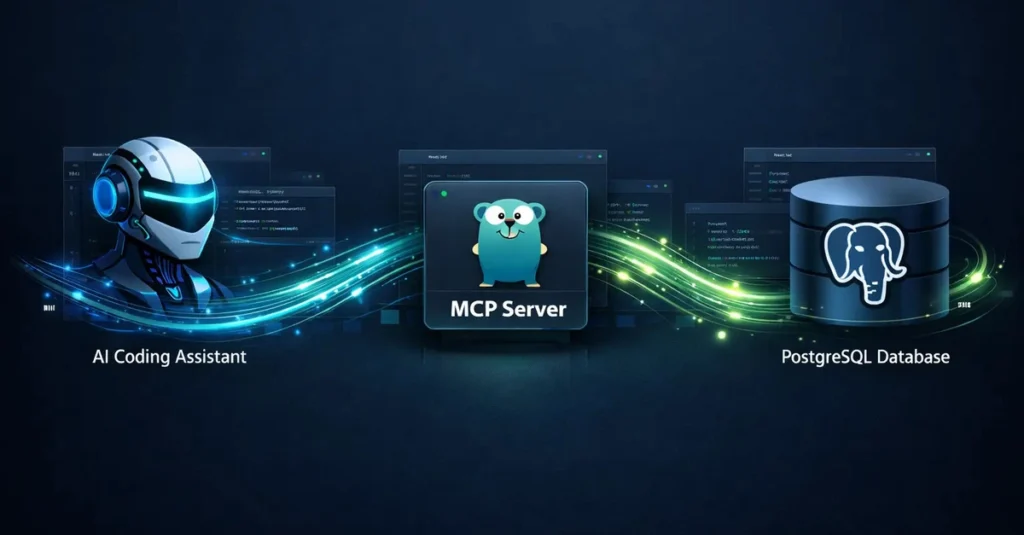
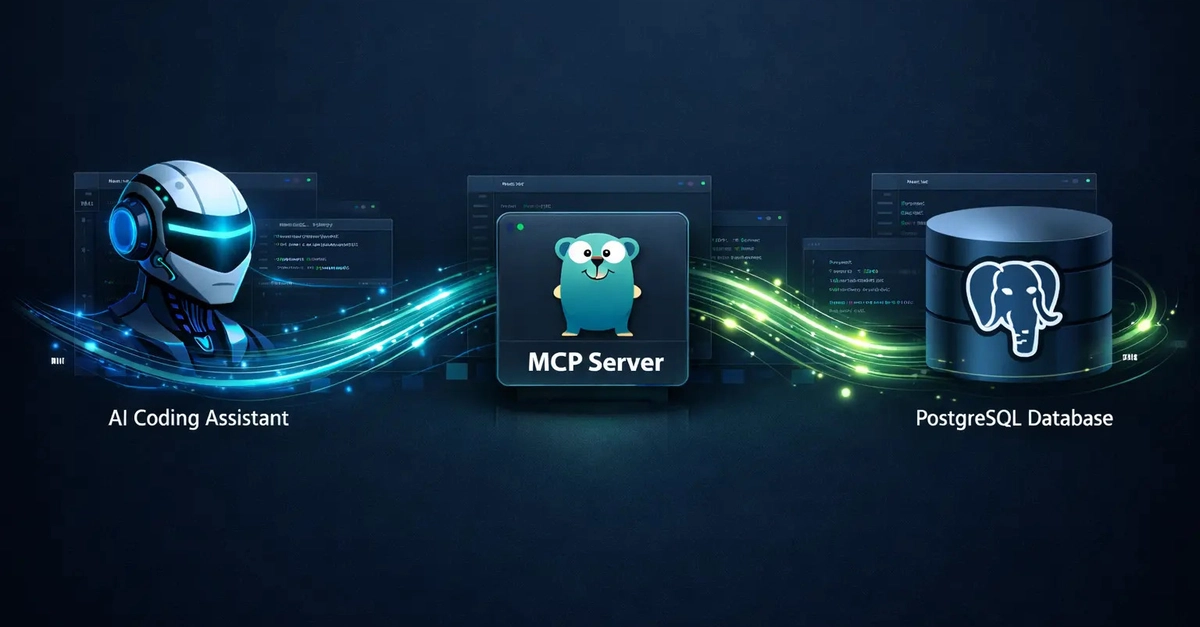
To solve this problem, independent developer Akshay Gupta has open-sourced postgres-mcp, a high-performance Model Context Protocol (MCP) server written in Go. The project, hosted on GitHub, bridges the gap between active development environments (such as Claude Code and Cursor) and live PostgreSQL databases.
The Model Context Protocol, initially introduced by Anthropic, acts as an open standard for connecting AI models to external data sources and tools. By implementing this protocol in Go, Gupta’s server allows AI assistants to securely inspect database schemas, read performance statistics, generate execution plans, and even simulate indexes on live PostgreSQL instances. This approach addresses the "hallucination" and contextual blind-spots common in database-related AI interactions, where LLMs are forced to guess schema structures and performance bottlenecks without direct visibility.
+-------------------+        Model Context Protocol        +----------------------+
|  Claude Code /    | ===================================> |  postgres-mcp Server |
|  Cursor Editor    | <=================================== |      (Go Binary)     |
+-------------------+                                      +----------------------+
                                                                      ||
                                                           Secure, Read-Only /
                                                           Read-Write Connection
                                                                      ||
                                                                      /
                                                           +----------------------+
                                                           |  PostgreSQL Database |
                                                           +----------------------+
Chronology: The Road to Context-Aware AI
To understand the significance of Gupta’s Go-based MCP server, it is necessary to trace the progression of AI development workflows and the emergence of the Model Context Protocol.
Phase 1: The Copy-Paste Paradigm (2022–2024)
Following the mainstream adoption of generative AI, developers relied on chat interfaces to write database migrations, debug queries, and design schemas. Because these models had no direct connection to the target runtime environments, developers had to manually feed raw schema definitions (DDL) into the prompt. If a query performed poorly in production, the developer had to act as a manual courier, passing query plans (EXPLAIN ANALYZE outputs) back and forth between database clients and the AI chat box.
Phase 2: The Standardization of MCP (Late 2024)
Recognizing the limitations of closed, chat-bound environments, Anthropic introduced the Model Context Protocol. MCP established a standardized, bidirectional JSON-RPC-based protocol over Stdio or HTTP, enabling LLM clients to safely invoke tools and read resources provided by local or remote servers. This prompted an influx of open-source MCP servers designed to expose filesystems, search engines, and developer tools directly to the LLM context.
Phase 3: The Python Proof-of-Concept
Among the early database implementations was crystaldba/postgres-mcp, a Python-based server that successfully demonstrated how an AI client could query PostgreSQL metadata. While functional, the Python implementation introduced systemic operational challenges. Developers wishing to run the server locally had to manage Python runtimes, configure virtual environments, resolve dependency conflicts, and tolerate the resource overhead associated with interpreted runtimes.

Phase 4: Re-Engineering in Go (Present)
Seeking a more robust, lightweight, and deployment-friendly solution, Akshay Gupta rebuilt the PostgreSQL MCP server from scratch using Go. By leveraging Go’s compilation model, Gupta successfully consolidated the server, its dependencies, and its runtime into a single, highly optimized static binary. The project was subsequently published as open-source, introducing a enterprise-grade toolchain for developers using Claude Code and Cursor.
Supporting Data: Technical Architecture and Performance
The technical architecture of postgres-mcp is designed around three core principles: low operational footprint, rigorous security, and deep database observability.
Go vs. Python Runtime Dynamics
By shifting from Python to Go, the project achieves significant performance and deployment advantages:
| Metric | Python-based MCP Server | Gupta’s Go MCP Server (postgres-mcp) |
|---|---|---|
| Distribution Format | Multiple source files, virtual environments | Single compiled static binary |
| Binary Size | N/A (requires Python runtime > 50MB) | ~15 Megabytes |
| Memory Footprint | Moderate to high | Extremely low (native Go concurrency) |
| Runtime Dependencies | pip packages, interpreter, OS-level libs |
Zero external runtime dependencies |
| Deployment Model | Manual script configuration or complex Docker | docker build or direct binary execution |
The Nine Core Diagnostic Tools
The server exposes nine specialized tools over the Model Context Protocol, allowing Claude Code or Cursor to perform targeted, non-destructive investigations:
- Schema Inspector: Retrieves precise definitions of tables, columns, data types, and constraints.
- Query Executor: Safely executes ad-hoc queries within specified transaction boundaries.
- Execution Plan Analyzer (
EXPLAIN): Runs plans on target queries to locate sequential scans or nested loop bottlenecks. - Index Analyzer: Identifies missing indexes or unused indexes cluttering memory.
- Table and Index Size Monitor: Measures disk usage to identify bloating.
- Query Statistics Reader (
pg_stat_statements): Queries historical runtime metrics to pinpoint high-frequency, slow-running operations. - Hypothetical Index Generator (
hypopg): Tests the impact of an index without actually writing it to disk. - Active Session Monitor: Displays currently running queries and locks.
- Database Configuration Auditor: Inspects parameters like
shared_buffersandwork_memto recommend optimization tweaks.
       +-------------------------------------------------------+
       |             postgres-mcp Tool Suite                   |
       +-------------------------------------------------------+
       |  [1] Schema Inspector      [2] Query Executor         |
       |  [3] Execution Plan        [4] Index Analyzer         |
       |  [5] Size Monitor          [6] pg_stat_statements     |
       |  [7] hypopg Simulation     [8] Session Monitor        |
       |  [9] Config Auditor                                   |
       +-------------------------------------------------------+
Database-Level Security over String Matching
A critical flaw in many AI-database integrations is their reliance on naive string matching (e.g., using regular expressions to block queries containing INSERT, UPDATE, or DELETE). This method is highly vulnerable to SQL injection bypasses, nested transactions, or executing functions with side-effects.
Gupta’s implementation solves this by offloading security directly to the PostgreSQL engine:
- Restricted Mode: When active, the server wraps every incoming call inside a read-only transaction block (
SET TRANSACTION READ ONLY). - Engine Enforcement: Write protection is enforced at the database kernel level. Even if an AI agent is manipulated into executing a destructive query, the PostgreSQL engine immediately aborts the transaction, guaranteeing absolute safety for production databases.
Continuous Integration and Quality Assurance
To ensure reliability in production environments, the repository features an exhaustive testing framework containing:
- Unit Tests: Verifying isolated code logic and JSON-RPC protocol adherence.
- Integration Tests: Evaluating tool interactions.
- End-to-End (E2E) Tests: Executed against a live PostgreSQL container pre-configured with the advanced extensions
pg_stat_statementsandhypopg. - CI Enforcement: The Continuous Integration pipeline is configured to fail automatically if code coverage drops below 95%, establishing a high standard of code quality for open-source infrastructure tools.
Official Responses and Developer Perspectives
Writing on his blog and developer portals, Akshay Gupta detailed his motivation for building the server and highlighted the immediate efficiency gains of combining Go with the Model Context Protocol.

"Most ‘AI plus database’ workflows still look like this: copy SQL out of a chat window, paste it into a DB client, run it, copy the output back," Gupta noted. "It breaks flow, and the assistant never sees your actual schema, so it guesses. MCP fixes the connection problem. This server is what sits on the other end for Postgres."
Gupta also emphasized the ease of deployment achieved through Go’s compilation model:
"I rebuilt it from scratch in Go so it ships as a single ~15 MB static binary. No Python runtime, no dependency chasing.
docker build, point Claude Code at it, done."
Early feedback from the open-source community has highlighted the inclusion of the hypopg extension as a standout feature. Historically, verifying whether an index would fix a slow query required running migration scripts in staging environments. By exposing hypopg to an LLM via the Go server, the AI can simulate the index, run a hypothetical EXPLAIN plan, and confirm the performance improvement in seconds, all without modifying the physical database schema.
Implications: The Rise of the Autonomous Database Administrator
The release of postgres-mcp points to a fundamental shift in how developers interact with database systems, signaling a move toward agentic workflows.
Demystifying Database Administration (DBA)
Historically, advanced query tuning, index optimization, and performance diagnostics required specialized DBA expertise. By granting secure, read-only access to runtime statistics (pg_stat_statements) and execution plans, a Go-based MCP server allows developers of all skill levels to use LLMs as virtual DBAs. The AI can proactively flag unindexed foreign keys, detect table bloat, and write optimized queries based on actual, live-schema statistics rather than theoretical shapes.
The Security Standard for AI Integrations
As enterprises begin to integrate AI agents into internal systems, security remains the primary blocker to adoption. The security design of postgres-mcp—relying on database-native read-only transactions rather than application-layer string parsing—sets a vital precedent. It proves that AI tools can be granted access to sensitive systems safely, provided developers leverage the native security mechanisms of the underlying technologies.
The Standardizing Power of MCP
The success of projects like postgres-mcp highlights the growing importance of Anthropic’s Model Context Protocol. By decoupling the AI client from the underlying data source, MCP allows developers to build modular, highly specialized tools. As more databases, APIs, and services adopt this open standard, software engineering will transition from static code generation toward dynamic, real-time system interaction and autonomous problem-solving.