Building the Future of Low-Power IoT: How the No-Code ePaper Weather Dashboard is Democratizing Smart Home Environmental Monitoring
By the Tech & Hardware Editorial Team
Published: August 2026
Main Facts: A Paradigm Shift in Maker-To-Consumer IoT
In the rapidly evolving landscape of Internet of Things (IoT) development, a major barrier has historically separated creative hardware concepts from polished, consumer-ready deployments: software development. Programming graphical user interfaces (GUIs), managing API calls, handling memory allocation for displays, and configuring network stacks have traditionally demanded a solid foundation in languages like C++, Python, or JavaScript.
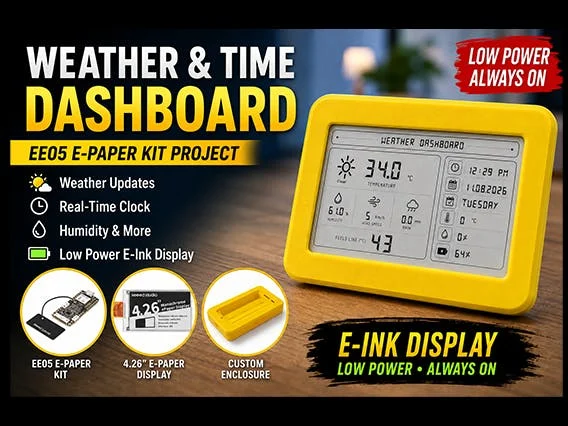
However, a groundbreaking project spearheaded by the maker community—documented extensively on Hackster.io by iotprojectsideas—is fundamentally altering this paradigm. By pairing Seeed Studio’s newly minted XIAO EE05 board (powered by the Espressif ESP32-S3 microcontroller) with a crisp, high-resolution 4.26-inch monochrome ePaper display, creators can now design, deploy, and mount sophisticated, highly readable environmental data hubs completely without writing a single line of code.
At its core, the ePaper weather dashboard is a compact, ultra-low-power desktop or wall-mounted unit that delivers real-time meteorological metrics, local time, and system data. Utilizing the SenseCraft Seeedash—a cloud-based, drag-and-drop no-code visualization and management platform—the project streamlines the entire lifecycle of an IoT gadget. Users simply flash an initial firmware binary, connect via a smartphone-driven Wi-Fi captive portal, and map their chosen data widgets across an 800×480 pixel canvas.
The resulting appliance mimics the aesthetic of commercially manufactured e-reader and smart-home gadgets. It displays temperature, humidity, wind speed, precipitation metrics, date, time, and battery health with exceptional clarity, all while sipping negligible amounts of electrical current. By bridging the gap between advanced microcontrollers and accessible user interfaces, this project highlights an accelerating trend toward democratization in hardware engineering.
Chronology: From Concept to Desktop-Ready Appliance
The realization of this zero-code ePaper dashboard did not happen overnight; it is the culmination of advancements in low-power display technology, modular microcontroller form factors, and the maturation of no-code cloud platforms for edge computing.
Phase 1: Hardware Selection and Form-Factor Minimization
The foundational components of the project required careful optimization. Engineers needed a microcontroller that balanced miniature physical dimensions with robust wireless capabilities. Seeed Studio’s XIAO series emerged as the ideal candidate, specifically the ESP32-S3-based EE05 iteration. Offering integrated Wi-Fi and Bluetooth Low Energy (BLE), the board provides the necessary computational overhead for cryptographic handshakes, TLS connections, and rapid JSON parsing without sacrificing physical space.
To maximize readability and minimize energy consumption, the project builders bypassed traditional power-hungry TFT or OLED panels in favor of electrophoretic ink (ePaper) technology. Specifically, a 4.26-inch monochrome panel with an 800×480 pixel array was selected. This resolution strikes a sweet spot: large enough to present comprehensive sensor data yet compact enough for a desktop enclosure.
Phase 2: Wiring and Firmware Initialization
The physical assembly begins with hardware integration. The 4.26-inch ePaper display interfaces directly with the XIAO EE05 board via a standard 24-pin Flexible Printed Circuit (FPC) connector. This mechanical standardization eliminates messy jumper wires and soldering errors, reducing the assembly learning curve.
Once physically integrated, the board is connected to a host workstation via a standard USB-C cable. Instead of opening an Integrated Development Environment (IDE) like Arduino or ESP-IDF, the developer uses the online SenseCraft Seeedash Firmware Flasher tool. Within seconds, a pre-compiled, universal communication firmware is transferred to the ESP32-S3 flash memory.
Phase 3: Wireless Provisioning and Cloud Linking
Upon its initial boot, the newly flashed device enters provisioning mode, generating a unique on-screen QR code directly on the ePaper matrix.
- The user scans the QR code using any modern smartphone camera.
- The smartphone is automatically directed to a local captive portal hosted by the ESP32-S3.
- The user inputs their local Wi-Fi SSID and password credentials.
- Within seconds, the device connects to the wireless local area network (LAN) and registers itself with the user’s SenseCraft Seeedash cloud workspace.
Phase 4: Drag-and-Drop Canvas Configuration
With the hardware online, the configuration moves entirely to the browser. The SenseCraft Seeedash interface presents a virtual 800×480 pixel canvas mirroring the physical display dimensions. Creators drag and drop modular widgets—temperature gauges, humidity trackers, wind-vector indicators, and clock faces—onto the workspace. Once positioned to preference, a single click pushes the layout configuration over-the-air (OTA) to the hardware.
Phase 5: Enclosure Fabrication and Final Assembly
The final chronological phase addresses mechanical protection and aesthetics. Using standard 3D-printing materials (such as PLA or PETG), builders fabricate a custom desktop enclosure designed to house the XIAO EE05, a compact lithium battery, and the ePaper panel. Total build time—including printing, wiring, and final mechanical alignment—averages roughly four hours, culminating in a finished, highly professional gadget.
Supporting Data & Technical Specifications
To fully understand the engineering merits of this project, it is essential to examine the raw specifications of its core components. The synergy between the Espressif silicon, the ePaper display medium, and the cloud software platform creates a compelling technical profile.
| Component / Parameter | Specification Detail | Operational Benefit |
|---|---|---|
| Microcontroller Board | Seeed Studio XIAO EE05 (Espressif ESP32-S3) | Dual-core Tensilica LX7 CPU, native Wi-Fi & BLE, compact footprint, ultra-low power sleep states. |
| Display Technology | 4.26-inch Monochrome ePaper (Electrophoretic) | 800 × 480 pixel resolution; zero power consumption to hold static images; phenomenal sunlight readability. |
| Connectivity | Wi-Fi (802.11 b/g/n) & Bluetooth LE | Seamless cloud synchronization, OTA layout updates, and local API data ingestion. |
| Interface Platform | SenseCraft Seeedash | Zero-code drag-and-drop dashboard design, cloud widget management, and automated template rendering. |
| Physical Integration | 24-pin FPC Connector, USB-C Power/Flash | Secure ribbon-cable data transmission, plug-and-play programming, and standardized charging. |
| Enclosure Design | Custom 3D-Printed Desktop Case | Protects internal circuitry, isolates the display screen, and yields a polished, commercial aesthetic. |
| Total Assembly Time | ~4 Hours (Printing, Wiring, Setup) | Rapid prototyping capability suitable for hobbyists, educators, and enterprise proof-of-concepts. |
The Power-Saving Advantage of ePaper
Unlike traditional Liquid Crystal Displays (LCDs) or Organic Light-Emitting Diodes (OLEDs) that require a constant stream of electrical energy to backlight pixels or illuminate organic compounds, electrophoretic ePaper displays consume energy only when the image changes. Charged pigment microcapsules shift their physical orientation under an electrical field and hold their position indefinitely without power.

For a weather dashboard that updates its data every 15 to 60 minutes, this characteristic translates into extraordinary energy efficiency. The ESP32-S3 can remain in deep sleep, wake up briefly to pull fresh weather data via Wi-Fi, update the ePaper screen, and return to sleep mode. This cycle preserves battery life for weeks or even months on a relatively modest power cell.
Official Responses and Maker Community Reactions
The introduction of the no-code ePaper dashboard has generated considerable buzz across hardware forums, open-source communities, and embedded systems channels.
The Maker Perspective: Lowering the Barrier to Entry
Prominent open-source hardware advocates and community contributors have praised the project for redefining what beginners can achieve. In discussions surrounding the Hackster.io release, community feedback emphasized that while advanced programmers enjoy writing custom firmware in C++, the sheer friction of GUI development often stalls projects for casual makers.
"We are witnessing the democratization of information appliances," noted one prominent embedded systems blogger in a community forum review. "For years, building a custom e-reader or weather station meant wrestling with SPI display libraries, buffer management, font rendering, and erratic Wi-Fi reconnection loops. By abstracting the presentation layer into a cloud-based drag-and-drop platform like SenseCraft Seeedash, projects that used to take weeks of debugging now take an afternoon."
Hardware Manufacturers: Embracing Modular Interoperability
Representatives from Seeed Studio and other open hardware manufacturers have increasingly pivoted toward modular, connector-based ecosystems (such as the XIAO series and Grove systems). Official commentary from hardware development teams highlights a strategic shift toward "ready-to-deploy" modularity.
By standardizing on connectors like the 24-pin FPC for ePaper displays, manufacturers are acknowledging that users prefer spending creative energy on casing design, placement, and data integration rather than troubleshooting pinout diagrams and soldering microscopic surface-mount pads. Furthermore, the compatibility of the EE05 board with variable ePaper screen sizes—ranging from small 1.54-inch variants up to expansive 7.5-inch boards—provides exceptional design scalability for future product iterations.
Implications: The Future of Consumer IoT and Edge Interfaces
The success of the XIAO EE05 ePaper dashboard points to several broader implications for the future of consumer electronics, smart home automation, and enterprise IoT prototyping.
1. The Rise of "No-Code" Edge Hardware
While no-code platforms have dominated web development (via tools like WordPress, Webflow, and Bubble) and backend automation (via Zapier and Make), hardware has traditionally lagged behind. Projects utilizing environments like SenseCraft Seeedash signal the dawn of the No-Code Hardware Era.
As microcontrollers become cheaper, more powerful, and equipped with native wireless stacks, the need to write low-level firmware for standard tasks (such as displaying weather, stock tickers, calendar events, or smart home sensor readouts) is diminishing. This shift empowers non-engineers—such as interior designers, small business owners, educators, and hobbyists—to build custom physical computing devices tailored precisely to their workflows.
2. Sustainable Design and Ambient Computing
As consumer fatigue grows around glowing, notification-heavy smart screens that contribute to digital burnout and high energy consumption, ambient computing is gaining traction. Ambient devices blend seamlessly into the background of a living space, providing calm, glanceable information without demanding active engagement.
Monochrome ePaper displays are the gold standard for ambient computing. Because they emit no blue light, cause no eye strain, and mimic physical paper under ambient room illumination, they represent a more sustainable and ergonomic approach to smart home interfaces. Combined with deep-sleeping microcontrollers like the ESP32-S3, these devices minimize electronic waste and power consumption.
3. Rapid Prototyping for Commercial Enterprises
Beyond the maker community, this architecture holds profound implications for enterprise rapid prototyping. Product development teams often spend months building custom proof-of-concept hardware to pitch to stakeholders. By leveraging off-the-shelf boards like the XIAO EE05, standardized ePaper modules, 3D printing, and drag-and-drop cloud dashboards, engineering teams can validate product concepts, test user interface layouts, and gather ergonomic feedback in a matter of days rather than months.
Alternative Ecosystems and Future-Proofing
While the current implementation relies on the ESP32-S3 and SenseCraft Seeedash, the underlying design philosophy is hardware-agnostic. Makers looking to expand upon this architecture are already experimenting with alternative pathways:
- The ESP32-C6-Zero: Incorporating Wi-Fi 6 and Thread/Zigbee protocols for next-generation smart home mesh networking.
- Color ePaper (ACeP / Gallery displays): Transitioning from monochrome to multi-color electrophoretic panels for richer data visualization.
- TFT Touch Alternatives: Integrating ESP32 modules with 2.8-inch color capacitive touch screens for interactive, bidirectional control panels.
Conclusion
The ePaper weather dashboard built around the Seeed Studio XIAO EE05 and SenseCraft Seeedash platform is more than just a clever weekend project—it is a harbinger of how smart devices will be conceived, built, and deployed in the years to come. By stripping away the intimidating software barriers of GUI programming and display driver management, the project invites a broader audience into the world of physical computing.
With its sleek 3D-printed enclosure, ultra-low-power ePaper screen, wire-free configuration workflow, and robust ESP32-S3 core, this weather station proves that professional-grade IoT appliances no longer require a corporate engineering lab. Whether deployed in a home office, a corporate boardroom, or a high-school science classroom, this zero-code marvel redefines what is possible when modern modular hardware meets intuitive cloud-based design.