Driving the Software-Defined Vehicle: How TCS and Kautex Overcame the Automotive Industry’s Toughest Engineering Hurdle
By Automotive & Technology Desk
Published: October 2026
Main Facts
The automotive industry is undergoing its most profound transformation since the invention of the assembly line. As vehicles evolve from mechanical marvels into software-defined, connected computers on wheels, traditional Tier-1 suppliers face an existential imperative. The challenge is no longer merely about forging stronger steel, casting durable blocks, or optimizing fluid dynamics; it is about embedding rigorous, safe, and scalable software into every facet of the vehicle architecture.
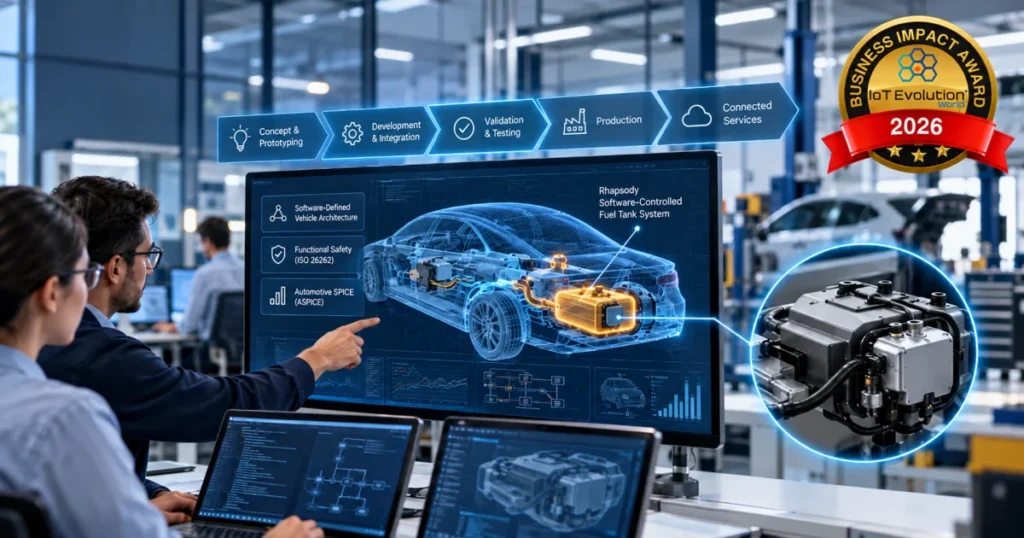
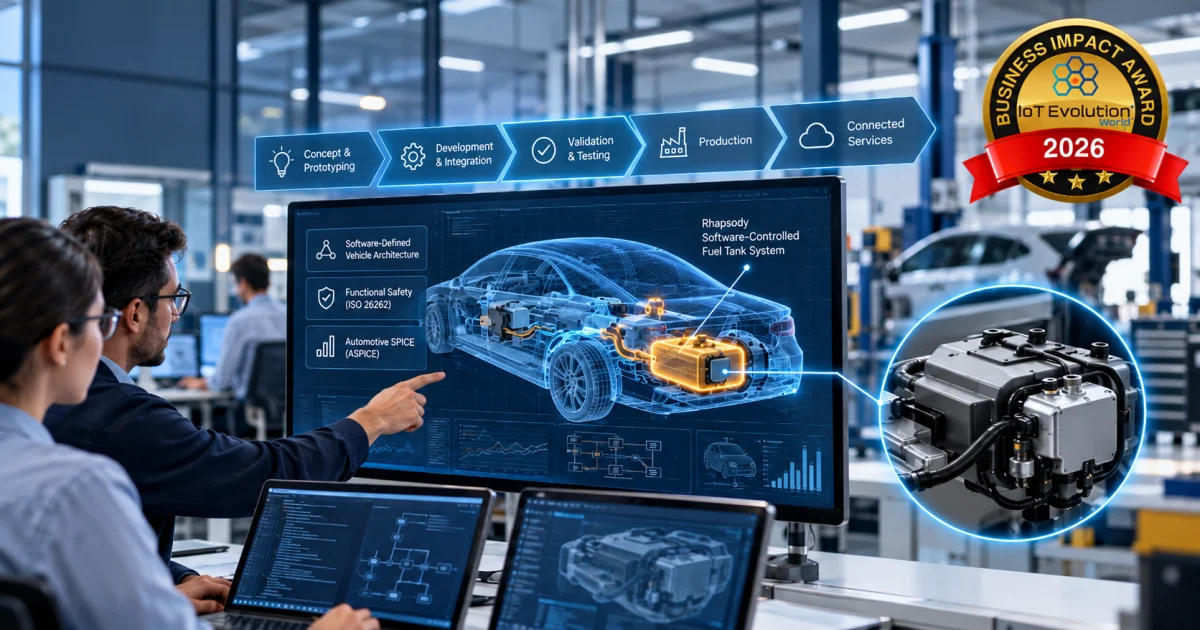
A prime case study in this historic transition is the successful collaboration between Tata Consultancy Services (TCS) and Kautex, a premier German automotive supplier ranked among the world’s top 100. Faced with the complex task of digitalizing a legacy mechanical product—the Rhapsody software-controlled fuel tank system—the partners deployed an end-to-end engineering framework. This initiative yielded critical operational capabilities, including 100 percent development traceability, a 50 percent reduction in testing efforts, and a streamlined path to achieving Automotive SPICE (ASPICE) Level 1 certification within a single year.
The partnership operates under the umbrella of TCS DriveSphere, a comprehensive mobility engineering portfolio that spans the entire vehicle lifecycle. From initial concept and prototyping through mass production and aftermarket support, DriveSphere integrates connected services, electrification, cockpit electronics, body and chassis software, and multi-level validation. Supported by a global network of over 55 labs and prototyping facilities, TCS is proving that traditional industrial giants can successfully transform into software-driven innovators without sacrificing the strict safety and reliability demanded by the road.
Chronology: The Journey from Hardware to Software
The transformation of Kautex from a mechanical components manufacturer into an agile, software-enabled automotive powerhouse did not happen overnight. It required a carefully orchestrated, chronological sequence of strategic milestones, technical interventions, and process re-engineering.
Phase 1: Assessment and Ecosystem Discovery (Initial Alignment)
The journey began with an intensive joint workshop between the engineering teams of TCS and Kautex. Before a single line of code was written, both organizations needed to deeply understand Kautex’s existing product ecosystem, legacy engineering workflows, and cultural landscape. This discovery phase was crucial for identifying the capability gaps that typically derail traditional manufacturing companies when they attempt software development.
Phase 2: Structural Foundation and Toolchain Setup (Months 1–4)
Following the discovery workshop, TCS assisted Kautex in establishing an autonomous, in-house software organization. This phase involved defining the exact development scope, selecting the appropriate toolchain, and deploying an agile operational environment. To ensure seamless collaboration across distributed teams, TCS integrated Application Lifecycle Management (ALM), DevOps pipelines, and Continuous Integration/Continuous Deployment (CI/CD) frameworks. This created a unified operational backbone for all subsequent software initiatives.
Phase 3: Model-Based Engineering and Rigorous Validation (Months 5–8)
With the operational foundation secured, the engineering phase kicked into high gear. TCS developed sophisticated model-based applications and foundational software while simultaneously managing requirements analysis, architectural design, coding, integration, verification, and validation. Testing was executed across multiple rigorous tiers:
- Model-in-the-Loop (MIL): Validating algorithms and control logic against mathematical models before any code is written.
- Software-in-the-Loop (SIL): Testing compiled software code within a simulated virtual environment.
- Hardware-in-the-Loop (HIL): Running production-intent software on physical electronic control units (ECUs) connected to simulated vehicle environments.
Concurrently, hardware design methodologies, functional safety protocols (aligning with ISO 26262), and ASPICE process standards were integrated into the framework.
Phase 4: Certification, Scaling, and Pandemic Resilience (Months 9–12)
By the end of the first year, Kautex achieved a major industry milestone: formal certification at ASPICE Level 1. Remarkably, this entire software rollout and certification process proceeded with zero delays, even as the global COVID-19 pandemic forced engineering teams around the world into remote-work setups. Following this success, the proven engineering framework began deployment across other Kautex product lines, validating its scalability and reusability.
Supporting Data & Technical Metrics
The success of the TCS-Kautex partnership is not measured merely in qualitative improvements, but in hard, quantifiable data that demonstrates immediate return on investment and engineering efficiency.
- 50 Percent Reduction in Testing Effort: By implementing automated validation frameworks across MIL, SIL, and HIL test levels, Kautex cut its total software-testing workload in half. This dramatically accelerated time-to-market without compromising quality.
- 100 Percent Development Traceability: Safety-critical automotive systems require an unbroken audit trail connecting high-level safety requirements to low-level implementation and final test evidence. The TCS framework achieved complete traceability, ensuring that no engineering change could be lost in informal handoffs.
- ASPICE Level 1 in 12 Months: Achieving this foundational automotive standard within a single year demonstrated that a traditional mechanical supplier could rapidly adopt rigorous software maturity models.
- Zero Rollout Delays: The program maintained its aggressive deployment schedule throughout the disruptions of the COVID-19 pandemic, proving the resilience of the established DevOps and remote collaboration toolchain.
The Emerging Horizon: Generative AI in Automotive Testing
While the Kautex deployment relied on robust automation and structured model-based engineering, TCS is already pushing the boundaries of validation further through artificial intelligence. In recent disclosures highlighted by industry partner NVIDIA, TCS introduced its Automotive Gen-AI Suite.
This advanced testing engine utilizes a fine-tuned Llama 3 8B Instruct model, enhanced by retrieval-augmented generation (RAG) and specialized post-processing, to automatically generate unit-level test cases directly from unstructured engineering requirements. To safeguard sensitive intellectual property, all training and inference are conducted strictly offline. When deployed on on-premises NVIDIA DGX H100 systems via NVIDIA NIM microservices, the platform achieves:
- Doubled Pipeline Speed: Overall test-case generation speed has increased by roughly 100%.
- Superior Inference Performance: NIM-based inference runs 2.5 to 3 times faster than comparable open-source direct-inference models while maintaining equivalent accuracy across critical metrics such as decision coverage, condition coverage, and Modified Condition/Decision Coverage (MC/DC).
Although these AI metrics stem from broader TCS test pipelines rather than the initial Kautex rollout, they illustrate how legacy validation bottlenecks are systematically being dismantled by next-generation technologies.
Official Responses and Industry Perspectives
The convergence of mechanical engineering and software development has elicited strong reactions from industry leaders who recognize the stakes involved in the software-defined vehicle (SDV) revolution.
Automotive analysts and engineering leaders have long warned that traditional tier-one suppliers face an "innovator’s dilemma." Transitioning from physical manufacturing—where design changes are costly and physical—to software engineering, where changes are rapid but fraught with complex safety dependencies, requires a cultural and structural evolution.
Executives close to the TCS DriveSphere portfolio emphasize that the primary barrier to automotive software success is rarely a lack of coding talent; rather, it is the absence of a governed, repeatable development system.
"When automotive differentiation moves into software, it is no longer enough to write functional code. You must build an organizational capability that can withstand the rigorous audits of functional safety standards like ISO 26262 and ASPICE," notes an industry expert familiar with the TCS-Kautex engagement. "What TCS and Kautex achieved was not just a functioning fuel tank system, but a permanent upgrade to Kautex’s corporate DNA."
Furthermore, feedback from validation engineers highlights the transformative impact of automation. By removing manual bottlenecks in the testing lifecycle, engineering teams can refocus their cognitive energy on edge cases, safety enhancements, and architectural innovation rather than repetitive regression testing.
Implications for the Future of Mobility
The success of the TCS and Kautex collaboration carries profound implications for the broader automotive and manufacturing sectors. As vehicles evolve into rolling data centers equipped with millions of lines of code, the historical boundaries between mechanical engineering, electronics, and software are dissolving.
1. The Imperative of Traceability and Compliance
As regulatory bodies worldwide tighten safety standards for autonomous and connected vehicles, compliance cannot be an afterthought. Frameworks that guarantee 100 percent traceability—from high-level requirement down to individual test cases—will become non-negotiable for any supplier wishing to participate in Tier-1 and Original Equipment Manufacturer (OEM) supply chains. The Kautex model demonstrates that achieving these high standards is entirely feasible within tight timeframes when supported by the right digital backbone.
2. Democratizing SDV Capabilities for Legacy Suppliers
Many traditional component suppliers fear being left behind by Silicon Valley-style software development houses. However, the TCS DriveSphere approach proves that legacy industrial firms do not need to build everything from scratch. By partnering with experienced engineering service providers, traditional suppliers can rapidly stand up internal software organizations, adopt agile methodologies, and achieve software maturity standards without disrupting their core manufacturing strengths.
3. Scaling Innovations Across Product Lines
One of the most significant takeaways from the Kautex project is the repeatability of the engineering framework. Once a robust toolchain, validation pipeline, and governance model are established for one product line—such as the Rhapsody fuel tank system—they can be efficiently replicated across other product portfolios. This scalability dramatically improves the long-term economics of software-defined product development.
4. The Integration of AI into Mission-Critical Validation
Looking ahead, the integration of generative AI into automotive testing—as demonstrated by TCS’s work with NVIDIA NIM microservices—signals the next frontier in engineering efficiency. As software complexity explodes, human-driven test case generation will inevitably hit a ceiling. Secure, domain-specific generative AI models will become essential tools for maintaining quality, ensuring safety coverage, and accelerating time-to-market in the next generation of connected vehicles.
Conclusion
The transformation of Kautex under the guidance of TCS DriveSphere serves as a masterclass for the modern automotive industry. It demonstrates that the journey toward the software-defined vehicle is not just about writing code or adopting new tools; it is about building a resilient, auditable, and scalable engineering ecosystem. By successfully bridging the gap between heavy mechanical hardware and safety-critical software, TCS and Kautex have set a new benchmark for what industrial manufacturing enterprises can achieve in the era of intelligent mobility.