Empowering Developers: itch.io Integrates ‘Butler’ CLI into Desktop App for Streamlined Distribution
In a significant move to democratize game distribution, itch.io has unveiled a major update to its official desktop application. The platform has officially integrated "Butler"—its powerful command-line interface (CLI) for build management—directly into the application’s graphical user interface (GUI). This development marks a pivotal shift for independent developers, bridging the gap between high-performance deployment tools and accessible, user-friendly software design.
For years, the command-line version of Butler has been the industry standard for itch.io creators, allowing for efficient, patch-based distribution. However, its reliance on terminal-based syntax often served as a technical barrier for newer developers. By bringing this functionality into the itch.io app, the platform is effectively streamlining the production pipeline for thousands of creators, removing the need for manual browser uploads and complex terminal commands.
The Technical Backbone: Understanding Butler’s Efficiency
To understand the weight of this update, one must first understand the underlying technology of Butler. Unlike traditional browser-based uploads, which require developers to re-upload entire game files—often gigabytes in size—every time a minor bug is fixed, Butler functions as a differential synchronization tool.
Patch-Based Deployment
Butler operates on a "patch-based" architecture. When a developer pushes a build to a specific "channel" (such as windows-beta or linux-arm64), Butler performs a comparative analysis between the new build and the previous version. It calculates the delta—the specific data that has changed—and uploads only that information.
The advantages of this are twofold:
- Developer Efficiency: Upload times are drastically reduced, as only the modified segments of the game are sent to the servers.
- User Experience: When end-users download an update, they do not need to redownload the entire game. Instead, they receive a small, optimized patch. This drastically reduces bandwidth consumption for both the developer and the consumer, particularly for games that receive frequent updates.
Once the patch is uploaded, itch.io’s backend servers perform an automated re-compression and optimization process, ensuring the smallest possible footprint for the end-user.
Chronology: From Terminal Exclusivity to GUI Accessibility
The evolution of itch.io’s deployment tools reflects the platform’s broader mission to support independent creators at every stage of their career.
- The CLI Era: For years, Butler existed exclusively as a command-line tool. While praised for its power and speed, it required a degree of technical literacy that excluded many creative developers who preferred an all-in-one desktop environment.
- The Desktop Integration Proposal: Recognizing the friction this caused, the itch.io engineering team began exploring ways to wrap the Butler engine inside the native desktop app, allowing for the same backend power with a visual, interactive front-end.
- Beta and Versioning: Throughout the development cycle, the team focused on stability, culminating in the requirement of at least
v26.12.0of the itch.io app to access the new functionality. - The Rollout: The update was pushed automatically to all desktop app users, ensuring that developers are always running the latest, most secure version of the deployment tool without manual intervention.
Supporting Data: The New "Builds" Dashboard
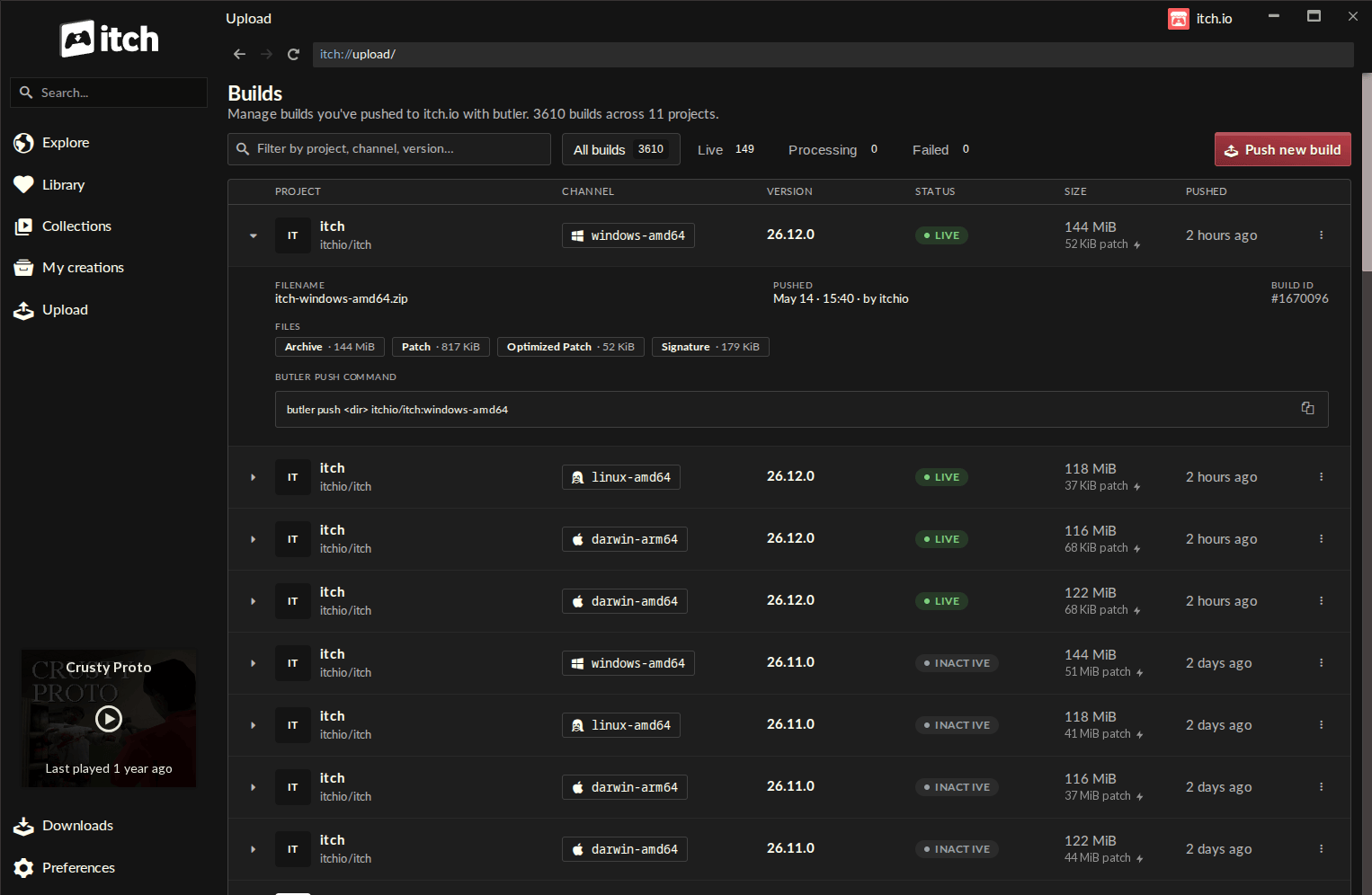
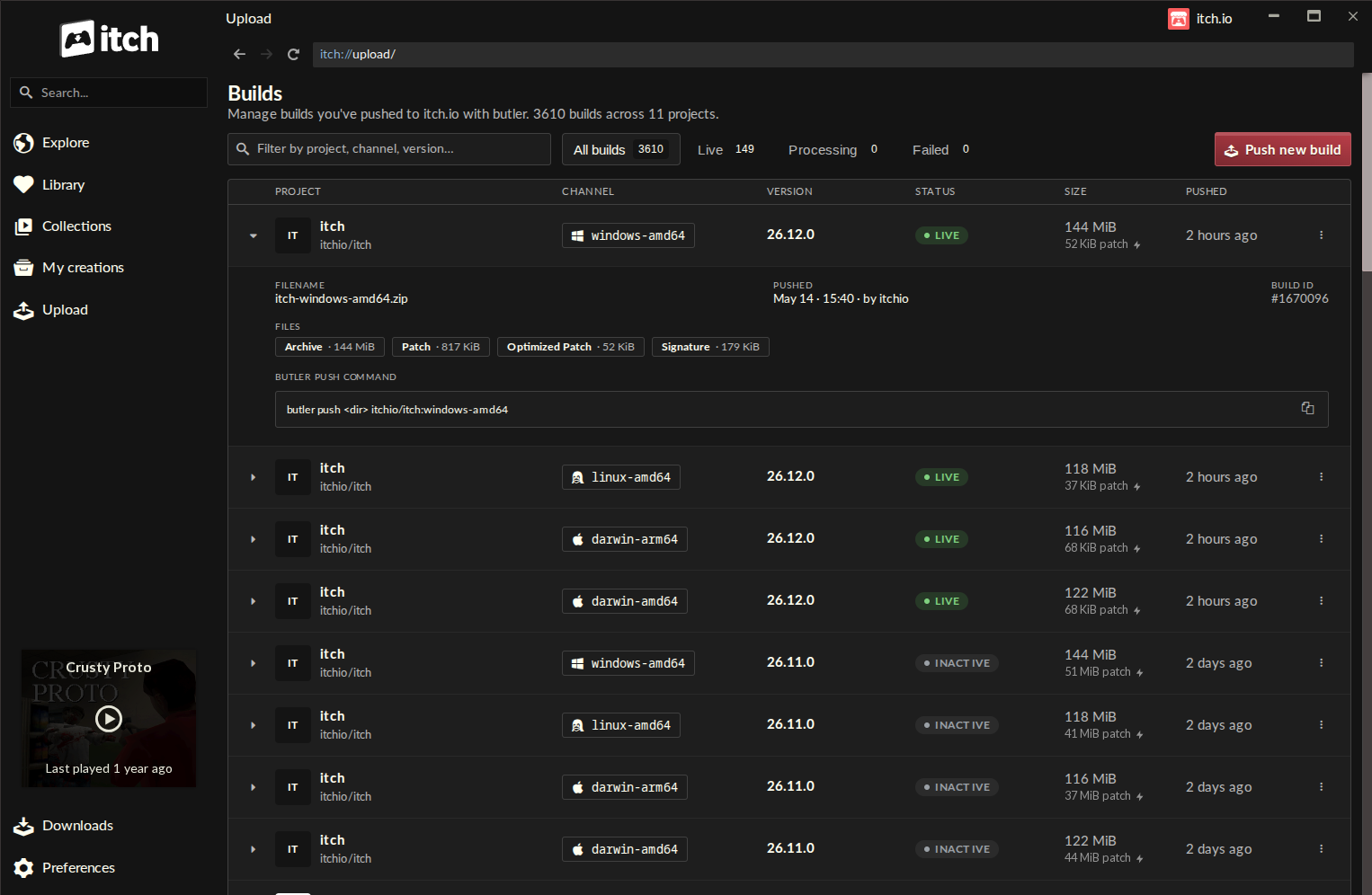
The centerpiece of this update is the new "Builds" section, accessible via the sidebar of the itch.io app. This dashboard serves as a command center for project management.
Key Features of the Dashboard:
- Comprehensive Inventory: The screen provides a granular list of every build associated with an account, categorized by project, channel, version, status, and file size.
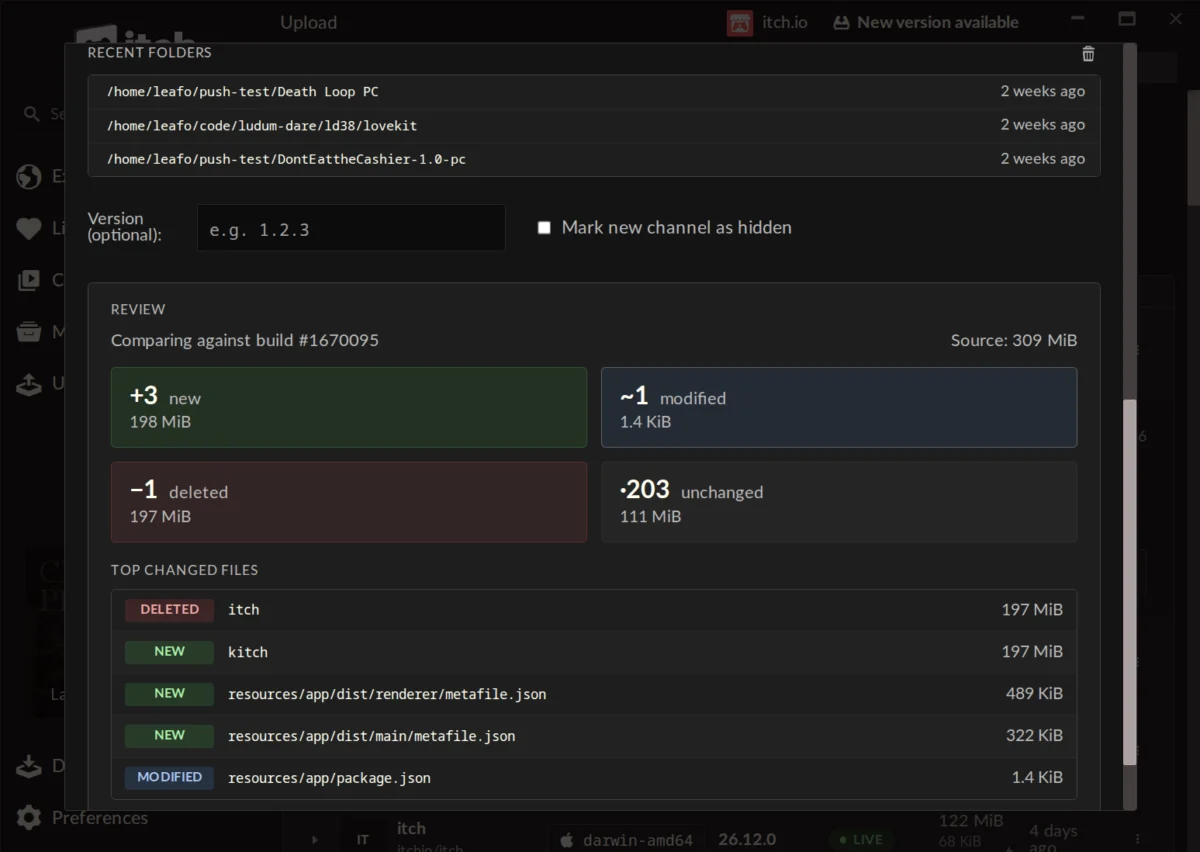
- Visualized Push Dialog: The "Push new build" button launches a dialogue that guides developers through the process of selecting a project, choosing a channel, and assigning a version number.
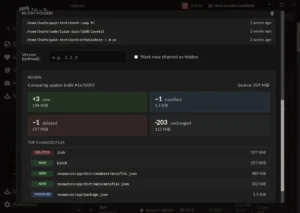
- Smart Previewing: Before finalizing a push, developers can generate a "Difference Report." This tool provides a detailed breakdown of how many files have been added, modified, or deleted. It even identifies the largest files undergoing changes, allowing developers to spot potential errors—such as accidentally including large, unnecessary temporary files—before the upload is finalized.
- Multi-Profile Support: The integration respects the itch.io app’s multi-account capabilities. Developers managing multiple profiles can switch seamlessly between them, ensuring that builds are pushed to the correct project under the correct identity.
Official Responses and Community Feedback
The reaction to the integration has been overwhelmingly positive, though it has sparked an important discussion regarding the platform’s long-term technical constraints.
The Developer Perspective
"Honestly, this is a lot faster than manually updating the webpage," noted one user in the official community forums. "The self-enforcing nature of the Compare step means I almost literally can’t mess it up."
The consensus among the developer community is that the GUI removes the "fragility" previously associated with the terminal approach. For those who were intimidated by the command line, the new interface acts as a safety net, providing a clear visual representation of their deployment history.
Addressing Limitations
Despite the praise, questions regarding the platform’s legacy systems remain. One user inquired about the possibility of migrating existing projects—originally uploaded via the standard browser interface—to the Butler system.
Leafo, representing the itch.io team, provided a candid response: "Unfortunately, it’s not possible right now, as a Butler push needs additional metadata alongside the file that is computed when you’re uploading. This could be something we add in the future but there are no immediate plans at the moment."
This interaction highlights the tension between legacy support and modern, metadata-heavy infrastructure. While the team remains open to future improvements, the current Butler system is built on a specific, rigid architecture that is incompatible with standard, non-versioned uploads.
Implications for the Industry
The integration of Butler into the itch.io desktop app is more than just a quality-of-life update; it is a signal of how the platform intends to compete with larger storefronts like Steam or Epic Games.
Democratization of Infrastructure
By providing high-end deployment tools to every developer regardless of their coding expertise, itch.io is lowering the barrier to entry for professional-grade distribution. Developers no longer need to choose between the ease of a web browser and the speed of a professional CLI; they can now have both.
The Future of "Self-Publishing"
As independent games become more complex, the ability to iterate rapidly is crucial. Developers who can update their games in seconds rather than minutes are better positioned to respond to community feedback, fix critical bugs, and keep their player base engaged.
Security and Maintenance
The fact that the app automatically keeps the Butler version updated is a subtle but critical security feature. It ensures that all developers are using the most secure, patched version of the upload tool, reducing the risk of broken pipelines or compatibility issues caused by outdated software.
Conclusion
The itch.io app’s transition toward a more integrated, GUI-driven workflow represents a maturation of the platform. By taking a complex, powerful tool like Butler and making it accessible to the masses, the itch.io team has empowered a new generation of creators to manage their projects with the efficiency of a major studio.
While challenges remain—such as the inability to retroactively apply Butler metadata to older projects—the trajectory is clear. The platform is focusing on building a robust, developer-first ecosystem that prioritizes speed, clarity, and ease of use. As more developers migrate their workflows to the desktop app, the community is likely to see an increase in the frequency and stability of game updates, ultimately benefiting the millions of players who call itch.io their home for independent gaming.