Endeavour’s Final Frontier: The Samuel Oschin Air and Space Center Prepares for Liftoff
Main Facts: A Monument to Human Ingenuity
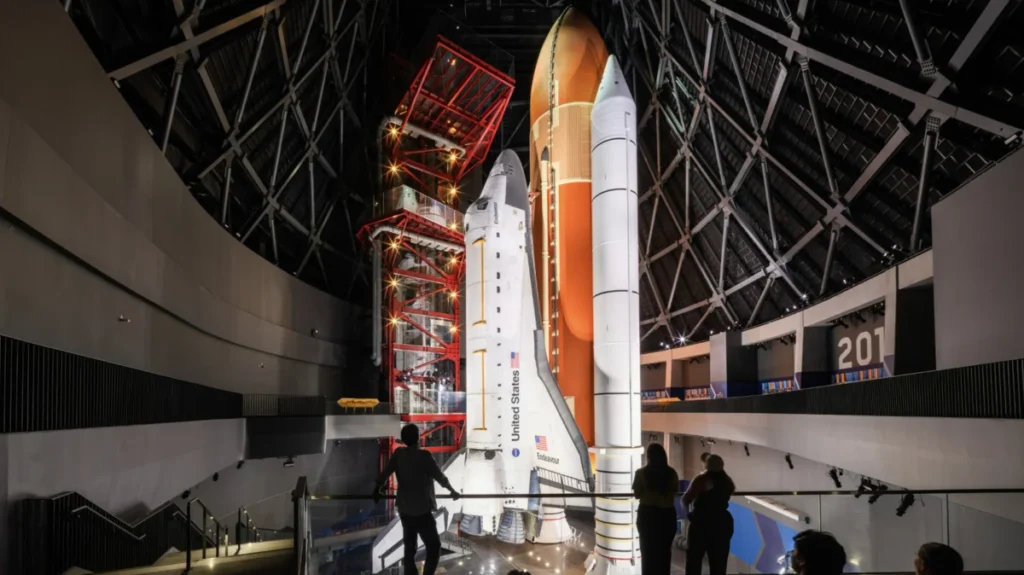
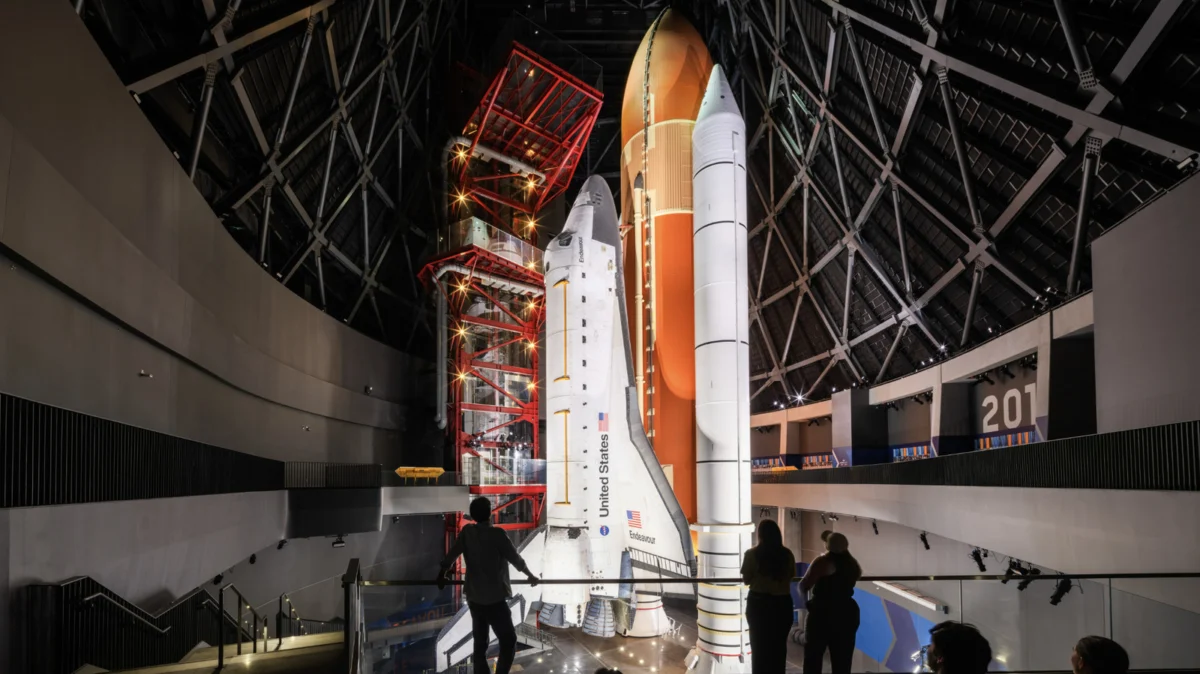
After more than a decade of anticipation and meticulous engineering, the California Science Center has officially confirmed that the Space Shuttle Endeavour will begin its final, permanent mission on November 13, 2026. Housed within the newly constructed Samuel Oschin Air and Space Center—a staggering 200,000-square-foot expansion in Los Angeles—the orbiter will be displayed in a vertical “ready-for-launch” configuration.
This exhibit is not merely a museum piece; it is a full-stack assembly, featuring the authentic orbiter, two solid rocket boosters, and the massive external fuel tank (ET-94). For the first time, visitors will be able to witness the sheer scale of the shuttle assembly exactly as it stood on the launchpad at Kennedy Space Center. Beyond the shuttle itself, the center will debut a collection of over 100 artifacts, many of which have never been seen by the public, ranging from historic aerospace components to personal gear used by the men and women who flew the fleet.
Chronology: From the Ashes of Tragedy to a Los Angeles Icon
The story of Endeavour is inextricably linked to the resilience of the American space program. Following the heart-wrenching loss of the Space Shuttle Challenger in 1986, Congress authorized the construction of a replacement orbiter. Named after the British ship commanded by explorer James Cook, Endeavour was built with the lessons of the Challenger tragedy embedded in its DNA, incorporating state-of-the-art navigation and structural improvements.
Key Milestones in the Life of Endeavour:
- 1987–1991: Construction takes place at the Rockwell International plant in Palmdale, California.
- May 7, 1992: Endeavour takes its maiden voyage (STS-49), a mission defined by the daring, first-of-its-kind manual capture and repair of the Intelsat VI satellite.
- 1993–2011: The orbiter completes 25 missions, serving as a workhorse for the Hubble Space Telescope repair missions and playing a pivotal role in the assembly of the International Space Station (ISS).
- June 1, 2011: Endeavour touches down at Kennedy Space Center for the final time, concluding its mission with STS-134.
- October 2012: After a cross-country ferry flight, the shuttle makes a legendary, slow-motion trek through the streets of Los Angeles, becoming a local icon as it passed landmarks like the Forum and navigated tight turns through urban neighborhoods.
- November 13, 2026: The official grand opening of the Samuel Oschin Air and Space Center.
The Engineering Marvel of the Vertical Stack
The centerpiece of the new museum is a feat of modern structural engineering. Displaying a space shuttle vertically is notoriously difficult, as the vehicles were designed to survive the vacuum of space, not the constant tug of gravity on their frames.
To support the 122-foot-tall stack, engineers have installed a base-isolation system, a seismic-protection feature essential for Southern California. The "launch stack" is held in place by a series of custom-designed steel support structures that carry the weight of the massive external tank, which in turn supports the orbiter.
Perhaps the most immersive aspect of the exhibit is the 140-foot gantry elevator. By ascending this structure, guests will be positioned at the level of the crew access arm—the "white room"—where astronauts took their final breaths of Earth’s atmosphere before boarding the craft. This perspective shift is intended to move the visitor from the role of a spectator to that of a participant in the mission experience.
Supporting Data: Why Endeavour Matters
The Endeavour program was more than just a transportation service; it was the backbone of scientific advancement in low-Earth orbit. During its service, the shuttle traveled over 122 million miles and spent 299 days in space.
- The Hubble Legacy: Endeavour was the designated vehicle for the first servicing mission of the Hubble Space Telescope (STS-61). Without the shuttle’s unique ability to carry massive replacement optics and a crew capable of intricate mechanical repairs, the telescope would have remained a flawed experiment.
- ISS Assembly: Endeavour flew 12 missions to the International Space Station, delivering vital components including the Unity module, the Z1 truss, and the Canadian-built robotic arm (Canadarm2).
- Economic and Educational Impact: The California Science Center estimates that the Samuel Oschin Air and Space Center will increase annual attendance by millions, serving as a primary hub for STEM education in the Los Angeles Unified School District and beyond.
Official Responses and Museum Vision
Jeffrey Rudolph, President and CEO of the California Science Center, has long championed the idea that the shuttle is more than a vehicle—it is a catalyst for inspiration. In a recent press release, Rudolph emphasized that the Samuel Oschin center is designed to "inspire the next generation of scientists, engineers, and explorers."
"When we look at the Endeavour, we aren’t just looking at the past," said one lead museum curator. "We are looking at the foundational technology that allowed us to become a space-faring species. By placing it in a vertical, launch-ready configuration, we are giving the public a visceral reminder of what it looks like when human ambition leaves the ground."
The project has been made possible through a massive public-private partnership, with significant contributions from the Oschin family and a wide array of aerospace donors. The construction of the facility itself, which features a facade designed to evoke the sleek lines of aerospace engineering, has been a multi-year project involving precision logistics.
Implications: The Future of Space Heritage
The decision to display Endeavour vertically has set a new gold standard for museum curation. By moving away from the static, horizontal displays common in other museums, the California Science Center is challenging other institutions to find ways to make history feel active and urgent.
Furthermore, the integration of "rare and historic objects"—including engines from the Titan rocket program and specialized satellite arrays—serves to contextualize the shuttle. It reminds the public that Endeavour was not an isolated triumph but the result of a vast, interconnected network of aerospace innovation.
As we move closer to 2026, the focus of the space industry has shifted toward the Artemis program and the commercialization of Low Earth Orbit (LEO). In this context, the Endeavour exhibit serves a vital purpose: it anchors the future of space exploration in the proven successes of the past. It provides a touchstone for the public, ensuring that the legacy of the Space Shuttle era is preserved not in dusty archives, but in a living, breathing monument to human potential.
When the doors to the Samuel Oschin Air and Space Center open on that November morning in 2026, visitors will be greeted by more than just a shuttle. They will be greeted by the physical embodiment of the phrase "the sky is not the limit." For those who visit, Endeavour will remain, as it has been since its maiden flight, a symbol of what can be achieved when science, courage, and technology align.