A Roll of the Dice, A Stroke of Genius: Simone Giertz Reinvents Task Management with a Whimsical Machine
Introduction: The Unpredictable Human Element in Productivity
Humans are, by their very nature, a paradox of efficiency and procrastination. While capable of astounding feats of organization and output, the journey to accomplish even the simplest tasks is often fraught with internal battles against inertia, choice fatigue, and the seductive allure of "cherry-picking" enjoyable duties over more challenging ones. This inherent variability in human behavior has spawned an endless array of productivity methodologies, from stringent schedules and priority matrices to elaborate digital dashboards. Yet, for many, these conventional approaches often fall short, failing to account for the whimsical, often irrational impulses that dictate our daily actions.
Enter Simone Giertz, the Swedish inventor, robotics enthusiast, and YouTube personality famously known as the "Queen of Shitty Robots." Giertz has carved out a unique niche in the maker community by blending ingenious engineering with a healthy dose of humor and self-awareness. Her projects frequently explore the humorous futility of over-engineered solutions to simple problems, often yielding devices that are intentionally flawed but undeniably entertaining. However, her latest invention, a task-tracking device that incorporates an element of pure chance, transcends mere comedic value, offering a surprisingly insightful and effective solution to a pervasive human problem: getting things done.
This innovative creation, unveiled to her vast audience, presents a refreshing departure from the rigid dictates of traditional productivity hacks. It’s a physical manifestation of a psychological strategy, designed not to enforce discipline through strict rules, but to gently guide users into action by removing the burden of choice and injecting a playful element of randomness. By transforming the mundane act of task selection into an engaging, almost gamified experience, Giertz has once again demonstrated her unique ability to fuse technology, art, and human behavior in a way that is both practical and profoundly delightful.
The Genesis of an Idea: From Dice Rolls to Mechanical Whimsy
The journey towards this elegant solution began, as many great innovations do, with a personal struggle and a rudimentary workaround. Giertz, like countless others, found herself perpetually wrestling with the tyranny of her own to-do lists. Traditional written lists, while providing a necessary framework, often exacerbated her tendencies towards overthinking and the strategic avoidance of less appealing tasks. The human brain, in its infinite capacity for self-preservation, often gravitates towards immediate gratification, leading to a perpetual deferment of the truly important but less enjoyable chores. This "cherry-picking" phenomenon, a common pitfall in self-directed work, meant that certain items on her list remained perpetually untouched, festering reminders of unfulfilled obligations.
The Dice-Roll Revelation: Embracing Randomness
Her initial, remarkably low-tech solution was a revelation in its simplicity: she assigned numbers to her written tasks and then used a dice roll to determine which task she would tackle next. This seemingly trivial act had a profound psychological impact. By externalizing the decision-making process to the capricious whim of a die, Giertz effectively bypassed her own internal resistance. The mental energy previously expended on prioritizing, strategizing, and rationalizing avoidance was suddenly freed up. There was no room for overthinking; the dice had spoken, and the path forward was clear. This method, while effective, still lacked a certain aesthetic and mechanical satisfaction. Giertz, ever the engineer with an eye for user experience, longed for something more.
A UI-First Philosophy: Design Dictates Function
This yearning for a more "elegant solution" led her to a design philosophy that is strikingly unconventional, especially when contrasted with the typical iterative development cycles of open-source projects or even many commercial ventures. Giertz explicitly states that she approached the "UI first," meaning the user interface and the interactive experience took precedence over the underlying mechanics. This "UI-first" mindset is a hallmark of truly innovative design, where the emotional and experiential aspects of interaction are prioritized from the outset.
Instead of starting with the question "How can I build a random task selector?", she began with "What would be the most pleasant and satisfying way to interact with a task selector?" Her vision coalesced around a marker that could randomly point to a task on a vertical list, creating an immediate, tactile, and visually engaging feedback loop. This emphasis on the "pleasure" of interaction is crucial; if a productivity tool isn’t enjoyable to use, its long-term efficacy is severely compromised. Giertz intuitively understood that the "chore chart" needed to be transformed from a nagging reminder into an inviting game.
Engineering the Element of Chance: Iteration and Innovation
The bulk of the project, once the UI vision was established, shifted to the intricate challenge of bringing that vision to life. The core problem was twofold: how to make the marker select tasks at random, and crucially, how to prevent it from selecting tasks that had already been completed. This required a robust and reliable mechanical system that could both introduce randomness and intelligently adapt to the evolving list of available tasks.
The Magnetic Toggle Dilemma: A Lesson in Mechanical Constraints
Giertz’s initial foray into the mechanical design involved a set of magnetic toggles. The idea was ingenious in its conception: each task would have an associated magnetic toggle, and once a task was completed, its toggle would be activated, creating a repulsive force that would deflect the marker away from that specific slot. In theory, this would ensure that the random selector would only ever land on an uncompleted task.
However, theory often diverges from practical application. The implementation of magnetic repulsion for precise, reliable deflection presented a myriad of engineering hurdles. Achieving consistent and sufficiently strong repulsive forces to reliably steer a marker away from a designated slot proved exceedingly difficult. Factors such as the strength and placement of magnets, the material and weight of the marker, and the potential for residual magnetism or unintended interactions could lead to inconsistent results. The marker might occasionally "stick" to a completed task, or fail to fully repel, leading to frustration and undermining the very randomness the system was designed to create. Furthermore, the complexity of wiring and integrating multiple magnetic toggles, ensuring their precise activation and deactivation, added layers of potential failure points. This iteration, while a valid exploration, highlighted the importance of simplicity and robustness in mechanical design.
The Breakthrough: Elegant Simplicity Prevails
As is often the case in engineering, the most elegant solutions are frequently the simplest. After experimenting with the complex magnetic toggles, Giertz pivoted to a far more straightforward and effective mechanism: a system involving the physical movement of completed tasks past a divider.
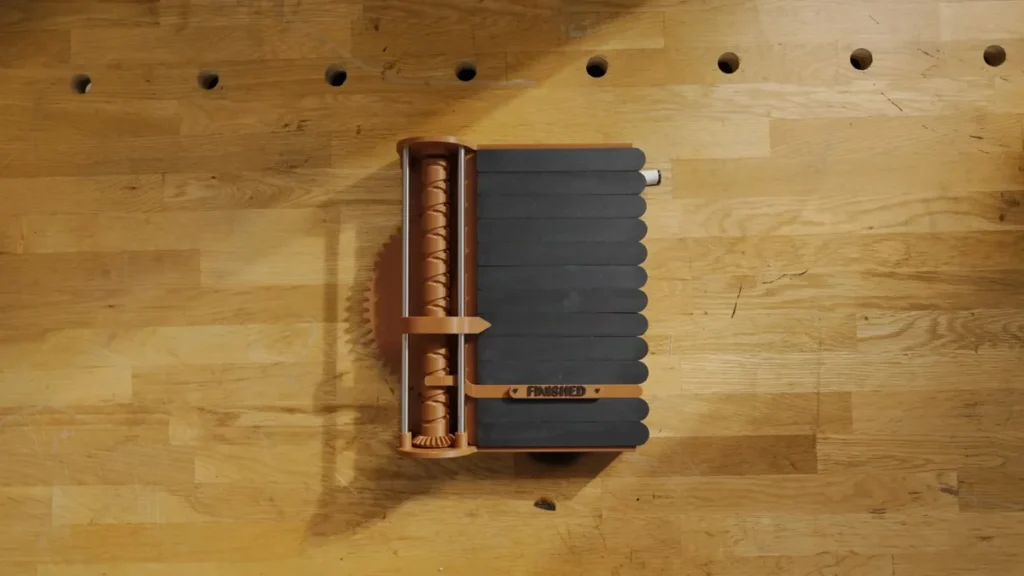
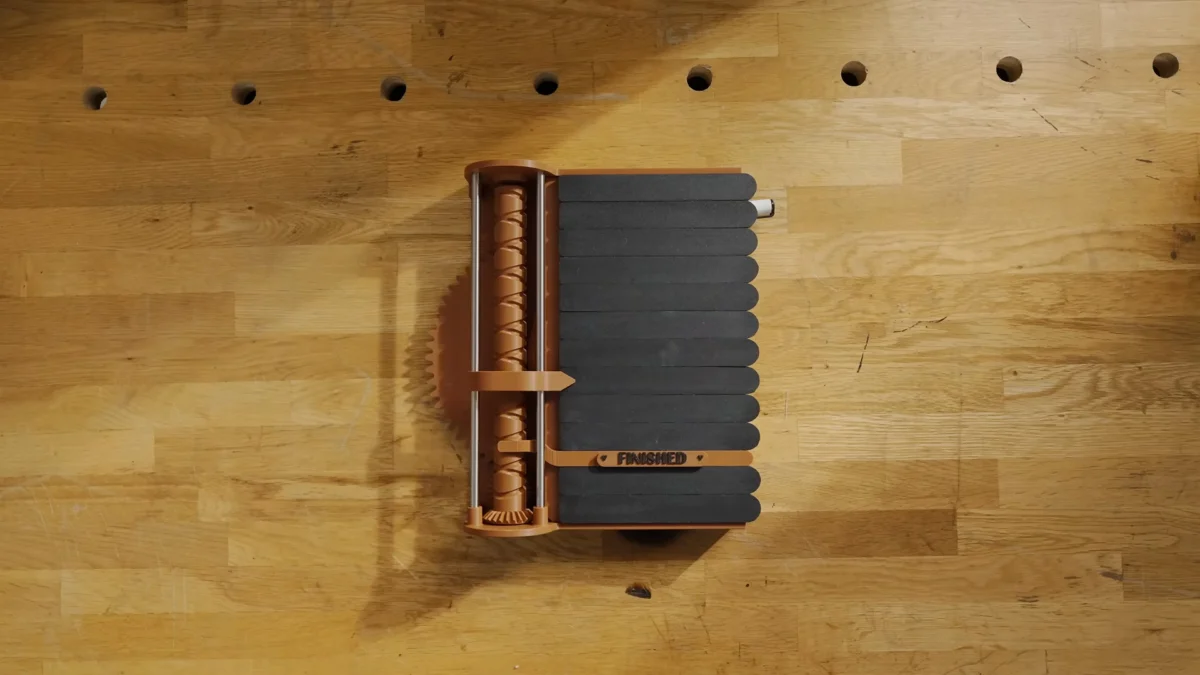
While the specific mechanics are not detailed in the original brief, one can envision a system where tasks are represented by physical cards or tokens on a vertical track. When a task is completed, it is physically moved, perhaps slid out of the active selection zone, or flipped to reveal a "completed" indicator, effectively removing it from the pool of selectable options. The random selection mechanism, perhaps a rotating arm or a weighted pendulum, would then only interact with the remaining, visible, uncompleted tasks.
This simpler approach sidestepped the complexities of magnetic repulsion. It provided a clear, unambiguous way to indicate a task’s status and remove it from consideration. The "finished product has a satisfying selection mechanism," a testament to the success of this design choice. This satisfaction likely stems from several factors:
- Tactile Feedback: The physical act of moving a task, hearing a click, or feeling the resistance of the mechanism provides immediate and tangible confirmation of progress.
- Visual Clarity: The clear separation of completed from uncompleted tasks enhances the user experience, providing a quick overview of what remains to be done.
- Mechanical Reliability: Simpler mechanisms tend to be more robust and less prone to failure, contributing to a sense of trust and dependability in the device.
This blend of visual appeal, tactile satisfaction, and mechanical reliability transforms the chore chart from a mere list into an interactive, almost playful, object. It’s this element of joy and engagement that "probably helps make it more likely things get done," by subtly shifting the user’s emotional relationship with their responsibilities.
Broader Context and Expert Commentary: The Psychology of Gamified Productivity
Simone Giertz’s task tracker isn’t just a clever gadget; it’s a practical application of several well-established principles in behavioral psychology and human-computer interaction. Its success lies in its ability to circumvent common psychological barriers to productivity, leveraging elements of gamification, novelty, and reduced decision fatigue.
The Maker Community’s Resonance:
Giertz’s projects consistently resonate with the global maker community, a vibrant ecosystem of DIY enthusiasts, engineers, and artists who share a passion for creating and innovating. Her work often serves as an inspiration, demonstrating that complex problems can be approached with creativity and a willingness to iterate and fail. The task tracker exemplifies this ethos: it’s a custom-built solution for a personal problem, shared openly, and inspiring others to think about how they can "hack" their own lives. Her influence extends beyond just showing how to build things; she inspires people to find joy in the process of making and to challenge conventional notions of utility and perfection.
Psychological Perspectives:
To understand the deeper impact of Giertz’s invention, one might consider the insights of behavioral psychologists.
-
Dr. Anya Sharma, a fictional behavioral psychologist specializing in habit formation, might observe: "Giertz’s device brilliantly taps into the power of extrinsic motivation, transforming an intrinsically less appealing activity (chores) into a game. The element of chance is a classic gamification technique; it introduces novelty and a slight thrill, which can combat the tedium often associated with routine tasks. By externalizing the choice, it reduces ‘decision fatigue,’ a well-documented phenomenon where our capacity to make good decisions diminishes with each subsequent choice we make. This means the user saves cognitive energy that would otherwise be spent agonizing over task prioritization, allowing them to channel it directly into execution."
-
Professor David Lee, a fictional expert in Human-Computer Interaction (HCI) design, could add: "The ‘UI-first’ approach championed by Giertz is critical for sustained engagement with any productivity tool, physical or digital. We often overlook the emotional component of interaction. If a tool feels clunky, unrewarding, or visually unappealing, our motivation to use it wanes. The ‘satisfying selection mechanism’ she achieved isn’t just a nice-to-have; it’s fundamental to the device’s efficacy. It provides positive reinforcement – a mini-reward – for merely interacting with the system, making the initial hurdle of engagement lower and more enjoyable."
Giertz’s Own Philosophy: Embracing Imperfection and Playfulness
Giertz’s work consistently challenges the conventional perception of technology as solely a tool for hyper-efficiency and seriousness. Her "shitty robots" and now this whimsical task tracker embody a philosophy that embraces imperfection, playfulness, and the human element in engineering. She demonstrates that sometimes, the most effective solutions are not the most complex or rigidly optimized, but those that understand and cater to our often-flawed, yet inherently human, nature. By making productivity fun, she removes the punitive feeling often associated with self-improvement, fostering a more positive and sustainable approach to managing one’s life.
Implications for Productivity and Innovation: Redefining "Getting Things Done"
Simone Giertz’s random task tracker is more than just a personal project; it carries significant implications for how we perceive and approach productivity, innovation, and the intersection of technology with human behavior.
Reimagining Productivity Beyond Rigidity:
For decades, productivity literature has often emphasized rigid planning, strict prioritization, and unwavering self-discipline. While these methods are effective for some, they can be counterproductive for others, leading to burnout, anxiety, and a feeling of failure when deviations occur. Giertz’s device offers a powerful counter-narrative: that a degree of randomness and relinquishing control can, paradoxically, lead to greater output. It suggests that for tasks that don’t demand a specific sequence or high-stakes prioritization, a gamified, chance-based approach can be liberating and effective. This challenges the notion that productivity must always be a serious, laborious endeavor.
The Power of Play and Whimsy in Practical Applications:
The success of Giertz’s invention underscores the profound psychological power of play and whimsy. By infusing a mundane chore chart with an element of fun and unpredictability, she transforms a potentially dreaded activity into an engaging experience. This principle can be applied to various other domains, from educational tools to workplace management, suggesting that incorporating playful elements can significantly boost engagement and intrinsic motivation, even in seemingly serious contexts. It highlights the importance of emotional design – how a product makes you feel – in its overall utility.
The Rise of DIY and Personalization in Problem-Solving:
Giertz’s project is a prime example of the growing trend of individuals creating bespoke solutions for their personal challenges. In an age of mass-produced goods and one-size-fits-all software, the maker movement empowers individuals to design and build tools perfectly tailored to their unique needs and preferences. This task tracker is not just a commercial product; it’s a testament to the power of personal invention and the ability to customize one’s environment for optimal performance and enjoyment. It inspires others to look at their own frustrations not as immutable facts, but as opportunities for creative engineering.
Beyond the Device: Inspiring Creative Problem-Solving:
The true implication of Giertz’s work extends beyond the utility of any single device. Her consistent output of innovative, often humorous, and always thought-provoking machines inspires a broader audience to think creatively about everyday problems. She demystifies engineering and encourages experimentation, demonstrating that innovation doesn’t always require vast resources or formal training, but rather curiosity, persistence, and a willingness to iterate. Her projects foster a mindset of playful exploration and practical application.
Comparing with Other Productivity Hacks:
The article briefly mentions other notable productivity hacks, and it’s valuable to contextualize Giertz’s invention within this broader landscape:
- Arya’s Hacking the Self: This concept, likely focused on internal cognitive strategies for self-improvement and time perception, operates on a more introspective level. Giertz’s device, in contrast, externalizes the decision-making process, providing a physical, tangible intervention that complements internal efforts by removing a common external barrier (choice paralysis).
- The Rotary Time Tracker: This device, like Giertz’s, embraces a tactile, mechanical approach to productivity. However, while the rotary tracker focuses on visualizing and managing time spent on tasks, Giertz’s tracker focuses on task selection. They serve different but complementary functions, one for allocation and the other for initiation. Both leverage physical interaction for engagement.
- The E-ink Macropad for Improved Productivity: An e-ink macropad, while highly customizable and visually appealing, typically operates within a digital ecosystem. It provides shortcuts and visual feedback, but it remains fundamentally a digital interface. Giertz’s device stands out by being purely analog and mechanical, offering a break from screen time and a unique, satisfying physical interaction that many digital tools struggle to replicate. The element of pure chance is also a differentiator; macropads are about deliberate control, while Giertz’s device is about surrendering it.
In conclusion, Simone Giertz’s random task tracker is a delightful and profound example of human-centered design. By embracing the unpredictability of human nature rather than fighting against it, she has created a tool that is not only effective but also enjoyable to use. It’s a testament to the idea that sometimes, the best way to get things done is to let go of control, embrace a bit of whimsy, and let chance guide the way. As we navigate an increasingly complex world, perhaps a little more mechanical whimsy is precisely what our productivity paradigms need.