High-Stakes Arrest of Cybersecurity Executive Tied to ShinyHunters Probe Shakes Industry
WASHINGTON — In a stunning twist that blurs the lines between corporate defense and cybercrime, federal authorities have arrested a prominent Canadian cybersecurity executive and author. The high-profile apprehension is directly tied to an escalating international investigation into the notorious ShinyHunters hacking collective—a group that recently pulled off one of the most embarrassing cyberattacks in modern U.S. history by breaching the FBI and exfiltrating sensitive dossiers on thousands of federal agents.
According to multiple sources speaking to KrebsOnSecurity, federal agents arrested Edward Dubrovsky, co-founder of Canadian security firm Cypfer and a key figure at CyberSteward, in Pennsylvania. The arrest follows a trail of international law enforcement actions that have systematically unspooled the operational network of a cybercriminal syndicate responsible for tens of millions of dollars in corporate extortion.
Main Facts
The core of the federal case centers on allegations of cyber extortion and conspiracy, a stark reversal of roles for a man who made his career advising Fortune 500 companies on how to navigate the treacherous waters of ransomware negotiations.
Federal court records indicate that Edward Dubrovsky—alternatively spelled Dobrovsky in initial filings—was taken into custody on October 8 in Pennsylvania. The charges unsealed thus far point to "conspiracy to threaten to impair the confidentiality of information with the intent to extort money" and "interference with commerce by threats."
While several core documents, including the primary criminal complaint, remain sealed, public court dockets confirm that the case has been rapidly transferred to the U.S. District Court for the Eastern District of Texas. Sources close to the investigation indicate that this Texan federal hub has now been designated as the centralized epicentre for the entire, sweeping federal probe into ShinyHunters.
Dubrovsky’s arrest is not an isolated incident; it represents a major escalation in a coordinated global dragnet. Law enforcement agencies across multiple continents have turned their sights not just on the core hackers, but on the fringe ecosystem of intermediaries, negotiators, and firms that interface between victimized corporations and extortionists.
Chronology of Events
The unraveling of the ShinyHunters infrastructure and the subsequent targeting of associated facilitators unfolded across a rapid, high-intensity timeline through the late summer and autumn of 2026:

- Late Summer 2026: Dutch law enforcement authorities execute a high-profile raid, arresting Pepijn van der Stap, a reformed hacker suspected of playing a critical role in the ShinyHunters operation. U.S. federal investigators immediately begin exploiting devices and communications data seized during the raid.
- September 2026: Edward Dubrovsky posts on LinkedIn, detailing his team’s upcoming travel plans to attend the high-profile Cyber Risk Summit in Philadelphia, Pennsylvania, expressing enthusiasm for continuing conversations around global, agnostic ransomware advisory and settlement strategies.
- October 5–7, 2026: The Cyber Risk Summit is held at the Loews Philadelphia Hotel. Canadian cybersecurity firm Cypfer—co-founded by Dubrovsky—serves as the summit’s premier corporate sponsor. Dubrovsky attends the conference.
- October 7, 2026: Reuters reports the detention of a teenage hacker known online as "Rey"—later identified as Saif Al-din Khader. Rey had recently assumed control of ShinyHunters following Van der Stap’s arrest, publicly taunting the FBI over the theft of personnel data. Investigations reveal Rey was apprehended while attempting to extort a digital aviation unit spun off from Boeing in late 2025.
- October 8, 2026: Edward Dubrovsky is arrested by FBI agents in Pennsylvania on cyber extortion and conspiracy charges.
- October 9, 2026: Legal proceedings are officially transferred to the Eastern District of Texas. Concurrently, The New York Times breaks the news of the arrest of a Canadian man assisting ShinyHunters, though initial reports omit his name. FBI Director Kash Patel issues a statement regarding the operation without naming the suspect.
Supporting Data & Profiling the Suspect
The intersection of Dubrovsky’s professional background and his alleged criminal liability provides a fascinating window into the dark mechanics of modern cybercrime syndicates.
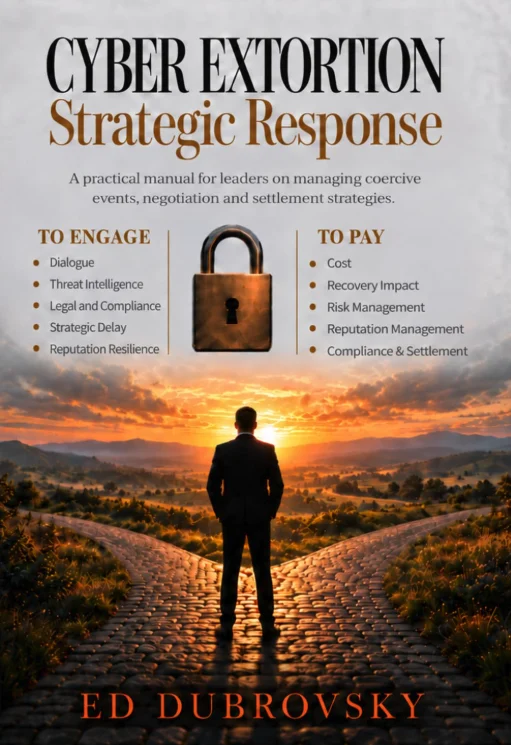
Dubrovsky is a recognized authority within the cyber insurance and incident response community. He is the author of Cyber Extortion Strategic Response, a 252-page manual designed to guide organizations through the complexities of ransom demands, containment, and recovery. Ironically, a widely cited excerpt from his book’s Amazon listing emphasizes the nuances of criminal communication:
"At the heart of the book is a critical distinction: communicating with a criminal is not the same as negotiating a payment, and negotiating is not a commitment to pay. Engagement can serve other objectives, including testing claims, gathering information, creating time, and preserving options while the organization evaluates its next move."
Despite his professional pedigree as a defensive strategist, federal prosecutors allege that Dubrovsky crossed the threshold from advisor to active participant in extortion schemes.
Financially and operationally, the target of the investigation—ShinyHunters—is an industrial-scale threat actor. According to FBI tracking data, the collective has successfully utilized phishing campaigns and credential-stuffing attacks to compromise software-as-a-service (SaaS) providers, siphoning corporate data and extorting more than $70 million from victims globally over the course of the year.
Official Responses and Institutional Fallout
The posture of federal law enforcement has shifted from defensive damage control to aggressive prosecution. However, official channels remain tight-lipped regarding the granular details of the ongoing legal actions.
When contacted for comment regarding Dubrovsky’s arrest and the centralization of the case in Texas, the Federal Bureau of Investigation declined to comment, citing the ongoing nature of the judicial proceedings. Similarly, public statements from FBI Director Kash Patel on social media platform X acknowledged the broad strokes of the arrests targeting ShinyHunters facilitators but omitted specific identities to protect the integrity of the broader investigation.

Court records indicate that as of the latest filings, Dubrovsky is being held at a federal facility in Philadelphia. He currently lacks retained private legal representation, and the court has yet to formally appoint a public defender to his case. Efforts by reporters to reach co-founders and representatives at CyberSteward and Cypfer for comment were met with silence as the corporate entities scramble to distance themselves from the unfolding scandal.
Implications for the Cybersecurity and Ransomware Ecosystem
The arrest of a high-profile industry executive like Edward Dubrovsky sends shockwaves through the cybersecurity, cyber insurance, and incident response communities, carrying profound implications:
1. The Perilous Gray Area of Incident Response
For years, the multi-billion-dollar incident response and ransomware negotiation industry has operated in a legal and ethical gray zone. While companies routinely hire specialized firms to talk down extortionists and securely deliver cryptocurrency ransom payments, law enforcement has grown increasingly suspicious of firms that act as financial conduits for cybercriminal cartels. Dubrovsky’s arrest signals that federal authorities are willing to scrutinize the actions of third-party negotiators who step past advisory roles into active collusion or facilitation.
2. Escalation of the ShinyHunters Probe
The compromise of the FBI’s own online recruitment portal—which exposed sensitive unit designations, specializations, and confidential medical and psychiatric records of federal agents—was an unprecedented black eye for the Bureau. The swift takedown of figures like Pepijn van der Stap, teenage mastermind Saif Al-din Khader ("Rey"), and now Edward Dubrovsky demonstrates that the U.S. government has prioritized the dismantling of the ShinyHunters infrastructure above all else, leveraging international police cooperation to hunt down every tier of the criminal enterprise.
3. Impending Industry-Wide Fallout
According to intelligence gathered by KrebsOnSecurity, federal investigators are actively reviewing seized digital evidence and financial ledgers. Sources suggest that Dubrovsky may not be the last executive to face criminal charges; additional indictments targeting principals at other companies specializing in ransomware negotiation and advisory services may be imminent.
As this fast-moving story continues to develop, the boundary lines defining legal defense, corporate crisis management, and criminal conspiracy have been irrevocably redrawn.