The Fall of Radaris: How a Landmark Privacy Law Smashed a Decade of Data Broker Impunity

In a stunning legal rebuke that could reshape the multi-billion-dollar consumer data-broker industry, the high-traffic people-search giant Radaris.com has lost control of its primary domain name. Following years of aggressive legal evasion, shell-company shuffling, and stonewalling, a New Jersey court has ordered the transfer of radaris.com and over a dozen sister domains to data privacy firm Atlas Data Privacy Corp.
The unprecedented seizure is the direct result of systematic violations of Daniel’s Law, a stringent New Jersey statute that shields law enforcement personnel, judges, and government officials from having their personal information harvested and published by commercial lookup services.
Rather than functioning as a mere administrative penalty, the domain transfer serves as an execution of a default judgment, marking a monumental turning point in the battle between digital privacy advocates and an industry that has long operated with virtual impunity. Today, visitors to radaris.com are no longer greeted by millions of searchable dossiers on everyday Americans. Instead, the site redirects to a stark compliance notice managed by Atlas, complete with links detailing the exposure of the network’s true architects.
Chronology of an Evasion: A Decade of Shell Games
To understand how Radaris finally fell, one must trace a decade-long trail of procedural attrition, offshore shell companies, and legal subterfuge.
The 2017 Precedent
Radaris’s playbook for handling legal pressure was established years prior. In 2017, the company lost a class-action lawsuit (Huebner v. Radaris, LLC) by default after refusing to mount a defense in court. When plaintiffs attempted to collect a $7.5 million default judgment, a judge ordered Verisign to transfer the radaris.com domain.
However, Radaris’s counsel—Val Gurvits of the Boston Law Group—stepped in on appeal, arguing that taking the domain violated due process because the lawsuit had failed to name the domain’s true owner: a Cyprus-registered entity called Bitseller Expert Limited. The judge halted the transfer, granting the plaintiffs permission to refile. They never did.
Sensing a winning formula, the operators quickly adapted. Shortly after the 2017 case, operation of Radaris shifted from Bitseller to Andtop Company, an entity incorporated in the remote Marshall Islands in October 2020.
The Atlas Confrontation
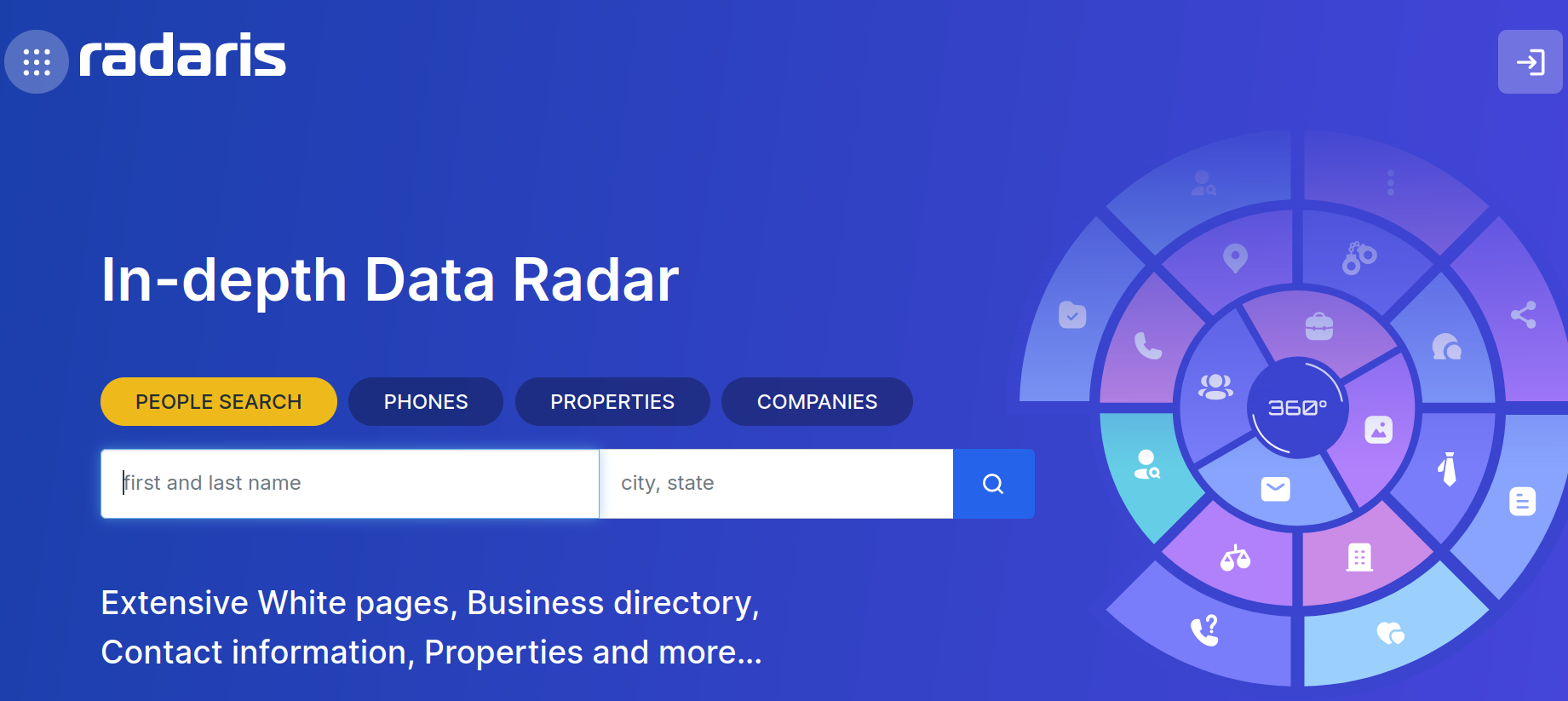
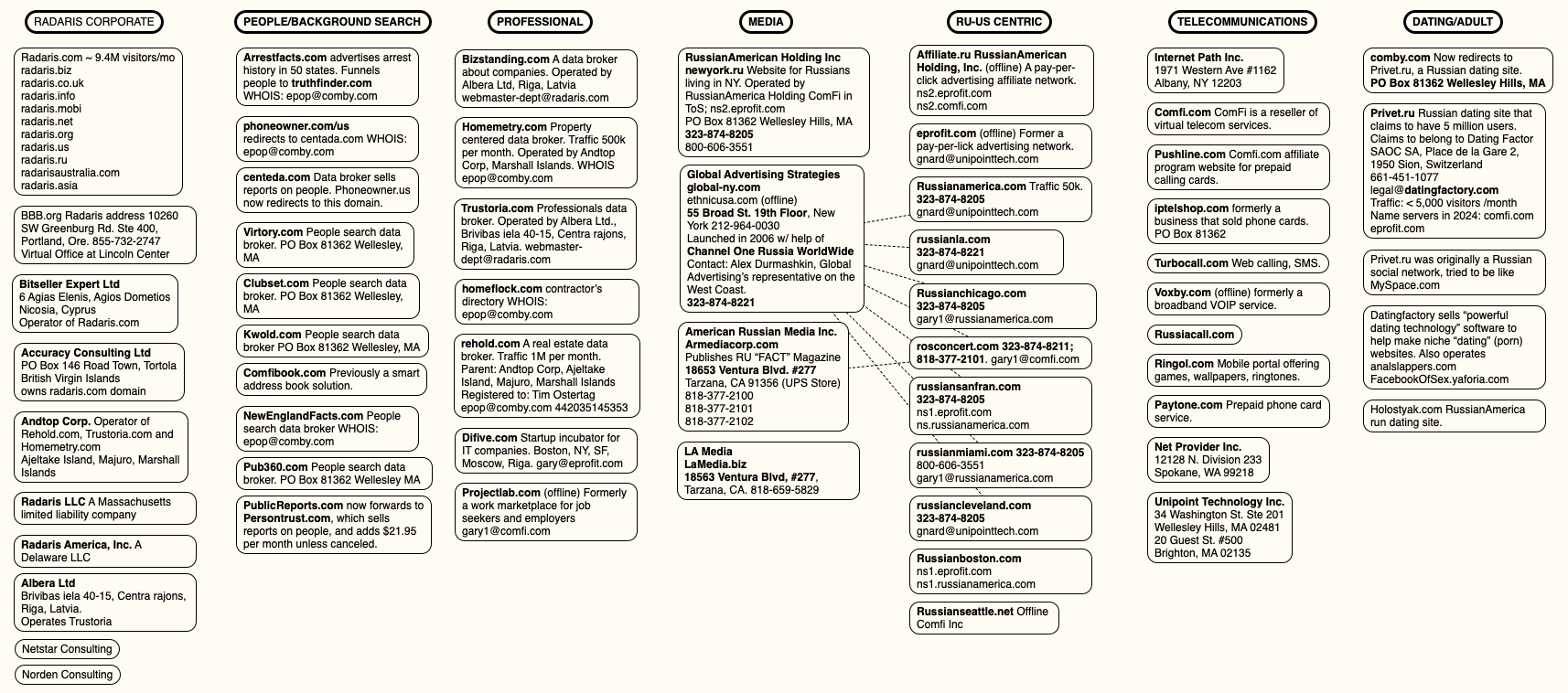
In February 2024, Atlas Data Privacy Corp took up the mantle, suing Radaris for blatant violations of Daniel’s Law. Within weeks of the lawsuit, investigative reporting by KrebsOnSecurity unmasked the true masterminds behind the sprawling network: Russian-born brothers Igor and Dmitry Lubarsky (also known as Gary and "Dan" Lybarsky), Massachusetts residents who operate a complex matrix of people-search websites and foreign dating services.
When confronted, attorneys for the Lubarsky brothers threatened defamation lawsuits and insisted the true owners were Ukrainians residing in Ukraine. They even manufactured a fictitious CEO named “Gary Norden,” utilizing his name in investor press releases—a fabrication later admitted by their own attorney, Val Gurvits.
When Atlas re-filed the lawsuit in June 2025 to expand the scope of targeted Daniel’s Law violations, Radaris deployed its classic delay tactics.
“We refer to this period as their island-hopping phase,” said Matt Adkisson, CEO of Atlas. “Privacy policies changed constantly, and new entities kept appearing from places like the Marshall Islands, the British Virgin Islands, and Seychelles.”
Adkisson noted that when defendants updated their terms of service to claim management by a Marshall Islands entity, Atlas investigators discovered the company didn’t even legally exist yet. For a decade, this strategy of exhaustion worked: plaintiffs grew tired of the endless jurisdictional shell games and walked away. But Atlas committed the necessary resources to see the fight through.
On August 26, 2025, a New Jersey judge ruled that the defendants had been granted ample opportunity to defend themselves and repeatedly failed to do so. Consequently, the court ordered the transfer of 14 domains tied to the Radaris network.
Supporting Data: Unmasking the Network
The collapse of Radaris has yielded an unprecedented trove of internal documentation. According to Atlas, the litigation has successfully forced the production of over 10,000 internal emails, financial records, and operational documents.
These documents definitively corroborate investigative findings that a dizzying array of nominal corporate entities—including Radaris America, Inc., Bitseller Expert Limited, Digital Orbit Corp, Core Solutions Group Inc, Lucky Solutions Inc, Virtura Corp, Veripages Inc., Nuform Solutions Inc., Growth Data Advisors Inc., and Property Experts, Inc.—are nothing more than legal facades.
Key insights derived from the document cache include:

- Centralized Operations: All 26 people-search websites in the network are administered by a tight-knit group of three or four individuals operating out of the Boston area.
- Infrastructure Footprint: Administrative, financial, and technical communications were heavily centralized across specific mail domains, notably difive.com and its successors (centerex.com, scienteco.com, eprofit.com, realmo.com, and pub360.com).
- Lucrative Partnerships: Financial records demonstrate that radaris.com pulls in approximately $42,000 monthly, while sister site Veripages.com nets around $45,000 per month through lucrative syndication partnerships with the Lifetime Value Company (operator of PeopleLooker, PeopleSmart, NumberGuru, and auto-history site Bumper).
- The "Disease and Cure" Loop: The documents also revealed that the Radaris ecosystem earns up to $25,000 monthly from Onerep, a privacy-cleansing service that claims to remove personal data from people-search directories. Investigations have previously exposed how Onerep’s founder simultaneously launched and operated people-search engines (such as Nuwber), effectively profiting off both the exposure and the removal of consumer data.
Official Responses and Legal Posturing
The legal fallout from the domain transfer has triggered swift reactions from the defense, signaling that the battle over radaris.com is far from over.
Attorney Val Gurvits declined to comment on the substantive rulings, noting that the case had been transitioned to another attorney, Victor Worms. In statements to the press, Worms mounted a technical defense against the court’s actions, arguing that the default judgment and subsequent domain transfer are fundamentally flawed.
“We have made a motion to vacate that default judgment on the grounds that it is void since a non-entity has no legal capacity to sue or be sued,” Worms asserted, referring to the naming convention of the litigation targeting radaris.com. “We also intend to pursue all appropriate appeals because we believe the transfer of Radaris.com amounts to a forfeiture in violation of various constitutional principles.”
Conversely, plaintiffs’ counsel remains unfazed by the defense’s procedural maneuvers. Raj Parikh, a partner at PEM Law in New Jersey who spearheads the Daniel’s Law litigation for Atlas, emphasized the broader societal stakes involved in the litigation.
“In the past, they won by attrition,” Parikh said. “Plaintiffs’ attorneys tired of the procedural games and just gave up. That strategy worked for a decade, and it probably would have worked in this case too, since any financial recovery from foreign actors will be difficult. But we were acutely aware of the threat this website posed to law enforcement officers and other public officials in New Jersey, and decided early on to commit whatever time and resources were necessary to remove that threat.”
Implications: The Constitutional Battle and the Future of Privacy
While the seizure of radaris.com represents a tactical victory for privacy advocates, the broader war over data broker regulation hangs in a precarious balance.
Daniel’s Law Under Fire
Radaris and its corporate siblings are still facing potential fines of $1,000 per violation under Daniel’s Law. However, the statute itself is weathering an intense existential challenge. Approximately 150 consumer data broker firms have banded together to challenge Daniel’s Law on constitutional grounds, arguing that the restriction of public records violates First Amendment protections.
At least 70 of these lawsuits have successfully forced proceedings into federal court. The U.S. Court of Appeals for the Third Circuit has yet to rule on the constitutionality of the New Jersey law, and legal analysts widely anticipate the ultimate verdict will end up before the U.S. Supreme Court.
The legal uncertainty is not confined to New Jersey. While at least 14 other states have introduced or passed legislation modeled after Daniel’s Law, federal friction is mounting. Notably, in August 2025, a federal district court ruled West Virginia’s version of Daniel’s Law facially unconstitutional under the First Amendment.
The Broader Regulatory Vacuum
Privacy experts argue that targeted state laws, while noble in intent, are symptoms of a larger systemic failure at the federal level.
Justin Sherman, a privacy expert and author of the upcoming book The Middlemen, which dissects the data broker surveillance economy, points out that the technology sector continues to aggressively lobby against meaningful federal oversight.
“These days at the federal level, add in the intense amount of lobbying against these laws from social media companies, big tech, cryptocurrency firms, and now AI proponents in the mix who claim that limiting their data scraping is somehow going to collapse the whole U.S. economy under Chinese rule,” Sherman warned.
Sherman explains that people-search companies will continue to find legal loopholes as long as federal law exempts standard government and public records—such as voting registries, property filings, marriage certificates, motor vehicle logs, and criminal histories—from comprehensive protection.
Without federal frameworks governing how data scrapers utilize and retain information acquired through identity verification systems—such as the massive September 2026 data breach at IDScan.net, which exposed the driver’s licenses of over 153 million Americans—consumers remain intensely vulnerable to automated identity theft.
“The average person can look at Daniel’s Law and have a perfectly normal reaction, which is that everyone should be covered, not just police and judges,” Sherman concluded. “But we don’t need more wake-up calls. We’ve had eight million wake-up calls already on the need for better privacy laws. The lack of comprehensive federal privacy law is not for a lack of knowledge, and anyone claiming otherwise is either not reading the news or kidding themselves.”