
Meet Quaddle: The Mini Quadruped Robot Bringing Physical AI to the Desktop
Main Facts
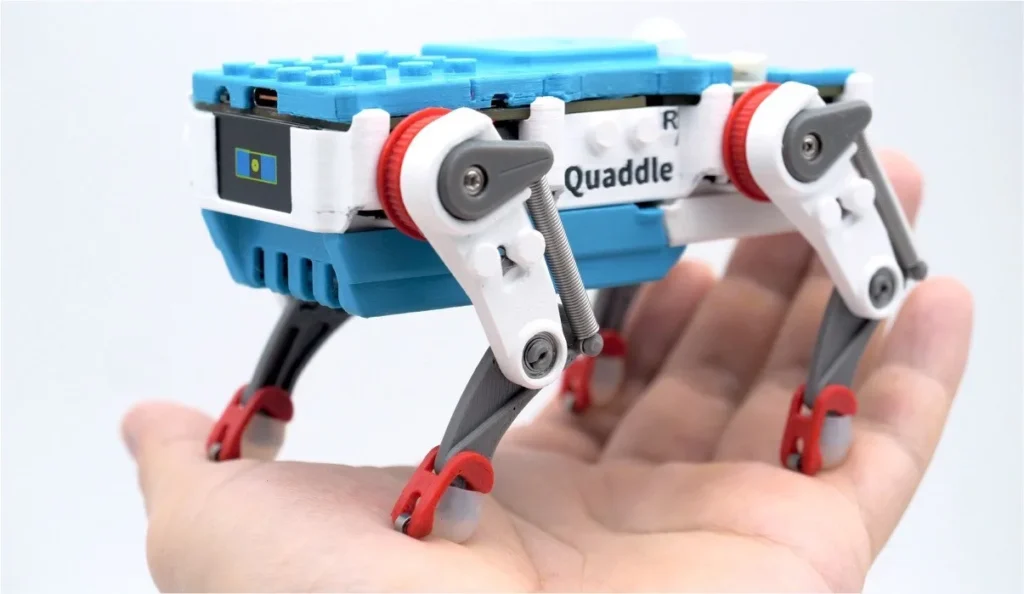
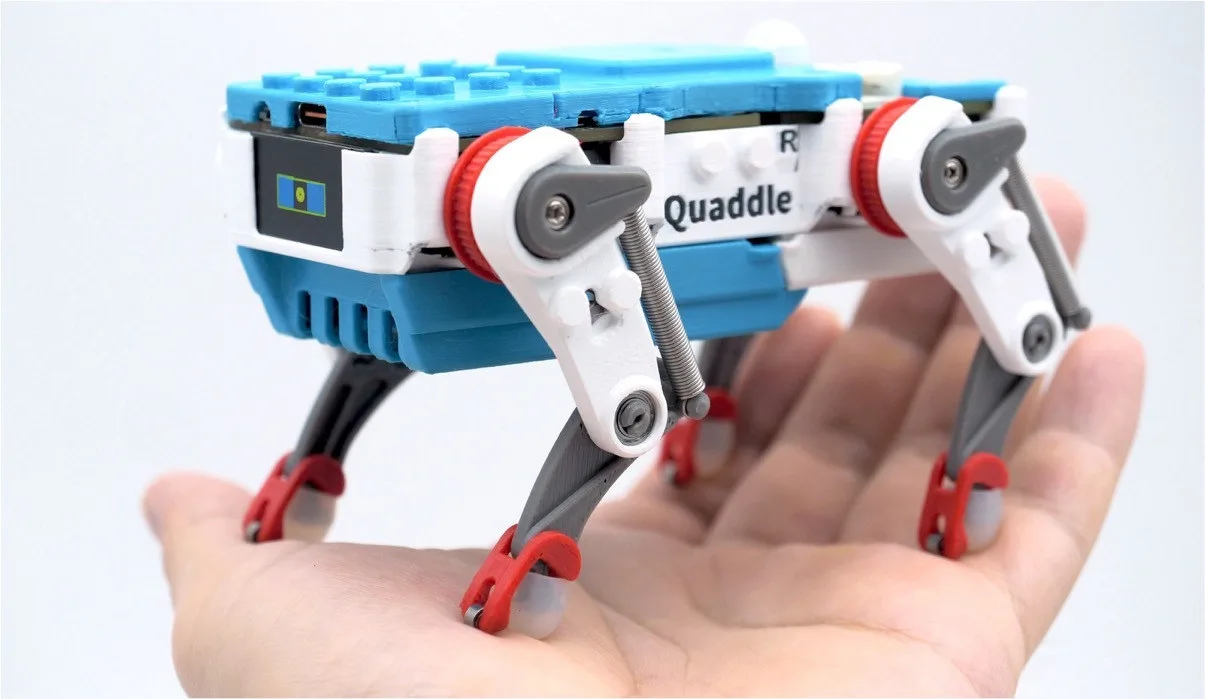
The landscape of robotics is undergoing a subtle yet profound shift. For decades, multi-legged robots—particularly quadrupeds—have been associated with high price tags, complex mechanical engineering, and a steep learning curve that relegated them primarily to university laboratories and industrial research facilities. Today, that paradigm is changing. Enter Quaddle, a mini desk-sized quadruped robot engineered explicitly for physical AI experimentation, education, and hobbyist innovation.
Created by Dr. Rongzhong Li and brought to life through a newly launched Kickstarter campaign, Quaddle leverages the established open-source OpenCat framework. What sets Quaddle apart in a crowded marketplace of robotic toys and kits is its radical design philosophy: it achieves fluid, dynamic locomotion using only four servos instead of the traditional eight to twelve actuators typically found in quadruped systems. This ingenious reduction in mechanical complexity drastically lowers both production costs and points of failure, making advanced quadrupedal movement accessible to a broader audience than ever before.
Quaddle is available in three distinct iterations tailored to varying user needs and budgets: Builder, Buddy, and Scout. At the physical heart of every model lies an ESP32-S3FN8 motion core, a powerhouse microcontroller capable of managing the servos, LED PWM outputs, an onboard buzzer, and a gyroscope responsible for stabilizing balance and processing touch responses.
For users seeking advanced capabilities, the top-tier Scout model steps up with an optional ESP32-S3R8 AI core, unlocking sophisticated functionalities like voice recognition and seamless smart home integration. Furthermore, the incorporation of position-feedback servos introduces an intuitive feature known as Puppet Mode. This allows users to physically guide the robot’s legs by hand to record and playback complex movements instantly, completely bypassing the need to write lines of code for basic choreographies.
Measuring compactly—dimensions vary slightly from 11 × 7 × 7 cm for the Builder and Buddy models, to 11 × 7 × 11 cm for the Scout—and weighing between 170 to 198 grams, Quaddle is genuinely built for the desktop. Despite its diminutive size, it packs impressive performance metrics: a top speed of 1.8 Body Lengths per second ($BL/s$) during a standard trot, scaling up to an agile $3 BL/s$ in a glide mode, alongside an in-place rotation rate of 90 degrees per second. Powering these maneuvers is a replaceable BL10C 1800 mAh battery, delivering between 1 to 1.5 hours of continuous operation depending on the active sensor suite and model tier.

Chronology
The journey toward Quaddle’s release is built upon a solid foundation of prior hardware iterations, community feedback, and successful crowdfunding milestones:
- Pre-Quaddle Era (The Foundation of OpenCat): Dr. Rongzhong Li began developing the open-source OpenCat framework to democratize quadruped robotics. Over the preceding years, the project evolved through earlier robotic animals and platforms, establishing a robust codebase and a dedicated global community.
- Prior Crowdfunding Successes: Dr. Li’s previous campaigns laid the operational groundwork for mass production, successfully shipping over 30,000 robots to enthusiasts, educators, and researchers across more than 60 countries, while collectively raising over $1 million in total funding.
- Engineering and Refinement (2024–2025): The core engineering challenge of the Quaddle project was identified: drastically reducing the mechanical parts count (servos) while maintaining—or even enhancing—locomotion agility. The integration of the ESP32-S3 microcontroller family was finalized to handle both low-level motion control and high-level AI tasks.
- Late 2026 Kickstarter Launch: The official Kickstarter campaign for Quaddle goes live, seeking a modest funding goal of $50,000 to initiate mass production runs.
- December 2026 Target Fulfillment: Manufacturing schedules are locked in, with global reward deliveries officially slated to arrive on backers’ doorsteps by December 2026.
Supporting Data
To truly understand how Quaddle fits into the modern educational and research ecosystem, it helps to examine its technical specifications, model configurations, and financial backing structure side-by-side:
Model Comparison & Pricing
| Model | Price (Kickstarter / MSRP) | Dimensions | Weight | Battery Life | Key Features & Sensors |
|---|---|---|---|---|---|
| Builder | $99 ($149 MSRP) | 11 × 7 × 7 cm | 170 g | ~1.5 hours | Base motion core, ESP32-S3FN8, ideal entry-level kit. |
| Buddy | $139 (TBD) | 11 × 7 × 7 cm | ~180 g | ~1.2 hours | Enhanced sensor integration, extension hat compatibility. |
| Scout | $199 (TBD) | 11 × 7 × 11 cm | 198 g | ~1.0 hour | ESP32-S3R8 AI core, infrared, light sensors, gesture & voice recognition, optional AI vision. |
Performance Metrics & Hardware Specs
- Locomotion Speeds: Up to 1.8 BodyLength/s (trot); up to 3 BodyLength/s (glide).
- Agility: 90°/s maximum in-place rotation speed.
- Power Source: Replaceable BL10C 1800 mAh Li-ion battery.
- Main Microcontroller: ESP32-S3FN8 motion core (manages servos, LED PWM, buzzer, gyroscope).
- Optional AI Core (Scout): ESP32-S3R8.
- Expansion Options: Dedicated extension hat adding a touchpad, RGB LEDs, dual microphones, Grove connectors, a Passive Infrared (PIR) sensor, and a UART port compatible with Raspberry Pi.
- Global Logistics: Worldwide shipping ($15 standard, $18 to the European Union).
Software and Academic Footprint
- Firmware: Fully open-source OpenCat firmware (hosted via Dr. Rongzhong Li’s GitHub repository).
- Programming Ecosystems: Native Arduino IDE foundation, complemented by full support for Python, MicroPython, C++, ROS (Robot Operating System), ESPHome, and Xiaozhi AI integrations.
- Academic Validation: The underlying OpenCat ecosystem has already been referenced and utilized in more than 20 peer-reviewed academic papers globally, underscoring its utility as a serious research tool rather than a mere novelty.
Official Responses and Creator Insights
When conceptualizing Quaddle, Dr. Rongzhong Li and his development team aimed to solve a fundamental contradiction in educational robotics: while robots with 12 degrees of freedom (DoF) offer incredible flexibility, their cost, weight, and fragility make them impractical for everyday classroom desks or casual home developers.
In statements accompanying the Kickstarter launch, the development team emphasized that paring the design down to a streamlined 4-servo architecture was not about cutting corners, but rather about smart engineering optimization. By carefully calibrating the kinematics, the team proved that a quadruped could achieve expressive, lively gaits without requiring a prohibitively expensive array of high-torque actuators.
Furthermore, the emphasis on the open-source OpenCat framework reflects a long-term commitment to community-driven development. Dr. Li has consistently highlighted that the longevity of platforms like Quaddle relies heavily on lowering the barrier to entry. By incorporating features like Puppet Mode—allowing physical, tactile programming—the project explicitly targets users who may find traditional syntax-based coding intimidating at first glance, while simultaneously offering robust C++, Python, and ROS pipelines for advanced engineering students and roboticists.

Implications
The introduction of Quaddle carries significant implications for several distinct sectors, ranging from primary STEM education to advanced machine learning research.
Transforming STEM Education and Accessibility
For schools and coding bootcamps, budget constraints have historically limited hands-on robotics education to wheeled robots or simple robotic arms. Quadruped robots were simply too expensive to deploy at scale. At a Kickstarter price point starting at $99, Quaddle breaks down these economic barriers. Students can now experiment with dynamic balance, multi-axis kinematics, and spatial awareness right on their school desks. Because the robot shares a uniform core architecture across all models, schools can mix and match Builder units for large classrooms while outfitting advanced student groups with Scout models equipped with AI vision and voice recognition.
Accelerating Physical AI and Edge Computing
As "Physical AI"—the intersection of artificial intelligence and physical hardware—becomes the dominant frontier in technology, researchers need rapid-prototyping platforms. Quaddle provides an affordable edge-computing testbed. With support for ROS, Python, and localized AI models via the ESP32-S3R8 core, developers can test reinforcement learning algorithms, computer vision tracking, and smart-home routines locally without requiring expensive industrial hardware rigs. The fact that over 20 academic papers already utilize the OpenCat platform proves that small-scale robots can yield scalable, real-world insights into quadrupedal locomotion and autonomous navigation.
The Future of Open-Source Hardware Communities
Quaddle’s reliance on the open-source community ensures that its capabilities will not remain static. As backers receive their units in December 2026 and begin tinkering with the hardware designs, extension hats, and GitHub repositories, the community-contributed libraries will undoubtedly expand. By bridging the gap between low-cost manufacturing, user-friendly physical programming (Puppet Mode), and high-level AI capabilities, Quaddle points toward a future where sophisticated robotics is as ubiquitous, customizable, and approachable as personal computing.








