Security Crisis at CISA: Congressional Leaders Demand Answers Over Massive Credential Leak
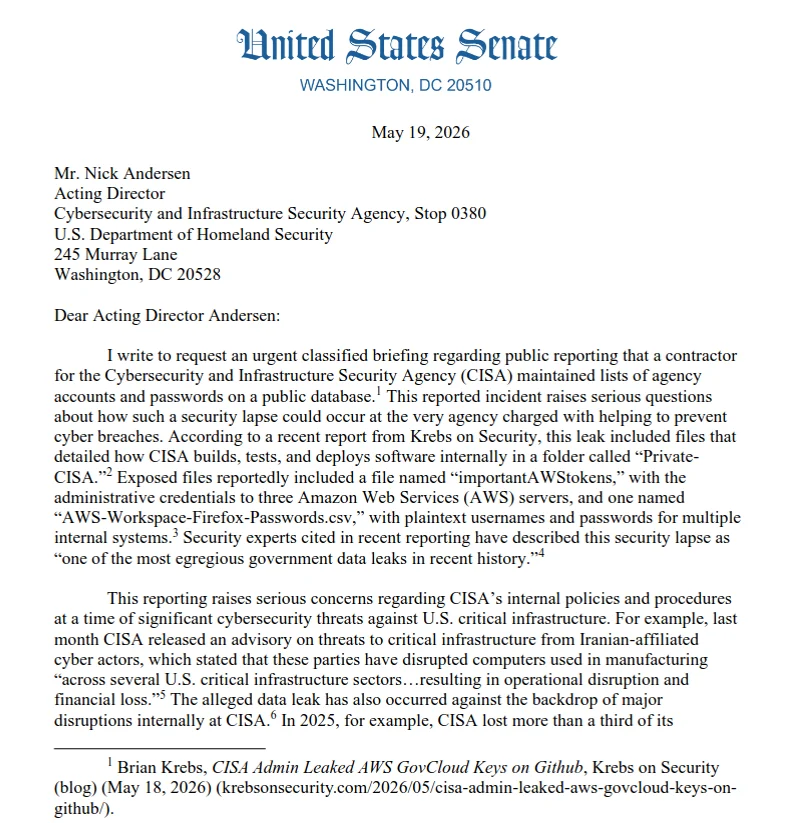
In a development that has sent shockwaves through the national security establishment, the Cybersecurity and Infrastructure Security Agency (CISA)—the very entity tasked with shielding the United States from digital threats—has found itself at the center of a catastrophic data exposure. Reports confirmed this week that a CISA contractor inadvertently, yet flagrantly, published high-level administrative credentials, AWS GovCloud keys, and a repository of agency secrets onto a public GitHub account.
The incident has triggered an immediate and aggressive response from Capitol Hill, as lawmakers question how an agency charged with setting the gold standard for cyber hygiene could permit such a glaring security lapse. As CISA scrambles to contain the fallout and rotate compromised keys, the incident has exposed deep-seated vulnerabilities within the agency’s internal controls and its reliance on third-party contractors.
The Anatomy of the Breach: A "Private" Repository Made Public
The controversy centers on a public GitHub profile titled "Private-CISA," created by a contractor with administrative access to the agency’s code development platforms. According to investigative reporting by KrebsOnSecurity, the repository served as a digital "scratchpad," where the contractor synchronized work files between agency systems and personal hardware.
Forensic analysis of the commit logs reveals a disturbing level of negligence: the contractor intentionally bypassed GitHub’s native security guardrails, which are specifically designed to detect and block the pushing of plaintext credentials or API keys to public repositories. By disabling these safeguards, the contractor facilitated the exposure of dozens of sensitive files, including "Important AWS Tokens.txt," "kube-config.txt," and browser-saved passwords from agency workstations.
Chronology of the Exposure
- November 2025: The "Private-CISA" repository is initially established, likely intended as a synchronization mechanism for the contractor’s workflows.
- Late April 2026: The repository is updated with the most critical and sensitive data, including high-level AWS GovCloud access tokens.
- May 18, 2026: KrebsOnSecurity publicly discloses the existence of the repository after being tipped off by the security firm GitGuardian.
- May 19, 2026: Sen. Maggie Hassan (D-NH) and Rep. Bennie Thompson (D-MS) issue formal inquiries to CISA’s acting leadership, demanding an exhaustive account of the breach.
- May 20, 2026: Dylan Ayrey, creator of the security tool TruffleHog, identifies that a critical RSA private key remains unrevoked, granting potential access to CISA’s entire IT GitHub organization. CISA begins emergency remediation following subsequent notifications.
The "TruffleHog" Discovery: A Roadmap for Adversaries
The severity of the breach was underscored by Dylan Ayrey, who highlighted that the leaked credentials provided a "skeleton key" to the agency’s digital infrastructure. Specifically, an exposed RSA private key allowed access to a GitHub app owned by the CISA enterprise account.
"An attacker with this key could read source code from every repository in the CISA-IT organization, including private repositories," Ayrey explained. "They could register rogue self-hosted runners to hijack CI/CD pipelines, access secret environmental variables, and modify repository admin settings, including branch protection rules and webhooks."

For a nation currently engaged in a high-stakes cyber standoff with sophisticated state-sponsored actors from Russia, China, and Iran, the exposure of these CI/CD (Continuous Integration and Continuous Delivery) pipelines is particularly harrowing. These pipelines are the arteries of modern software development; by compromising them, an attacker could inject malicious code into CISA’s internal tools, effectively turning the agency’s own infrastructure into a weapon.
Congressional Scrutiny and Agency Turmoil
The legislative branch has reacted with rare, bipartisan urgency. Sen. Maggie Hassan, in her letter to Acting Director Nick Andersen, expressed deep skepticism regarding CISA’s internal oversight. "This reporting raises serious concerns regarding CISA’s internal policies and procedures at a time of significant cybersecurity threats against U.S. critical infrastructure," Hassan wrote.
Rep. Bennie Thompson, joined by Rep. Delia Ramirez, framed the incident as a failure of institutional culture. In their letter, they noted: "We are concerned that this incident reflects a diminished security culture and/or an inability for CISA to adequately manage its contract support. It’s no secret that our adversaries seek to gain access to and persistence on federal networks. The files contained in the ‘Private-CISA’ repository provided the information, access, and roadmap to do just that."
Observers suggest that this breach cannot be viewed in a vacuum. It follows a period of significant internal upheaval at CISA. A recent wave of forced retirements, buyouts, and resignations—often attributed to shifting political mandates—has reportedly resulted in the loss of more than a third of the agency’s workforce. The resulting "brain drain" and the loss of veteran leadership have left the agency in a fragile state, struggling to maintain the rigor required for its high-profile mission.
Official Responses and the "Human Problem"
CISA’s response to the crisis has been characterized by both brevity and ambiguity. In an official statement, the agency claimed that "there is no indication that any sensitive data was compromised as a result of the incident." However, security experts remain unconvinced, noting that in the world of public repository monitoring, "no indication" is not the same as "no compromise."
When questioned specifically about the failure to rotate the critical RSA key until prompted by outside researchers, CISA stated: "CISA is actively responding and coordinating with the appropriate parties and vendors to ensure any identified leaked credentials are rotated and rendered invalid and will continue to take appropriate steps to protect the security of our systems."
Industry experts argue that this incident highlights a limitation in cybersecurity that no software patch can solve. Adam Boileau, host of the Risky Business podcast, noted that the core issue is a "human problem." Even with the most stringent technical controls, preventing a contractor from using a personal machine to sync work files is an immense challenge. "This is a thing you can’t solve with a technical control," Boileau argued. "This is a human problem where you’ve hired a contractor to do this work and they have decided of their own volition to use GitHub to synchronize content."
Implications for Federal Cybersecurity
The CISA breach serves as a stark reminder of the "firehose" nature of modern internet security. Companies like Truffle Security, which monitor GitHub’s public event stream, see a constant deluge of leaked credentials being harvested in real-time by cybercriminals. When a government agency becomes a source of that "firehose," the window of opportunity for an adversary is often mere minutes.
The long-term implications for CISA are significant:
- Trust Deficit: As the federal agency tasked with advising private industry on how to protect their own networks, CISA’s reputation has taken a tangible hit. Regaining the trust of the private sector will require radical transparency in its own internal audits.
- Contractor Oversight Reform: Congress is expected to push for more rigid, automated controls on how contractors handle federal data, likely moving toward mandatory hardware-based security keys and restricted development environments that prevent off-platform data movement.
- Cultural Rectification: The loss of experienced staff appears to have created gaps in the "security culture" that the agency is currently struggling to fill. Addressing the morale and expertise vacuum will be essential to preventing a recurrence.
As the dust settles, the "Private-CISA" incident will likely be studied for years to come as a quintessential example of the risks inherent in decentralized development and the dangers of bypassing established security protocols. For now, the agency remains in a defensive crouch, forced to prove to the public and to lawmakers that it can secure its own house before it can continue to demand the same of others.