
Streamlining Temporal Data Preprocessing: Google and Tryolabs Unveil Temporian and its Integration with TensorFlow Decision Forests


SAN FRANCISCO — In the fast-evolving landscape of applied machine learning, data scientists have long grappled with a persistent hurdle: the efficient processing and feature engineering of temporal data. Whether tracking erratic market prices, unpredictable weather patterns, or analyzing the precise intervals between heartbeats for medical diagnostics, time-sensitive data is omnipresent and frequently highly discriminative.
Addressing this critical industry bottleneck, Google—in close collaboration with machine learning boutique Tryolabs—has officially introduced Temporian, a powerful new open-source Python library tailored specifically for temporal data preprocessing and feature engineering. Paired with TensorFlow Decision Forests (TFDF), this duo provides practitioners with an end-to-end architecture capable of transforming raw, non-synchronized transactional inputs into high-performance forecasting models with unprecedented ease.

Main Facts: The Intersection of Temporian and TensorFlow
The newly released Temporian library is designed to ingest, manipulate, and aggregate multivariate, multi-index time sequences—frequently referred to as "event sets"—from multiple asynchronous sources. Traditional time series analysis relies heavily on uniformly sampled values, which often fail to capture the complex, sporadic nature of real-world events, such as retail purchases, server log alerts, or telemetry feeds.
By integrating Temporian with TensorFlow Decision Forests, developers can rapidly construct tabular machine learning datasets from chaotic event logs.

- The Core Problem: Temporal data changes continuously, and calculating features like moving averages or rolling sums across multi-indexed entities (such as individual products or unique clients) typically requires writing complex, error-prone SQL queries or custom Pandas scripts.
- The Temporian Solution: Temporian abstracts these operations into a cohesive, high-performance API that handles resampling, windowing, and calendar feature extraction natively.
- The Modeling Backend: TensorFlow Decision Forests (specifically Random Forest regressions) are uniquely positioned to ingest these preprocessed datasets, allowing models to automatically determine which temporal window lengths (e.g., 3-day, 7-day, or 28-day moving sums) carry the most predictive weight.
Chronology: Building an End-to-End Sales Forecasting Pipeline
To demonstrate the practical application of this workflow, the development team outlined a step-by-step tutorial centered on a common business challenge: forecasting future retail sales from individual, irregular transaction records.
Step 1: Ingesting Raw Transaction Logs
The process begins with a standard, unindexed CSV file (sales.csv) capturing transactional events from an online storefront. Each row records a precise timestamp, a client identifier, a purchased product ID, and the corresponding price:

$ head -n 5 sales.csv
timestamp,client,product,price
2010-10-05 11:09:56,c64,p35,405.35
2010-09-27 15:00:49,c87,p29,605.35
2010-09-09 12:58:33,c97,p10,108.99
2010-09-06 12:43:45,c60,p85,443.35
Using Temporian, data scientists can ingest this raw file into a general-purpose temporal container known as an EventSet with just a few lines of code:
import temporian as tp

# Load the CSV dataset into an EventSet
sales = tp.from_csv("/tmp/sales.csv")
Step 2: Computing Moving Windows and Managing Indices
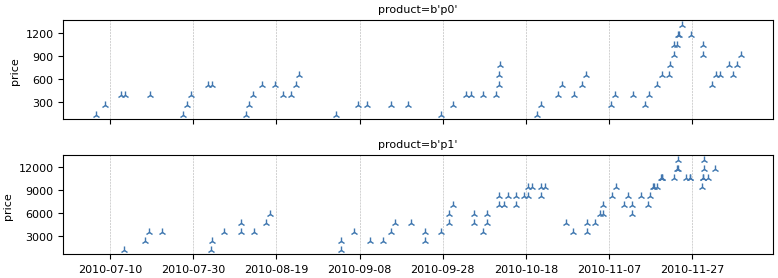
In raw form, visualizing global sales data can yield an overwhelmingly dense plot. However, applying operators like moving_sum allows practitioners to extract rolling temporal features effortlessly.

To analyze sales on a per-product basis rather than globally, developers apply an index to the EventSet:
# Index the data by product
sales_per_product = sales.add_index("product")

# Compute a 7-day moving sum of prices for each product independently
weekly_sales_per_product = sales_per_product["price"].moving_sum(
    tp.duration.days(7)
)
Step 3: Resampling and Feature Augmentation
To feed transaction records into a tabular machine learning model, sporadic events must often be aligned with a uniform sampling rate (such as daily ticks). Temporian achieves this via the .tick() operator, which establishes a regular cadence while retaining complex historical aggregations.

To prepare the dataset for TensorFlow, the pipeline constructs multiple moving sum features across varying window lengths (3, 7, 14, and 28 days), injects calendar metadata (such as the day of the week), and establishes a regression label by leaking sales data one day into the future:
daily_sampling = sales_per_product.tick(tp.duration.days(1))

features = []
for w in [3, 7, 14, 28]:
    features.append(
        sales_per_product["price"]
        .moving_sum(tp.duration.days(w), sampling=daily_sampling)
        .rename(f"moving_sum_w")
    )

# Add calendar data to capture human behavioral cycles
features.append(daily_sampling.calendar_day_of_week())

# Create the regression label (next day's sales)
label = (
    sales_per_product["price"]
    .leak(tp.duration.days(1))
    .moving_sum(tp.duration.days(1), sampling=daily_sampling)
    .rename("label")
)

dataset = tp.glue(*features, label)
Step 4: Training the TensorFlow Random Forest Model
Once the temporal dataset is fully prepared, converting it into a native TensorFlow Dataset format is seamless. The pipeline strips away raw timestamps and hands the structured tensors directly to TensorFlow Decision Forests:

import tensorflow_decision_forests as tfdf

def extract_label(example):
    example.pop("timestamp")
    label = example.pop("label")
    return example, label

tf_dataset = tp.to_tensorflow_dataset(dataset).map(extract_label).batch(100)

model = tfdf.keras.RandomForestModel(task=tfdf.keras.Task.REGRESSION, verbose=2)
model.fit(tf_dataset)
Supporting Data: Model Insights and Variable Importance
One of the primary benefits of combining Temporian with TensorFlow Decision Forests is the native interpretability provided by tree-based architectures. Upon concluding training, developers can inspect the model’s variable importance metrics to determine which temporal features drove the predictive performance.
Querying the model summary reveals the INV_MEAN_MIN_DEPTH variable importance breakdown:
Type: "RANDOM_FOREST"
Task: REGRESSION
...
Variable Importance: INV_MEAN_MIN_DEPTH:
    1.        "moving_sum_28"  0.342231  ################
    2.              "product"  0.294546  ############
    3. "calendar_day_of_week"  0.254641  ##########
    4.        "moving_sum_14"  0.197038  ######
    5.         "moving_sum_7"  0.124693  #
    6.         "moving_sum_3"  0.098542
The data clearly illustrates that the 28-day moving sum (moving_sum_28) held the highest predictive value (0.342), outperforming shorter windows such as 3-day or 7-day sums. Furthermore, the explicit product identifier and the calendar day of the week played substantial roles in shaping the decision trees, confirming that medium-term historical trends and weekly human routines dominate retail sales fluctuations.
Official Responses: The Collaborative Vision Behind Temporian
The release of Temporian represents a concerted effort between Google’s machine learning engineers and Tryolabs’ specialized algorithm developers to bridge a long-standing gap in the data science ecosystem.

Authored collaboratively by a multidisciplinary team—including Google’s Mathieu Guillame-Bert, Richard Stotz, Robert Crowe, Luiz Gustavo Martins (Gus), Ashley Oldacre, Kris Tonthat, and Glenn Cameron, alongside Tryolabs’ Ian Spektor, Braulio Rios, Guillermo Etchebarne, Diego Marvid, Lucas Micol, Gonzalo Marín, Alan Descoins, Agustina Pizarro, Lucía Aguilar, and Martin Alcala Rubi—the project underscores open-source community building.
In joint statements released alongside the library debut, the engineering teams emphasized that while tools like Pandas and SQL are ubiquitous, they are rarely optimized for the complex join operations, windowing mechanics, and data leakage prevention required when structuring chronological data for machine learning. Temporian was explicitly engineered to be declarative, highly optimized, and structurally aligned with how modern ML pipelines consume continuous data streams.

Implications: What This Means for Applied Machine Learning
The launch of Temporian and its deep integration with frameworks like TensorFlow Decision Forests carries profound implications for industries heavily reliant on real-time and historical event streams:
- Reduced Engineering Overhead: Data scientists traditionally spend up to 80% of their time on data cleaning and feature engineering. Temporian drastically cuts down the boilerplate code required to calculate rolling metrics across non-synchronized, multi-indexed entities.
- Prevention of Data Leakage: Time-series and event-based machine learning are notoriously vulnerable to accidental data leakage (using future data to predict past events). Temporian’s operator design structurally enforces chronological boundaries, ensuring robust and honest model validation.
- Domain Expansion: While retail sales forecasting served as the baseline demonstration, the underlying architecture is equally applicable to high-stakes domains such as financial fraud detection, server anomaly detection, predictive maintenance in IoT, and patient health monitoring.
- Democratization of Complex Pipelines: By abstracting multivariate multi-index time sequences into intuitive Python constructs ("event sets"), advanced temporal feature engineering becomes accessible to developers who may not specialize in low-level signal processing.
As machine learning models grow increasingly dependent on real-time context and historical behavioral patterns, tools like Temporian and TensorFlow Decision Forests establish a new standard for how data pipelines are built, tested, and deployed in production environments. Developers and data practitioners are encouraged to explore the open-source library on GitHub and dive into the official Temporian documentation to begin experimenting with their own temporal datasets.







