The Architecture of Precision: Inside Intel’s 8087 FPU and the Art of Trigonometric Computation
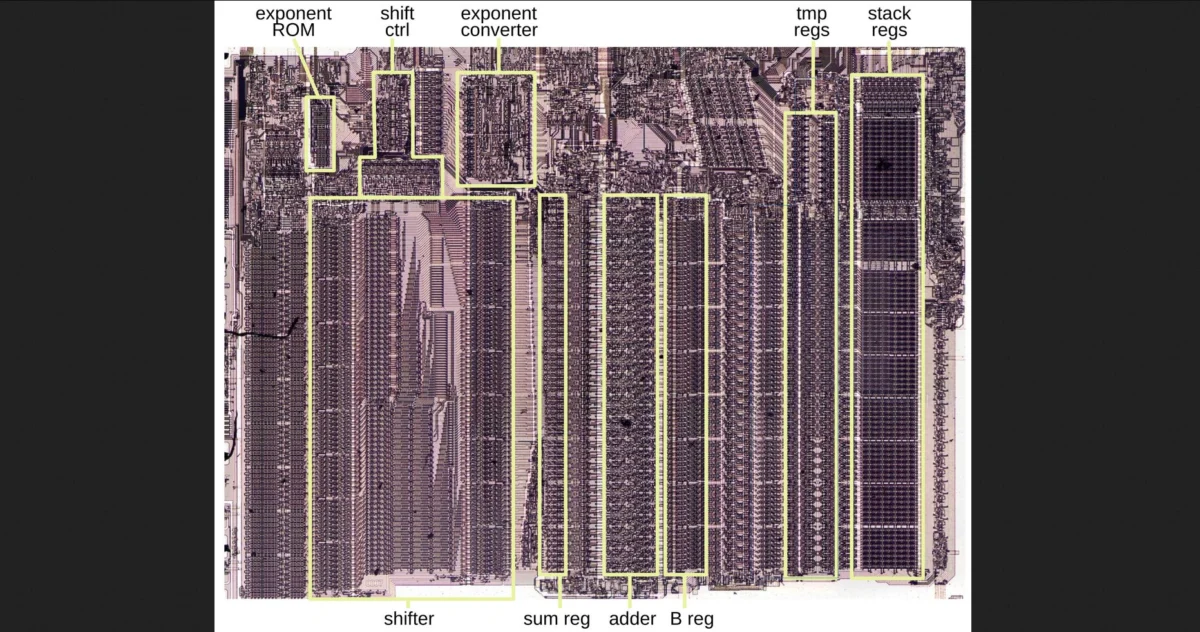
In the annals of computing history, few components have had as profound an impact on the trajectory of personal computing as the Intel 8087. As the first math coprocessor designed for the x86 architecture, the 8087 transformed the humble PC from a text-processing curiosity into a machine capable of genuine scientific and engineering work. Recently, noted hardware researcher Ken Shirriff and his collaborators pulled back the curtain on one of the most enigmatic parts of this vintage chip: the implementation of the FPTAN (tangent) instruction.
Through meticulous reverse-engineering of the silicon, Shirriff has provided an unprecedented look at how Intel’s engineers managed to cram high-precision floating-point arithmetic into the limited transistor budget of the early 1980s. The findings reveal a sophisticated hybrid algorithm that balanced the iterative efficiency of CORDIC (COordinate Rotation DIgital Computer) with the rapid convergence of Padé approximants.
Main Facts: The Hybrid Engine of the 8087
At its core, the 8087 was tasked with a monumental challenge: providing IEEE-standard floating-point performance at a time when logic gates were expensive and memory was scarce. When a programmer invoked FPTAN, the coprocessor had to determine the tangent of an angle with extreme precision.
While modern CPUs rely on massive look-up tables or complex hardware-accelerated polynomial expansion, the 8087 utilized a "best-of-both-worlds" approach. The algorithm effectively splits the computational burden. Initially, it utilizes CORDIC—a method that requires only basic addition, subtraction, and bit-shifting—to resolve the first 16 bits of the result. Once the value is sufficiently refined, the chip switches gears to a Padé approximant, which calculates the ratio of two polynomials to resolve the remaining precision. This technique is computationally "cheap" because, by the time the algorithm reaches the Padé stage, the input value is already quite small, allowing the polynomial approximation to converge with blistering speed.
A Chronological Perspective: From CORDIC to SIMD
To understand why the 8087’s approach was so revolutionary, one must view it within the broader timeline of numerical computing.
The Era of Scarcity (Pre-1980)
Before the 8087, computers without dedicated FPUs relied on software routines. These routines were agonizingly slow, often requiring thousands of clock cycles to compute simple trigonometric functions. Developers used basic algorithms like CORDIC because they didn’t require expensive hardware multipliers, which were physically too large to fit on 1970s-era microprocessors.
The 8087 Breakthrough (1980–1985)
When Intel released the 8087, it changed the landscape. By integrating the FPU directly into the ecosystem of the 8086/8088, Intel allowed developers to offload complex math to a dedicated silicon partner. The use of the hybrid CORDIC/Padé approach was a stroke of genius; it bypassed the "time penalty" associated with purely iterative CORDIC calculations while avoiding the massive "area penalty" of a purely lookup-based table or a massive hardware multiplier.
The Pentium Transition (1993–Present)
As transistor counts ballooned, the necessity for such clever, space-saving hybrids began to fade. By the time the Pentium series arrived, Intel moved away from CORDIC entirely. As Shirriff notes, CORDIC is notoriously difficult to scale; as the requirement for precision increases, the number of iterations required grows linearly, which is death to performance in a high-clock-speed environment. Modern CPUs now leverage highly parallel hardware multipliers and specialized SIMD (Single Instruction, Multiple Data) instructions to achieve results that would have been mathematically impossible on an 8087.
Supporting Data: Deconstructing the Cycle Count
Shirriff’s analysis provides a rare glimpse into the "instruction budget" of the 8087. By examining the microcode listings—the internal instructions that tell the silicon how to behave—he was able to break down the execution time of the FPTAN function.
The breakdown of the execution cycle is as follows:
- CORDIC Pseudo-Division: 33% of the execution time.
- CORDIC Pseudo-Multiplication: 47% of the execution time.
- Padé Approximation: 15% of the execution time.
- Overhead/Logic Management: 5% of the execution time.
This distribution is fascinating. It shows that Intel spent the vast majority of its time (80%) in the CORDIC phase. Why? Because CORDIC is stable and easily implemented with existing hardware shifts. The fact that the Padé approximation could handle the "tail end" of the calculation in just 15% of the time proves that the hybrid approach was a masterclass in optimization. By sacrificing a small amount of silicon area for the Padé hardware, Intel saved countless clock cycles that would have otherwise been wasted on the slow, iterative tail-end of a pure CORDIC process.
Official Responses and Historical Context
While Intel has long since moved on from the microarchitecture of the 8087, the documentation surrounding it remains a cornerstone of computer science education. For years, the exact "how" of the 8087’s transcendental functions was shrouded in proprietary mystery. Intel’s original manuals were clear on the accuracy of the results, but the methodology was a closely guarded trade secret.
Ken Shirriff’s work serves as a retroactive peer review of these decades-old designs. By publishing the microcode and annotating the logic paths, he has provided the missing link for historians. Former Intel engineers have occasionally commented on these projects, noting that the design constraints of the 8087 were "brutal." In an era where a few hundred transistors meant the difference between a chip that could fit on a die and one that would have a 0% yield, every line of microcode had to be earned.
Implications: Why This Matters Today
The study of the 8087 is not merely an exercise in nostalgia; it holds critical lessons for modern engineering, particularly in the realm of embedded systems and RISC-V architectures.
The Return of Resource-Constrained Computing
As the industry moves toward ultra-low-power IoT devices and edge computing, the constraints that faced Intel in 1980 are becoming relevant again. We are once again seeing a surge in demand for hardware that can perform high-precision math without draining battery life or requiring massive, power-hungry multipliers. The 8087’s hybrid approach is a blueprint for efficiency that modern designers can adapt for ARM Cortex-M or RISC-V cores.
The Legacy of Precision
The 8087 established the standard for what programmers expected from a floating-point unit. Its impact was so significant that the x87 instruction set survived for decades, even after it was rendered technically obsolete by SIMD. The "FPU mindset"—the idea that hardware should handle the heavy lifting of mathematics—is precisely why we have the high-performance gaming and scientific simulation capabilities we enjoy today.
The Value of Open Analysis
Shirriff’s project underscores the importance of transparent hardware history. When we understand how a processor thinks, we become better architects of future systems. By reverse-engineering the 8087, we aren’t just uncovering a dead technology; we are learning the fundamental principles of algorithmic efficiency that define the limits of what a computer can do.
Conclusion
The Intel 8087 stands as a monument to a time when engineering was a high-wire act of balance between speed, precision, and physical space. Through the lens of Ken Shirriff’s research, we can appreciate the elegance of the FPTAN implementation. It was a bridge between the iterative, low-hardware requirements of CORDIC and the rapid, polynomial-based future of modern computing. As we look forward to the next generation of AI-optimized hardware and custom silicon, the lessons of the 8087 remain clear: when the silicon is limited, the math must be clever. The 8087 did not just compute tangents; it defined the standard for the next forty years of computational excellence.