The Dawn of Personal Computing: NickZero’s Ultra-Minimal Cyberdeck Redefines Portability and Customization
In an era dominated by mass-produced, often proprietary computing devices, a burgeoning movement of enthusiasts is reclaiming the essence of personal computing through the creation of "cyberdecks." These bespoke, self-contained portable computers, often inspired by cyberpunk aesthetics and a deep desire for hardware autonomy, represent a powerful counter-narrative to mainstream tech. Among the latest and most compelling examples is NickZero’s "ultra-minimal" cyberdeck, a masterclass in efficient design and judicious component selection that epitomizes the ethos of tailored computing.
This innovative project, detailed on Instructables and showcased in a compelling YouTube video, strips away all but the most essential elements to deliver a highly portable, low-power machine. It stands as a testament to the idea that personal technology should not only serve a function but also reflect the unique preferences and design philosophy of its user. NickZero’s creation is more than just a gadget; it is a statement on the potential for personalized interaction with digital environments, offering a tangible glimpse into a future where computing devices are crafted, not just consumed.
Main Facts: A Paradigm Shift in Portable Computing
The core appeal of cyberdecks lies in their inherent customizability. Unlike off-the-shelf laptops or tablets, cyberdecks are purpose-built machines, designed from the ground up to fulfill specific user needs and aesthetic desires. NickZero’s project, dubbed the "Ultra-Minimal Cyberdeck," is a shining example of this philosophy, pushing the boundaries of what constitutes a functional, portable computer by embracing extreme minimalism.
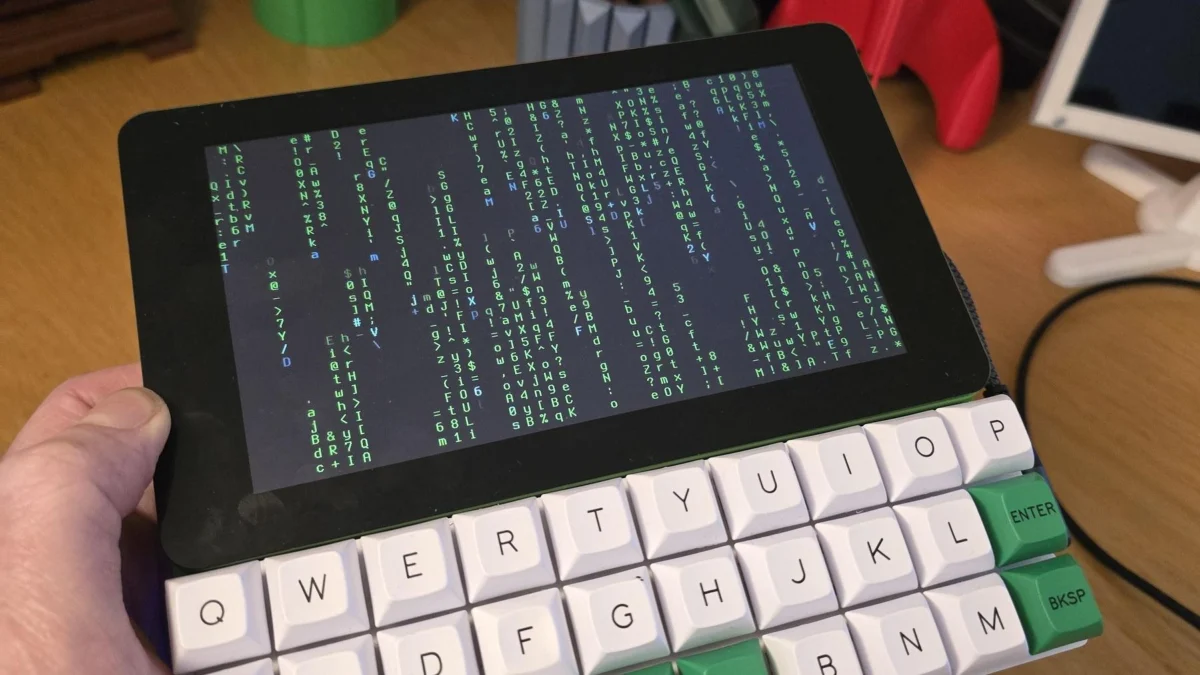
At its heart, the device is powered by a Raspberry Pi Zero 2W, a choice that immediately signals a commitment to efficiency and compactness. This micro-single-board computer, known for its minuscule footprint and low power consumption, provides the necessary processing power without the bulk or energy demands of its larger siblings. Complementing the Pi is a Gherkin 30% layout keyboard kit, an exceptionally compact peripheral that perfectly matches the width of the chosen 7-inch Waveshare touch display. This meticulous alignment underscores the design’s emphasis on visual cohesion and spatial efficiency.
Powering this ingenious setup is a robust 4000 mAh lithium-ion cell, managed by an Adafruit Powerboost 1000 charger module, ensuring ample battery life for on-the-go operations. The entire assembly is elegantly housed within a custom-designed, 3D-printed case, which not only provides structural integrity and protection but also contributes significantly to the device’s sleek, unified aesthetic.
NickZero’s cyberdeck demonstrates that powerful, personalized computing doesn’t require complex, high-spec components. Instead, it highlights how a thoughtful selection of readily available, off-the-shelf parts, combined with innovative design and DIY spirit, can result in a highly cohesive and surprisingly satisfying computing experience. The project serves as an accessible blueprint for aspiring makers, proving that the barrier to entry for custom hardware is lower than ever before, fostering a community of creators who prioritize functionality, aesthetics, and personal expression in their digital tools.
Chronology: From Concept to Creation – The Journey of an Ultra-Minimal Cyberdeck
The genesis of any cyberdeck project is typically rooted in a desire for a computing experience fundamentally different from the mainstream. For NickZero, this journey began with a clear vision: an "ultra-minimal" build that would prioritize portability, efficiency, and a sleek aesthetic. Understanding the iterative process of such a creation illuminates the thoughtful decisions behind each component.
The Genesis of an Idea: Embracing the Cyberdeck Ethos
The concept of the cyberdeck itself draws heavily from the cyberpunk literary genre, where protagonists often wielded custom, ruggedized, and highly personalized portable terminals. This cultural inspiration has resonated deeply with modern makers and tech enthusiasts who yearn for greater control over their computing environments. Beyond aesthetics, the cyberdeck movement is also a practical response to the limitations of commercial devices – their often-closed ecosystems, planned obsolescence, and lack of repairability. The freedom to select components, design enclosures, and install preferred operating systems offers a compelling alternative. For NickZero, this meant translating the abstract ideal of a personalized, powerful, and portable machine into a tangible reality, with minimalism as the guiding principle.
NickZero’s Vision: The Quest for Minimalism
NickZero’s specific design goal was to create a cyberdeck that was as compact and power-efficient as possible without sacrificing core functionality. This wasn’t merely about making a small computer; it was about defining the absolute minimum viable set of components for a usable portable workstation. This vision inherently demanded careful consideration of every part, seeking out components that offered maximum utility within the smallest possible footprint and lowest power draw. The "ultra-minimal" directive shaped every subsequent decision, from the choice of the single-board computer to the keyboard layout and battery capacity. The aim was to achieve a harmonious balance where each element served a critical purpose, free from unnecessary bulk or complexity.
Component Selection and Justification: The Art of Deliberate Choice
The heart of NickZero’s cyberdeck is the Raspberry Pi Zero 2W. This choice was pivotal to achieving the minimalist goal. Unlike the larger Raspberry Pi 4 or 5 models, which offer significantly more processing power and RAM but also consume more power and occupy greater space, the Zero 2W strikes an ideal balance. It boasts a quad-core 1GHz ARM Cortex-A53 processor and 512MB of LPDDR2 RAM, sufficient for basic computing tasks like text editing, web browsing (with lightweight browsers), light programming, and even retro gaming. Crucially, its integrated Wi-Fi and Bluetooth capabilities eliminate the need for external dongles, further reducing clutter and power consumption. This selection underscores a pragmatic approach: use only what is necessary for the intended tasks, thereby optimizing for size and battery life.
For human input, NickZero opted for a Gherkin 30% layout keyboard kit. This is perhaps the most audacious minimalist choice. A 30% keyboard features only 30 keys, omitting a traditional number row, function keys, and many common modifiers. This radical reduction necessitates the heavy use of "layers," where a modifier key (often a dedicated "Fn" key) changes the function of other keys. For instance, pressing Fn + ‘Q’ might produce a ‘1’, or Fn + ‘A’ might act as ‘Ctrl’. While it presents a significant learning curve, the Gherkin’s compact size (often just 90mm wide) perfectly complements the 7-inch display, maintaining the device’s narrow profile. This choice emphasizes the user’s willingness to adapt to a highly specialized interface in exchange for ultimate portability and a distinct aesthetic.
The visual interface is provided by a 7-inch Waveshare touch display. Waveshare displays are popular in the DIY community for their quality, affordability, and compatibility with Raspberry Pi boards. The 7-inch size offers a respectable viewing area for general use while remaining compact enough to integrate seamlessly into a portable form factor. The touch functionality adds a layer of intuitive interaction, particularly useful given the minimal keyboard, allowing for direct manipulation of on-screen elements, which can be invaluable in a constrained input environment. Its dimensions, neatly matching the width of the Gherkin keyboard, contribute significantly to the overall aesthetic harmony.
Powering the entire system is a 4000 mAh lithium-ion cell, managed by an Adafruit Powerboost 1000C charger module. The Powerboost 1000C is a common and reliable choice for portable Pi projects, offering regulated 5V output, battery charging capabilities, and status indicators. A 4000 mAh battery, combined with the low power draw of the Pi Zero 2W and the display, provides several hours of continuous operation, making the cyberdeck genuinely portable for extended periods. This power solution is critical, as a portable device is only as useful as its battery life.
Finally, the entire ensemble is meticulously integrated within a nifty 3D-printed case. 3D printing technology has revolutionized DIY electronics, enabling hobbyists to design and produce custom enclosures with precision and flexibility. NickZero’s case is not merely a box; it’s an integral part of the design, engineered to securely hold all components, provide necessary cutouts for ports and screen, and present a finished, professional appearance. The choice of material and color would further enhance the minimalist aesthetic, creating a cohesive and visually appealing device.
Assembly and Integration: The Cohesive Whole
The process of lacing these disparate components together is where the vision truly takes shape. This involves careful wiring, soldering (especially for the keyboard kit), and precise fitting within the 3D-printed enclosure. Challenges might include managing cable clutter in a confined space, ensuring proper power distribution, and configuring the software to correctly recognize and utilize the specialized keyboard and touch display. The satisfaction, however, comes from seeing individual parts transform into a functional, unified system – a true testament to the maker’s skill and perseverance. The availability of resources like NickZero’s Instructables guide makes this journey less daunting for others, offering a clear path to replicating or adapting the design.
Supporting Data: The Broader Landscape of Custom Computing
NickZero’s ultra-minimal cyberdeck is not an isolated phenomenon but rather a prominent example within a vibrant and growing subculture of custom computing. To fully appreciate its significance, it’s essential to contextualize it within the broader cyberdeck movement, understand its technical underpinnings, and recognize the role of open-source and DIY principles.
The Cyberdeck Movement: A Broader Context
The modern cyberdeck movement is a fascinating blend of retro-futurism and contemporary technological accessibility. Its philosophical roots can be traced back to the gritty, high-tech, low-life worlds depicted in cyberpunk literature from authors like William Gibson and Neal Stephenson, where bespoke, often ruggedized, computing terminals were tools of survival and rebellion. Early inspirations also came from vintage portable computers like the Osborne 1 or Kaypro II, machines that, while clunky by today’s standards, offered self-contained computing long before laptops became ubiquitous.
The resurgence of interest in cyberdecks today is largely fueled by several factors:
- Affordable Single-Board Computers (SBCs): Devices like the Raspberry Pi, Arduino, and ESP32 have made powerful, miniature computing platforms accessible to hobbyists at a low cost.
- Advances in 3D Printing: This technology allows individuals to design and fabricate custom enclosures, mounts, and structural components with unprecedented ease and precision, removing a significant barrier to hardware customization.
- Open-Source Hardware and Software: The proliferation of open-source designs for electronics, operating systems (like Linux distributions), and software tools provides a vast ecosystem of resources for builders.
- Desire for Digital Sovereignty: Many enthusiasts are drawn to cyberdecks as a way to escape the closed ecosystems of major tech companies, gaining full control over their hardware and software.
Within this movement, there’s a vast diversity of builds. NickZero’s ultra-minimal design stands in stark contrast to maximalist cyberdecks, which might incorporate multiple displays, full-sized keyboards, an array of external ports, integrated tools (like SDRs, oscilloscopes, or multi-meters), and robust, often heavy-duty enclosures designed for extreme environments. Other variations include ruggedized field terminals for specific industrial or scientific applications, retro-computing decks that mimic vintage aesthetics, and specialized penetration testing rigs equipped with an array of networking and security tools. NickZero’s project carves out a niche emphasizing stealth, portability, and elegant simplicity.
Technical Specifications and Performance
The choice of the Raspberry Pi Zero 2W is central to the cyberdeck’s minimalist performance profile.
- CPU: Quad-core 1GHz ARM Cortex-A53. While not a powerhouse, this processor is significantly more capable than the original single-core Pi Zero and can comfortably handle tasks like running a lightweight Linux distribution (e.g., Raspberry Pi OS Lite with a minimal desktop environment like Openbox or LXDE), basic web browsing, text editing with Vim or Nano, Python scripting, and even some emulation of older game consoles.
- RAM: 512MB LPDDR2. This is the primary limiting factor for heavy multitasking or resource-intensive applications. Careful software selection and efficient workflow management are key to a smooth experience.
- Connectivity: Integrated 2.4 GHz 802.11n Wi-Fi and Bluetooth 4.2/BLE. This built-in wireless functionality is crucial for a portable device, allowing internet access and peripheral connections without external dongles, preserving the minimal aesthetic and reducing power draw.
- Power Efficiency: The Pi Zero 2W typically consumes between 0.5W and 1.5W under load, significantly less than larger Pi models (which can draw 5W+). This low power footprint, combined with the 4000 mAh Li-ion battery, could provide 4-8 hours of usage depending on screen brightness and CPU load. The Adafruit Powerboost 1000C ensures efficient power delivery and safe charging.
The Gherkin 30% keyboard presents a unique ergonomic and learning challenge. Users must become proficient with keyboard layers, effectively remapping keys to access numbers, symbols, and modifiers. This level of customization requires dedication but also offers immense power for those who master it, allowing for highly optimized workflows. Many users program custom firmware (like QMK) to tailor keymaps precisely to their needs. The 7-inch Waveshare touch display enhances usability, especially for navigating graphical user interfaces or performing actions that are cumbersome with a minimal keyboard. Its resolution (often 800×480 or 1024×600) is adequate for its size, providing clear text and images.
The Role of Open Source and DIY
Projects like NickZero’s cyberdeck are deeply embedded in the principles of open source and DIY.
- Accessible Components: The availability of inexpensive, modular components from vendors like Adafruit, Waveshare, and the Raspberry Pi Foundation democratizes hardware development.
- Community Knowledge Sharing: Platforms like Instructables, GitHub, Hackaday, and various forums (e.g., r/cyberdecks) facilitate the sharing of designs, code, and troubleshooting tips, accelerating learning and innovation.
- Software Freedom: The reliance on Linux-based operating systems provides users with full control over their software stack, enabling deep customization and ensuring privacy and security.
- Empowerment: The act of building a cyberdeck from scratch imbues the creator with a deeper understanding of computing hardware and software, fostering technical literacy and problem-solving skills.
Official Responses: Community Acclaim and Industry Insights
While NickZero’s cyberdeck is a personal project and thus doesn’t elicit "official responses" from governmental bodies or major corporations in the traditional sense, its impact is clearly visible in the vibrant communities it inspires and the broader implications for tech industries. These "responses" manifest as community reception, expert observations, and indirect influence on market trends.
Community Reception and Impact
The immediate "official response" to projects like NickZero’s typically comes from the maker, hacker, and cyberdeck communities themselves. Shared on platforms like Instructables, YouTube, and specialized forums (such as Reddit’s r/cyberdecks or Hackaday comments sections), these builds often generate significant enthusiasm, discussion, and constructive feedback.
- Enthusiasm and Inspiration: NickZero’s ultra-minimal design has been widely praised for its elegance, practicality, and the ingenious use of components. Many aspiring cyberdeck builders see such projects as a realistic starting point, demonstrating that a functional and aesthetically pleasing device doesn’t require advanced engineering skills or an exorbitant budget. The project provides a clear, actionable guide, fostering a sense of "I can do that too."
- Technical Discussion: The choice of a Raspberry Pi Zero 2W sparks debates about performance versus power consumption. The Gherkin 30% keyboard often leads to discussions on usability, the learning curve associated with minimalist layouts, and the power of custom keymaps (e.g., using QMK firmware). The power management system and 3D-printed enclosure also draw attention, with community members sharing their own experiences and tips.
- Validation of the Ethos: The positive reception validates the core tenets of the cyberdeck movement: personalization, DIY, and control over one’s computing tools. It reinforces the idea that there’s a strong desire for alternatives to mass-market electronics.
- Educational Value: The detailed Instructables guide serves as a valuable educational resource, breaking down the build process into manageable steps. This contributes to the collective knowledge base of the DIY electronics community.
Expert Commentary and Observations
While no formal "experts" have likely issued press releases on NickZero’s specific build, observations from tech journalists, hardware reviewers, and prominent figures within the maker community often highlight the merits of such designs.
- Design Philosophy: Experts would likely commend NickZero for the clear and consistent design philosophy. The commitment to "ultra-minimalism" throughout component selection and physical design demonstrates a strong understanding of product development principles. The balance between form and function, especially with the challenging keyboard choice, would be noted.
- Resourcefulness and Ingenuity: The ability to create a cohesive and functional device from readily available, off-the-shelf components is a hallmark of ingenuity. It showcases how commodity hardware, when thoughtfully integrated, can surpass the utility of more expensive, specialized solutions for certain use cases.
- Technical Elegance: The efficient power management system and the compact integration within the 3D-printed case exemplify technical elegance. The project is not just functional but also well-engineered for its intended purpose.
- Contribution to the DIY Ecosystem: Projects like NickZero’s are crucial for the health and growth of the DIY electronics ecosystem. They demonstrate the versatility of products from companies like Raspberry Pi and Adafruit, indirectly driving sales and encouraging further innovation in the market for hobbyist components.
Manufacturer Perspective: Indirect Endorsement
Manufacturers of components used in cyberdecks, such as the Raspberry Pi Foundation, Waveshare, and Adafruit, indirectly benefit from and respond to projects like NickZero’s.
- Showcasing Product Versatility: Every cyberdeck build, particularly those that gain traction, acts as a powerful testimonial to the versatility and robustness of their products. The Raspberry Pi Foundation, for instance, thrives on community projects that push the boundaries of what their single-board computers can achieve, from industrial applications to highly personalized gadgets.
- Inspiring New Users: Seeing such innovative uses of their components inspires new hobbyists to purchase these parts and embark on their own projects, thereby expanding the customer base.
- Feedback Loop: While not direct "responses," the collective experience of the maker community using these components in diverse ways often provides valuable, implicit feedback to manufacturers regarding features, ease of use, and potential improvements.
- Community Engagement: These companies often actively engage with the maker community through sponsorships, forums, and social media, recognizing the critical role these independent creators play in fostering innovation and demonstrating the potential of their technology.
In essence, the "official responses" to NickZero’s ultra-minimal cyberdeck are a testament to the power of community-driven innovation, showcasing how individual creativity can ripple through a global network of enthusiasts and indirectly influence the broader technology landscape.
Implications: Reshaping Our Relationship with Computing
NickZero’s ultra-minimal cyberdeck, while a niche project, carries profound implications that extend far beyond the realm of hobbyist electronics. It challenges conventional notions of personal computing, points towards future trends in device design, and empowers users with a renewed sense of digital agency.
Future of Portable Computing: Beyond Consumer Paradigms
The most immediate implication of projects like NickZero’s is their potential to redefine what we expect from portable computing. In a market saturated with uniform laptops and tablets, cyberdecks offer a vision of hyper-specialized, user-centric devices. This isn’t about replacing the MacBook Pro for everyone, but rather demonstrating the viability of machines tailored precisely to an individual’s workflow, environment, and aesthetic preferences.
- Modular and Adaptable Design: The use of off-the-shelf components signifies a move towards modularity. Imagine a future where computing devices are not monolithic units but rather assemblies of interchangeable parts, allowing for easy upgrades, repairs, and reconfigurations based on evolving needs. This contrasts sharply with the current trend of increasingly integrated, non-repairable consumer electronics.
- Emphasis on Specificity: Instead of general-purpose devices trying to be all things to all people, minimalist cyberdecks highlight the power of specificity. For tasks like focused writing, light programming, field diagnostics, or even just digital journaling, a device stripped of distractions and optimized for power and portability can be far superior to a bulky, power-hungry laptop.
- Pushing Boundaries of Form Factor: NickZero’s cyberdeck challenges what constitutes a "comfortable" or "usable" form factor. The 30% keyboard, while demanding, pushes users to reconsider their input habits, potentially leading to new, more efficient interaction paradigms for ultra-portable devices.
Empowerment Through Customization: Digital Sovereignty
Perhaps the most significant implication is the empowerment of the end-user. Building a cyberdeck is an act of digital sovereignty, a rejection of the black-box nature of commercial devices.
- Understanding Your Tools: When you build your computer, you understand its components, how they interact, and how to troubleshoot them. This demystifies technology, fostering a deeper connection and sense of control.
- Freedom from Vendor Lock-in: By selecting open-source hardware (like the Raspberry Pi) and software (Linux), users free themselves from proprietary ecosystems, gaining full control over their operating system, applications, and data. This promotes privacy and security by design, as users can audit their own systems.
- Personal Expression: A cyberdeck is a canvas for personal expression. Its design, materials, and even the choice of keyboard layout reflect the builder’s identity, transforming a utilitarian object into a personal artifact. This fosters a sense of ownership and pride that is rarely found with mass-produced consumer goods.
Sustainability and Modularity: A Greener Computing Future?
The DIY nature of cyberdecks also carries implications for sustainability and the circular economy.
- Repairability and Longevity: Devices built from modular components are inherently easier to repair. If a screen breaks, it can be replaced; if a battery degrades, it can be swapped. This extends the lifespan of the device significantly, reducing electronic waste.
- Reduced Obsolescence: Instead of replacing an entire laptop, users can upgrade individual components (e.g., a newer Pi model) as technology advances, making their device future-proof to a greater extent.
- Resource Efficiency: By repurposing off-the-shelf components and focusing on low-power devices, cyberdecks can represent a more resource-efficient approach to computing compared to the constant churn of new, energy-intensive consumer electronics.
The Niche Market for Cyberdecks: A Growing Appeal
While cyberdecks may never replace mainstream laptops, their implications for niche markets are substantial.
- Field Technicians and Engineers: Professionals needing rugged, customizable diagnostic or control terminals in remote or challenging environments.
- Digital Nomads and Minimalists: Individuals prioritizing ultra-portability, long battery life, and a focused computing experience for tasks like writing, coding, or communication while traveling.
- Educators and Students: Cyberdecks serve as excellent educational tools, teaching electronics, programming, and design principles in a hands-on manner.
- Privacy Advocates: Those seeking complete control over their hardware and software for enhanced security and privacy.
The growing visibility of projects like NickZero’s indicates a burgeoning demand for these specialized tools, suggesting that what begins as a hobbyist pursuit can evolve into a significant segment of the custom electronics market.
Educational Value: Inspiring the Next Generation of Innovators
Finally, the educational implications are profound. Cyberdeck projects serve as tangible, exciting entry points into STEM fields. They combine elements of:
- Electronics: Understanding circuits, power management, and component integration.
- Programming: Configuring operating systems, writing scripts, and customizing keyboard firmware.
- 3D Design and Printing: Creating custom enclosures and mechanical parts.
- Problem-Solving: Troubleshooting issues and iteratively refining designs.
These projects empower individuals to move beyond passive consumption to active creation, fostering critical thinking, practical skills, and a deeper appreciation for the technology that shapes our world. NickZero’s ultra-minimal cyberdeck is more than just a cool gadget; it is a beacon for a future where personal computing is truly personal, empowering users to craft their digital destiny.