The Digital Renaissance of a Toy Box Icon: How TekkaSketch Reimagines the Etch-a-Sketch
For over six decades, the Etch-a-Sketch has stood as a bastion of tactile creativity. Since its introduction by the Ohio Art Company in 1960, the device has challenged millions of users to master its two white knobs—one for horizontal axis, one for vertical—to maneuver a stylus through aluminum powder. Yet, for all its charm, the device has always suffered from a singular, frustrating limitation: the "all-or-nothing" nature of its canvas. A single slip of the wrist could ruin an hour of intricate shading, requiring the user to shake the device, effectively erasing their progress in a cloud of metallic dust.
Enter TekkaSketch, a visionary engineering project that seeks to bridge the chasm between mid-century analog play and modern digital utility. By preserving the iconic aesthetic of the original toy while integrating a sophisticated suite of electronic components, the project offers an "undo" functionality and a suite of interactive games, proving that even the most static relics of our childhood can find new life in the era of the Internet of Things (IoT).
The Genesis of the Concept: Understanding the Analog Barrier
To understand why TekkaSketch is a triumph of engineering, one must first appreciate the original mechanism. The Etch-a-Sketch is essentially a mechanical plotter. Inside the frame, a thin film of aluminum powder coats the back of a glass screen. A plastic stylus, connected to a pulley system driven by two rotary knobs, scrapes away the powder as it moves. The "image" is not drawn with ink; it is rendered by the absence of material.
This inherent mechanical limitation is what the creator of TekkaSketch sought to solve. The initial design phase was characterized by "blue-sky" thinking. The creator famously toyed with the idea of a micro-vacuum system—a mechanical contraption designed to suck up the powder and redistribute it to "erase" specific lines. While conceptually brilliant, the mechanical complexity and the risk of device failure rendered it impractical.
The pivot point occurred when the developer looked back at their own history, specifically the 1990s PC era. Inspired by the addictive, continuous-path mechanics of Snake—specifically the Nibbles.bas version that shipped with MS-DOS—the creator realized that the Etch-a-Sketch’s knob-driven movement was not just a tool for drawing, but a rudimentary game controller waiting to be unlocked.
Chronology of Innovation: From Prototype to Digital Canvas
The path to the current version of TekkaSketch was neither linear nor simple. The project underwent several distinct phases of iteration:
1. The AR and Transparency Phase
The earliest prototypes attempted to augment the physical experience without discarding it. The creator experimented with Augmented Reality (AR) via smartphone overlays, hoping to guide users through drawings. They also tested transparency sheets with fruit illustrations placed over the screen, essentially turning the device into a low-tech tracing pad. These efforts, while intellectually stimulating, failed to solve the fundamental lack of fluidity and the permanence of mistakes.
2. The Electronic Integration
The breakthrough arrived when the creator decided to perform "open-heart surgery" on the device, removing the aluminum powder entirely. By replacing the glass and powder interior with a modern E-Ink display, the project achieved a "best-of-both-worlds" scenario. The E-Ink screen provides the high-contrast, paper-like aesthetic that mimics the original, but the digital backbone—powered by an ESP32 microcontroller—allows for instantaneous updates.
3. The Refinement of Controls
The final hurdle was the feel of the knobs. Replacing the original pulleys with high-precision rotary encoders required custom software logic. Because rotary encoders measure rotation differently than a physical pulley, the software had to be tuned to account for variations in speed and tension. This ensures that the movement on the E-Ink screen feels "weighted" and familiar to anyone who grew up playing with the original.
Supporting Data: The Hardware Under the Hood
The success of TekkaSketch rests on its hardware selection. The project utilizes:

- ESP32 Microcontroller: Chosen for its dual-core processing capability and integrated Wi-Fi/Bluetooth support, the ESP32 manages the heavy lifting of rendering images and running game logic with minimal latency.
- E-Ink Display: This is the heart of the project. E-Ink was selected specifically for its "bistable" property—meaning it requires power only when the image changes. This allows the device to display a drawing indefinitely, even when disconnected from a battery, perfectly mirroring the "static" nature of the original toy.
- Rotary Encoders: These components provide the tactile resistance necessary to replicate the mechanical "grind" of the original knobs.
- Partial Refresh Logic: One of the most significant technical challenges was the latency inherent in E-Ink displays. By implementing a sophisticated partial refresh algorithm, the project minimizes the "ghosting" effect, allowing for fluid drawing and real-time gameplay in the Snake modes.
Implications: The Future of Retro-Tech Fusion
The implications of the TekkaSketch project extend far beyond the nostalgia of 1980s living rooms. It serves as a case study in "Physical Computing," a field of design that seeks to bridge the digital and physical worlds in ways that feel intuitive rather than alienating.
Bridging the Generational Divide
For older generations, TekkaSketch provides a familiar interface that removes the "fear of failure" associated with the original toy. For younger users, who are accustomed to touchscreens and infinite undo/redo options, the project introduces the concept of physical hardware constraints, teaching them that engineering is often the art of working around limitations rather than merely ignoring them.
Expanding the Ecosystem
The project is currently open-ended. Because the hardware is modular, the creator has hinted at the potential for:
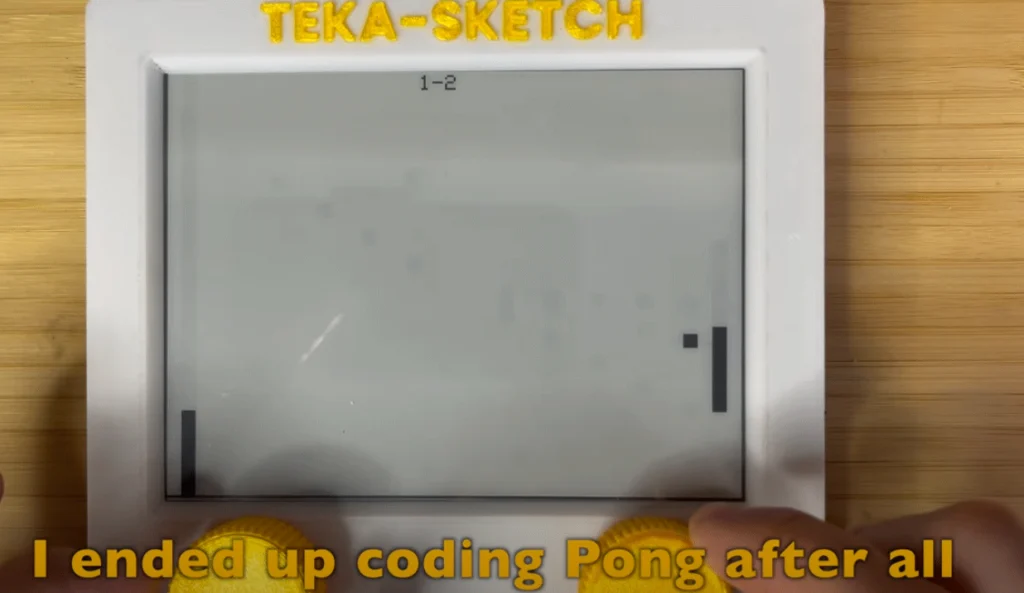
- Multiplayer Capabilities: The two-player Snake mode is already functional, with each knob controlling a separate serpent. This transforms the solitary Etch-a-Sketch into a competitive social device.
- Downloadable "Stencils": Future updates could allow users to upload drawing templates to the ESP32, which could then be displayed on the screen as a faint "guide" layer, allowing users to trace complex images without the frustration of freehand error.
- Connectivity: With the ESP32’s Wi-Fi, the device could theoretically receive "drawing challenges" from an online server or share finished art pieces directly to social media platforms.
Official Perspective and Design Philosophy
While there has been no official statement from the Ohio Art Company regarding this specific mod, the project has garnered significant interest within the maker community and the open-source hardware sector. The philosophy behind TekkaSketch is rooted in the "Right to Repair" and "Maker" movements, which argue that consumers should be able to modify, improve, and extend the life of their devices.
In a statement regarding the project’s development, the creator noted: "The goal was never to replace the Etch-a-Sketch, but to honor it. By integrating digital persistence into an analog form factor, we aren’t destroying the toy—we are giving it a memory."
This sentiment echoes a broader trend in technology: the move away from disposable, black-box electronics toward hardware that is hackable, personal, and profoundly human.
Conclusion
TekkaSketch is more than just a clever DIY hack; it is a profound exploration of how we interact with technology. It takes an object that was once defined by its rigid, unforgiving mechanical nature and infuses it with the fluid, iterative potential of the 21st century.
As we look toward a future increasingly dominated by screens and virtual interfaces, projects like TekkaSketch remind us that the most engaging technology is that which respects the past. It keeps the knobs, it keeps the frame, and it keeps the joy—all while ensuring that the next time you make a mistake, you don’t have to shake your world to pieces to fix it. Instead, you simply press a button, learn from the error, and continue the drawing.
Whether it becomes a commercial kit or remains a boutique hobbyist project, TekkaSketch has successfully redefined the boundaries of a classic. It has proven that the Etch-a-Sketch was never just a toy—it was a platform, and it is finally ready for its next act.