The "Undo" Button for Infrastructure: AWS Revolutionizes Kubernetes Stability with EKS Version Rollbacks
For nearly a decade, the Kubernetes community has operated under a sobering, industry-wide reality: upgrading a control plane is a "one-way door." In the fast-paced world of cloud-native development, once a cluster administrator pushed the button to move from one minor version to another, there was no turning back. If a breaking change, an incompatible API, or a latent configuration error surfaced post-upgrade, the only path forward was often a frantic, high-pressure scramble to troubleshoot or, in worst-case scenarios, a complete rebuild of the environment.
Today, Amazon Web Services (AWS) has fundamentally altered this landscape. With the announcement of native version rollbacks for Amazon Elastic Kubernetes Service (EKS), the company is providing a long-awaited safety net for organizations managing complex, large-scale containerized infrastructure. This feature allows administrators to reverse a Kubernetes version upgrade within a seven-day window, effectively restoring the cluster to its previous, fully validated state.
The Fragile State of Kubernetes Upgrades: A History of "One-Way" Operations
To understand the magnitude of this development, one must first look at the history of Kubernetes lifecycle management. Open-source Kubernetes, the foundation upon which EKS is built, has historically lacked native support for control plane rollbacks. While the open-source community has made incremental progress—notably through KEP-4330, which introduces the concept of "emulated versions" to simplify the rollback process—these solutions have often remained theoretical or difficult to implement in production environments.
The Cost of Caution
Because the "one-way door" constraint was so absolute, organizations were forced to adopt what can only be described as "defensive infrastructure management." This led to the creation of elaborate, time-consuming mechanisms designed to mitigate risk:
- Bake Periods: Teams would often delay upgrades for weeks or months to ensure no third-party add-on or application dependency would fail.
- Staggered Groups: Complex, multi-stage rollout strategies were required to limit the "blast radius" of a failed upgrade.
- Automated Sign-offs: Institutional bureaucracy grew to surround the simple act of upgrading, creating a bottleneck that slowed innovation.
With Kubernetes releasing three minor versions per year, these conservative strategies often backfired. Teams would find themselves falling behind the official support cycle, running clusters on older, potentially insecure versions because they lacked the confidence to move forward. This created a vicious cycle of technical debt, where the fear of an unrecoverable failure led directly to the very security and performance vulnerabilities that upgrades were meant to resolve.
The Mechanics of EKS Version Rollbacks
AWS’s new rollback feature is not merely a stop-gap; it is a structural change to how EKS handles versioning. Unlike the "emulated" approaches seen elsewhere in the ecosystem, EKS version rollbacks restore the cluster to the exact, fully functional, production-proven binary state it occupied before the upgrade.

How It Works: The Seven-Day Safety Net
The core of the feature is a seven-day window. If a cluster administrator upgrades from, for example, Kubernetes 1.34 to 1.35 and discovers a critical compatibility issue within that week, they can trigger a rollback. The control plane returns to its 1.34 state, bypassing the need for manual troubleshooting or environment redeployment.
Intelligent Risk Mitigation
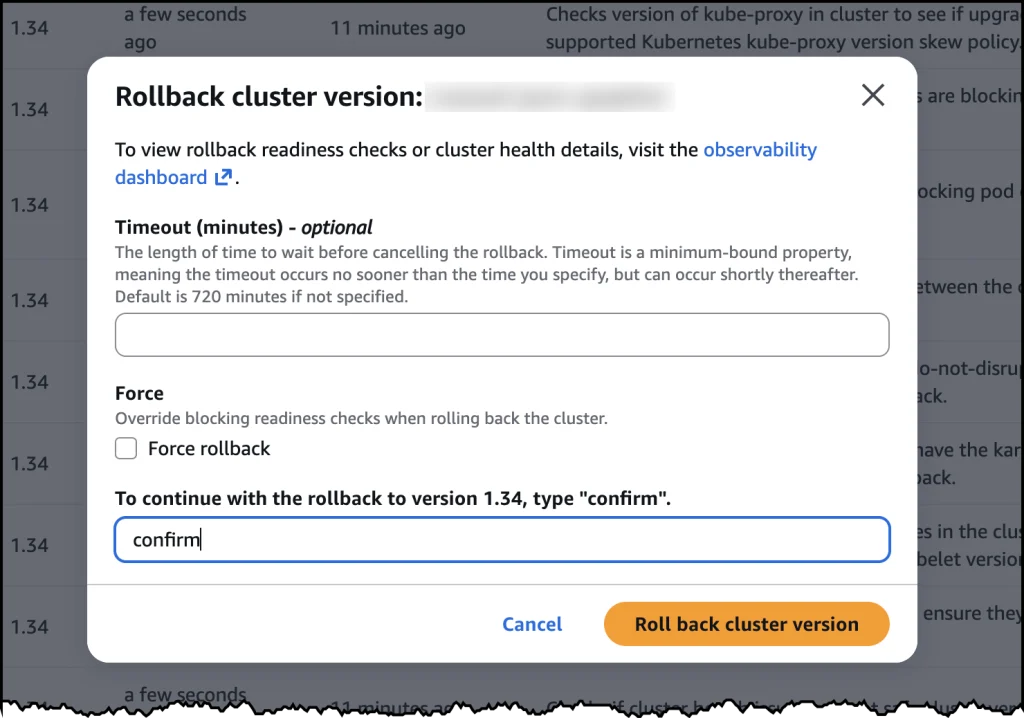
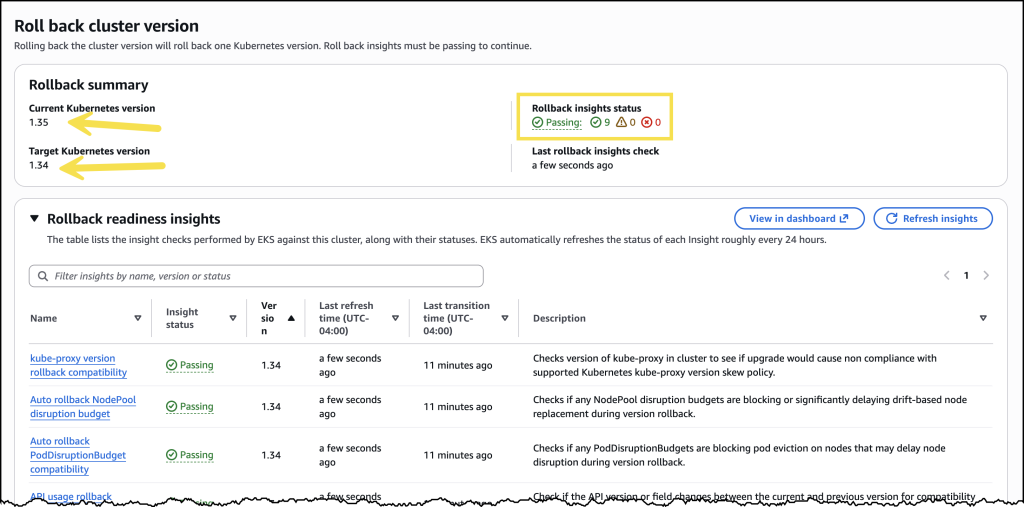
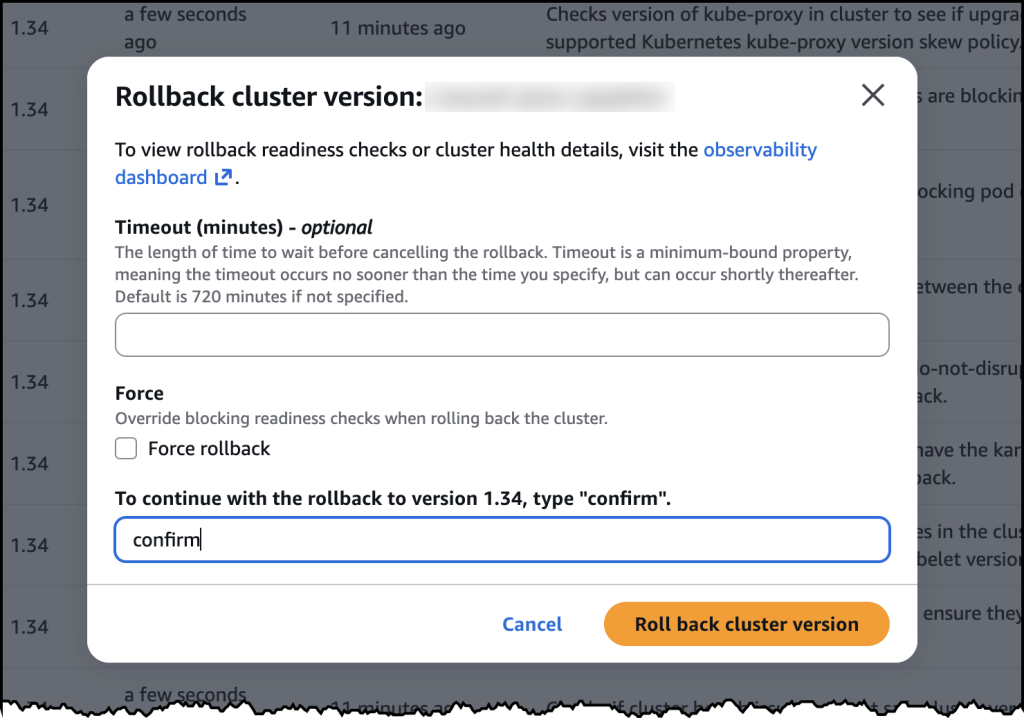
AWS has integrated this feature with Cluster Insights, a tool that provides real-time health checks. Before a rollback is initiated, EKS performs an automated evaluation of the cluster’s readiness. It flags potential blockers—such as node version compatibility issues or specific add-on dependencies—that could complicate the reversal process. While experienced administrators can use the --force flag to bypass these checks, the default inclusion of these safety gates ensures that rollbacks are as predictable as the upgrades themselves.
Deep Dive: Rollback for EKS Auto Mode
For organizations that have moved toward fully managed infrastructure, AWS has introduced a more advanced layer of support through EKS Auto Mode. In these environments, the complexity of a rollback increases significantly because the system must revert both the control plane and the managed nodes simultaneously.
The "Cancel" API: Granting Operator Control
A primary challenge in rolling back a cluster with managed nodes is the interaction with Pod Disruption Budgets (PDBs). Because EKS prioritizes workload stability, it will not bypass these budgets during a rollback, which can occasionally extend the time required for the operation.
Recognizing that in an emergency, an administrator may need to change their strategy, AWS has introduced a new cancel API. This allows users to halt a node rollback at any moment. If the process is taking longer than expected, or if an administrator decides they would rather address an issue manually than wait for a full node reversion, they can stop the process, adjust their disruption budgets to accelerate the movement, or pursue an entirely different remediation path.
Implications for Regulated Environments and Enterprise IT
The introduction of version rollbacks is expected to have a profound impact on highly regulated sectors such as finance, healthcare, and government. In these industries, uptime is not just a performance metric—it is often a legal or compliance requirement.
Accelerating Compliance
By removing the "fear factor" from upgrades, AWS is effectively enabling a more aggressive patching schedule. Security patches and minor version upgrades, which were previously delayed by lengthy risk assessments, can now be executed with the assurance that a fallback exists. This "fail-safe" approach allows security teams to stay current with the latest releases, ensuring that clusters are hardened against vulnerabilities without risking the availability of critical services.
Reducing Operational Overhead
For DevOps and Platform Engineering teams, the financial and temporal costs of managing Kubernetes are largely tied to "firefighting." By providing an "undo button," AWS is significantly reducing the cognitive load on operators. Instead of spending days documenting the exact state of a cluster before an upgrade to ensure a recovery path exists, teams can trust the AWS control plane to manage the transition and, if necessary, the reversal.
A User-Centric View: The Workflow Experience
The implementation of this feature is designed for seamless integration into existing AWS management workflows. For an operator, the process is straightforward:
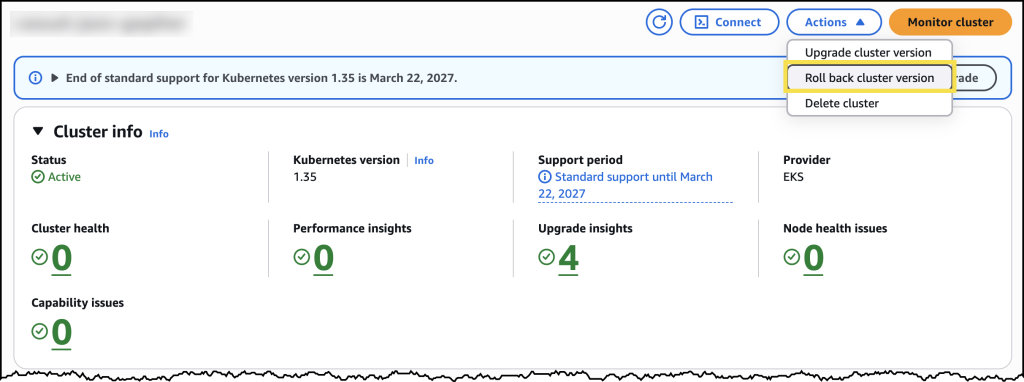
- Selection: In the Amazon EKS console, the administrator selects the cluster that has recently undergone an upgrade.
- Configuration Check: The console displays the active rollback window, informing the user exactly how much time remains to initiate a reversal.
- Reviewing Insights: Before committing, the user reviews the rollback insights generated by AWS. This diagnostic view provides a clear summary of node status and potential conflicts.
- Execution: Once confirmed, the rollback begins. Throughout the process, the cluster remains functional. The control plane rollback typically concludes within 20 minutes, mirroring the duration of a standard upgrade.
- Validation: Once the rollback is complete, the cluster returns to its previous version, with nodes gracefully reconciling based on existing PDBs.
Conclusion: Setting a New Standard for Infrastructure
The launch of version rollbacks for Amazon EKS represents a maturation of the Kubernetes ecosystem. It acknowledges that, despite the best CI/CD practices, the real world is unpredictable. By providing a native mechanism to reverse changes, AWS is not just offering a new tool; it is providing peace of mind.
This feature is available today at no additional cost in all commercial AWS regions where EKS is operational. Customers pay only for the standard EKS and compute costs incurred, making it an accessible upgrade for any organization currently running Kubernetes on AWS. As cloud-native architectures continue to evolve, the ability to safely navigate the lifecycle of a cluster will prove to be a defining factor in which platforms can truly scale for the enterprise. With this release, AWS has effectively removed one of the most significant barriers to production-grade Kubernetes, setting a new standard for reliability and operational excellence in the cloud.