What’s !important: The Evolution of CSS, Dialog UX, and the Highlights of CSS Day 2026
The landscape of front-end development is shifting at an unprecedented velocity. As we move through the second half of 2026, the CSS specification is evolving from a mere styling language into a robust, programmable engine. From the impending arrival of custom CSS functions to nuanced quality-of-life improvements for native browser elements, developers are being gifted new tools that simplify complex workflows.
In this edition of What’s !important, we break down the critical updates, the expert analysis surrounding the latest specifications, and the community buzz emerging from the most recent industry gatherings.
The New Frontier: CSS Functions and alpha()
Demystifying @function
Perhaps the most significant development on the horizon is the introduction of @function in CSS. As highlighted by Jane Ori in her recent deep-dive on Frontend Masters, custom CSS functions represent a fundamental shift in how we handle logic within stylesheets. While the prospect of writing functional logic directly in CSS might feel intimidating to developers accustomed to traditional rule-based styling, Ori’s pedagogical approach—breaking the concept down into manageable, baby-step iterations—makes the transition accessible.
The industry expects @function to be the primary CSS feature to achieve "Baseline" status this year, signaling widespread cross-browser interoperability. To support this transition, CSS-Tricks has published comprehensive documentation curated by Declan Chidlow, serving as an essential reference for developers looking to integrate functional logic into their design systems.
The alpha() Paradigm Shift
While custom functions capture the headlines, a more surgical tool has recently entered the discourse: the alpha() function. At first glance, veteran developers might ask: Why do we need this? We have long possessed the ability to manipulate alpha channels via oklch() or rgba().
However, the utility of alpha() lies in its ability to decouple color definition from opacity, providing a cleaner syntax for design systems. By using alpha(from var(--color) / 0.5), developers can now maintain a single variable for a base color—stored as raw values—and apply varying levels of transparency without the repetitive, verbose boilerplate associated with color-space-specific functions. This change is not just about brevity; it is about semantic clarity. It allows the CSS to communicate the intent of the modification rather than forcing the developer to declare the underlying color format repeatedly.
A Field Guide to Grid Lanes
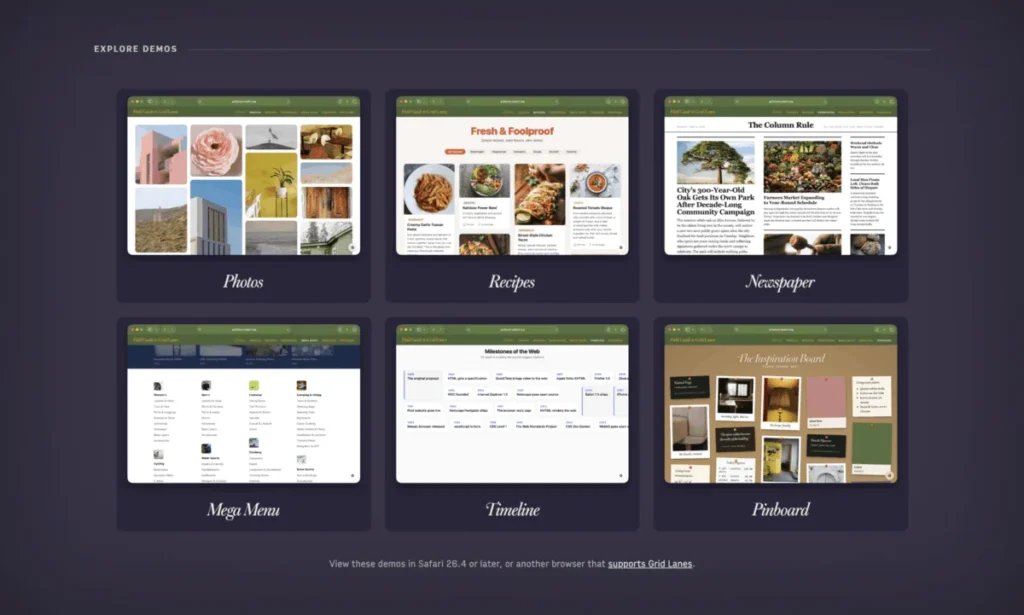
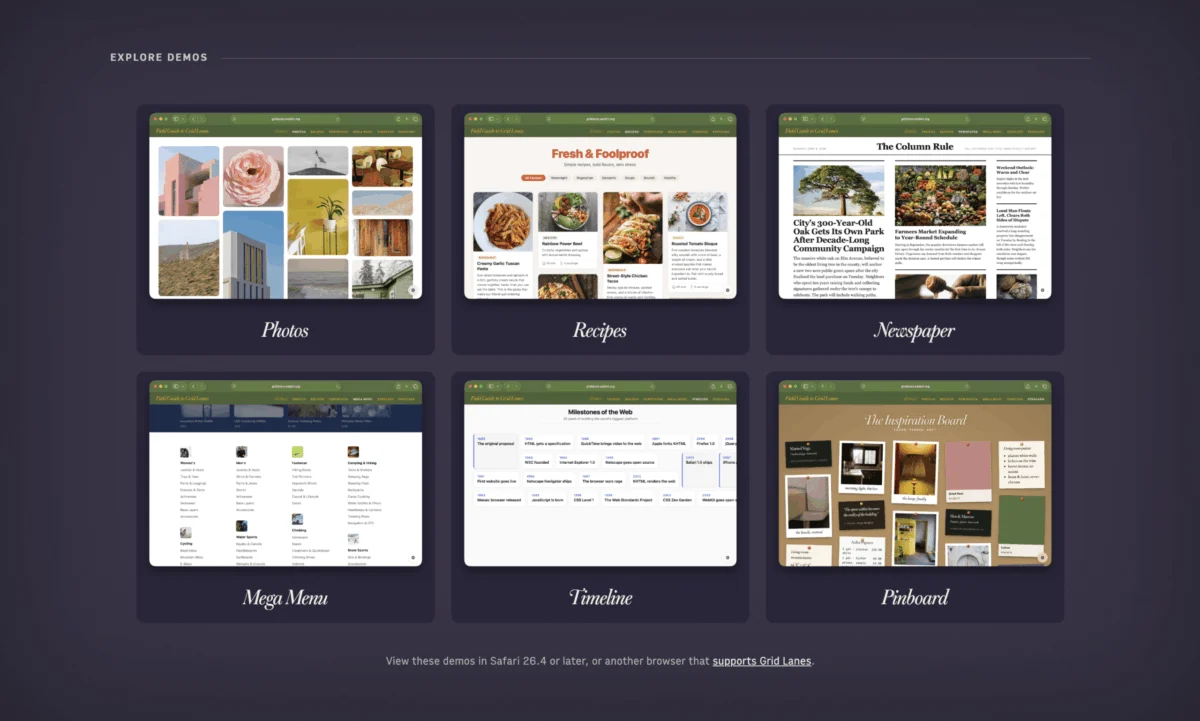
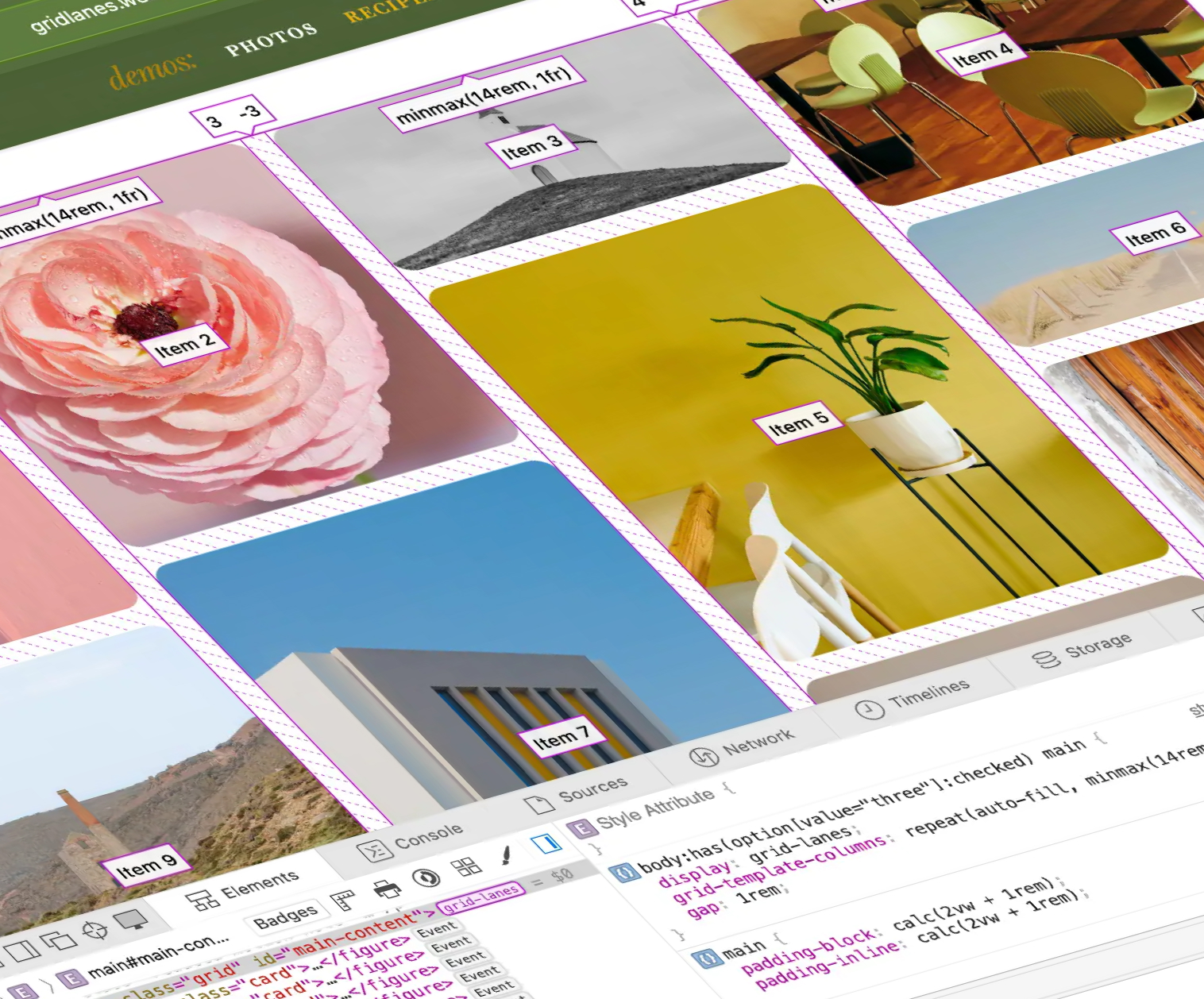
WebKit has officially launched the Field Guide to Grid Lanes, a comprehensive resource that aims to clarify one of the more misunderstood aspects of the Grid specification. Formerly discussed in the context of "CSS masonry," the Grid Lanes documentation provides a structured, academic approach to understanding how elements traverse the grid.
Much like the legendary CSS-Tricks guides that have defined a generation of front-end education, the Field Guide utilizes a mix of abstract theory and concrete, real-world examples. From mega-menus to timeline visualizations, the guide illustrates how grid alignment can be harnessed for complex layouts that were previously reliant on hacky workarounds or bloated JavaScript libraries. By providing barebones templates, WebKit is encouraging a standard-compliant approach to complex UI structures, reducing the "layout tax" that often plagues large-scale web applications.
Modernizing the Native <dialog> Element
The HTML <dialog> element has revolutionized how we handle modal windows, yet it has remained a source of frustration regarding edge cases—specifically around user experience and scroll behavior.
Quality-of-Life Upgrades
Una Kravets recently highlighted two critical enhancements that address long-standing UX pain points:
- The
closedbyAttribute: This attribute offers granular control over how a modal is dismissed, potentially ending the era of "light-dismiss" implementation bugs. overscroll-behavior: contain: By applying this property, developers can prevent the dreaded "scroll chaining" effect, where scrolling inside a modal inadvertently moves the background content.
Furthermore, community discourse has surfaced the importance of scrollbar-gutter: stable. When a modal opens and forces a vertical scrollbar to appear (or disappear), the entire page often suffers a layout "shift." This property forces the browser to reserve space for the scrollbar, ensuring a seamless, jitter-free transition when users interact with dialogs.
Mastering the Animation Lifecycle
Despite the power of the <dialog> element, animating it in and out remains a point of contention. Chris Coyier’s recent series on Frontend Masters, In & Out Animations for Dialogs, serves as a vital reminder that while the process is simple in theory, it is prone to error. The key, as always, lies in the precise usage of @starting-style and the @keyframes lifecycle. Developers are advised to treat these as "bookmark-worthy" techniques, as the complexity of state-transitions often requires a quick reference even for seasoned engineers.

Chronology: CSS Day 2026 and Industry Impact
CSS Day 2026, held in Amsterdam on June 11th and 12th, served as the focal point for the year’s styling discourse. The conference, which has become a pilgrimage for CSS enthusiasts, focused on the intersection of browser performance and creative engineering.
Event Highlights
While the absence of a live stream was noted, the community-driven documentation on platforms like Bluesky has provided a digital archive of the event. Attendees witnessed a range of talks that moved beyond basic syntax, exploring the limits of browser rendering engines.
- June 11th: The opening day focused on the "State of CSS," highlighting the rapid adoption of container queries and the future of CSS Houdini.
- June 12th: The second day centered on performance-first design and the ethical implications of complex, JS-heavy UI patterns.
The consensus among attendees was that the CSS community is entering a "post-framework" phase. With the browser now handling tasks that were once the exclusive domain of libraries—such as layout, animation, and functional logic—the need for heavy external dependencies is diminishing. The recordings, expected to be released in late June, are anticipated to set the agenda for the remainder of the year.
Implications for Future Development
The collective weight of these updates points toward a more declarative future. As we gain the ability to define functions in CSS, utilize standardized grid lane management, and rely on native browser support for modal UX, the role of the front-end developer is shifting.
The Shift Toward Semantic Stylesheets
We are moving away from "JavaScript-everything" and toward a paradigm where CSS is a first-class participant in application logic. The introduction of alpha() and @function suggests that the W3C is listening to developer feedback regarding the "monotony" of stylesheet maintenance. By reducing the reliance on long-form, repetitive declarations, these tools allow for cleaner codebases that are easier to refactor and maintain.
The "CSS-First" Ecosystem
The popularity of tools like Sunkanmi Fafowora’s CSS Wordle—a game built entirely on the logic of CSS—is perhaps the most telling indicator of this cultural shift. It proves that CSS is no longer just a "presentation layer." When developers spend their downtime engaging with the intricacies of CSS logic, it signals a deeper maturation of the craft.

As we look toward the next quarter, the focus will undoubtedly shift to how these new features can be combined. A design system that utilizes custom CSS functions, leverages the closedby attribute for native modals, and implements complex layouts via the Field Guide to Grid Lanes will be vastly more performant and easier to debug than the architectures of 2024 or 2025.
Conclusion
The current state of the web is one of refinement. We are no longer asking how to "make it work"; we are asking how to make it cleaner, faster, and more maintainable. Whether it is the subtle elegance of the alpha() function or the structural clarity provided by the Grid Lanes documentation, the tools we have today are designed to reduce the cognitive load on the developer.
As we await the official recordings from CSS Day 2026 and the continued rollout of @function support, developers should take this time to audit their current workflows. The "What’s !important" takeaway is clear: the browser is evolving. If you aren’t evolving your stylesheets to match, you are already falling behind. Stay tuned to the official CSS-Tricks documentation as these features move from experimental specs to standard implementations.