From Frustration to Filtration: Unraveling the Mystery of a Silent HDMI to VGA Converter
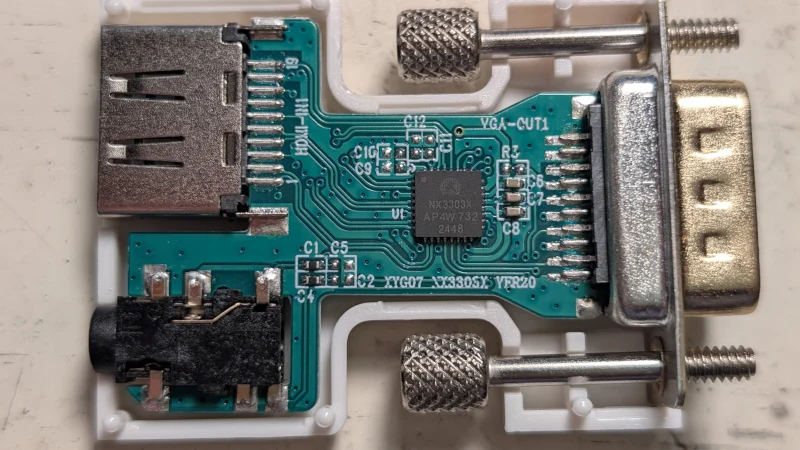
The unpredictable landscape of budget electronics often presents a binary choice: a surprisingly functional bargain or a frustratingly flawed dud. For one intrepid tinkerer, [Nyanpasu64], a recent acquisition from the lower echelons of the mail-order electronics market fell squarely into the latter category. What began as a simple HDMI to VGA converter with an advertised audio output quickly devolved into a compelling technical challenge, culminating in a profound exploration of audio digital-to-analog converter (DAC) design and the critical role of output filtering. This saga not only highlights the inherent risks and occasional rewards of cheap imports but also underscores the invaluable contributions of the do-it-yourself (DIY) community in demystifying and perfecting consumer technology.
Introduction: The Unpredictable World of Budget Electronics
The global marketplace, particularly for electronics, is awash with low-cost components and devices, often sourced directly from manufacturers in regions known for their competitive pricing. These products, ranging from simple cables to complex converters, promise functionality at a fraction of the cost of their premium counterparts. However, this economic advantage frequently comes with a caveat: a significant variance in quality control, documentation, and overall performance. Consumers engaging with this segment of the market often find themselves embarking on a journey of discovery, where each package holds the potential for either a triumphant unboxing or a perplexing troubleshooting session.
This inherent unpredictability is precisely what confronted [Nyanpasu64] upon receiving an HDMI to VGA converter, a device designed to bridge the gap between modern digital video outputs and older analog displays, with the added promise of extracting audio. Such converters are ubiquitous, serving a vital function in various setups, from repurposing legacy monitors to integrating older projectors. Yet, despite its seemingly straightforward purpose, this particular unit suffered from a critical flaw: a complete failure in its audio output, transforming a potentially useful tool into a curious case study in hardware malfunction.
The Allure and Risks of Mail-Order Bargains
The appeal of bottom-end electronics, particularly those available through international mail order, is undeniable. For hobbyists, students, and budget-conscious consumers, these platforms offer access to an astonishing array of components and devices that might otherwise be prohibitively expensive. The thrill of finding a "diamond in the rough" – a well-performing component at an unbeatable price – is a significant driver. However, this pursuit often entails navigating a minefield of potential issues: inconsistent build quality, inadequate or incorrect specifications, a complete lack of technical support, and, as [Nyanpasu64] discovered, outright non-functional features. The lack of rigorous testing and the pressure to minimize production costs can lead to shortcuts in design and component selection, with audio subsystems often being among the first to be compromised.
A Faulty Converter’s Tale: Diagnosing the Silent Signal
The journey from a non-functional device to a working solution is often a testament to perseverance and technical acumen. For [Nyanpasu64], the silence from the audio output of the HDMI to VGA converter was not an immediate cause for discarding the unit but rather an invitation to delve deeper. This investigative approach is characteristic of the maker community, where problems are viewed as puzzles awaiting solutions, and faulty hardware becomes a canvas for learning and innovation.
Initial Discovery and Symptom Analysis
Upon connecting the converter and verifying its video output, the absence of any discernible audio signal was the first red flag. Initial diagnostics would typically involve checking connections, ensuring correct input/output settings, and perhaps testing with different source devices and audio receivers. When these basic steps yielded no positive results, it became clear that the issue was internal to the converter itself, pointing towards a more fundamental hardware flaw rather than a simple user error. The fact that the device should work, based on its advertised features, made the problem all the more intriguing and frustrating.
Deep Dive into the Delta-Sigma Architecture
The heart of the audio problem, as [Nyanpasu64] meticulously uncovered, lay within the device’s integrated audio digital-to-analog converter (DAC). Specifically, the converter employed a delta-sigma (ΔΣ) DAC design. Delta-sigma modulation is a sophisticated technique widely used in modern audio applications due to its ability to achieve high resolution and linearity with relatively simple analog components. Its operational principle involves oversampling the input signal – sampling it at a much higher rate than the Nyquist frequency – and then shaping the quantization noise to higher frequencies, moving it out of the audible band. This process effectively trades resolution in time for resolution in amplitude.
A core advantage of delta-sigma DACs is their inherent robustness against component tolerances and their capacity to achieve high signal-to-noise ratios (SNR) and dynamic range. They are particularly favored in integrated circuits where space and cost are at a premium, as they can be implemented with a significant portion of their circuitry in the digital domain. However, the very mechanism that makes them effective – the shifting of noise to higher frequencies – also necessitates a critical component: a robust analog low-pass filter at the output stage. This filter’s role is to remove the high-frequency switching noise and other artifacts, leaving behind only the desired analog audio signal.
Unmasking the Filter Failure
In [Nyanpasu64]’s faulty converter, the delta-sigma DAC was indeed generating an output, but it was far from the clean audio signal expected. Instead, the high-frequency switching noise, a byproduct of the delta-sigma modulation process, was prominently present in the audio output. This indicated a fundamental failure in the output filtering stage. The filter, which should have attenuated these high frequencies to negligible levels, was clearly not performing its intended function.
The consequence of this failure was an output signal that, while technically containing the audio information, was heavily contaminated with high-frequency noise. This would manifest as a harsh, distorted, or even silent audio output, depending on the severity of the noise and the downstream audio amplification stages. The diagnostic process involved carefully analyzing the output waveform, likely using an oscilloscope, to visualize the spectral content and confirm the presence of unwanted high-frequency components. This critical step pinpointed the exact nature of the malfunction: not a dead DAC, but a DAC whose output was unusable due to inadequate post-processing.
Engineering a Solution: The Art of Audio Filter Design
With the problem precisely identified, the next phase was to engineer a solution. This transition from diagnosis to design is where the true value of [Nyanpasu64]’s work shines, transforming a simple repair into an educational treatise on analog circuit design. The challenge was to design and implement a new, effective low-pass filter that could seamlessly integrate with the existing DAC output, stripping away the unwanted noise without degrading the desired audio signal.
Principles of Low-Pass Filtering for Audio
A low-pass filter (LPF) is an electronic filter that passes signals with a frequency lower than a certain cutoff frequency and attenuates signals with frequencies higher than the cutoff frequency. In audio applications, LPFs are crucial for anti-aliasing (preventing higher frequencies from folding back into the audible spectrum) and for smoothing out the stair-step output of digital-to-analog converters. For delta-sigma DACs, the LPF is specifically designed to remove the high-frequency quantization noise that has been "shaped" out of the audible band.
Designing an effective audio LPF involves several considerations:
- Cutoff Frequency (Fc): This is the frequency above which signals are attenuated. For audio, it’s typically set just above the human hearing range (e.g., 20 kHz to 22 kHz) to allow all audible frequencies to pass while rejecting higher noise components.
- Roll-off Rate: How steeply the filter attenuates frequencies above the cutoff. This is often expressed in dB per octave or decade. A steeper roll-off (e.g., 24 dB/octave) provides better noise rejection but can introduce more phase distortion.
- Filter Type: Common types include Butterworth, Chebyshev, and Bessel filters.
- Butterworth filters are known for their maximally flat response in the passband, meaning they introduce minimal amplitude distortion to the audio signal.
- Chebyshev filters offer a steeper roll-off than Butterworth for a given order but exhibit ripple in the passband (Type I) or stopband (Type II), which can be undesirable for audio fidelity.
- Bessel filters provide a maximally flat group delay, resulting in excellent phase response and minimal transient distortion, though at the cost of a less steep roll-off compared to Butterworth or Chebyshev.
- Order of the Filter: This refers to the number of reactive components (capacitors and inductors, or equivalent active stages). Higher-order filters provide a steeper roll-off but are more complex to design and implement.
- Component Selection: The choice of resistors, capacitors, and potentially inductors (for passive filters) or operational amplifiers (for active filters) is critical for achieving the desired filter characteristics and maintaining audio quality. Low-noise, stable components are essential.
[Nyanpasu64]’s task was to select an appropriate filter topology and component values that would effectively suppress the DAC’s switching frequency without introducing audible artifacts into the desired audio signal. This likely involved considering a multi-pole active or passive low-pass filter to achieve a sufficiently steep roll-off.
The Critical Role of Impedance in Filter Performance
Beyond the theoretical design of a filter, its practical implementation hinges critically on impedance matching. Impedance, a measure of the opposition to alternating current, plays a profound role in how a filter interacts with the preceding DAC output and the subsequent audio amplifier or device.
- Source Impedance: The output impedance of the DAC affects how much current can be drawn from it and influences the actual cutoff frequency and roll-off of a passive filter. If the filter’s input impedance is too low, it can "load" the DAC, distorting its output.
- Load Impedance: The input impedance of the next stage (e.g., an amplifier) similarly affects the filter’s output. A mismatch can lead to signal loss, altered frequency response, and even reflections if dealing with high-frequency signals over transmission lines.
The original, faulty filter likely suffered not just from an inadequate design or poor component choice, but potentially also from a severe impedance mismatch. A filter designed without proper consideration for the source and load impedances will deviate significantly from its theoretical performance, potentially allowing noise to pass or attenuating desired frequencies. [Nyanpasu64]’s write-up, by highlighting the "effect of impedance" on filter performance, underscores a fundamental principle in analog electronics: theoretical elegance must be complemented by practical considerations of circuit interaction. Correct impedance matching ensures that the filter operates as intended, preserving signal integrity and maximizing power transfer.
Iteration and Refinement: Crafting the New Filter
The process of designing a new filter is rarely a one-shot affair, especially in a repair scenario where the exact characteristics of the integrated DAC might not be fully documented. It often involves:
- Theoretical Design: Calculating initial component values based on desired cutoff frequency, roll-off, and filter type.
- Simulation: Using software tools (like SPICE) to model the filter’s behavior, predict its frequency response, and identify potential issues.
- Prototyping: Building a physical circuit, often on a breadboard or perfboard, to test the design with real-world signals.
- Measurement and Analysis: Using test equipment (oscilloscope, spectrum analyzer, audio analyzer) to measure the actual performance, comparing it against theoretical predictions.
- Iteration: Adjusting component values, refining the topology, and repeating the process until the desired performance is achieved.
[Nyanpasu64]’s detailed write-up suggests a thorough iterative process, likely involving careful measurements and adjustments to ensure the new filter not only removed the switching noise but also preserved the fidelity of the audio signal. The success of this endeavor is a testament to applying fundamental electrical engineering principles to a practical problem, transforming a cheap, faulty device into a functional one.
Industry Perspective and Community Impact
The case of [Nyanpasu64]’s HDMI to VGA converter offers insights into both the manufacturing realities of consumer electronics and the vibrant culture of the DIY community.
The Economic Realities of Mass Production
From an industry perspective, the failure observed in the converter’s audio filter is a stark reminder of the trade-offs inherent in mass-producing low-cost electronics. Manufacturers operating in highly competitive markets are under immense pressure to minimize bill-of-materials (BOM) costs. This often leads to:
- Component Downgrades: Using cheaper, lower-tolerance components, or even omitting components deemed "non-essential" for basic functionality (like a robust output filter).
- Minimal Design Iteration: Skipping extensive testing and refinement phases for sub-systems, especially those considered secondary features (like audio in a video converter).
- Generic Designs: Employing reference designs with minimal customization, which might not be perfectly optimized for the specific characteristics of the chosen DAC or surrounding circuitry.
While a few extra dollars might have resulted in a better, working unit, these "few dollars" add up significantly across millions of units, impacting profit margins in a highly price-sensitive market. This economic reality explains why devices with seemingly minor flaws like [Nyanpasu64]’s are common, and why detailed technical issues often go unaddressed by manufacturers.
The Power of Open-Source Troubleshooting and Documentation
The decision by [Nyanpasu64] to not simply discard the faulty converter but to meticulously diagnose and repair it, and then document the entire process, holds immense value for the broader electronics community. This kind of detailed write-up serves several critical functions:
- Knowledge Sharing: It educates others on the intricacies of DAC operation, filter design, and impedance matching, topics often covered theoretically but rarely demonstrated with a real-world, problematic device.
- Empowerment: It empowers other hobbyists and engineers to tackle similar issues, providing a roadmap for troubleshooting and repair. This fosters a culture of self-reliance and extends the lifespan of electronic devices.
- Reverse Engineering and Analysis: Such deep dives effectively reverse-engineer aspects of the original design, exposing potential flaws and providing insights into manufacturing practices.
- Inspiration: It inspires others to look beyond superficial failures and engage in deeper technical exploration, proving that even a "super-cheap module" can be a source of profound learning.
Platforms like Hackaday thrive on such contributions, acting as repositories of practical engineering knowledge and fostering a global community of problem-solvers. The value derived from [Nyanpasu64]’s detailed analysis far outweighs the cost savings of simply buying a slightly more expensive, functional unit.
Broader Implications: Beyond a Single Repair
The narrative of [Nyanpasu64]’s HDMI to VGA converter extends beyond a single repair, touching upon broader implications for consumers, manufacturers, and the future of technological literacy.
Empowering the Consumer and the Maker
In an era of increasingly complex and often opaque consumer electronics, the ability to diagnose, understand, and repair devices is a powerful form of empowerment. It shifts the dynamic from passive consumption to active engagement. For the consumer, it means less e-waste and more control over their purchases. For the maker community, it reinforces the ethos of creation, modification, and knowledge sharing. Projects like [Nyanpasu64]’s highlight that even highly integrated circuits can be understood and their surrounding support systems optimized, challenging the notion that modern electronics are "black boxes" beyond the scope of individual repair. This fosters a sense of resilience and resourcefulness in the face of technological challenges.
Lessons in Design and Manufacturing Ethics
The prevalence of devices like the faulty converter also prompts a discussion on design ethics and manufacturing responsibility. While cost-cutting is an undeniable driver in the consumer electronics market, there’s a fine line between economical design and deliberately shipping products with known or easily preventable flaws. Instances where critical components, like output filters for DACs, are demonstrably inadequate raise questions about the minimum acceptable standard of quality. This doesn’t necessarily call for luxury-grade components in every device, but rather for a baseline of functional reliability that aligns with advertised specifications. A more robust approach to quality assurance, even in the budget segment, could reduce customer frustration and minimize environmental impact from prematurely discarded electronics.
The Enduring Value of Technical Deep Dives
Ultimately, [Nyanpasu64]’s detailed write-up serves as a powerful reminder of the enduring value of technical deep dives. In a world saturated with information, the ability to thoroughly investigate a problem, apply fundamental engineering principles, and clearly articulate the solution is an invaluable skill. These detailed analyses not only fix a specific problem but also enrich the collective knowledge base, serving as practical case studies for students, engineers, and hobbyists alike. They demonstrate that understanding the "why" behind a malfunction is often more rewarding and educational than simply replacing a faulty unit, cultivating a deeper appreciation for the intricacies of electronic design.
Conclusion: A Testament to Ingenuity
The journey of [Nyanpasu64] from a silent HDMI to VGA converter to a fully functional audio output device is a microcosm of the challenges and triumphs inherent in the world of electronics. It is a testament to the spirit of inquiry, the power of detailed technical analysis, and the collaborative nature of the DIY community. What began as a mere mail-order disappointment transformed into an extensive exploration of delta-sigma DACs, filter design, and the often-overlooked importance of impedance matching. In an age where disposability often trumps repair, such endeavors not only save a device from the landfill but also enrich the vast repository of human ingenuity, proving that sometimes, the most valuable lessons are found not in the perfectly engineered product, but in the compelling challenge of fixing a mess.