One Year of Innovation: Reflecting on the Evolution of the AWS Builder Center
It has been exactly one year since Amazon Web Services (AWS) unveiled the AWS Builder Center, a digital ecosystem designed to bridge the gap between abstract cloud concepts and hands-on implementation. Launched on July 9, 2025, the platform was envisioned as more than a documentation hub; it was intended to be a living, breathing community where developers, architects, and cloud enthusiasts could collaborate, experiment, and grow. As of mid-July 2026, the Builder Center has successfully transitioned from a nascent community hub into a comprehensive, feature-rich environment that is fundamentally changing how builders interact with AWS services.
To commemorate this milestone, the AWS team has released a series of retrospective reports, detailing a year of explosive growth, community-driven content, and the integration of sophisticated new tools, including the highly anticipated Sandbox Environments.
A Chronology of Growth: From Concept to Ecosystem
The trajectory of the AWS Builder Center over the past 52 weeks is a testament to the platform’s rapid iteration cycle. When it first launched, the Builder Center focused on foundational community engagement—introducing features like Wishlist voting, community profiles, and a basic toolbox. However, the roadmap quickly expanded to meet the demands of a global developer audience.
Phase 1: Foundational Infrastructure (Q3–Q4 2025)
The initial months were dedicated to establishing a reliable knowledge base. The introduction of "AWS Capabilities by Region" was a major milestone, providing transparency into the 1,500+ services currently operational across 37 global AWS Regions. During this period, the platform also prioritized identity and accessibility, integrating "Sign-in with GitHub and Amazon" to streamline the onboarding process for developers already embedded in those ecosystems.
Phase 2: Community and Gamification (Q1 2026)
By the start of 2026, the platform began to emphasize social proof and engagement. The rollout of the badge and streak system in March 2026 transformed the learning process into a gamified experience, encouraging users to maintain consistent activity. This period also saw the launch of "Spaces," allowing for the creation of community-led groups, and the implementation of article series and saved items, which helped users curate their own learning paths.
Phase 3: The Era of Frictionless Execution (Q2–Q3 2026)
The most recent phase of development has focused on lowering the barrier to entry for hands-on experimentation. With the introduction of Sandbox Environments—the centerpiece of the first-year celebration—the Builder Center has effectively removed the financial and logistical hurdles that often deter developers from exploring new services.
Supporting Data: The Quantitative Impact of the Builder Center
The success of the AWS Builder Center is not merely anecdotal; the metrics released by the AWS team demonstrate a thriving, high-velocity community.
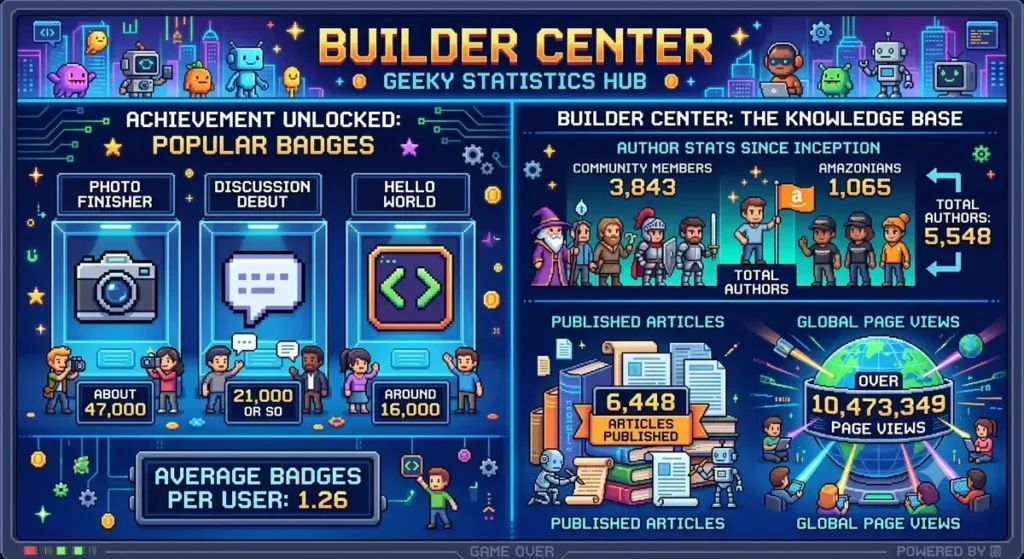
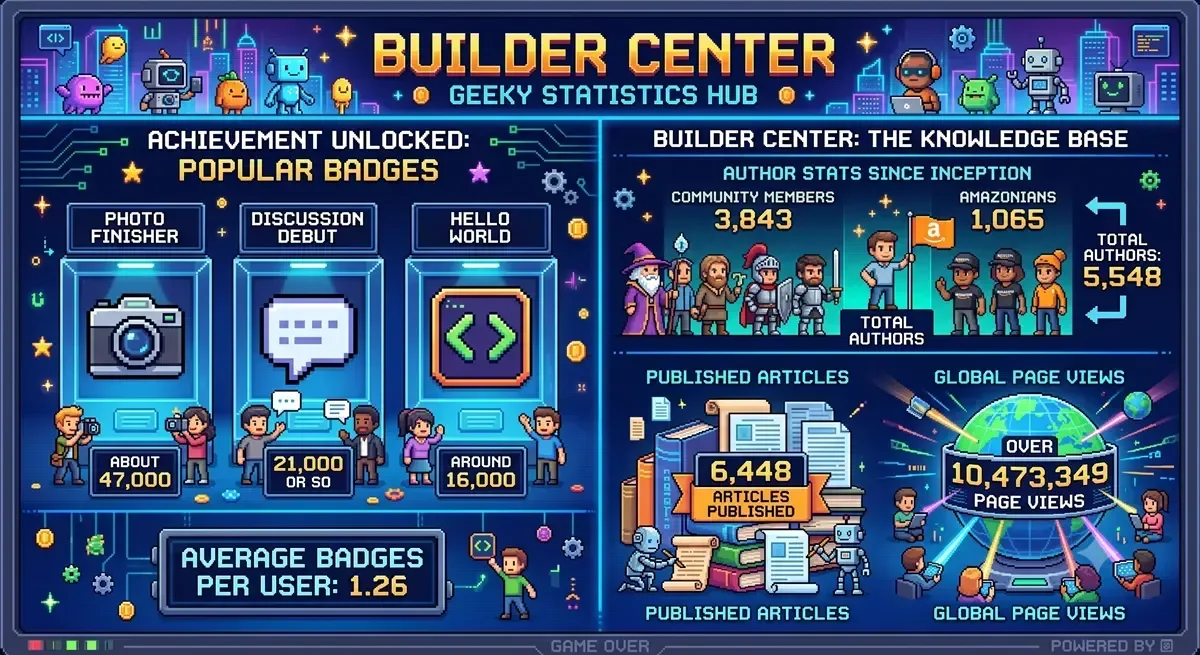
- Author Engagement: Since its inception, 5,548 unique authors have contributed to the platform, generating 6,448 individual articles.
- Audience Reach: The collective body of work has garnered over 10.4 million page views, indicating a high demand for community-vetted technical guidance.
- Gamification Success: The introduction of the badge system proved to be an immediate hit, with 99,226 badges awarded to users in just four months.
- Community Feedback Loop: The "Wishlist" feature, which allows users to request specific features or improvements, has become a core driver of development. Out of 565 submitted wishes, 10 have already been fully implemented and shipped, with another 20 currently on the near-term roadmap.
Top-Performing Content
The content that resonated most with the community highlights a shift toward practical, problem-solving architecture:
- Building an AWS Study Buddy with MCP + Strands Agents SDK (Dineshraj Dhanapathy): With over 50,000 views, this article underscores the current industry obsession with AI agents and Large Language Models (LLMs).
- Migrating an EOL Linux Server to AWS in 8 Hours with Kiro (Chris Miller): Garnering 45,000+ views, this piece reflects the perennial need for efficient, low-downtime migration strategies.
- AIdeas: NeuroVoice – Multimodal AI for Early Screening of Neurological Diseases (Yash Aggarwal): Achieving 38,000+ views, this article demonstrates the community’s interest in using cloud technology for social good and healthcare innovation.
Official Perspectives: Reflections on the First Year
In a formal retrospective, AWS veteran Jeff Barr noted that the goal of the Builder Center was always to facilitate "frictionless building." By centralizing workshops, documentation, and community support, the platform has successfully reduced the time it takes for a developer to go from a "Hello World" concept to a functional, cloud-native application.
Rick Suttles, who spearheaded the launch of the Sandbox Environments, emphasized the utility of the new tool. "Sandboxes are designed to solve the ‘setup anxiety’ that many developers feel," Suttles noted. By providing a free, pre-provisioned AWS account that automatically de-provisions after eight hours, the platform allows users to experiment with complex architectures without the fear of racking up unexpected costs or the hassle of manual cleanup.
Implications: The Future of Cloud Development
The maturation of the AWS Builder Center signals a broader shift in the cloud computing landscape. We are moving away from an era of static documentation toward an era of "Active Learning."
Lowering Barriers for Innovation
By providing free sandbox environments, AWS is acknowledging that the next generation of cloud innovation will come from students, hobbyists, and enterprise developers who need a "sandbox" to test dangerous or complex ideas. This move effectively democratizes access to cloud resources, ensuring that the ability to build is tied to creativity rather than credit card limits.

The Power of Peer-to-Peer Knowledge
The success of community-authored articles—which are outperforming many traditional, official AWS whitepapers in terms of engagement—suggests that builders trust the "battle-tested" advice of their peers. The Builder Center has successfully curated a culture where the knowledge gap between a novice and an expert is bridged by transparent, community-shared experiences.
Integration with the Broader AWS Ecosystem
Looking forward, the integration of these features into the wider AWS console and "What’s New" pages suggests that the Builder Center will continue to act as the primary interface for developers. As more features are added, we can expect to see deeper integration between community workshops and live AWS services, potentially allowing users to "one-click deploy" entire workshop environments into their own production or testing accounts.
Conclusion: Looking Ahead
As the AWS Builder Center enters its second year, it is clear that the platform has successfully established itself as the beating heart of the AWS developer community. With a proven model for feature deployment, a high-engagement community, and a suite of tools that simplify the complex, the center is well-positioned to support the next wave of cloud architecture.
For those looking to participate, the call to action is clear: the Builder Center is not just a place to read; it is a place to build. Whether you are migrating legacy systems, experimenting with multimodal AI, or simply looking to earn your next badge, the infrastructure is now ready to support your ambitions.
As the summer season continues, the platform is expected to keep pace with the rapid innovation cycles of the cloud industry. For those of us observing these developments, it is a reminder that in the world of AWS, the only constant is the drive to keep building.
For more information on upcoming features, events, and community initiatives, visit the AWS Builder Center. Stay tuned to the AWS "What’s New" page for the latest in service announcements, and keep an eye on the AWS Blog for deeper technical dives.