From Aluminum Dust to E-Ink: How TekkaSketch Reimagines a Childhood Icon
For over six decades, the Etch-a-Sketch has occupied a unique space in the toy hall of fame. It is a masterpiece of minimalist mechanical engineering: a screen coated in aluminum powder, two white plastic knobs, and a complex system of pulleys that move a stylus to scrape away the powder, leaving behind a persistent, albeit fragile, line. Yet, for all its charm, it has always suffered from a binary frustration: once a line is drawn, it is permanent. A single slip of the wrist requires the "nuclear option"—shaking the device until the screen clears, effectively destroying the entire work of art.
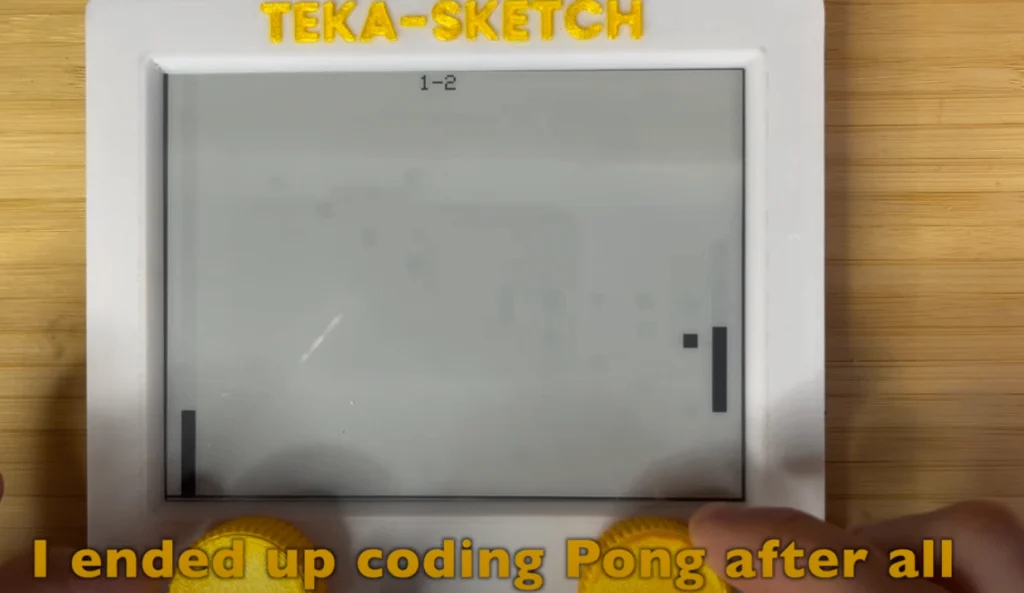
Enter TekkaSketch, an ambitious engineering project that bridges the chasm between analog nostalgia and digital utility. By stripping away the aluminum powder and replacing it with modern E-Ink technology, the creators have not only solved the "undo" problem but have transformed a static drawing toy into a dynamic, interactive gaming console.
The Genesis of an Idea: Deconstructing the Mechanism
To understand the genius of TekkaSketch, one must first appreciate the constraints of the original. The classic Etch-a-Sketch operates on a clever, low-tech principle. The internal stylus moves along an X-Y axis, displacing aluminum dust from the back of the glass screen. This is not "drawing" in the traditional sense; it is an act of erasure. The negative space is what creates the image.
The initial challenge for the TekkaSketch team was maintaining this tactile satisfaction while introducing digital logic. During the early design phases, the team toyed with radical, albeit mechanically nightmarish, ideas. One proposed solution involved a micro-vacuum system designed to suck up the aluminum powder and redistribute it locally to "undo" mistakes.
"We quickly realized that the mechanical complexity was a rabbit hole," the lead developer noted in early project logs. "Adding moving parts to a device that was intended to be simple risked turning a toy into a maintenance-heavy industrial machine."
The pivot came from an unlikely source: the 1990s PC classic, Nibbles.bas—the primitive, addictive version of Snake. The team observed that the continuous, linear movement required to control a snake in a digital environment shared a striking structural similarity to the continuous, fluid motion of the Etch-a-Sketch stylus.
Chronology of Development: From AR to E-Ink
The evolution of TekkaSketch was not a straight line, but a series of iterative prototypes that tested the limits of DIY hardware integration.
Phase 1: The Augmented Reality Experiment
Before settling on an internal screen, the team attempted to augment the physical device. Using smartphones mounted above the Etch-a-Sketch, they tried to overlay digital graphics onto the physical drawing surface. They experimented with rotary encoders geared into the original knobs and even printed illustrations on transparencies to guide the user. While visually impressive, the interactivity was fundamentally broken; the "drawing" was still trapped in the physical world of aluminum dust, and the lag between the digital overlay and the physical movement rendered it a curiosity rather than a functional tool.
Phase 2: The Hardware Breakthrough
The breakthrough arrived when the team decided to stop "augmenting" the toy and start "rebuilding" it. They gutted the internal mechanism, replacing the aluminum powder screen with an E-Ink display. This was a critical choice. Unlike traditional LCDs, E-Ink screens are bistable—they require power only to change the image, meaning the "drawing" remains visible even when the device is completely powered off, perfectly mirroring the persistence of the original toy.
Phase 3: System Architecture
At the heart of the new device lies an ESP32 microcontroller. Chosen for its robust processing power and integrated wireless capabilities, the ESP32 manages the signal processing from two high-precision rotary encoders. These encoders serve as the modern equivalent of the original knobs, but with a crucial upgrade: they can be polled for speed and direction with much higher granularity, allowing for a "fluid" drawing experience that the original mechanical stylus could never achieve.

Technical Specifications and Supporting Data
The TekkaSketch is more than just a nostalgic shell; it is a sophisticated piece of embedded hardware. Below are the key specifications that define its performance:
- Processor: ESP32 Dual-Core (240MHz), providing the necessary overhead to manage E-Ink refresh rates.
- Display: High-contrast E-Ink panel. The team utilized "partial refresh" algorithms to minimize the latency typically associated with E-Ink, allowing the "pen" to move across the screen with minimal ghosting.
- Input: Dual quadrature rotary encoders. These provide the same tactile "click" feel as the original toy while outputting digital pulses that the ESP32 interprets as coordinate shifts.
- Persistence: By leveraging the E-Ink display, the drawing remains etched on the screen indefinitely, satisfying the core "persistent memory" requirement of the Etch-a-Sketch brand.
- Control Logic: The firmware includes a software-based "speed compensation" algorithm. Because human hands rarely turn two knobs at perfectly uniform speeds, the code dynamically adjusts the cursor path to ensure smooth diagonal lines, correcting for the natural inconsistencies of the user.
Implications for Future Play: Beyond the Sketch
The inclusion of a Snake mode is the project’s most compelling feature. By turning the knobs into game controllers, the device shifts from a passive drawing tool to an active gaming console.
The software architecture is modular, meaning the device is not limited to a single game. The two-player version of Snake—where each knob controls an independent line—demonstrates the potential for collaborative or competitive play. Because the ESP32 is capable of OTA (Over-the-Air) updates, the device can technically be programmed to support a library of simple games, turning the TekkaSketch into a platform for "retro-modern" indie developers.
Furthermore, the project highlights a shift in the "Maker" community toward "Product Archeology." By taking iconic, outdated objects and retrofitting them with contemporary technology, designers are creating a new category of "hybrid artifacts." These objects satisfy the human need for tactile, physical interaction while providing the convenience of digital storage and connectivity.
Official Perspective and Community Response
While there has been no formal comment from the original manufacturers of the Etch-a-Sketch, the project has been met with widespread enthusiasm in the open-source hardware community. Experts in human-computer interaction (HCI) point to TekkaSketch as a textbook example of "Affordance Mapping."
"The creators didn’t try to reinvent the user interface," says Dr. Elena Vance, a researcher in physical computing. "They kept the knobs. That is the genius. They respected the mental model that generations of children have already learned. By keeping the interface and upgrading the engine, they removed the friction of learning a new tool while exponentially increasing the capabilities of the device."
The project’s open-source nature means that the blueprints, code, and hardware lists are available for others to replicate. This democratizes the innovation, potentially leading to a wave of "Tekka-style" modifications for other vintage toys.
Conclusion: The Future of Nostalgia
TekkaSketch is more than just a hack; it is a thoughtful meditation on the nature of digital versus physical play. By resolving the fundamental flaw of the Etch-a-Sketch without sacrificing its "soul," the developers have created something that feels both ancient and futuristic.
As we move further into an era defined by touchscreens and haptic-less glass panels, the value of physical, mechanical interfaces is only increasing. TekkaSketch serves as a reminder that the best way to innovate is not always to discard the past, but to understand what made it work in the first place—and then give it the digital tools to evolve. Whether it is used to sketch a masterpiece that you can finally "save," or to play a frantic game of Snake with a friend, TekkaSketch proves that with a little ingenuity, the most iconic toys can have a second, more powerful life.