Intelligent Illumination: Scaling NeoPixel Installations via Wi-Fi and Python
The landscape of modern lighting design has undergone a radical transformation, shifting from static illumination to dynamic, programmable ecosystems. At the heart of this revolution are Adafruit Industries’ NeoPixels—addressable RGB LEDs that integrate a controller and a light source into a single, compact SMD package. While these components have become a staple for hobbyists and professional lighting designers alike, the challenge of managing complex, multi-node installations has long been tethered to physical limitations. By leveraging the power of the ESP8266 chip—integrated into boards like the Fishino Guppy and NodeMCU—and marrying it with Python-based remote control, developers can now orchestrate sophisticated light shows across a home or office environment without the need for cumbersome manual re-programming.
The Evolution of Addressable Lighting
To understand the magnitude of this project, one must first look at the technology that makes it possible. Before the introduction of NeoPixels, managing a large-scale LED display required complex wiring, external drivers, and significant data management overhead. Adafruit’s breakthrough was the consolidation of the controller (the WS2811 or WS2812 driver) and the RGB LED (typically a 5050 SMD unit emitting roughly 20 lumens) into a single, addressable unit.
This innovation allows a microcontroller, such as an Arduino or an ESP8266-based board, to send a stream of byte-arrays with microsecond-level timing to a chain of LEDs. Each pixel interprets its portion of the data string, allowing for individual control over color and intensity. As these LEDs became available in versatile formats—strips, rings, arcs, and matrices—the project potential exploded. From wearable technology to expansive LED walls, the limitation shifted from hardware to software management.
Chronology of the Project: From Concept to Connectivity
The development of the "NeoPy" system was driven by a specific requirement: the need for a centralized, flexible control system that eliminates the need for physical tethering. Traditional setups often rely on USB-connected microcontrollers running loops of predefined effects. Changing an animation in such a setup requires updating the device’s firmware via the Arduino IDE—a tedious process when dealing with multiple installations distributed throughout a building.
Phase 1: Hardware Foundation
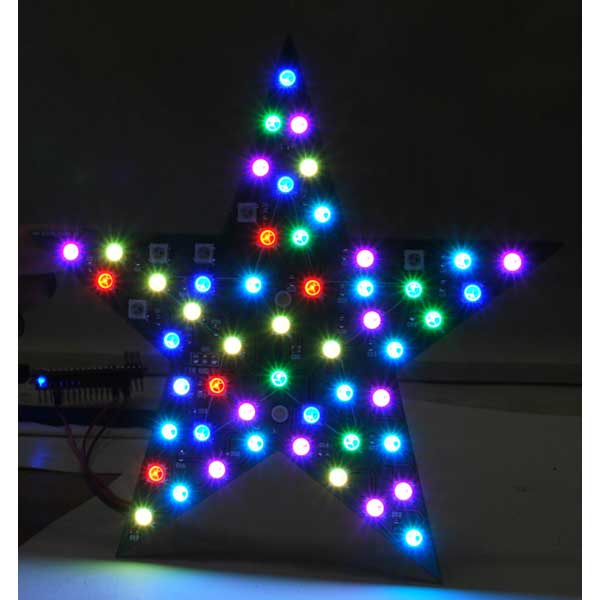
The project centers on the Fishino Guppy and the NodeMCU. Both boards utilize the ESP8266, providing robust Wi-Fi capabilities. The hardware architecture was established by defining two primary nodes: a 56-LED NeoPixel star and a 150-LED strip. A critical component of this design is the power management. With each LED drawing up to 60mA at peak white brightness, the 150-LED strip requires a 9-amp power budget, necessitating a high-current 5V DC power supply.
Phase 2: Signal Integrity and Logic Conversion
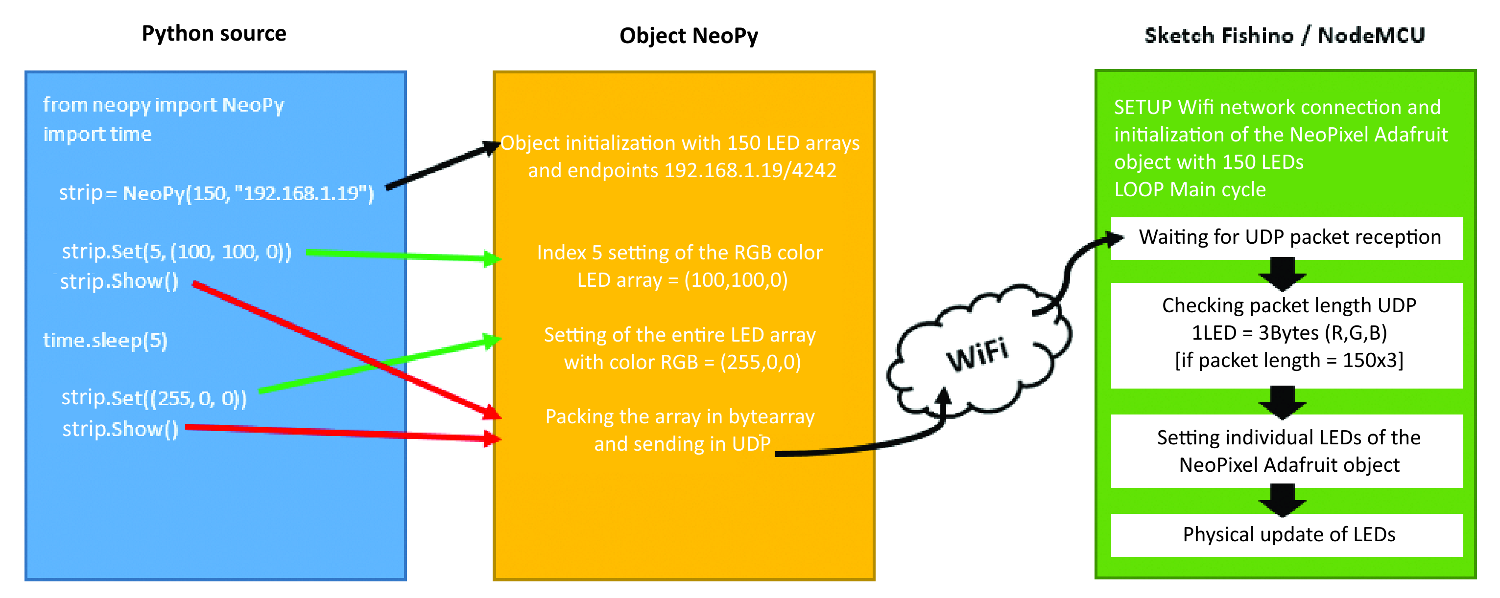
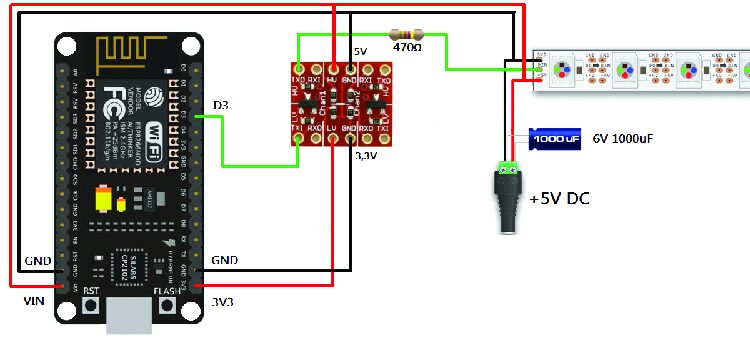
As the design moved toward implementation, the team identified the necessity of signal conditioning. Because the NodeMCU operates on 3.3V logic, a level shifter is mandatory to bridge the gap to the 5V requirement of the NeoPixel data line. Additionally, the inclusion of a 470-ohm resistor on the data input prevents voltage spikes from damaging the sensitive driver chips, while large 1,000µF capacitors ensure a stable power supply during rapid color transitions.
Phase 3: Software Orchestration
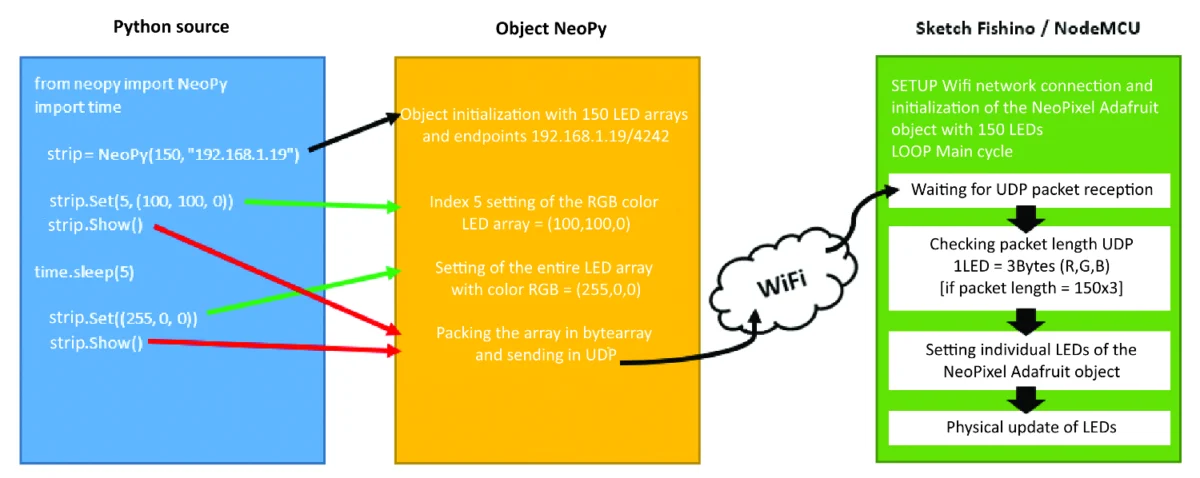
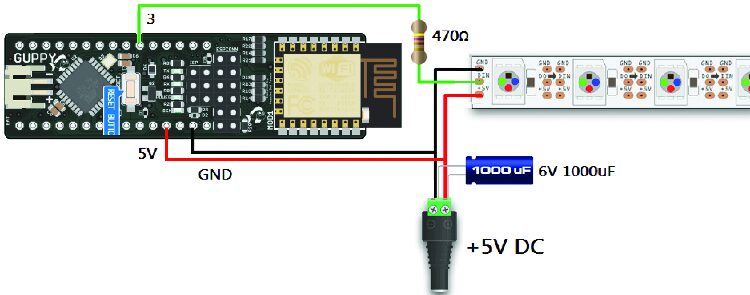
The final stage of the development process involved writing the "NeoPy" library. By opting for a UDP (User Datagram Protocol) architecture, the system achieves the low-latency communication necessary for fluid, high-frame-rate animations. Unlike TCP, which is slower due to packet verification, UDP is ideal for light data where an occasional lost packet is imperceptible to the human eye.
Technical Specifications and Supporting Data
The system relies on a well-defined communication protocol. The Python controller transmits packets where the length is strictly determined by the number of LEDs multiplied by three (the R, G, and B values).
Essential Components
- 5-meter NeoPixel Strip (STRIP300LED): High-density addressable output.
- FT1300M Christmas Star: An integrated 56-LED PCB-based design.
- Fishino Guppy & NodeMCU: ESP8266-based control hubs.
- Logic Level Converter (LLCTTL): Bridging 3.3V control to 5V data.
- Raspberry Pi: Acting as the central, low-power server for scheduling.
Data Flow Logic
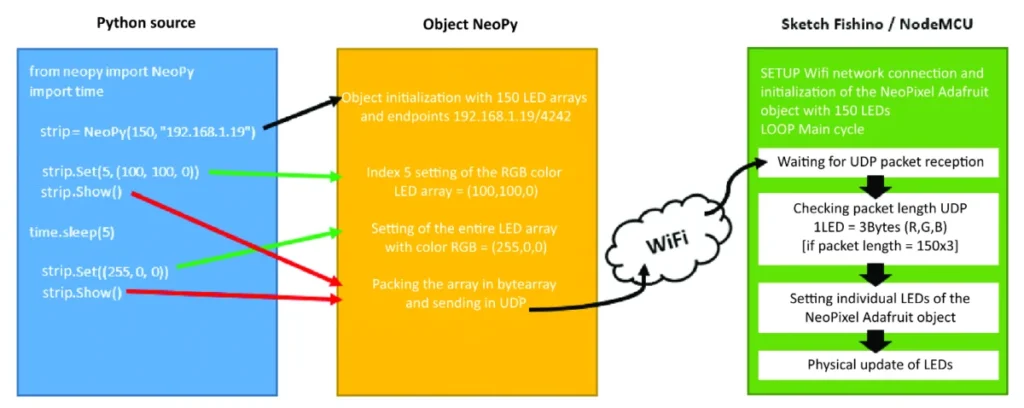
The system operates through a "Set-and-Show" paradigm. The Python library creates an object that maintains a local buffer of the entire installation’s color state. When the .Show() method is invoked, the entire buffer is pushed via UDP to the target IP. This separation of state-management and transmission allows for massive scalability. A single Raspberry Pi can host dozens of objects, each representing a unique physical installation, updating them simultaneously or in sequence based on the user’s requirements.
Insights from the Engineering Team
During the development of the library, the engineering team noted that Python was chosen specifically for its cross-platform versatility. "The goal was to provide a language that allows for rapid prototyping," says the development lead. "By running the controller on a Raspberry Pi, we’ve effectively offloaded the heavy lifting from the microcontrollers to a device that is always on and energy-efficient. The microcontrollers are relegated to their primary task: reading UDP packets and updating the LED shift register. This decoupling is what makes the system ‘smart’—you can change the animation logic on the Raspberry Pi without ever touching the code on the LED controllers themselves."
The team also emphasized that the use of crontab on the Linux-based Raspberry Pi provides a robust, enterprise-grade scheduler for home automation, allowing for time-based triggers—such as sunset-dependent lighting or "presence simulation" while the homeowner is away.
Implications for Smart Home Integration
The implications of this project extend far beyond mere holiday decorations. By creating a standardized, Wi-Fi-enabled LED interface, the project provides a blueprint for:
- Human-Centric Lighting: Using the system to simulate natural sunrise and sunset patterns, which can help regulate circadian rhythms for occupants.
- Adaptive Security: Integrating sensors with the Raspberry Pi allows the lights to respond to environmental triggers—such as motion sensors or sound inputs—to act as an intelligent deterrent or a visual notification system.
- Scalable Art Installations: Because the communication is IP-based, these installations are not limited by wire length. A single controller could theoretically manage installations across different rooms, floors, or even separate buildings, provided they share a local network.
- Energy Efficiency: By using a centralized controller, users can implement intelligent power management, ensuring that unused installations are powered down during specific hours, directly addressing the high current draw of large-scale LED arrays.
Conclusion: A New Standard for DIY Lighting
The "NeoPy" project demonstrates a sophisticated synthesis of hardware accessibility and software control. By moving the "intelligence" of the system from the microcontroller to a centralized, Python-based server, the barrier to creating complex, multi-node lighting displays is significantly lowered. Whether for hobbyist applications or more serious smart-home integration, this approach offers a scalable, robust, and highly customizable platform for anyone looking to bring light to life in a digital age. As we look toward the future, the integration of these systems with larger IoT ecosystems remains the next logical frontier, promising a world where our environments respond to us as much as we respond to them.